
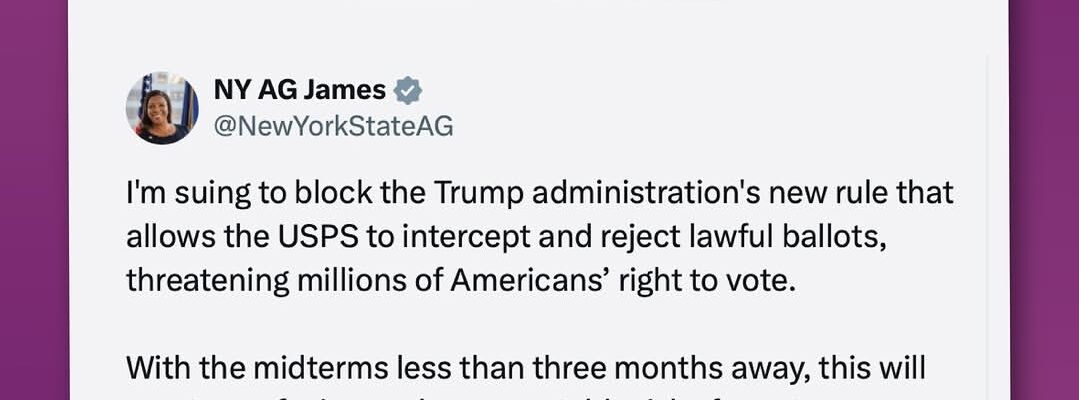
New York, Other Attorneys General Sue Trump Admin To Block USPS Rule Allowing Interception, Rejection Of Lawfully Submitted, Mail-In Ballots
Editor’s note: New Yorkers have become used to both mail-in voting and in-person early voting, which is offered at multiple locations around the state. The early voting locations are usually different from election day sites, so people should check before they go. New York’s courts have ruled that non-citizens cannot vote in local elections, just as they can’t in national elections. This new Postal Service rule provides a new and unique way to block voters from casting their ballots. The USPS has now made a new rule for itself, on the authority of the president’s Executive Order about mail in voting that allows them to intercept and reject potentially millions of mail-in ballots from registered voters in all fifty states. While all voters are eligible to vote in person, they should familiarize themselves with polling sites in advance. This is not always possible, and Americans from all states have always had the option of voting by mail.
Attorney Generals Nationwide Sue To Block USPS Rules Which Would Effectively Reject Most Mail-In Ballots At The Post Office Level:
The below is regarding the latest case against the USPS’ rules that are in response to the president’s Executive Order. The case over the EO itself was dismissed by SCOTUS as not being ripe. In other words, the damage had not yet occurred because it was an EO to get the rules to be made. Now that this has happened, and there are deadlines regarding the mail-in voting implementation, the case is ripe.
According the Attorney General for Arizona, during a rally, in that state, 80-90% of voters cast their vote by mail – and those ballots start going out in just two weeks. That is definitely not enough time to go competely back to the drawing board, redesign their ballots to be in compliance, and then get the designs done and finally mailed in. If there is an RFP (Request for Proposals) process affiliated with municipal purchases of products and services, which some states may have, then that adds at least another month to the whole procedure – possibly longer.
The arguments in this case are both burden of compliance and constitutionality/legality of the action. For a TRO you have to show risk of immediate/irreperable harm and likelihood to succeed on the merits, so the judge found that the AGs had successfully shown both. Harm can be tangible and intangible. Tangible would be money; intangible would be election integrity or states rights, for example.
Attorney General James Blocks Unlawful USPS Mail-In Voting Rule
NEW YORK – New York Attorney General Letitia James today released the following statement after a federal judge granted her motion for a temporary restraining order pausing the U.S. Postal Service’s (USPS) new mail-in voting rule:
“This rule is a clear attempt by the federal government to interfere in elections it has no power to control. Today, a federal court halted it before this administration could wreak havoc on our elections.
“The USPS does not have the authority to decide who can and cannot vote by mail. My office will keep fighting to ensure this rule cannot disrupt our midterm elections.”
Attorney General James Sues to Block Trump Administration Rule That Would Shut Millions of Voters Out of Mail-In Voting

With Midterms Less Than Three Months Away, New Rule Lets USPS Intercept and Reject Lawful Ballots
NEW YORK — New York Attorney General Letitia James today joined 23 other attorneys general and the governor of Pennsylvania in suing the U.S. Postal Service (USPS) to stop a new rule that gives the agency unprecedented control over mail voting in federal elections, just weeks before ballots go out for the November midterms. The rule, finalized at President Trump’s direction, forces states to hand over lists of every eligible mail voter to USPS and requires federal pre-approval of ballot envelope designs. Any ballot mailed to or by a voter missing from the federal list, or using an envelope USPS hasn’t approved, could be rejected and not delivered, regardless of whether that voter is fully eligible and registered under state law.
“Across the country, states are already deep into preparations for the 2026 elections. Now, at the last moment, the federal government is attempting to meddle in those preparations and potentially threaten countless Americans’ right to vote,” said Attorney General James. “The USPS has no authority to decide who can and cannot vote by mail. This new policy will just create confusion, unnecessary costs, and unacceptable risks for voters going into Election Day, and my office is going to court to stop it.”
On Monday, the U.S. Supreme Court stayed a lower court’s ruling against key portions of the president’s underlying executive order, which directed USPS to promulgate this rule. Now that USPS has finalized the rule, states have just weeks to comply before the midterm elections in November. Election officials will have to redesign ballot envelopes, obtain federal approval, and establish entirely new systems to transmit voter lists to USPS, all while preparing to mail ballots to millions of Americans. If states or local election officials cannot comply in time, eligible voters could be prevented from receiving or returning their ballots.
The rule requires states to provide USPS with lists of voters seeking to vote by mail. It also imposes new federal requirements for ballot envelopes, including unique Intelligent Mail barcodes, and requires states to submit ballot envelope designs to USPS for review and approval. Under the rule, USPS could refuse to deliver ballots associated with voters who are not on the lists or that fail to comply with the agency’s new requirements regarding envelopes.
The rule comes at a particularly critical moment for state election officials. States and localities have already been preparing for the November 2026 general election and, in many cases, have designed and purchased ballot envelopes based on existing USPS guidance. The new requirements could force election officials to purchase new envelopes and equipment, establish new systems for submitting and updating voter information, and train staff – imposing significant costs and administrative burdens with the election just weeks away. The USPS processed nearly 100 million ballots during the 2024 general election, and approximately 30 percent of voters nationwide voted by mail.
Attorney General James and the coalition warn that the rule could also disenfranchise voters through administrative errors or technical failures. Voter and mail ballot registration continues in the weeks leading up to an election, requiring states to continually update their lists. Yet under the new system, USPS would have the power to reject ballots based on compliance with its arbitrary requirements, even when a voter is eligible and registered under state law.
Attorney General James and the coalition argue that the rule violates the Voting Rights Act by directing USPS to refuse to deliver mail ballots to qualified voters who are otherwise entitled to vote under state law. In addition, the coalition argues that requiring states to provide USPS with information identifying voters who participate in mail voting violates the Privacy Act’s restrictions on federal collection of records describing individuals’ exercise of First Amendment rights.
The coalition also argues that the rule threatens to undermine states’ constitutional authority over elections. State law determines who is eligible to vote by mail and establishes the procedures voters must follow to receive and return their ballots. The USPS has no authority to establish its own federal eligibility requirements to vote by mail or to refuse to transmit ballots to or from voters who are eligible to vote by mail under state law. The coalition argues that the rule also exceeds USPS’s statutory authority because federal law requires USPS to accept, transport, and deliver lawful, properly posted mail, and does not authorize the agency to create new categories of mail that can be rejected based on its own election-related requirements.
With the midterms fast approaching, the coalition is asking the court to declare the rule unlawful, immediately block USPS from enforcing the rule while the case proceeds, and permanently strike down the rule.
Joining Attorney General James in filing the lawsuit are the attorneys general of Arizona, California, Colorado, Connecticut, Delaware, Hawaii, Illinois, Maine, Maryland, Massachusetts, Michigan, Minnesota, Nevada, New Jersey, New Mexico, North Carolina, Oregon, Rhode Island, Vermont, Virginia, Washington, Wisconsin, and the District of Columbia, as well as the Governor of Pennsylvania.
Banner Image: NY AG announces lawsuit. Image Credit – NY AG
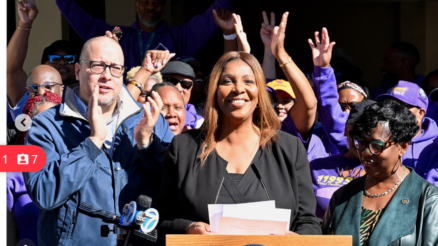


Leticia James NY State Attorney General
Letitia “Tish” James is the 67th Attorney General for the state of New York. With decades of experience and a long record of achievements, she is a powerful, effective attorney and lifelong public servant. When she was elected in 2018, she became the first woman of color to hold statewide office in New York and the first woman to be elected Attorney General.
There are no comments yet
Why not be the first