

For Staten Islanders, All New Yorkers: What Real ‘Affordability Crisis’ Looks Like On The Ground – Inflation, Tariffs, War, Gas Prices Contributed To Average Family Spend Of $5,000 More
Families Spent $5,000 More, Impending Veterans Community Affairs Clinic Upstate, Taking Aaway SNAP For Billionaire Tax Cuts, Expanding Access To Home and Community Based Care For Elderly and Disabled, Black Maternal Health Disparities, Empowering Voters: Senator Gillibrand
See below for several press conferences about the rising costs of health insurance for seniors, and of inflation and war driving up costs across the board for everyone – from gas to groceries and everything in between. See here for the Essentials Index, which tracks the inflation of items most families cannot do without – groceries, gas, heating, rent, etc.:
Editor’s note: Below are several stories about the rising costs and inflation that ordinary, everyday Americans are being forced to contend with. Whether they stem from the tariffs, the Iran War, the rising cost of essential consumer goods as well as of all consumer goods across the board, it is being experienced and felt by everyone. The amount of an actual effect it has on one’s daily habits depends very much on where they fall on the income level chart. Lower income individuals will be forced to cut back on essentials – such as food and gas – in order to compensate for a higher cost of health insurance. People who have high incomes will notice little difference when they have to pay a little more of their ample disposable income for their own necessities and luxuries. The senator also discusses the rising costs of health insurance, which have already started to skyrocket and are being felt by everyday Americans. For those among us who are in good health, this doesn’t pose much of an issue. If you never actually go to the doctor unless you are sick, the higher cost will just become a lower quality coverage policy, like one with a ridiculous deductible of, let’s say $4,000 instead of $1,500. What is a deductible? A deductible is the amount of money you must pay out-of-pocket for every doctor’s visit and every prescription you fill and every other cost, including alternative healthcare such as acupuncture and chiropractic. You must pay this amount before your future visits are covered and you only have to pay a co-pay (usually about $5-15 per visit).
If you don’t pay much attention to your own health insurance, which if it is employer-sponsored tends to have an available good low-deductible option, then you might not have noticed any change. But for those who don’t have good policies through their employer, or for those who work for app-based delivery or driving companies where health insurance is purchased and paid for privately since they are contractors and not employees, the change has been noticeable. For New Yorkers who fall within 200-250% of the Federal Poverty Level, which is not adjusted for the higher cost of living in this state, their free health insurance plan has now been cut due to the changes in Medicaid rules and spending. For people who see doctors often, which usually happens when one gets a little older or if they become sick, these co-pays and higher costs for health insurance can cause significant hardship. In addition, those who do purchase health insurance will be paying more, since as fewer people enroll, it has the effect of raising the prices of the entire pool, since the pool is now shared by fewer people. The more people who have and purchase health insurance, the lower the costs for everyone. The opposite is also true. Millions have already lost their health insurance as of today, and that is expected to worsen as this year continues, so Americans will be unable to avoid feeling the pain of rising costs. This is what Senator Gillibrand discusses in her video below, with regard to rising costs overall, due to inflation and other factors, along with the increase in health insurance premiums.
NEW STUDY: FAMILIES IN NEW YORK HAVE HAD TO SPEND $5,000+ MORE BECAUSE OF TRUMP
JEC Report: The Average Household In New York Has Had To Pay An Additional $5,000+ For Goods And Services Due To Rising Costs Under President Trump
Washington, D.C. — Today, a new Joint Economic Committee (JEC) report found that as of July 2026, the average household in New York has had to pay an additional $5,000+ for goods and services due to rising costs under President Trump. When campaigning in 2024, candidate Trump promised, “Starting on day one of my new administration, we will end inflation, and we will make America affordable again.”
In response to the new report and Republicans broken promises, U.S. Senator Kirsten Gillibrand issued the following statement:
“President Trump and Congressional Republicans promised to lower costs and end inflation, instead they’ve made life $5,000 more expensive for New Yorkers,” said Senator Gillibrand. “Look at what they have done: they gutted Medicaid and cut Medicare and health care subsidies to fund tax breaks for billionaires, launched a war that increased gas prices, and supported tariffs to make groceries and essentials more expensive. I will not stop fighting to lower New Yorkers’ costs and hold this administration accountable for hurting working families and small businesses across our state.”
Additional breakdowns of the JEC report:
Housing Costs
- New York families have had to spend an additional $1,078 on housing costs such as rent and mortgage payments since President Trump took office.
Grocery Costs
- Americans paid an additional $310 for groceries in President Trump’s first year than in 2024, and grocery prices are now more than 4 percent higher than when Trump took office.
- Beef and coffee prices are hitting Americans especially hard. Since the President took office, the average price of ground beef has risen almost every month to a record high of more than $7 per pound. Coffee prices also spiked and are now nearly $10 per pound.
Energy Costs

- Gas prices have soared since the start of Trump’s Iran War. In total, people across New York have spent an additional $3 billion on gas since the beginning of the Iran war. That has cost the average family in New York an additional $521 in gas costs
- Families in New York spent an additional $190 on electricity in 2025 under President Trump than they did in 2024. And, in just the first six months of 2026, they are expected to spend an additional $225 on electricity than they did in the first half of 2024.
- New York families who use heating oil paid an additional $248 to heat their homes this March compared to last year.
Health Care Costs
- Because of Trump and Republicans’ refusal to extend the Affordable Care Act (ACA) tax cuts that help people afford their health insurance, monthly premiums for ACA plans rose over 50 percent on average in 2026 compared to last year. Meanwhile deductibles surged to record highs, increasing by more than $1,000 on average.
Sources: Bureau of Labor Statistics Consumer Price Index and Average Price Data, Joint Economic Committee– Republicans, Bureau of Economic Analysis, U.S. Department of Agriculture, Walmart.com, AAA.com, Edmunds.com, Federal Highway Administration, Energy Information Administration, National Weather Service, heatable.com, Kaiser Family Foundation. Gas cost calculations are current through August 17, 2026.
GILLIBRAND, SCHUMER, TONKO RAISE THE ALARM AMID IMPENDING CLOSURE OF SCHENECTADY VETERANS AFFAIRS COMMUNITY BASED OUTPATIENT CLINIC
Closure Would Jeopardize Care for 1,500+ Capital Region Veterans Who Rely on the Schenectady VA Clinic
New York, NY – Today, U.S. Senator Kirsten Gillibrand (D-NY), Senate Democratic Leader Charles Schumer (D-NY), and Representative Paul Tonko (D-NY-20), following continued concern from local Capital Region veterans, called on Secretary of Veterans Affairs Doug Collins to provide more information about the planned closure of the Schenectady Veterans Affairs (VA) Community Based Outpatient Clinic (CBOC) at the end of the month. When the closure was announced in March 2026, the lawmakers immediately called on the VA to halt the closure and provide immediate answers to ensure that healthcare for the over 1,500 Capital Region veterans who rely on this clinic would not be disrupted. Now, five months following their original letter and with the closure looming, few questions have been answered.
In the letter, the members addressed the lack of communication from the VA and the confusion that Capital Region veterans are experiencing with little to no guidance as to the future of their care. They wrote, “Since the closure was announced this past spring, vanishingly little detail or communication has been made available to veterans or the broader public in the Capital Region. The lack of communication has raised concerns about the burden this disruption will place on veterans with ongoing care. Five months since the announcement of the closure, we continue to hear from veterans and non-profit organizations working to cover gaps in care and transportation for veterans, who find themselves less informed, more confused, and in greater precarity.”
The members noted that this would be the second CBOC closure in the Capital Region in five years, forcing veterans to seek out alternative care in places that may be even farther from their homes. They continued, “The communities we represent have expressed significant doubt regarding the VA’s claim that transportation time to the new clinics will be shorter for 80% of veterans. Many older veterans in the area are reliant on public transportation, ride-share services, and friends, family, and their communities for transportation to VA appointments. We are especially concerned that the decision to shift care away from the Schenectady CBOC does not account for the additional bus routes, ride-share costs, and time commitments from friends and families to ensure that veterans have regular access to care at a different facility.”
In a series of questions, the members demanded immediate transparency and requested that the VA release concrete data and outreach plans regarding the facility’s closure by August 27th. The inquiry pushes the VA to detail its justification for the closure and the projected impact on veterans in the region, as well as the VA’s plans for ensuring that patients maintain their access to high-quality care.
The lawmakers stressed that not a single local veteran or advocacy group had reached out to their offices to voice support for the clinic’s closure. They concluded, “The lack of clear communication and proper planning has caused significant anxiety for veterans in the Schenectady region who place their trust in the VA to manage their care. We urge the VA to listen to the community that would be most immediately affected by this plan, halt the closure of this clinic until all the questions posed in this letter can be properly addressed, and work with us to rebuild trust among veterans in the Capital Region.”
The full letter can be read HERE.
GILLIBRAND: TRUMP IS RIPPING FOOD FROM THE MOUTHS OF NEW YORK FAMILIES TO PAY FOR TAX CUTS FOR BILLIONAIRES
New Federal Data Shows SNAP Enrollment Has Fallen More Than 13% Nationwide Under Trump’s “Big Beautiful Bill”
More Than 200,000 New Yorkers Have Been Pushed Off Food Assistance
Washington, D.C. – Today, in response to new data showing that enrollment in the Supplemental Nutrition Assistance Program (SNAP) has dropped by more than 13% since May 2025 — just before Trump’s “Big Beautiful Bill” passed with massive SNAP cuts — U.S. Senator Kirsten Gillibrand released the following statement:
“At a time when people can barely afford a cart of groceries or a tank of gas, this president is kicking families off food assistance to fund tax cuts for the richest people in the country — and pouring billions into a war overseas while he does it,” said Senator Gillibrand. “He has money for the wealthy. He has money for war. But somehow, he has nothing for parents trying to feed their children in Buffalo, or Rochester, or the Bronx. Those are not the values of this country, and I will fight to reverse these cuts.”
New federal data reported by the Associated Press shows that SNAP enrollment has plunged from 42.2 million Americans in May 2025 to 36.6 million in May 2026 — a drop steeper than the government itself projected. In New York, more than 200,000 people have already fallen off the rolls, and more than 300,000 households are at risk of losing some or all of their food assistance by the end of the year.
These New Yorkers having food ripped away from them and their families is the direct and intended result of what President Trump and Republicans believe is their greatest legislative accomplishment: handing tax breaks to the wealthiest Americans and biggest corporations, paid for by taking food off the tables of children, seniors, and working families.
The cuts land at a moment when families are already stretched to the breaking point. Grocery bills and gas prices remain painfully high, and Gillibrand has repeatedly warned that the administration’s own policies are driving costs up rather than down. Against that backdrop, the president is simultaneously pouring billions of dollars into waging war overseas — money spent abroad while American families are told there is nothing left for them at home.
This massive drop in enrollment comes as President Trump’s cuts to SNAP have yet to even fully take effect. Starting October 2026, states will have a larger burden to administer the program. This burden will be forced onto counties, as New York is one of only three states where counties pay the full non-federal share of SNAP administrative costs. The New York State Association of Counties estimates that $168 million will now be shifted to county budgets. Additionally, starting October 2027, the so-called “Big Beautiful Bill” will shift the cost of SNAP benefits onto states, forcing states to either bear the cost or choose not to participate in SNAP at all.
GILLIBRAND, COLLEAGUES LEAD LEGISLATION TO EXPAND ACCESS TO HOME AND COMMUNITY-BASED CARE FOR OLDER ADULTS AND PEOPLE WITH DISABILITIES
Washington, D.C. – U.S. Senator Kirsten Gillibrand (D-NY) joined her Senate colleagues to introduce the Home and Community-Based Services (HCBS) Access Act, legislation to ensure older adults and people with disabilities have a real choice between receiving long-term care at home or in institutional settings. The legislation would make home and community-based care a mandatory Medicaid benefit, gradually eliminate waiting lists for services, strengthen the home and community-based care workforce, and provide greater support for family caregivers.
Under current Medicaid policy, many older adults and people with disabilities have access to nursing homes and other institutional care, but if they want to remain in their home and community, access to home and community-based services often depends on state waiver programs that can leave people waiting years — or even decades — for the care they need. The HCBS Access Act would expand access to home and community-based care and ensure that people who want to stay in their home and receive care can.
“A safe, accessible place to live should be a right, not a privilege, for our seniors,” said Senator Gillibrand. “The Home and Community-Based Services Access Act would help ensure that New York seniors and people with disabilities can access the care that best meets their needs, allowing them to live comfortably in the communities of their choice. As the top Democrat on the Senate Aging Committee, I’ll keep fighting to remove barriers to HCBS and expand access to quality, affordable care for our seniors.”
Specifically, the Home and Community-Based Services Access Act would:
- Make HCBS a mandatory Medicaid benefit, ensuring eligible individuals can choose between receiving care at home or in an institutional setting.
- Eliminate the need for administratively burdensome Medicaid HCBS waiver programs.
- Increase federal Medicaid funding for home and community-based services.
- Provide grants to help states expand their HCBS capacity and reduce waiting lists.
- Strengthen the direct care workforce by improving job quality, stability, and workforce availability.
- Support states in providing caregiving workers with stable, quality jobs and living wages.
- Expand training and support for family caregivers.
- Improve oversight and quality assurance for home and community-based services.
Senator Gillibrand continues to fight in the Senate for older adults and people with disabilities to live and age with dignity in the setting of their choice. In May, Gillibrand introduced an initiative to help counteract Trump’s cuts to Medicaid and services that support our seniors and caregivers. Her Older Americans Act (OAA) Reauthorization Act, which passed the Senate unanimously this July, would extend funding for nutritional programs, transportation services, and in-home assistance for seniors, allowing them to continue thriving in their communities and delaying the transition to institutional care. In August, she introduced the Senior Accessible Housing Tax Credit Act and the Visitable Inclusive Tax Credits for Accessible Living (VITAL) Act, both of which would support accessible housing for seniors and people with disabilities, promoting community living.
In addition to Gillibrand, the HCBS Access Act is co-sponsored by U.S. Senators Angela Alsobrooks (D-MD), Tammy Baldwin (D-WI), Richard Blumenthal (D-CT), Tammy Duckworth (D-IL), John Fetterman (D-PA), Maggie Hassan (D-NH), Tim Kaine (D-VA), Andy Kim (D-NJ), Ben Ray Luján (D-NM), Ed Markey (D-MA), Jeff Merkley (D-OR), Patty Murray (D-WA), Jack Reed (D-RI), Bernie Sanders (I-VT), Jeanne Shaheen (D-NH), and Elizabeth Warren (D-MA).
The HCBS Access Act is supported by Justice in Aging, National Health Law Program, PHI, Service Employees International Union (SEIU), American Federation of State, County and Municipal Employees (AFSCME), Caring Across, National Domestic Workers Alliance (NDWA), Autism Society of America, The Arc of the United States, Well Spouse Association, Little Lobbyists, Partnership for Inclusive Disaster Strategies, CommunicationFIRST, Independence Center, Cure SMA, Lakeshore Foundation, American Association on Health and Disability, Care in Action, National Association of Councils on Developmental Disabilities (NACDD), National Alliance for Caregiving, National Academy of Elder Law Attorneys (NAELA), National Association of County Behavioral Health and Developmental Disability Directors (NACBHDD), Easterseals, Autism Speaks, ANCOR, ADAPT, and MomsRising.
Full bill text is available here.
GILLIBRAND, COLLEAGUES REINTRODUCE BICAMERAL MOMNIBUS ACT TO END AMERICA’S BLACK MATERNAL HEALTH CRISIS
Washington, D.C. – U.S. Senator Kirsten Gillibrand (D-NY) joined a bicameral group of colleagues in reintroducing the landmark Momnibus Act, a comprehensive legislative package designed to end the nation’s maternal health crisis and directly confront the devastating disparities that continue to claim the lives of Black mothers at alarming rates. Senator Gillibrand leads the Moms Matter Act included in the package, which would increase investments in maternal mental health programs and expand this vital workforce to better support moms and pregnant women.
“It is shameful that women in the United States are more likely to die from pregnancy-related complications than in any of our peer countries,” said Senator Gillibrand. “The Momnibus Act will invest in comprehensive research on risks disproportionately affecting Black mothers, fund community support, and strengthen federal programs aimed at assisting new mothers. I am proud to lead the Moms Matter Act included in this package, and I will continue fighting to ensure that every mother receives high-quality healthcare regardless of race or socioeconomic status.”
For years, the United States has had the highest maternal mortality rate among high-income countries, with stark racial disparities. In 2024, Black women faced a pregnancy-related mortality ratio more than three times higher than White women—even though more than 80% of pregnancy-related deaths are preventable.
Senator Gillibrand has long championed efforts to address the maternal health crisis and eliminate racial disparities in maternal health outcomes, including through the Momnibus Act. She also introduced the Modernizing Obstetric Medicine Standards (MOMS) Act, which would promote standardized maternal safety best practices, and the Maternal CARE Act, which would support states in their work to end preventable morbidity and mortality in maternity care with two new grant programs. Additionally, her Into the Light for Maternal Mental Health and Substance Use Disorders Act, which passed into law in 2022, reauthorized grants to states for essential programs to screen and treat maternal mental health conditions and established the National Maternal Mental Health Hotline to provide 24/7 voice and text support services to pregnant women and their loved ones.
In addition to Senator Gillibrand, the Momnibus Act is cosponsored by U.S. Senators Cory Booker (D-NJ), Alex Padilla (D-CA), Jeff Merkley (D-OR), Tim Kaine (D-VA), Tammy Duckworth (D-IL), Raphael Warnock (D-GA), Ruben Gallego (D-AZ), Martin Heinrich (D-NM), Brian Schatz (D-HI), Richard Blumenthal (D-CT), Mazie Hirono (D-HI), Tammy Baldwin (D-WI), Peter Welch (D-VT), Catherine Cortez Masto (D-NV), Amy Klobuchar (D-MN), Adam Schiff (D-CA), Elissa Slotkin (D-MI), Michael Bennet (D-CO), Andy Kim (D-NJ), Tina Smith (D-MN), Edward Markey (D-MA), John Hickenlooper (D-CO), Chris Van Hollen (D-MD), Angela Alsobrooks (D-MD), Lisa Blunt Rochester (D-DE), Patty Murray (D-WA), Gary Peters (D-MI), and Bernie Sanders (I-VT). U.S. Representatives Lauren Underwood (D-IL-14) and Alma S. Adams (D-NC-12), co-founder and co-chair of the Black Maternal Health Caucus, introduced companion legislation in the House.
The Momnibus Act makes targeted, high-impact investments to address the drivers of the Black maternal health crisis, including social determinants of health, access to culturally congruent care, mental health assistance, community-based supports, and the effects of climate change and public health emergencies on Black mothers and babies.
The Momnibus Act is composed of 14 bills that would:
- Invest in social determinants of health—including housing, transportation, and nutrition—to reduce preventable risks disproportionately affecting Black moms.
- Extend WIC eligibility during postpartum and breastfeeding periods.
- Fund community-based organizations trusted by Black families and rooted in the communities they serve.
- Increase maternal health care funding for veterans, including Black women veterans who face unique barriers.
- Grow and diversify the perinatal workforce to ensure Black mothers receive care from providers who understand their lived experiences.
- Improve maternal health data collection to identify and eliminate disparities.
- Expand maternal mental health and substance use disorder support, with attention to the needs of Black moms.
- Improve care for incarcerated mothers, who are disproportionately Black.
- Invest in digital tools to expand access to care in underserved communities.
- Promote innovative payment models that incentivize high-quality, culturally congruent care.
- Strengthen federal programs addressing maternal and infant health risks during public health emergencies.
- Support climate resilience initiatives for moms and babies, including Black families disproportionately exposed to environmental hazards.
- Invest in research to eliminate racial disparities and prevent maternal deaths.
- Promote maternal vaccinations to protect moms and infants.
The text of the Momnibus Act is available here.
GILLIBRAND REINTRODUCES BILL TO MAKE POLITICIANS ANSWER TO VOTERS, NOT BILLIONAIRE MEGADONORS
Gillibrand’s Bill Would Create First-Of-Its-Kind “Democracy Dollars” Voucher Program To Empower Voters To Donate To Candidates Of Their Choice, Ensuring That Campaigns Are Funded By Everyday Voters, Not Billionaires
Washington, D.C. – Today, U.S. Senator Kirsten Gillibrand (D-NY) introduced landmark legislation to empower everyday American voters to participate in the campaign finance system and to reduce the influence of big money in politics. Gillibrand’s Clean Elections Act would give every American citizen “Democracy Dollars” to donate to the federal candidates of their choice, so campaigns are funded by everyday voters rather than a handful of megadonors.
“When billionaires and special interests buy our elections, it’s working families who pay the price — in higher costs at the grocery store, higher drug prices, and tax breaks that flow to the wealthy,” said Senator Gillibrand. “Political candidates should be answering to their constituents, not special interest groups and wealthy donors. My Clean Elections Act gives every American ‘Democracy Dollars’ to support the candidates of their choice, so winning elections means delivering lower costs and better lives for working families, not doing favors for wealthy megadonors.”
Today, a tiny group of ultra-wealthy donors dominates how campaigns are funded. As of April 2024, over 65% of the roughly $8.6 billion raised for federal campaigns had come from PACs, with $2.6 billion coming from just 100 billionaire families throughout the 2024 election cycle. . Meanwhile, only about 1% of Americans contributed more than $200 to any federal campaign. The result is a system where candidates court a small circle of wealthy donors behind closed doors, while the voters they’re supposed to represent are drowned out.
Gillibrand’s Clean Elections Act would help shift the balance of power back to everyday Americans by creating a “Democracy Dollars” voucher system. This system would provide every eligible U.S. citizen with $100 in “Democracy Dollars” for each federal election (House, Senate, and presidential, both primary and general, for a total of up to $600). Citizens could then donate these funds in $10 increments to candidates of their choice, making every voter a donor whose support candidates have to earn.
The Clean Elections Act is endorsed by End Citizens United, Stand Up America, and Demos.
“When Big Money floods our elections, politicians become more responsive and beholden to deep-pocketed donors instead of their constituents,” said End Citizens United Action Fund President Tiffany Muller. “Elections should be decided by the strength of candidates’ ideas and the trust they earn from voters, not by their ability to attract wealthy donors. Senator Gillibrand’s Clean Elections Act is a practical solution that would level the playing field by giving everyday Americans a greater voice in our elections. We’re grateful to Senator Gillibrand for leading this pragmatic and vital reform.”
“For decades, big money in politics has drowned out the voices of everyday people in our democracy. Americans are fed up with the outsized influence of wealthy donors and want Congress to act,” said Brett Edkins, Managing Director of Policy and Political Affairs at Stand Up America. “The Clean Elections Act helps level the playing field by giving every registered voter democracy dollars to support the candidates of their choice, making every voter a more powerful participant in our elections. We applaud Senator Gillibrand for championing this bold reform and urge Congress to advance the Clean Elections Act.”
The full text of the bill can be found here.
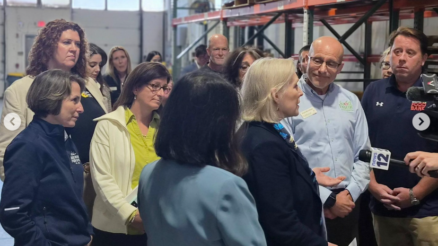
Banner Image: Senator Gillibrand video still. Image Credit – Sen. Gillibrand


There are no comments yet
Why not be the first