
OPINION: NYC TSA Officers Are Being Told To Stand. But Does Standing Without Chairs Make Us Safer?
TSA Officers Are Being Told to Stand. But Does Standing Make Us Safer?
Editor’s note: We previously covered Senator Rand Paul’s report that Americans were surveilled by the TSA for their political opinions and other irrelevant reasons, non-security-related issues.
I have no problem with TSA officers being alert. I have no problem with them standing when their duties require it. And I certainly have no problem with the Transportation Security Administration expecting its officers to be professional, attentive and ready to protect the traveling public.
But somewhere in this debate, we need to remember something very important: there is a human being inside that uniform. The TSA officer checking your identification is not simply someone sitting or standing behind a checkpoint. That officer is part of the frontline security system protecting millions of people traveling through American airports.
Transportation Security Officers are responsible for screening passengers and baggage, identifying potentially dangerous items, maintaining awareness in stressful environments and making decisions that can have serious consequences. Federal job postings describe the work as requiring attention to detail, critical thinking, visual observation and the ability to remain focused in busy and sometimes difficult environments. So I understand why TSA wants its officers to be alert.
What I question is whether standing by itself makes an officer more alert, more professional or more effective.
TSA has now removed chairs from the positions where officers check passengers’ travel documents, requiring those officers to remain standing. The agency says the change is intended to strengthen security and keep officers “on their feet and alert.” But a chair does not make an officer inattentive, just as standing does not automatically make an officer more vigilant. That is the part of this decision that deserves more discussion.
The bigger question is what happens to the human body when an employee is required to remain standing for prolonged periods, day after day and year after year. This isn’t about being lazy. It isn’t about giving security officers permission to sit back and ignore passengers. It is about recognizing that prolonged standing can place real physical demands on the body.
Occupational health research has associated prolonged standing with low back pain, physical fatigue, muscle pain, leg swelling, tiredness and other discomfort. Workplace safety guidance has also emphasized the importance of allowing workers to change positions rather than keeping them in one posture for extended periods.
Think about what that means for a real TSA officer. A person arrives for work. The airport gets busy. Passenger after passenger comes through. Identification is checked. Questions are answered. The officer remains on their feet. Hour after hour, day after day, that officer is expected to remain professional and focused through crowds, noise, pressure and sometimes difficult interactions with passengers.
And here is where the security argument becomes even more important. Fatigue is not simply a matter of whether someone’s feet hurt. Fatigue can affect attention, concentration, reaction time and judgment. So if TSA’s goal is security, shouldn’t the agency also be asking whether its workplace policies could contribute to unnecessary fatigue?
Standing and being alert are not the same thing. Sitting and being careless are not the same thing either.
The union representing TSA officers has raised concerns about the physical demands of the new policy, arguing that chairs provide basic ergonomic and safety support for employees who already spend long periods standing and walking on hard surfaces. That concern should not simply be dismissed.
TSA officers are not sitting in an office all day. They deal with thousands of strangers. They work in crowded airports, deal with pressure and are expected to remain focused because missing a genuine security threat could have serious consequences. They are also human beings.
And that is why I believe the debate should be bigger than a chair. We should be asking how we protect the people who are protecting us.
If an officer can stand when necessary, sit when appropriate and move throughout the shift, why must a chair automatically be treated as a threat to security? The chair isn’t checking the passport. The chair isn’t identifying a threat. The chair isn’t making the security decision. The officer is.
If that officer is alert, attentive and performing the job properly, I would rather see a workplace designed to support that officer’s ability to remain focused than one that creates unnecessary physical strain simply to give the appearance of greater vigilance.
Perhaps the better solution is not to choose between sitting and standing. Perhaps it is to allow officers to change positions throughout their shifts. That would not weaken security. It could actually recognize something that should never be forgotten in any workplace: employees are human beings, and their health matters too.

America asks these officers to help protect millions of travelers. Who protects them?
That is the question TSA should be asking before deciding that a chair has no place at the checkpoint.
Because the people protecting the American public deserve to be protected from unnecessary harm, too.
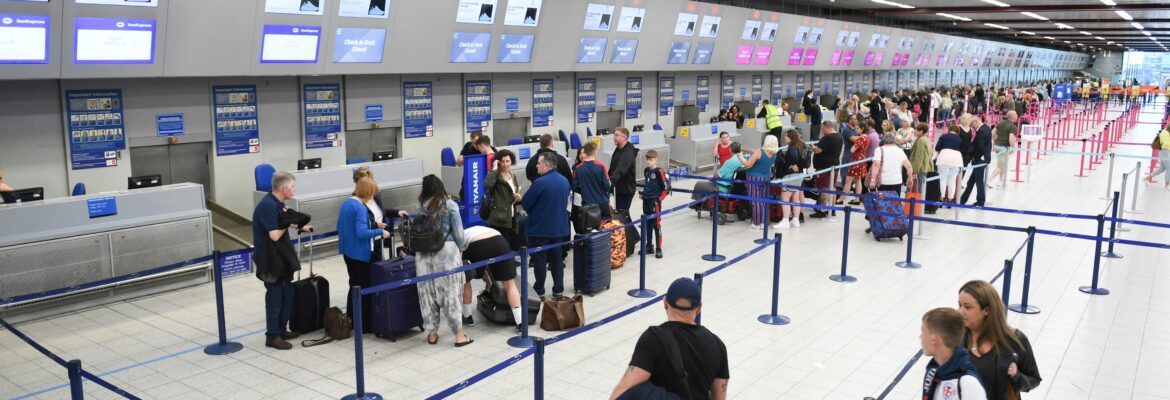
Banner Image: Airport security. Image Credit – Phil Mosley


Tony Mark Ramjewan
Tony Mark Ramjewan is a Trinidadian-Canadian writer and newspaper contributor with 16 years of writing experience across newspapers in Trinidad and Tobago and the wider Caribbean region. My work focuses on humanitarian concerns, children’s rights, social justice, public accountability and the everyday struggles of ordinary people. Throughout my writing career, I have sought to highlight issues that deserve greater public attention, including child protection in Guyana following the tragic death of Zi Feng Cao, Haiti’s humanitarian crisis, and social challenges affecting communities across the Caribbean. I believe opinion writing can help bring overlooked experiences into the public conversation, encourage accountability and give a voice to people whose struggles might otherwise go unheard. Alongside my writing career, I continue to work with Ferreira-Wells Immigration Services Inc., a Canadian immigration services firm based in Toronto, as an Internet Integrity Officer – Social Media. I assist the company remotely from Trinidad and Tobago, helping protect its reputation, its clients and prospective immigration applicants from online impersonation, fraudulent offers and individuals falsely representing the firm. This work reflects my commitment to online integrity, public awareness and protecting people from exploitation. The team at Ferreira-Wells has become like family to me. I value the trust, loyalty and lasting relationship we share, and I take pride in continuing to support the company and its work. Having lived in both Trinidad and Tobago and Toronto, Canada, I bring a cross-cultural perspective to my writing. My experiences have shaped my interest in migration, social justice, community concerns and the humanitarian issues that affect people across borders. My faith in God is an important part of my life and informs the compassion and sense of responsibility I bring to my work. I believe every child deserves protection, every family deserves dignity, and vulnerable people should never be forgotten simply because their struggles receive little attention.
There are no comments yet
Why not be the first