
Holy Nostalgia, Batman! How Three Seasons Changed Superheroes Forever – Collectors Confessions
Holy Nostalgia, Batman! How Three Seasons Changed Superheroes Forever
By Chad Farley | Collectors Confessions
In January 1966, a television show debuted that would forever change the way Americans viewed superheroes. It featured a millionaire dressed as a bat, a teenage sidekick in brightly colored tights, outrageous villains, and fight scenes punctuated by giant words like “POW!” “BAM!” and “ZAP!”
That show was Batman, starring Adam West as the Caped Crusader and Burt Ward as his faithful sidekick, Robin. And while the series lasted just three seasons, from 1966 to 1968, its impact on popular culture, comic book collecting, and generations of superhero fans continues to be felt 60 years later.
Think about that for a moment. A television series that aired for only three seasons helped create a cultural phenomenon that has lasted six decades.
For many Americans, especially those growing up during the 1960s and 1970s, Adam West wasn’t simply an actor playing Batman. He was Batman.
Before Michael Keaton, Christian Bale, Ben Affleck, or Robert Pattinson ever put on the cape and cowl, there was Adam West.
And for an entire generation, that was more than enough.
Same Bat-Time, Same Bat-Channel!
When Batman premiered on ABC on January 12, 1966, it was unlike anything television audiences had experienced.
Rather than presenting Batman as the dark, brooding vigilante familiar to many modern audiences, the series embraced a colorful, campy, and often wonderfully ridiculous interpretation of the character.
Adam West played Batman with complete seriousness, even when the situations surrounding him were completely absurd. Burt Ward’s Robin punctuated almost every adventure with an enthusiastic “Holy” exclamation, while the Dynamic Duo faced villains whose schemes ranged from elaborate bank robberies to increasingly bizarre attempts at taking over Gotham City.
The series initially aired twice a week, with Wednesday episodes frequently ending on cliffhangers that would be resolved on Thursday.
Would Batman escape the giant trap? Could Robin survive another elaborate death machine? Would the villain finally defeat the Dynamic Duo?
Of course, we knew our heroes would survive. But that didn’t stop millions of viewers from tuning in.
And who could forget the unforgettable theme song?

You didn’t even need to see the television screen. The moment you heard that familiar music and the chorus of “Batman!” you knew exactly what was coming.
The Villains Were Just as Important as the Heroes
One of the show’s greatest achievements was transforming Batman’s rogues’ gallery into household names.
Cesar Romero brought a mischievous energy to the Joker, famously keeping his mustache beneath the character’s white makeup. Burgess Meredith created an unforgettable Penguin, complete with his distinctive laugh. Frank Gorshin’s manic interpretation of the Riddler made the character one of television’s most memorable villains.
Julie Newmar and Eartha Kitt each brought their own style to Catwoman, while Lee Meriwether portrayed the character in the 1966 theatrical film.
And then there were the celebrity guest appearances.
Vincent Price appeared as Egghead, Otto Preminger and Eli Wallach were among the actors who portrayed Mr. Freeze, and numerous famous personalities appeared during the show’s memorable Batclimb scenes.
For viewers, seeing recognizable Hollywood stars become comic book villains was something special. For the comic book industry, it was even more significant.
Characters who had once existed primarily on the printed page were suddenly being introduced to millions of people who might never have picked up a comic book.
Batman was no longer simply a comic book character. He was a national celebrity.
Batmania Takes Over America
The television series introduced an enormous audience to characters who had already existed for decades in DC Comics.
Batman had made his debut in Detective Comics #27 in 1939, with Robin following in Detective Comics #38 in 1940. By the time the television series arrived, the characters already had a rich publishing history.
But the show brought those characters into living rooms across America in a way that comic books alone never could.
Suddenly, children who had never visited a comic book shop or newsstand specifically looking for superhero comics had a reason to do so.
For some, those comics became the beginning of a lifelong hobby.
A Generation of Collectors Was Born
Ask longtime comic book collectors what first sparked their interest in superheroes, and you’ll hear a variety of answers.
Some discovered Superman through the comics. Others fell in love with Spider-Man through Marvel’s stories. Still others remember watching superhero cartoons on Saturday mornings.
But for countless collectors, the answer is Adam West’s Batman.
The television series became a gateway into the larger world of comic books.
A child who loved Batman on television might begin buying Batman and Detective Comics. From there, they might discover Superman, the Flash, Green Lantern, Wonder Woman, or the Justice League.
Eventually, those same readers might discover Marvel Comics, the Fantastic Four, the Avengers, the X-Men, and Spider-Man.
What began as a half-hour television adventure could develop into a lifetime of reading, collecting, and appreciating comic book history.
And the collectibles associated with the show have become a hobby all their own.
Original 1966 Batman trading cards, vintage toys, promotional items, lunchboxes, and other memorabilia remain popular among collectors today.
The famous Topps Batman trading card sets, featuring dramatic painted artwork and scenes inspired by the television phenomenon, are particularly memorable examples of the era’s collectibles.
Many of those items were originally purchased for pennies, played with, traded, or eventually thrown away.
Today, surviving examples—especially those in excellent condition—can be highly desirable.
That’s one of the fascinating things about collecting.
Something that was once simply a childhood toy or trading card can become a treasured piece of cultural history.
From Campy Television to the Dark Knight
Of course, not everyone appreciated the show’s lighter approach.
Over the years, some Batman fans have criticized the 1966 series for making the character seem silly or turning serious comic book villains into comedic personalities.
But I think that criticism misses something important.
Batman has always been a character capable of reinvention.
The Batman of the 1940s was different from the Batman of the 1960s. The version presented by Frank Miller in The Dark Knight Returns was different from Adam West’s interpretation. Tim Burton’s Batman was different from Christopher Nolan’s, and today’s comic book Batman continues to evolve.
Yet each interpretation has contributed something to the character’s extraordinary longevity.
The show produced 120 episodes over three seasons before ending in March 1968.
Three seasons. That’s it.
Yet through decades of reruns, home video releases, streaming, conventions, and generations of fans introducing the show to their children and grandchildren, Batman never really disappeared.
Adam West and Burt Ward remained beloved figures in the superhero community for decades after the series ended.
West embraced his place in pop culture history, while Ward continued to celebrate the character and the fans who grew up watching him.
The series even found new life through animated reunions, including Batman: Return of the Caped Crusaders in 2016 and Batman vs. Two-Face in 2017.
For those of us who love comic books and collecting, the show represents something larger than nostalgia.
It reminds us of a time when superheroes were fun, colorful, accessible, and capable of bringing families together in front of the television.
It also reminds us that the things we loved as children often stay with us for the rest of our lives.
The Lasting Legacy of the Caped Crusader
Today, Batman is one of the most recognizable fictional characters in the world.
He has appeared in countless comic books, animated series, television programs, films, video games, and collectibles.
His image is recognized around the globe.
But for an entire generation, the journey into Gotham City began with Adam West sliding down the Batpole, Burt Ward shouting another enthusiastic “Holy” exclamation, and the Batmobile racing out of the Batcave.
The 1966 television series wasn’t simply a superhero show.
It was a cultural event.
It introduced millions of people to the world of Batman, helped inspire generations of comic book readers and collectors, and demonstrated that superheroes could capture the imagination of the entire country.
And while the series lasted only three seasons, its influence has endured for 60 years.
That’s a legacy that even the Joker couldn’t laugh away.
Same Bat-Time. Same Bat-Channel. Forever.
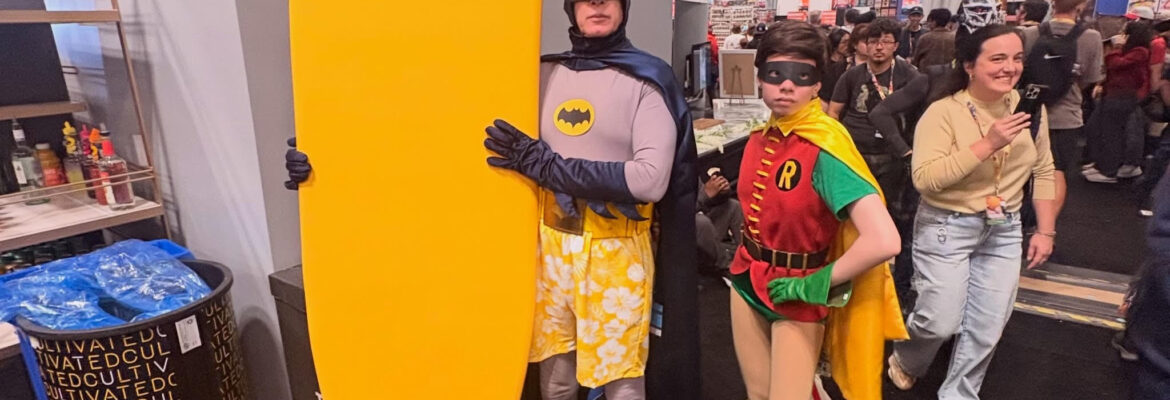
Banner Image: Batman and Robin at NYC Comic Con. Banner Image: Collectors Confessions
Collectors Confessions
Chad and Brian are the duo behind Collectors Confessions, a YouTube channel born from a lifelong love of comic books, pop culture, and their hometown of Staten Island. What started as a shared passion for reading comic books, visiting local comic shops and conventions has grown into a community of over 64,000 subscribers who join them each week for shop tours, convention vlogs, creator interviews, and their popular weekly comic haul live streams. From exploring hidden gem comic shops across the tri-state area to sitting down with industry legends like Jason Aaron, Jeremy Adams, and Mike Allred, Chad and Brian bring an authentic, collector-first perspective to everything they cover — comics, toys, Star Wars, Marvel, and beyond.
There are no comments yet
Why not be the first