

OPINION – Universal Health Care: A Conservative Case for a Healthy Nation
Universal Health Care: A Conservative Case for a Healthy Nation
There is a curious notion in American political life that universal health care is inherently a liberal or progressive proposition, incompatible with conservatism, fiscal discipline, individual responsibility, or a limited conception of government. I believe this is a mistake. Indeed, I would argue that providing every person in this country with access to a basic standard of health care is not merely compatible with a traditional conservative philosophy; it is consistent with some of its most fundamental principles.
One need not believe in an expansive welfare state, government ownership of hospitals, or the bureaucratic administration of every aspect of medical care to recognize that a nation has a compelling interest in keeping its population healthy. One need not embrace every fashionable theory about social justice to understand that untreated illness imposes costs on everyone. And one need not abandon personal responsibility to acknowledge that a functioning society has obligations that extend beyond the individual.
The question, properly understood, is not whether government should provide unlimited medical services to everyone. It is whether a civilized, wealthy, and advanced nation should permit large segments of its population to go without the basic care necessary to remain healthy, productive, and capable of contributing to the society in which they live.
I believe the answer is self-evident.

Public Health Is a Public Responsibility. Image Credit – Staten Islander News
Public Health Is a Public Responsibility
Begin with a simple observation: virtually every other advanced industrial democracy has established some form of universal health coverage. The systems differ considerably. Some rely predominantly on government financing, others on regulated private insurance, and still others on combinations of public and private provision. They are not all equally efficient, and none is without shortcomings. But they have reached a common conclusion: access to essential health care is a necessary component of a functioning modern society.
It is difficult to understand why the United States, with its extraordinary wealth, medical institutions, scientific capabilities, and entrepreneurial resources, should be unable to establish a comparable baseline of protection.
This is not an argument that we should imitate another country’s system wholesale. Americans have every reason to preserve competition, innovation, patient choice, private medical practice, and the extraordinary research capabilities that have made our medical institutions world leaders. But these achievements are not reasons to leave millions of people inadequately insured or effectively excluded from ordinary medical care.
The first responsibility of public health is to protect the public.
Disease does not respect income, employment status, or insurance coverage. An infectious illness contracted by someone who cannot afford a physician does not remain confined to that person’s household. It can reach coworkers, classmates, neighbors, customers, and strangers on public transportation. An individual who cannot afford testing or treatment may delay seeking care until an illness has become more serious and more contagious.
We learned these lessons long before the modern insurance industry existed.
The history of cholera, tuberculosis, influenza, and other infectious diseases taught civilized societies that sanitation and public health cannot be organized exclusively around individual purchasing power. Clean water, sewage systems, food inspection, vaccination, disease surveillance, and the control of communicable illnesses became accepted public responsibilities because the consequences of neglect were borne by the entire population.
We do not ask whether a person can afford clean drinking water before providing it. We do not permit sewage to run through the streets because some residents cannot afford adequate sanitation. We understand that the health of one household is connected to the health of the neighborhood, and the health of the neighborhood to the health of the nation.
Medical access belongs in this same conversation.

A healthy population is a productive population. Image Credit – Staten Islander News
A Healthy Population Is a Productive Population
There is another argument, perhaps even more compelling to a conservative, that receives insufficient attention: the economic consequences of untreated illness.
People who are sick are less productive. They miss work, perform less effectively, and are more likely to leave the workforce altogether. Parents who cannot obtain medical care for themselves or their children face additional burdens that affect their ability to earn a living and maintain stable households. Children whose illnesses go untreated may fall behind in school, suffer preventable developmental consequences, and enter adulthood at a disadvantage.
The consequences extend well beyond the individual.

Employers lose experienced workers. Families lose income. Communities lose volunteers, caregivers, and productive citizens. Businesses absorb the costs of absenteeism and employee turnover. Hospitals and taxpayers eventually pay for conditions that might have been treated earlier and less expensively.
A society that allows manageable health problems to become medical emergencies is not demonstrating fiscal prudence. It is practicing expensive neglect.
Consider the economics of an individual with untreated diabetes, hypertension, or heart disease. Regular examinations, medication, and appropriate intervention can prevent or delay serious complications. Without that care, the same individual may eventually require hospitalization, surgery, emergency treatment, or long-term assistance.
The difference in cost can be enormous.
The same principle applies to mental health, maternal care, childhood illnesses, and many other conditions. Early treatment is frequently less expensive than allowing a problem to become a crisis.
This is not to suggest that every preventive measure saves money in every circumstance. Some do not, and responsible policymakers should examine the actual evidence rather than assume that every proposed intervention produces a financial return. But the broad principle remains: a health system that emphasizes timely, appropriate care is better positioned to prevent avoidable suffering and unnecessary expense.
Conservatives rightly insist that public expenditures be judged by their results. Universal access to essential care should be judged by that same standard.

Prevention Is Not an Ideology. Image Credit – Staten Islander News
Prevention Is Not an Ideology
One of the more encouraging developments in recent public discussion has been the renewed attention to prevention, nutrition, exercise, environmental influences, and the long-term causes of chronic illness. Robert F. Kennedy Jr., whatever one’s disagreements with his positions on particular matters, has helped bring some of these questions into wider public debate.
There is no need to endorse all of his ideas, or to suspend scientific judgment, to recognize the importance of the underlying subject.
A country that spends enormous sums treating advanced disease while paying comparatively little attention to the conditions that produce it should reconsider its priorities.
We should want children to receive appropriate vaccinations and regular medical examinations. We should want reliable information about nutrition and physical activity. We should want to reduce childhood obesity, address the consequences of poor diets, identify environmental hazards, and make preventive screening accessible. We should want physicians to have the time and resources to identify problems before they become emergencies.
These are not radical propositions. They are common sense.
There is something distinctly conservative about maintaining what one has rather than allowing it to deteriorate and then paying a much greater price to repair it. We maintain our homes, our roads, our bridges, and our machinery. We understand that regular maintenance is generally preferable to catastrophic failure.
Why should the human body be treated differently?
Prevention is not a substitute for individual responsibility. People should be encouraged to exercise, eat sensibly, avoid harmful habits, and take reasonable responsibility for their own health. But responsible behavior is easier when people have access to sound information, regular medical care, and the means to address health problems before they become overwhelming.
A system that makes preventive care available is not absolving people of responsibility. It is giving them the opportunity to exercise it.

The Social Contract and the Meaning of Civilization. Image Credit – Staten Islander News
The Social Contract and the Meaning of Civilization
There is a deeper question here, one that goes beyond economics and public administration.
What do we mean when we describe ourselves as a civilized society?
The United States has always understood itself as a nation of extraordinary opportunity, a place where people could arrive with little and build something substantial through work, enterprise, and determination. Our national story has been shaped by the conviction that people deserve the opportunity to make something of their lives.
The Statue of Liberty’s invitation to the tired and poor is part of that inheritance. Its famous words are not a comprehensive statement of American immigration policy, nor should they be treated as one. But they express something important about our national character: that human dignity does not depend entirely on wealth or circumstance.
We also learned, through painful experience, that goodwill alone does not create a healthy society. The cholera epidemics of the nineteenth century, the tuberculosis crisis, and the subsequent development of modern sanitation and public-health institutions demonstrated that a minimum standard of public protection must be established and maintained.
Civilization requires infrastructure. Some of that infrastructure is physical: roads, water systems, sewers, schools, and public buildings. Some is institutional: courts, police, fire departments, and public education. And some is medical.
A society cannot function well if significant portions of its population are too ill to work, care for their children, participate in their communities, or meet the ordinary responsibilities of citizenship.
We should not confuse this with a promise that government can eliminate every misfortune or guarantee perfect health. No government can do that. Nor should we expect the public to finance every conceivable treatment without regard to medical necessity or cost.
But there is a reasonable minimum below which a civilized society should not fall.
That minimum should include access to primary care, emergency treatment, appropriate preventive services, maternal and pediatric care, and the diagnosis and treatment of communicable disease. The precise structure and financing of such a system are matters for serious debate. The principle, however, should not be particularly controversial.

The Immigration Question Is Real, but It Is a Different Question. Image Credit – Staten Islander News
The Immigration Question Is Real, but It Is a Different Question
There is one objection that deserves to be addressed directly, particularly from a conservative perspective.
What about people who are in the United States without legal authorization?
I believe the United States has both the right and the responsibility to establish and enforce its immigration laws. A nation that cannot control its borders, establish orderly procedures for entry, and distinguish between legal and illegal immigration undermines the integrity of its own institutions. Immigration policy is a legitimate subject of public debate, and it is entirely reasonable to insist that people seeking to enter the country do so through lawful channels.
But the question of who should be permitted to enter the United States is distinct from the question of what public-health protections are necessary once people are living here.
If an individual is present in our communities, works in our economy, or has children attending our schools, the public-health consequences of untreated communicable disease do not disappear because that individual’s immigration status is irregular.
Consider tuberculosis. Active pulmonary tuberculosis can be transmitted through the air, and prompt diagnosis, appropriate treatment, and public-health follow-up are essential to protecting everyone who may be exposed. Latent tuberculosis infection, by contrast, is not contagious. This distinction matters because responsible policy should be based on medical facts, not generalized suspicion of immigrant populations.
If children are attending American schools, we have an interest in ensuring that communicable diseases are identified and appropriately treated. That interest is not limited to children whose parents have legal immigration status. It is an interest in protecting all the children in the school.
The same logic applies to adults working in restaurants, hospitals, nursing homes, construction sites, and other workplaces. A public-health system that refuses to identify or treat communicable illness because a person lacks legal status would be irrational and potentially dangerous.
This does not mean that providing essential public-health services constitutes an endorsement of unlawful immigration. Nor does it settle the separate questions of eligibility for publicly financed insurance, immigration enforcement, or the terms under which noncitizens may receive benefits.
Those are legitimate policy questions that deserve their own discussion.
But we should not allow disagreement over immigration policy to prevent us from protecting the health of the population already here. We do not benefit from allowing preventable disease to circulate in our communities. And we certainly do not benefit from allowing children to become vectors of untreated illness simply because their parents’ immigration circumstances are disputed.
A sensible conservative can hold two positions simultaneously: immigration laws should be enforced, and basic public-health protections should extend to everyone within the country’s borders.
There is no contradiction.
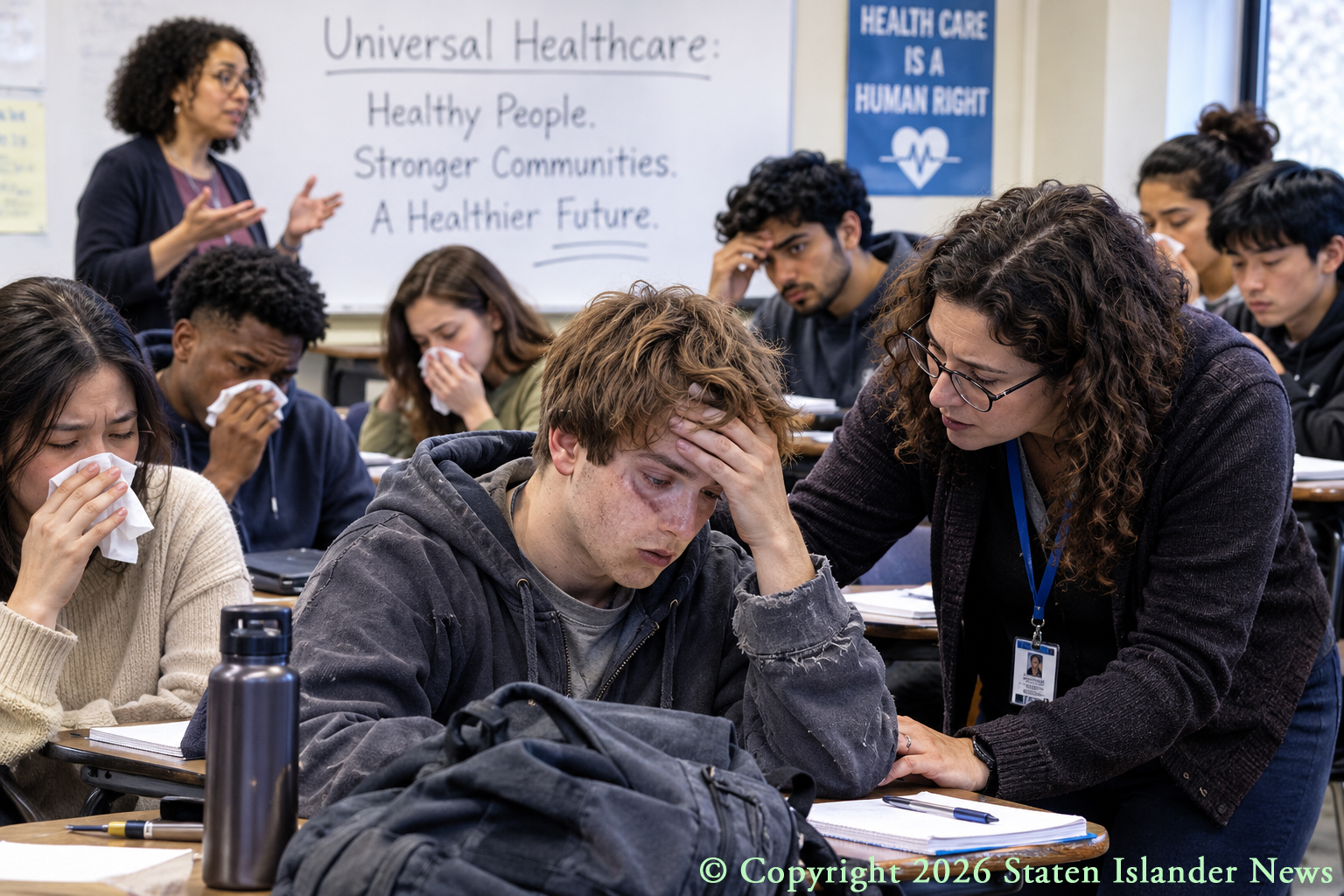
Universal coverage does not require unlimited government. Image Credit – Staten Islander News
Universal Coverage Does Not Require Unlimited Government
Finally, we should distinguish universal access from unlimited government control.
The American health-care system has many strengths worth preserving. Private hospitals, independent physicians, pharmaceutical research, medical entrepreneurship, competition, and patient choice have contributed enormously to medical progress. A properly designed universal system need not destroy these institutions.
Indeed, there are several ways to achieve broad coverage while retaining a substantial role for private enterprise. The essential requirement is that people have access to a defined foundation of medically necessary services, regardless of whether their employment circumstances, income, or health history make conventional insurance difficult to obtain.
We should be willing to debate how that foundation is financed, how providers are compensated, how administrative costs are controlled, and how we prevent unnecessary utilization. We should demand transparency, measurable outcomes, competition where it improves quality, and accountability for public expenditures.
We should also be honest about trade-offs. Universal coverage is not free. It requires someone to pay, whether through taxes, insurance premiums, employer contributions, or some combination of these. The relevant comparison, however, is not between the cost of universal coverage and a hypothetical system in which health care costs nothing. It is between the costs of different ways of financing and delivering care, including the enormous costs already imposed by uncompensated treatment, medical debt, delayed diagnosis, and preventable illness.
A serious conservative approach would insist on sound actuarial analysis, careful implementation, and regular evaluation. It would reject waste and politically fashionable promises that cannot be sustained. It would favor practical solutions over ideological purity.
But it would also recognize that a system in which millions of people cannot obtain ordinary medical care is not necessarily less expensive simply because its costs are distributed less visibly.
Universal Coverage Does Not Mean Mandatory Health Care
Oh, and, let’s not forget to mention one last important issue: Health Choice and the concept of Freedom. This may be the biggest issue for many Staten Islanders.
Whether vaccines or treatments show efficacy is not the issue here; what really is, is whether Universal Health Coverage could possibly mean mandatory health treatments and the like. Or, some might be concerned about mandatory check-ups. Or, some might wonder if this could then translate into tax penalties for not utilizing any sort of health care, because they might be perceived as a greater burden to society.
If citizens don’t like a health care procedure, they are free to choose another. If they don’t like one doctor, there are abundant options. Our system is based on choice.
It’s not likely that Universal Health Care might become Mandatory Health Care. Some would not use the plan by choice; many other Americans already have viable alternatives from their occupational coverage. Just because we’d all be covered wouldn’t mean we are all costing the same amount, nor that we must agree to any medical treatment that is against our values or will.
So, logically, no mandatory Flu Shots or bunion treatments or obligatory group morning exercise routines. That all seems a bit too much, and in fact a lot more like what people on the Right are rightly wary of.
Remember when President Trump proposed a greater role for Complementary Health Care Modalities? These modalities and treatments are not all quackery, and some evidence-based options could easily save the nation on its health care bills.
RFK and his ideas of Prevention are right on the money, in that way, no matter how you look at it, or whether you agree with his specific ideas regarding wellness and health.
The Conservative Conclusion
Conservatism, properly understood, is not indifference to the condition of one’s fellow citizens. It is an appreciation of institutions, continuity, responsibility, and the conditions that allow individuals and communities to flourish.
A healthy population is one of those conditions.
We want people to work, raise families, educate their children, build businesses, care for aging parents, and participate in civic life. We want our children to grow up healthy and capable. We want our employers to have dependable workers and our communities to have engaged citizens. We want to avoid the enormous human and financial costs of preventable disease.
None of these objectives can be achieved reliably if access to basic health care is treated as a privilege available only to those fortunate enough to have the right job, the right insurance arrangement, or sufficient personal wealth.
The United States is not a poor country. We possess extraordinary medical resources. We spend more on health care than any other advanced nation, yet we have struggled to ensure that every person has dependable access to essential services. That is not a triumph of individualism or free enterprise. It is a failure of institutional design that deserves to be corrected.
The answer need not be socialism. It need not be the nationalization of medicine. It need not be an unlimited entitlement or an abandonment of personal responsibility.
It can be a distinctly American solution: one that preserves private enterprise, encourages innovation, respects individual choice, insists on fiscal discipline, and guarantees a reasonable minimum of medical protection to everyone.
We already understand that certain things are too important to leave entirely to the accidents of individual circumstance. We understand it about clean water, sanitation, public safety, and education. We understand that the consequences of neglect are not confined to the person who suffers them.
Health is no different.
A country that expects its citizens to obey its laws, contribute to its economy, educate its children, support its institutions, and participate in its common life has a legitimate interest in ensuring that they are healthy enough to do so.
That is not an extravagant demand on government. It is a reasonable expectation of civilization.
And it is an expectation that conservatives, of all people, should be able to defend.
Banner Image: Universal coverage does not require unlimited government. Image Credit – Staten Islander News


The Sensible Staten Islander
Read what I write. Tell me what you think. Not open to arguing but insightful discussion in the comments is always an option.
There are no comments yet
Why not be the first