

NYC Drought Level Increased To Warning, Key To The City Of NY Awarded To Gracie Mansion Annual Gala Honorees, Updates On Migrant Response, Back-To-Back Record-Breaking Years Supporting Minority, Women-Owned Businesses, First-Ever Civil Service Exams For Multiple Public Service Positions
MAYOR ADAMS AWARDS KEY TO THE CITY OF NEW YORK TO GRACIE MANSION CONSERVANCY ANNUAL GALA HONOREES DARREN WALKER, MARC MORIAL, AND MICHELLE MILLER
Gala Honors Walker, Morial, and Miller for Decades of Work on Social Justice, Philanthropy, and Human Rights
Editor’s note: Staten Islander has previously covered the drought warning issued by the Mayor. This situation has continued to worsen, as there has still been very little rainfall in the reservoir regions. We also published an article by the mayor about the drought situation and how New Yorkers can help.
NEW YORK – New York City Mayor Eric Adams today awarded a Key to the City of New York to Gracie Mansion Annual Conservancy Gala honorees Darren Walker, Marc Morial, and Michelle Miller. Walker currently serves as president at the Ford Foundation, Morial is the president of the National Urban League, and Miller co-hosts CBS Saturday Morning and has additionally provided decades of volunteer work in philanthropy. The honorees received their respective Keys to the City for their decades of work toward social justice, human rights, and philanthropic support for marginalized communities.
“Our administration has made it a priority to welcome New Yorkers from every community to Gracie Mansion, and to celebrate the diversity that defines our city across the globe,” said Mayor Adams. “Our city is a home for all New Yorkers and its history, including Black History, and tonight’s honorees are an impressive addition to our story. Marc Morial, Michelle Miller, and Darren Walker have transformed this city with their vision and advocacy and defined what Black excellence means for a new generation, and I am honored to present them with the Key to the City of New York for all their contributions to our city.”
“New York City has long been a destination for people from all over the world who strive to reimagine what’s possible and realize their dreams, including me,” said Darren Walker, president, Ford Foundation. “I have the privilege to call this world-class city home, and to lead one of the many great New York-based institutions that support the vibrant arts, culture, and economy that New York has to offer. But, most importantly, I have the privilege to work in support of the New Yorkers who will always be the crown jewel of this city. I thank the City of New York for this recognition and honor.”
“I am honored to receive the Key to the City of New York and see the recognition as a celebration of the tireless work of countless individuals and organizations dedicated to advancing social justice, equality, and opportunity in this great city,” said Marc Morial, CEO, National Urban League. “Thank you to Mayor Adams for taking the time to recognize this important work and for helping us all tackle the tough challenges facing our communities — whether it’s addressing disparities in education, economic mobility, or other persistent challenges. This key is a reminder that our collective work to deliver for New Yorkers is never finished, but is a powerful symbol that when we come together, we can unlock the doors to a better, more equitable future for all.”
“I am humbled to receive the Key to the City of New York and accept it standing on the shoulders of the generations of journalists, philanthropists, and public servants who continue to contribute to our great city,” Michelle Miller, co-host, CBS Saturday Morning. “I am grateful for the opportunity to serve on the boards of the School of American Ballet and Education Africa, where I’ve seen firsthand the power of education and the arts to transform lives. I am also thankful for the chance to volunteer alongside dedicated individuals in public schools across Harlem and Brooklyn, where I work to uplift and empower our next generation of leaders. I am grateful to Mayor Adams for this meaningful honor, and I pledge to continue doing everything I can to serve the people of New York City.”
About Darren Walker
Darren Walker is president of the Ford Foundation, a $16 billion international social justice philanthropy. Under his leadership, the Ford Foundation became the first non-profit in U.S. history to issue a $1 billion designated social bond to stabilize non-profit organizations in the wake of COVID-19. Before joining Ford, Walker was vice president at the Rockefeller Foundation. Previously, he was the chief operating officer of Harlem’s Abyssinian Development Corporation. Walker co-founded both the U.S. Impact Investing Alliance and the Presidents’ Council on Disability Inclusion in Philanthropy. In 2022, he was awarded France’s highest cultural honor, Chevalier des Arts et des Lettres, for leadership in the arts. In 2023, he was also appointed by Her Majesty, Queen Elizabeth II, to the Order of the British Empire for services to U.K./U.S. relations. He serves on many boards, including the National Gallery of Art, Carnegie Hall, the High Line, the Smithsonian National Museum of African American History & Culture, the Committee to Protect Journalists, Ralph Lauren, Bloomberg Inc., and PepsiCo. In 2024, President Joe Biden awarded Walker the National Humanities Medal, which honors individuals or groups whose work has deepened the nation’s engagement with the arts and humanities.

About Marc Morial
Marc Morial is a distinguished leader and advocate known for his commitment to social justice and urban development. Born in New Orleans, Morial served as the Crescent City’s mayor from 1994 to 2002, where he implemented policies that revitalized the city and enhanced the quality of life for its residents. Currently, Morial serves as president and CEO of the National Urban League, the nation’s largest historic civil rights and urban advocacy organization. In his tenure, Morial has championed economic empowerment and equality, advocating for marginalized communities across the nation. Morial’s career is marked by numerous accolades, including one of the 100 most influential Black Americans by Ebony Magazine, one of the top 50 Non-Profit Leaders by the Non-Profit Times, one of the 100 Most Influential Black Lawyers in America, and he was inducted into the International Civil Rights Walk of Fame in Atlanta, Georgia.
About Michelle Miller
Michelle Miller is an award-winning national correspondent, New York Times bestselling author, and co-host of “CBS Saturday Morning,” renowned for her dedication to journalism. In addition to her co-hosting and reporting duties, Miller is a board member for the School of American Ballet and Education Africa and has served on the March of Dimes National Communications Advisory Council and Links, Inc. National Communication Committee. She is a member of the Greater New York Chapter of the Links, Inc., Jack & Jill of America, and National Association of Black Journalists. Miller believes in paying it forward. She volunteers around New York City with various public schools in Harlem and Brooklyn. She also has worked with a domestic violence shelter in Harlem and serves as a mentor to many in the journalism field. Since joining CBS News in 2004, she has covered major stories including Hurricane Katrina, the Boston Marathon bombing, the Charleston church shooting, and the 2020 presidential election. Miller’s reporting has earned her prestigious journalism awards, including an Emmy for her series of reports on the National Guard’s Youth Challenge Academy, an Edward R. Murrow for her coverage of a daycare center stand-off in New Orleans, and she was part of the Alfred I. duPont – Columbia Award winning team for coverage of the Newtown, Connecticut school shooting. Her career in broadcast and print journalism includes work at the Los Angeles Times, the Star Tribune in Minneapolis, and ABC News’ “Nightline” in Washington, D.C, to name a few.
The Key to the City of New York was first awarded in 1702 by New York City Mayor Phillip French, when he offered “Freedom of the City” to Viscount Edward Cornbury, governor of New York and New Jersey. By the mid-1800s, it became customary to award the Key to the City of New York as a direct symbol of the city’s wish that a guest feel free to come and go at will. Today, the Key to the City of New York is a beloved symbol of civic recognition and gratitude reserved for individuals whose service to the public and the common good rises to the highest level of achievement.
MAYOR ADAMS ELEVATES DROUGHT LEVEL TO WARNING, PAUSES DELAWARE AQUEDUCT REPAIR PROJECT, ORDERS CITY AGENCIES TO IMPLEMENT WATER-SAVING MEASURES AND NEW YORKERS TO CONTINUE CONSERVING WATER
Comes After City Saw Longest Rainless Streak in Recorded History; City’s Water Supply Needs Almost Eight Inches of Rain to Reach Normal Levels
Drought Warning is Second of Three Levels of Water Conservation Declaration Possibly by City; Mayor Issued Drought Watch on November 2nd
Mayor Banned Grilling in Parks, Urged New Yorkers to Take Additional Precautions and Preserve Water Following Forest Fire in Prospect Park
Last Drought Warning Issued in 2002
NEW YORK – New York City Mayor Eric Adams and New York City Department of Environmental Protection (DEP) Commissioner Rohit T. Aggarwala today elevated the citywide drought watch to a drought warning and paused the final phase of DEP’s largest ever infrastructure repair project — the $2 billion Delaware Aqueduct Repair Project — amid a historic and continued precipitation shortage. As such, Mayor Adams ordered city agencies to implement a range of drought protocols to conserve water and reminded New Yorkers to continue to do their part in saving water wherever possible. Pausing the repair project will allow the city to reopen the aqueduct soon, restarting the flow of water from four additional reservoirs. Conserving water will slow the depletion rate of the stored water in city reservoirs and can potentially postpone or eliminate the threat of a serious shortage. Mayor Adams and Commissioner Aggarwala first issued a drought watch back on November 2.
“As our city and watershed continues to experience significant precipitation shortages, today, I’m upgrading our drought watch to a drought warning, pausing our Delaware Aqueduct repair project, and ordering our agencies to immediately implement water saving measures,” said Mayor Adams. “Our city vehicles may look a bit dirtier, and our subways may look a bit dustier, but it’s what we have to do to delay or stave off a more serious drought emergency. We need New Yorkers to continue to save water too, so we can water our parks and fill our pools this coming summer. New Yorkers always look out for each other. We are resilient and we will get through this together.”
“Recent unseasonably warm weather and lack of precipitation have led to dry conditions for many counties in New York, resulting in Hudson Valley and New York City area counties being elevated to drought warning status and a statewide drought watch,” said New York Governor Kathy Hochul. “Across the state, local water restrictions and educating New Yorkers about how to help conserve water resources are crucial steps to help prevent a more severe shortage until conditions improve.”
“We have emphasized the importance of treating the drought watch with seriousness and encouraging all New Yorkers to conserve water whenever possible. As we enter the warning level, the need for vigilance and conservation becomes even more crucial,” said Chief of Staff and Extreme Weather Coordinator Camille Joseph Varlack. “City agencies will now begin to implement their respective drought protocols and water conservation measures. As we continue to monitor this situation, we ask all New Yorkers to double down on their efforts to conserve water.”
“The fires that have burned from Brooklyn to the Bronx are a stark reminder that extreme weather knows no boundaries — but neither do New Yorkers. Time after time, New Yorkers step up to help each other and our city, and today’s drought conditions are no different. By taking water-savings steps now, like shorter showers, we are protecting our city in the most fundamental way,” said Deputy Mayor for Operations Meera Joshi. “For the city’s part, we are putting immediate water-saving measures into effect across city operations and made the difficult but necessary decision to pause our Delaware Aqueduct Repair Project.”
“The ongoing and historic lack of rainfall, both in the city and in the upstate watershed where our reservoirs are located, has become more critical,” said New York City Chief Climate Officer and DEP Commissioner Rohit T. Aggarwala. “Our city agencies are leading by example in finding innovative ways to save water every day. Now we need the public to do the same so that we can avoid banning things like watering lawns and filling up swimming this spring.”
“Our city is facing an unprecedented and historic drought, and New York City Emergency Management is supporting City Hall and the Department of Environmental Protection in mobilizing a strong response among our partners and agencies,” said New York City Emergency Management Commissioner Zach Iscol. “With the drought watch now elevated to a warning, city agencies are activating enhanced drought protocols and conservation measures, and we urgently need every New Yorker to join these efforts. By making simple but impactful changes, such as taking shorter showers, running dishwashers and laundry machines only with full loads, and spreading the message about water conservation, you can play a vital role in protecting our city’s essential water supply. We’re calling on all residents and businesses to redouble their conservation efforts and help safeguard our water resources during this critical period.”
Given the lack of precipitation forecast in the coming weeks, DEP will halt repairs currently underway to the Delaware Aqueduct, an 86-mile pipeline that delivers half of the city’s water supply from the Catskill Mountains. The final phase of the $2 billion repair project, which is DEP’s largest-ever infrastructure project, would have prevented 35 million gallons of drinking water from leaking into the ground in upstate New York every day by connecting a 2.5-mile bypass tunnel near Newburgh, where the leak is occurring. In order to initiate that final phase, the city stopped the flow of water from the four reservoirs that feed into the Delaware Aqueduct. However, the lack of rain upstate has meant that water reserves across all reservoirs are not where they need to be to complete the project in the spring. In the coming days, the city will begin the process of reopening the aqueduct to resume the flow of water from those reservoirs to New York City. DEP will work to restart the project next year to ensure that the Delaware Aqueduct — the world’s longest tunnel of any kind — continues to bring New Yorkers the best drinking water in the world for generations to come.
A drought warning is the second of three levels of water conservation declarations from the city. As conditions evolve, the city may declare a drought emergency, which involves escalating requirements on government agencies and New Yorkers to reduce water usage.
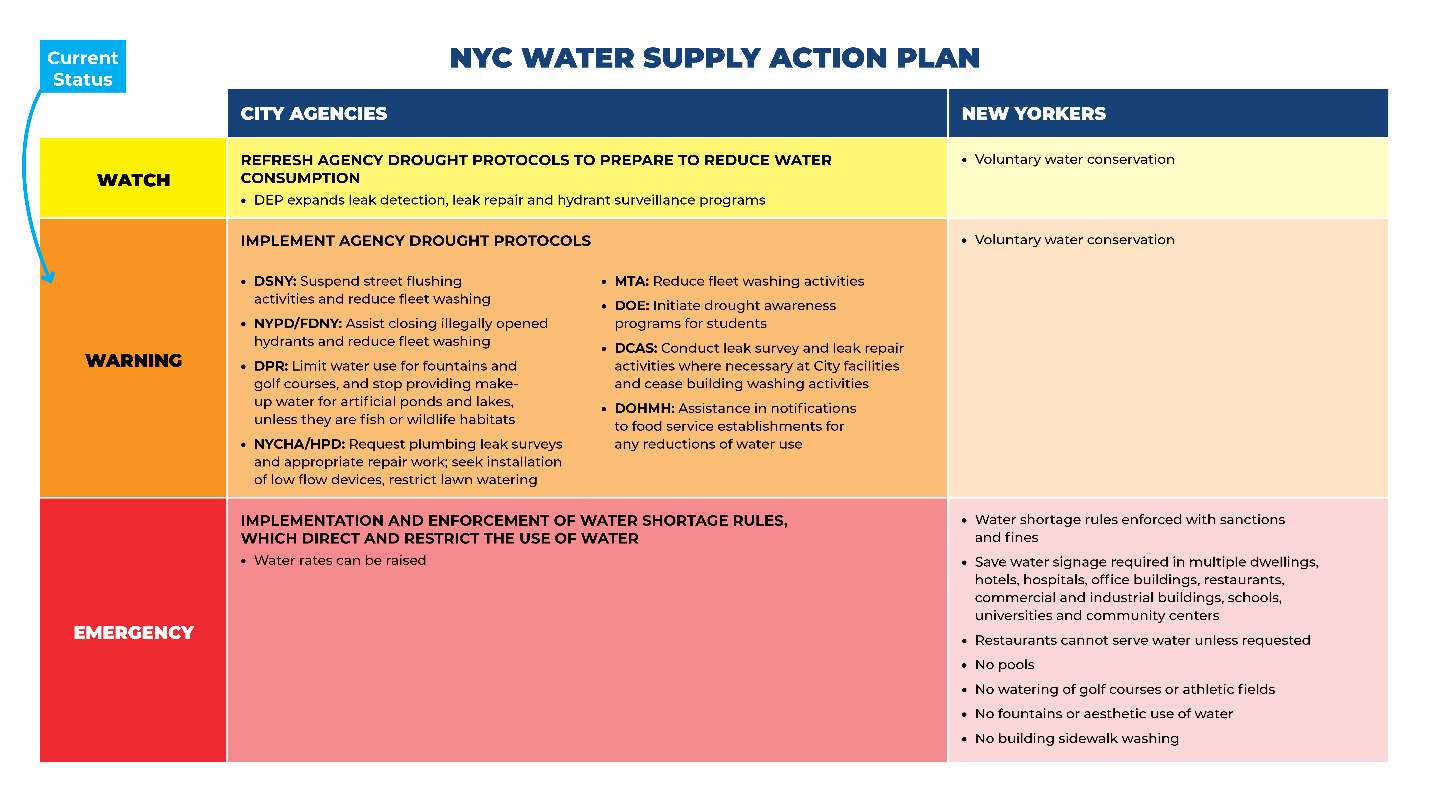
Stages of drought response in New York City. Credit: City Hall
City and state agency water-saving measures include:
- The New York City Department of Sanitation is suspending street flushing activities and reducing vehicle washing.
- The New York City Police Department and Fire Department of the City of New York (FDNY) are assisting in closing illegally opened hydrants and reducing vehicle washing.
- The New York City Department of Parks and Recreation (NYC Parks) is limiting water use for fountains and golf courses and no longer providing make-up water for artificial ponds and lakes unless they are habitats for fish or other wildlife.
- The New York City Housing Authority and New York City Department of Housing Preservation and Development are requesting plumbing leak surveys and appropriate repair work, seeking to install low-flow plumbing fixtures wherever possible and restricting lawn watering.
- New York City Public Schools is initiating water conservation awareness programming for students.
- The New York City Department of City Administrative Services (DCAS) is conducting leak survey and leak repair activities where necessary at city facilities and is no longer washing the exteriors of city buildings.
- The New York City Department of Health and Mental Hygiene (DOHMH) is communicating with food service establishments about reductions of water use.
- The Metropolitan Transportation Authority is reducing fleet washing.
“With a drought warning now in place, we are once again urging New Yorkers tol
P2do their part, conserve water, and take the necessary steps to reduce the chances of a brush fire occurring during this extraordinarily dry period,” said FDNY Commissioner Robert Tucker. “Remarkably dry conditions in October and so far in November have resulted in a historic amount of brush fires over the last two weeks, and we need the public to remain vigilant and conserve water so that we can continue to effectively respond to fires when they occur. We thank all New Yorkers who have seen smoke and called 911, and we urge the public to do the same.”
“Our greatest strength as a school system lies in our community and our collective commitment to creating a better New York for our kids. At New York City Public Schools, we are actively contributing to water-saving efforts by raising awareness among students, families, and staff about the critical importance of water conservation and the impacts of a drought in our city,” said New York City Public Schools Chancellor Melissa Aviles-Ramos. “I commend our partners across various agencies who are stepping up and doing their part for all New Yorkers.”
“As custodians of our city’s greenspaces, we know how important it is to preserve our natural resources. We’re doing our part to help our city navigate this challenge while keeping our parks and public spaces healthy and welcoming for all,” said NYC Parks Commissioner Sue Donoghue. “We implore all New Yorkers to be mindful of their behavior in our greenspaces and refrain from barbecuing and grilling. And remember smoking of any kind is never allowed in our parks.”
“As our city enters a drought warning — a time for us all to take stock of our water usage — we’re proud to join our sister agencies in stepping up to conserve water,” said DCAS Commissioner Louis A. Molina. “At DCAS, we’ll be scaling back our facility exterior washing and conducting a comprehensive leak survey of our buildings to make sure no water is being wasted. We urge New Yorkers to join in and do their part as we collectively come together to save water.”
“The causes of climate change — and subsequently the current drought we are experiencing — extend far beyond the borders of New York City. But we are not powerless,” said DOHMH Acting Commissioner Dr. Michelle Morse. “There is much we can do here on the local level to mitigate its effects on resources such as water. All New Yorkers can contribute to conservation efforts so that we are the healthiest and most resilient city we can be.”
As part of the initial drought watch, DEP has already expanded its leak detection, leak repair, and hydrant surveillance programs.
Mayor Adams, today, also reminded all New Yorkers to do their part to conserve water. Some simple tips include:
- Report open fire hydrants and street leaks to 311. An open hydrant can release more than 1,000 gallons per minute, which wastes 1.4 million gallons of drinking water in a 24-hour cycle.
- Don’t flush the toilet unnecessarily. According to the U.S. Environmental Protection Agency (EPA), toilets are by far the main source of water use in a home, accounting for nearly 30 percent of an average home’s indoor water consumption. Each flush can use 1.6 gallons, with older models using as much as 6 gallons.
- Take shorter showers, saving five to seven gallons a minute. When taking a bath, fill the tub only halfway and save 10 to 15 gallons.
- Don’t run the tap while shaving, washing hands, or brushing teeth. Faucets use two to three gallons per minute.
- Fix leaks. A leaky faucet that drips at the rate of one drip per second can waste more than 3,000 gallons per year, according to the EPA.
- Run the dishwasher and washing machine only when full. Use short cycles if available. Turn off the water while washing dishes.
- Install water-saving fixtures, including low-flow toilets and showerheads, as well as faucet aerators.
- Sweep driveways and sidewalks clean rather than washing them down with a hose.
- For even more ideas, visit DEP’s Water Savings Tips website.
New York City has been successful in conserving water for decades. The city’s average daily water demand has decreased by approximately 35 percent over the past several decades, even as the city’s population has grown by more than 1 million people. During its peak, in 1979, the city’s average water usage was 1.5 billion gallons of water a day. Thanks to improved management strategies — systemwide leak detection and repairs, replacing old meters with automated meter readers, and providing an online platform for customers to track and monitor water usage and quickly detect leaks in their buildings — the city now uses just 1.1 billion gallons a day on average, and under 1 billion gallons during the winter months.
DEP manages the nation’s largest municipal water supply system, which provides high-quality drinking water each day to nearly 10 million residents, including 8.3 million in New York City. The water is delivered from a watershed that extends more than 125 miles from the city, comprising 19 reservoirs and three controlled lakes. Approximately 7,000 miles of water mains, tunnels, and aqueducts bring water to homes and businesses throughout the five boroughs.
“Water is one of our most precious resources, and it has never been more clear with today’s drought warning,” said New York State Assemblymember Jenifer Rajkumar. “Climate change caused an exceptionally warm fall, leading to our reservoir system being at only 63% capacity. As New Yorkers always do in a crisis, we are coming together to face this challenge, cutting our water usage however we can. Importantly, that includes pausing the Delaware Aqueduct Repair Project, in order to deliver water from four additional reservoirs. New York is now among 48 states experiencing drought conditions due to climate change, showing we must reduce greenhouse gas emissions to give our children the sustainable future they deserve.”
“The escalating dangers of this drought warning have been made clear in the last week, as dry climate has led to dangerous brush fires clouding our city with smoke, damaging our public spaces and communities,” said New York City Public Advocate Jumaane D. Williams. “These conditions are a long-term consequence of the climate, and as we continue to push for real action to address climate change, New Yorkers can have short term impact to mitigate the harm. By taking simple steps to conserve water — limiting washing machine use, shortening showers, and minimizing running sinks — we can each do our part to save water, and potentially save our communities from further damage.”
“The fires in Inwood Hill Park and other parts of upper Manhattan this week have been a wake-up call. New Yorkers need to take the drought and the dry conditions it’s brought seriously, which means conserving water whenever possible and being extremely careful in dry areas of the city, like parks,” said Manhattan Borough President Mark Levine. “Thank you to the FDNY and Parks Department for putting out the fires and keeping New Yorkers safe.”
“While this historic stretch of beautiful weather seems favorable at first glance. the reality is that New York City is starting to suffer the impacts of a lack of rainfall, from an unprecedented amount of brush fires across the five boroughs to the very real threat of water shortages,” said Queens Borough President Donovan Richards Jr. “All of us have a role to play in keeping our city safe and preserving our water supply, so I encourage all New Yorkers to conserve water where they can and be aware when handling anything that can start a fire while outdoors.”
“As New York City faces a historic drought, the elevation to a drought warning underscores the urgent need for collective action,” said New York City Council Majority Whip Selvena N. Brooks-Powers. “I will continue to work with Mayor Adams and DEP Commissioner Aggarwala to raise awareness on this critical issue and ensure we are implementing citywide conservation measures. I urge all New Yorkers to join in conserving water wherever possible to ensure the resilience of our city’s water system in the face of this ongoing challenge.”
“As chair of the New York City Council’s Committee on Environmental Protection, Resiliency & Waterfronts, I urge all New Yorkers to do their part to conserve water during this historic precipitation shortage. Pausing the Delaware Aqueduct Repair is a necessary move, but this must be a team effort,” said New York City Councilmember James F. Gennaro. “I’d also like to remind all New Yorkers that these dry conditions greatly elevate the chances of brush fires, as we recently saw in Prospect Park. Please remain vigilant and take added precaution, especially with flammable items.”
“MTA is ready to do its part to reduce water usage during this historic drought warning,” said Metropolitan Transit Authority Chair and CEO Janno Lieber. “Managing impacts of climate change and increasing transit resiliency are always top of mind, and we will work closely with our partners at the city to keep New Yorkers safe.”
MAYOR ADAMS ELEVATES DROUGHT LEVEL TO WARNING, PAUSES DELAWARE AQUEDUCT REPAIR PROJECT, ORDERS CITY AGENCIES TO IMPLEMENT WATER-SAVING MEASURES AND NEW YORKERS TO CONTINUE CONSERVING WATER
Deputy Mayor Meera Joshi, Operations: All right, good afternoon, everyone, and thank you for joining us to go over our current conditions and what it means for the city and what actions our city agencies are taking to protect New Yorkers.
The fires that have burned from Brooklyn to the Bronx and in northern New Jersey are a stark reminder of the extreme weather that we’re having and that it knows no boundaries. But neither do New Yorkers. Time after time, New Yorkers step up to help each other out and to help our city. Today’s drought conditions are no different.
We implemented a drought watch earlier this month, and now we’re asking all New Yorkers to do their part. By taking water-saving steps, simple ones, as simple as just taking a shorter shower, we’re protecting our city in the most fundamental way possible. And we are in this together. The city itself is taking a range of steps to protect the city from the more serious impacts of the drought, not just for today, but for six months down the line, when our pools need to be full and our trees need to be watered to keep New Yorkers cool in the ever-hotter New York summers. So today, we’re looking to the future and ensuring that no matter what, New York has the water reserves it needs to go forward. And next, we’ll hear from our mayor, Eric Adams.
Mayor Eric Adams: Thanks so much, deputy mayor. And it becomes a reality, as I was speaking with Commissioner Aggarwala, to see the actual decrease in water in our reservoir, how this is a real issue. It’s hard to believe that we’d be talking about brush fires and droughts in New York City.
But the reality is that this past October and November saw the second longest rainless streak in city records, dating back to 155 years to 1869. I want to also thank MTA head, Janno Lieber, who’s also joining us at this time.
But as you can see from the pictures over my left shoulder, our reservoirs are nowhere near where they should be. And our city and watershed continues to experience significant precipitation shortages. And today, I’m upgrading our drought watch to a drought warning and ordering our agencies to immediately implement water-saving measures. A drought warning is the second of three levels of water conservation in our city. And I want to be clear on this. This is not normal, and I’m pretty sure if you’re outside, you may enjoy the beautiful weather in November, but the reality is climate change is real and is impacting our city. And while we cannot make it rain, we can take actions to reduce the risk of drought emergencies in our city.
The city is leading by example on water conservation, and our city vehicles may look a little dirtier, but if we could take small steps, we could have a major impact. We’re asking New Yorkers to do their part as well and continue to save water wherever and whenever possible. Every New Yorker can help by, as the deputy mayor indicated, simple things like shorter showers, while you’re brushing your teeth, don’t let the water run. But also there’s some amazing tips on the DEP’s water savings website. New Yorkers can visit DEP’s water saving tips to find out more.
If we pull together and save water together, we’ll be able to ride this through. And we can avoid a more serious drought that will require further restrictions in the city. In addition, as an additional measure to mitigate the risk of a drought, we are pausing the Delaware Aqueduct repair project, something that we announced a few months ago in Queens and, we don’t want to do this, but we have to make sure it’s done correctly. We will restart the Delaware Aqueduct project as soon as possible so we can stop the 35 million gallon daily leak and secure the future of our water supply. But with as little rain as we received this fall, and subsequently lower than expected water reserves, we have to press pause on the project now.
New Yorkers should not underestimate the dry weather and what it means. Last week, we saw a series of fires, as well as what we saw happen and take place in Prospect Park. We’ve seen brush fires in Manhattan and Marine Park all week. The fire risk is high and the fire risk is real. We have already taken action to keep New Yorkers safe, including banning grilling in our parks, and I’m urging all New Yorkers to take common sense steps to prevent brush fires going forward, including removing litter and leaves from sidewalks and disposing of cigarette butts and matches properly.
I really want to thank the team, the MTA, DEP, NYCEM, and the FDNY for coordinating our citywide effort to prepare our city. As I stated, climate change is here, it’s real, and we’re going to fortify the city to be prepared for it and how to respond accordingly.
Deputy Mayor Joshi: Thank you. As we mentioned, this is not a city impact, this is a regional impact, and so we do this work in connection with our partners on the state level and the governor’s office, and I’d like to welcome up DHSES, that’s got to be the best acronym ever, Deputy Commissioner O’Leary. Thank you.
Deputy Commissioner Terence O’Leary, Division of Homeland Security and Emergency Services: Good afternoon. So I’d like to start by thanking the mayor and New York City for their partnership in responding to this drought. We’ve been working on the state level closely with the Department of Environmental Protection here in the city to coordinate our response to this drought, and the drought is real and its effects are real. We’ve already seen that upstate.
New York State has been responding to over 15 wildfires in the last two weeks alone, including the Jennings Creek fire, which is one of the largest in New York State in the last 30 years. Currently, the fire is about 5,200 acres, including 3,100 acres in New York. On Monday and Sunday night, we evacuated over 270 households in response to this fire, which burned all the way to some people’s backyards. I’d like to thank many members of the New York State Fire Service. Over 420 fire departments responded with over 1,300 firefighters to help combat this fire.
In response to this drought, the Department of Environmental Conservation is declaring a drought warning in 10 counties and New York City. Those counties outside of New York City are Delaware, Dutchess, Green, Orange, Putnam, Rockland, Schoharie, Sullivan, Ulster, and Westchester. What this declaration means is that the Department of Environmental Conservation has seen the groundwater supply as well as stream flows decrease to such a level, when combined with the lack of rainfall, that we need to start working with our partners upstate to conserve water.
What the state will do is the Department of Environmental Conservation will continue to monitor stream flows. They will continue to monitor well water and other groundwater sources. They will work with upstate partners to make sure that their wells are working. If they’re not, they will work with them to find out why they’re not working so that we can see just how bad the drought is.
The State Department of Health will work with municipal water suppliers, those that supply over 3,000 customers, to make sure that those municipal water suppliers are starting to look at conservation plans. They should be working with their large customers to make sure that they’re conserving water. They should also be making projections to see, if the weather does not change, how long can they continue to supply water at the current rate for.
In addition to this, the governor has declared a burn ban statewide that bans the burning of debris and brush throughout the state. It also bans uncontrolled campfires, as well as uncontrolled fires which are for the purpose of cooking. There are some exceptions for controlled campfires, but if you’re going to have a campfire or do something within the bounds of the burn ban, be prepared. You’ll be surprised just how fast a campfire can get out of control. So make sure you have water available. If you can, have a shovel with you. Be prepared for the fire to jump the bounds and to spread very, very quickly.
The upcoming weather should help a little bit. We’re hopeful that an incoming storm on Wednesday and Thursday will bring some rain and relief, both to New York City as well as upstate New York, but it’s not going to be enough. What we need are New Yorkers to make sure that they are thinking about the ways to conserve. You heard the mayor already talk about ways to conserve water. We need each and every person to do their part until we get the weather and the rain that we need here.
With that, I’d like to say thank you for the partnership to the mayor and to our partners in New York City government, including the New York City Office of Emergency Management, which stays in constant contact with us to make sure that we’re sharing resources, sharing information, and that we’re handling this, not only as a city and not only as a state, but together. Thank you.
Deputy Mayor Joshi: Thank you. And our city agencies are not the only government entities in New York City that are taking extreme steps now to save water. Next up is our MTA CEO, Janno Lieber, to talk about how the MTA is taking water conservation measures.
Janno Lieber, CEO and Chair, MTA: Thank you, deputy mayor, and thank you, Mayor Adams, for your leadership. I’m glad to be with you to share an update on the MTA’s strategy for managing our part in this prolonged drought. Obviously, reducing water consumption, as everybody has said today, is priority one.
So we’re going to reduce our fleet washing of Long Island Railroad and Metro North trains, as of now. The subway’s Department of New York City Transit is also cutting back on washings dramatically. We’re going to prioritize leaks in tunnels and stations, and our buses will now be washed less frequently. I know that [inaudible] may say that they didn’t know MTA buses were washed at all, but I’ll tell you, every day our riders appreciate the fact that we do look after that side of the business.
Our employees have been placed on a high alert for fires within the system, and this is real. Mayor and I grew up in a New York where the subway had track fires all the time, and we’re doing a lot to reduce that risk by picking up garbage and cleaning more aggressively. But in addition, above ground, our bridges and tunnels personnel are going to be actively inspecting all of our sites to make sure that hazardous materials are properly stored under and around facilities and crossings. Likewise, the MTA construction development professionals are going to make sure that construction sites don’t have any hazardous conditions that could lead to fire starts.
Listen, we have protocols in place to quickly extinguish anything, any fire that gets started, whether it’s on tracks or in electrical substations or in above ground areas. And every step of the way, we are building on our extraordinary collaboration and cooperation with all the city partners. The Mayor’s Office, the Fire Department, the Police Department, the Office of Emergency Management. These are all partners on a daily basis and not a new thing for us to work with them constantly.
And as always, we encourage folks to stay updated by checking social media, our apps, our digital screens and stations. They’ll have real-time information. And there is a service alerts. If you want more information on that, you can go to the MTA website and sign up for a service alert. I won’t go through the website, but it’s there right on the MTA website, mta.info, for folks to get it. So we’re ready to do our part. And as the mayor and the governor lead us through this emergency situation, we’re going to be looking for collaboration and upgrading if necessary. Thank you.
Deputy Mayor Joshi: Next, we’ll speak, we’ll hear from DEP Commissioner Aggarwala, who runs a very complex and important agency and as he will explain, covers every facet of water in our city.
Commissioner Rohit Aggarwala, Department of Environmental Protection: Thank you, deputy mayor. Good afternoon. I’m Rohit Aggarwala, commissioner at the Department of Environmental Protection. Just a couple of facts and figures to start us off.
Today our reservoirs are at about 60.1 percent capacity. Usually at this time of year, they are above 79 percent capacity. That’s an indication of how far down we are. Over the last 10 weeks, we have had 8.23 inches less rain than in the average year, over just 10 weeks. So this drought has come on fast, it has come on furious, and that’s why the last six weeks have been the driest on record.
As the mayor said with this drought warning, we will now be requiring city agencies, as well as our partners like the MTA and the Port Authority, to change their practices and as Jamno just pointed out, this is going to lead to some visible changes in the way that the city looks. We’ll be limiting the use of water in city parks, for example, and I’m sure Commissioner Donoghue will talk about that in a moment. We’re going to be increasing, as we’ve already done at DEP, all of our ongoing efforts to identify and stop leaks throughout the system, and DEP’s public affairs team will be working with the Department of Education and other schools to provide curriculum material to help teachers teach students about water conservation.
As the mayor said, we made the very difficult decision to stop work on the Delaware Aqueduct repair. It’s only six weeks ago that we announced it, and at the time in September, all of the forecasts, including that from NOAA, that the federal government forecasted a wetter than average October. And that forecasted wetter than average October, on which we based our decision to proceed, which of course turned into a record dry October and the drought that we are now in. We can only do this repair work during the winter because water consumption is down compared to the summer during the winter, and so unfortunately this means we will be postponing that work by at least a year until next October.
And of course, it’s also worth noting that given that the weather has been so much warmer than it normally is, in addition to the risk of fire, one of the things we’ve seen is that our average daily water consumption is higher than it normally is at this time of year. And it’s one of the reasons that we need so much help from New Yorkers. So even though the drought warning does not lead to mandatory restrictions on what the general public does, as the mayor said, we need all New Yorkers to help us.
A couple of things that I would add to what’s already been said, DEP does have a leak notification program that anybody with a water account can sign up for, whether it’s an apartment building, a business, or an individual homeowner. You go to our website, as the mayor said, nyc.gov/savewater, and you go to your My DEP account, and it will actually send you an electronic notice if your water use goes up in a way that is inconsistent with the past. So if your toilet is running or if there is a leak in your house, it will send you an email. It will let you know that there is a leak going on. And usually that’s a great way to save money, because we want people to save money. But right now we need New Yorkers to pay attention to those leaks.
In addition, we, as the mayor said, we need to ask you to take shorter showers. Don’t run the water while shaving. Don’t use your toilet as a wastebasket. Each unnecessary flush can waste up to five gallons of water. And please, again, don’t put off those repairs. If you have a leaky faucet, if you have a running toilet, please get on that now to help your city and help all of us. We’d also like to ask people, where possible and where consistent with the current rules, to sweep your driveways. Don’t power wash your driveways, just to get some leaves off of them. And one thing that I’d like to ask is please be on the lookout. If you see an open fire hydrant, call 311 immediately. An open fire hydrant is one of the biggest ways that we waste water in New York City.
I’ve been really grateful, both the general public and colleagues around city government have increased the number of notices they’ve given us. There was one day over the last week we had 100 phone calls alerting us to open fire hydrants, and we immediately dispatched a crew to go close those. Again, we are not at a drought emergency yet. And one of the reasons that we are doing all of this at the city level and that we’re asking New Yorkers to help is so that we can postpone as long as possible when those much more significant restrictions on the general public come into play. But it will take a city, and this is real, but I want to thank you. Thank you, Mr. Mayor. Thank you, deputy mayor. And thanks to the state as well for their partnership.
Deputy Mayor Joshi: Thank you. Brush those leaves into a paper bag because that helps us deter fires. But also, we have a citywide organics program that rolled out this fall, and so you’ve got a great place to leave them on the curbside. Next to speak about how we are combating the new rash of fires that we’re seeing throughout our city and mostly in our parks is our FDNY Commissioner Tucker.
Fire Commissioner Robert Tucker: Thank you, deputy mayor, and thank you, Mr. Mayor, for this leadership. We at the FDNY use and need water to fight fires, and so this move is very important to us after a very dry October and November.
The FDNY has extinguished over 300 brush fires, and we obviously use water to do that. We need water to do that. And so this move is giving us pause, and it’s keeping New Yorkers safe. So thank you to everyone behind me and to you, Mr. Mayor, for that.
It’s part and parcel of a bigger plan that the mayor has led us on, which is to understand where these brush fires are coming from, investigate them, and hope to thwart them on a going forward basis. We have started a task force to have highly specialized fire marshals, fire inspectors, and firefighters, not only working with the city agencies behind us, but also with our state and federal colleagues at the U.S. Fire Administration to share best practices.
As I said, more than 300 brush fires ignited this month, and every single one of them have been put out. There’s a small one burning right now in Queens, which is under control, but we expect to see small pockets of fire until we get some significant rain, which hopefully we’ll start to see at the end of the week. But I just want to thank all of our partners in this effort. Again, the FDNY needs water to fight fires, so Mr. Mayor, thank you for your leadership on this. Thank you.
Deputy Mayor Joshi: And taking care of the city’s backyard in these difficult times is our Parks Commissioner, Sue Donoghue.
Commissioner Sue Donoghue, NYC Parks: Thank you, Deputy Mayor Joshi, and thank you, Mayor Adams. As we’re seeing all over the city, these dry conditions are leading to an increase in brush fires throughout our natural areas. We at the Parks Department are drawing on our expertise and more than 40 years of experience caring for our urban forests.
We’re working hard to keep our natural areas safe and to ensure a healthy recovery for these critical ecosystems. We regularly maintain our natural areas by removing overabundant species like mugwort that can cause brush fires to spread faster and burn longer. And we’re working with our partners at FDNY to inspect and remove known tree hazards along paths and trails, as well as along heavily trafficked perimeters.
As the mayor mentioned, we have banned grilling in our parks, and there’s never smoking or open flames allowed in parklands. We will also continue to monitor tree risk and to quantify the impact of these brush fires. And we’re prepared to help our forested areas recover by filling canopy gaps that might arise from mature tree loss and restoring vegetation closer to the ground.
These conditions present a challenge for our natural areas, but we’re well equipped to limit the impact of these conditions and to help these vital green spaces recover. And we urge all New Yorkers to help us by taking these drought guidelines seriously for the safety of our communities and to protect our critical natural areas. I want to also thank FDNY, the Office of Emergency Management, all our city agency partners for their incredible collaboration for keeping our green spaces safe.
Deputy Mayor Joshi: And next, we’ll hear from the coordinator of all of the agencies on an emergency basis, NYCEM Commissioner Zach Iscol.
Commissioner Zach Iscol, NYC Emergency Management: Thank you, Deputy Mayor Joshi, who is our real quarterback throughout all this, and Mr. Mayor for your leadership. We really do live in an age of extreme weather, and it’s really important for all New Yorkers to be prepared.
Just to give you a couple statistics, in the 1970s and 80s, in terms of heat, we would see about 12 days on average with temperatures above 86 degrees. Last couple of years, last few years, we’re close to 30 days a year with those types of temperatures. Flash floods in the mid-1980s, we had about 30 flash floods a month across the United States. We’re now seeing 80 to 90 flash floods a month across the United States. In the 1980s, we saw about $8 billion disasters a month. Last year, we had over $23 billion disasters a month, FEMA disasters a month. And now we’re dealing with this drought caused by dry weather, which has increased the risk of brush fires and created additional issues like poor air quality.
As you heard from my colleagues, the city is doing a lot to deal with the drought through water conservation measures and its impacts, like dealing with brush fires around the city. I am incredibly grateful for our partners at DEP, the FDNY, our other partners at the state, partners like the MTA, who are doing their part to keep New Yorkers safe. It’s incredibly important that New Yorkers also do their part.
Number one, you can help the FDNY by reporting smoke fires or dangerous situations by calling 911. You can help us conserve water through some of the tips given to us by our partners at DEP. And then also, it’s really important that all New Yorkers are monitoring air quality and taking the necessary steps to protect yourself and your loved ones.
As you are well aware, fires create smoke. This can cause hazy skies that can impact our health. Even if you can’t see the fires nearby, you might experience the effects, eye irritation, coughing, difficulty breathing, even chest pain. Some New Yorkers are more susceptible to others to smoke, especially those with existing heart or lung conditions, older adults, folks who are pregnant or have weakened immune systems, children, those experiencing homelessness or lacking access to health care.
When the air quality index is at unhealthy levels, there’s a number of ways you can protect yourself. Avoid strenuous exercises, stay indoors as much as possible, close your windows and doors to keep smoke out, and use air purifiers if you have one. When outdoors, especially for extended periods of times, you can wear a well-fitted N95 or KN95 mask. The city has made them available at all precincts and at your local libraries. They’re available for the public. And of course, please seek medical attention if you experience symptoms like shortness of breath, dizziness, or chest pain.
For those of you that grew up watching G.I. Joe, you’re familiar with the PSA, knowing is half the battle. It is important for all New Yorkers to stay informed and to know what is going on. Air quality in particular can be very difficult to forecast. A lot of these brush fires can have very localized effects. You can stay abreast of air quality through the weather apps or by going to www.airnow.gov. You can also get more information about protecting yourself and loved ones at nyc.gov/fireandsmoke. And please do not forget to sign up for notify NYC, our city’s public communication system for emergencies, where we put out alerts for all sorts of emergencies, including about fires, droughts, and air quality. It’s available in 14 languages, including American Sign Language. Thank you all so much. And back over to you, Deputy Mayor Joshi.
Deputy Mayor Joshi: I think we’re ready for questions, right?
Question: [Inaudible.]
Commissioner Aggarwala: Well, now that we’re in it– so there’s watch, which we were in now we’re in a warning and then there’s emergency. It’s hard to say just how close we are. You know, there is a little bit of rain on the forecast. It’s not enough to end the drought. I think we’ll reassess in a week or two.
Some of it will simply depend on how much we as a city can bring our water down because a lot of it depends on how much water is left or the, the, the way we determine when we need to go into an emergency is a combination of how much water is in the reservoirs, what’s in the forecast and what’s the consumption pattern that we’re seeing. And so we project that ahead.
Question: [Inaudible.]
Mayor Adams: And that’s a great question, particularly since we’re in a region where we don’t focus on droughts, brush fires. We have a tendency to be creatures of habits and running in the water while we’re shaving, having a shower run as we get ready to get in it. We have a lot of habits that we have to break and we’re asking people to undo their muscle memories and start to understand this is extremely serious.
And I believe that the visualization that we are showing to see what our water supply looks like. And I think that what Commissioner Aggarwala and his team is doing about really having our young people— they are great at going home and telling their parents, “Hey, don’t you know, we’re in a drought, why are you doing that?”
And so it’s the combination, it’s a holistic approach and it’s more than, as I have been educated on this issue, it’s not just rain, but where you get the rain, we need the rain up in our reservoirs. And so I think your question is the right question. We’re going to have to change our habits because conservation is important, right now.
Question: How much of the rain deficit are we in? What would it take in, would you say, in inches to declare, to lift this water requirement?
Mayor Adams: I think Commissioner Aggarwala, he used the analysis of how much rain we need. So why don’t you share?
Commissioner Aggarwala: Well, if you look back at what normal patterns are over the last, from the beginning of September, we’ve had 8.23 inches less rain than an average period from September 1st to today. I think it’s a little bit difficult exactly how much of that we need, but we basically— we’ve got an eight inch deficit. We’ve got to make up before things go back to normal.
I mean, and just by way of reference, Hurricane Ida, I believe was a seven inch rainfall. I think I’d have to check that. But so that’s eight inches. That’s a lot of rain.
Mayor Adams: We don’t want Hurricane Ida. Let’s be clear on that. But we need a lot of rain. Okay.
Questions: What kind of safety plans should be in state for the possible threat of a wildfire? And would you say that this is a kind of situation where a grab-and-go bag would be needed and what should be in that grab-and-go bag?
[Crosstalk.]
Commissioner Tucker: Thank you for that question. We’re going to split it into two parts. I want every New Yorker to know that the FDNY is prepared to respond to every call for service that is made. And we have responded and successfully extinguished over 300 brush fires of varying sizes. Obviously, the picture that was a little viral about Prospect Park and scary was a more serious fire and we’ve got ample resources to handle that. And we are going to continue to do that. But we use water to fight fires. And today, the mayor is taking a leadership role on asking New Yorkers to conserve water so that, for example, we have it available to fight fires.
Commissioner Iscol: Short answer is yes. Every New Yorker should have a go bag. I really appreciate that question. But every household is different. I have a wife, four kids, three rescue dogs, occasionally my mother-in-law is staying with us. That’s very different than somebody who might live by themselves, older adults. You might have different medication needs.
We have great resources on our website, nyc.gov/readyny, where we provide toolkits for people to design a go-bag that works for them and their families. But essentially, you should plan on having what you need to sustain yourself for about 72 to 96 hours.
Question: [Inaudible.]
Commissioner Iscol: I have not checked the AQI monitors in the last few hours, but it’s very easy to monitor. There are no warnings or advisories in effect, which is— they’re produced by our partners at the State Department of Environmental Conservation. But again, it is very, very difficult to forecast air quality.
Generally, they do those forecasts about 24 to 48 hours in advance, both for particulate air quality, but also for other types of ozone air quality issues that we can have in the city. So what we’re encouraging New Yorkers to do is to make sure you’re monitoring it through airnow.gov, through the apps, because from the wildfires in New Jersey, upstate, even brush fires, based on the winds that can come in and out of the city very quickly, just as when we have household fires of you have a building fire, one of the things we always alert New Yorkers to is that there could be air quality issues from a regular building fire as well. So it gives you real-time monitoring from the monitors that are around the city.
MAYOR ADAMS ISSUES ORDERS TO FURTHER SAVE TAXPAYER DOLLARS AND HELP MIGRANTS TAKE NEXT STEPS IN JOURNEYS, UPDATES NEW YORKERS ON CITY’S ONGOING MIGRANT RESPONSE
City Case Managers Have Held Over 700,000 Exit Planning Meetings With Asylum Seekers in City’s Care
Since Intensive Case Management Started, 42 Percent More Families in Humanitarian Centers are Taking Next Steps Towards Self-Sufficiency
70 Percent of Eligible Adults in City’s Care Have Applied for or Received Work Authorization Thanks to First-In-Nation Asylum Application Help Center
Shelter Census Has Declined for 19 Straight Weeks
NEW YORK – New York City Mayor Eric Adams today announced two updates to city policy that will save taxpayers millions of dollars and allow the city to more effectively help migrants take their next steps towards self-sufficiency. First, following their second 60-day notice, families with children in kindergarten through sixth grade can stay in the same shelter they were previously assigned to if they still need more time in the system, making it easier for those children to continue attending their same schools and saving the city hundreds of thousands spent on busing those students to those schools. The city will also establish a centralized mail center in the coming weeks to further ensure that migrants have access to critical legal information — like updates on their asylum, temporary protected status (TPS), or work authorization applications — as well as other correspondence, regardless of their location in the city, including if they leave the system.
Additionally, Mayor Adams today released new data and operational updates on the city’s ongoing response to the over 223,000 migrants and asylum seekers who have arrived in New York City and sought city services since the spring of 2022. NYC Health + Hospitals’ team of case managers have conducted more than 700,000 exit planning meetings with asylum seekers in the city’s Humanitarian Emergency Response and Relief Centers, helping them identify needs and set goals to leave the city shelter system, and connecting them to the appropriate legal, medical, and social services. Thanks to those meetings, and the city’s nation-leading Asylum Application Help Center — which has submitted more than 84,000 total applications for work authorization, asylum, and TPS — 70 percent of eligible adults have either completed applications or been approved for work authorization. As a result of the above efforts, since intensive case management services began in October 2023, 42 percent more families with children in humanitarian centers each week have been able to take their next steps out of shelter and towards building a life of self-sufficiency. As a result of these updates, the city has been able to close or schedule the closure of numerous shelters, including the Randall’s Island tented humanitarian relief center.
“Over the past two years, our teams have accomplished the Herculean task of providing compassionate care for a population twice the size of Albany and saving taxpayers billions of dollars,” said Mayor Adams. “We’ve focused on helping people take their next steps out of shelter, and that focus is paying off. Whether it’s connecting 47,000 migrants with friends, families, and networks outside of New York City; the 84,000 applications for TPS, work authorization, and asylum we’ve submitted; or the 700,000 case management meetings we’ve held, we’re doing everything we can to make sure that our shelter system serves its purpose as a soft landing spot for new arrivals — not their final landing spot. And with our census declining for the past 19 weeks in a row, it’s clear that our efforts are working. The new policies we’re implementing today will build on our successes, save taxpayers millions, and help even more migrants take their next steps towards fulfilling their American Dream.”
“In response to the ongoing needs of the migrant population in our care, the city is implementing essential measures to ensure the well-being of children and families while responsibly utilizing public resources. By allowing families with school-age children to remain in their original shelters, we aim to minimize disruptions to their education and significantly decrease transportation-related costs,” said Chief of Staff Camille Joseph Varlack. “ Furthermore, the establishment of a centralized mail center will provide every individual in our care with the necessary tools to navigate their path toward legal stability. These initiatives underscore our commitment to compassionate care along with fiscal responsibility, and we remain dedicated to creating a viable path forward for all individuals in our care.”
“Today’s announcement follows sustained efforts over the last two-plus years by teams of case managers working in collaboration with nearly a quarter million people coming to New York City seeking a better life for themselves and their families,” said Deputy Mayor for Health and Human Services Anne Williams-Isom. “We’ve also helped submit 84,000 work authorization, TPS, and asylum applications. All of this work has been done one meeting at a time, one conversation at a time, and one step in the process to work together with our newest New Yorkers as they pursue the ability to work and achieve the American Dream for themselves and their loved ones. Thank you to the remarkable teams at our Asylum Application Help Center, at NYC Health + Hospitals, and all those who have joined in this work. We will continue to do our part as a city and build on the successful systems we’ve created.”
“New York City has led the nation in supporting asylum seekers with unmatched dedication and compassion,” said New York City Emergency Management Commissioner Zach Iscol. “We’ve seen a decline in our shelter population thanks to this administration’s efforts, including providing critical support to help families achieve self-sufficiency. From creating the nation’s first Asylum Application Help Center to assisting thousands with work authorization and employment, this administration’s initiatives are making a real and lasting impact — showcasing the strength and compassion of this city.”
“Every time a family leaves our system to start their lives in a new home, or every time an adult starts their first job after we helped them receive work authorization, we are reminded that the over 700,000 case management meetings we’ve provided asylum seekers have an impact that cannot be measured in numbers alone,” said Ted Long, MD, MHS, senior vice president, Ambulatory Care and Population Health, NYC Health + Hospitals. “Those meetings show that, in New York City, we have forged a strategy that couples compassion with efficacy, helping over 160,000 people, or approximately 74 percent of all new arrivals, take the next step forward in their journeys. They show that we have risen to meet the demands of the crisis since it began, creating and improving systems to manage asylum seekers’ needs such as our Arrival Center and case management program. I want to thank our Case Management Community Advisory Board and community partners who have guided us and offered feedback to enhance our city’s response. And I want to thank our team at NYC Health + Hospitals who have moved heaven and earth to help each new arrival pursue the American Dream.”
“Throughout this humanitarian response, teams across multiple city agencies have been incredibly focused on providing shelter and care for our new arrivals, as well as putting the necessary structures in place to set them up for success as they continue to navigate their paths to better futures,” said Office of Asylum Seeker Operations Director Molly Schaeffer. “Because of this work — which includes completing more than 700,000 individual case management appointments, submitting more than 84,000 legal applications, and standing up over 200 emergency shelters — we have made real and lasting impacts on peoples’ lives. But even as we met these milestones, we’ve continued to assess our work to find better ways to serve the needs of our newest New Yorkers. Implementing policies to ensure that asylum seekers, no matter where they are, have continued access to critical mail services and that families with children have continuity in their education access are just two of the ways we are accomplishing this goal.”
The city’s case management efforts, overseen by NYC Health + Hospitals’ staff at city humanitarian relief centers, began in October 2023. The first steps begin at the city’s Arrival Center, where registration teams review asylum seekers’ information — including their legal documents; the status of their applications for asylum, work authorization, and TPS; employment history; and education — so that case managers can identify new arrivals’ individual barriers and offer informed, effective assistance. In addition, Arrival Center staff recently implemented same-day work authorization filings for recent arrivals, expediting the application process as much as possible.
In April, NYC Health + Hospitals convened a Case Management Community Advisory Board to receive feedback from community leadership with experience working with immigrants, refugees, and individuals experiencing homelessness. The board — which meets every other week and currently includes around 30 community-based organizations and individuals — has informed the city’s understanding of asylum seekers’ needs, helped identify more effective case management strategies to meet those needs, and connected asylum seekers to impactful support, including legal services, as they take their next steps forward. The board has also supported NYC Health + Hospitals Resource Fairs at humanitarian relief centers, where guests are provided with on-site connections to community organizations offering employment, housing, legal, and social assistance.
Since the first buses of asylum seekers arrived in the spring of 2022, New York City has continued to focus on building the structures needed to help migrants take their next steps towards self-sufficiency. The city’s Asylum Application Help Center — a first-in-the-nation entity — has helped complete more than 84,000 applications for work authorization, TPS, and asylum. The city has also purchased over 47,000 tickets to help migrants reach their preferred destinations and help reduce long-term costs for New York City taxpayers. As a result, of reticketing, intensive case management, and legal support, more than 164,000 migrants who requested services from the city — or approximately 74 percent — have taken the next steps in their journeys towards self-sufficiency.
MAYOR ADAMS CELEBRATES BACK-TO-BACK RECORD-BREAKING YEARS FOR SUPPORTING MINORITY-AND-WOMEN-OWNED BUSINESSES
City Awarded $6.4 Billion in Total M/WBE Contracts During Fiscal Year 2024
City Agencies Utilized M/WBEs at Highest Rate Ever Recorded in Fiscal Year 2024
Highest Total Contract Amount Awarded to M/WBEs in Program’s History
Adams Administration Announces M/WBE Advisory Council of Prominent Business, Civic, and Advocate Leaders to Continue Historic Progress with M/WBEs
Milestones Mark Progress Towards Administration’s Moonshot Goal of Awarding $25 Billion by Fiscal Year 2026
NEW YORK – New York City Mayor Eric Adams, Chief Business Diversity Officer Michael J. Garner, Mayor’s Office of Contract Services (MOCS) Director Lisa Flores, and the New York City Department of Small Business Services (SBS) Commissioner Dynishal Gross celebrated a multi-agency effort to deliver back-to-back record-breaking years for spending on, and supporting, minority-and-women owned business enterprises (M/WBE). In Fiscal Year 2024 (FY24), the city awarded $6.4 billion in M/WBE contracts and continued to make meaningful progress towards Mayor Adams’ OneNYC goal of awarding $25 billion in M/WBE city contracts by FY26. Under Local Law 1 (LL1), which governs the city’s M/WBE program, the utilization rate was 31.2 percent — the highest ever in the program’s history. The city also set a record-high in total contract value awarded to M/WBEs under LL1 at $1.59 billion, a 15 percent increase since FY22, the first fiscal year of the Adams administration. Further, in FY24, more M/WBEs than ever were awarded contracts under the city’s M/WBE Small Purchase method, a streamlined process to engage directly with certified M/WBEs, representing an increase of 41 percent in contract value from the previous fiscal year.
Finally, Mayor Adams announced the M/WBE Advisory Council to advance the administration’s historic progress on supporting M/WBEs. Chaired by Chief Business Diversity Officer Michael Garner, the council will be co-chaired by former New York City Comptroller William Thompson and New York Building Congress Chairperson Emeritus Elizabeth Velez. The full list of members can be found online.
“When we came into office two and a half years ago, we had a mission: make this a safer, more affordable city for working-class New Yorkers, and we continue to deliver on that vision by putting money back into communities that have been denied a fair shot for far too long,” said Mayor Adams. “Today, we are proud to announce another record-breaking year for minority-and-women owned business enterprises in New York City with the city awarding $6.4 billion in M/WBE contracts for Fiscal Year 2024, and the creation of the M/WBE Advisory Council to help advance the administration’s historic support of M/WBEs. This council will help us build on the progress we have already made and reach our moonshot goal of awarding $60 billion by Fiscal Year 2030 to ensure M/WBEs finally are able to open their small businesses, support their families, and truly get ahead.”
“Since the beginning of this administration, we have used every tool at our disposal to ensure M/WBEs are getting their fair share of city dollars,” said First Deputy Mayor Maria Torres-Springer. “We are proud to announce our Fiscal Year 2024 results: $6.4 billion in total M/WBE contracts and a record-breaking 31.2 percent M/WBE utilization rate, milestone achievements that mark our progress towards awarding $25 billion in contracts to M/WBEs by Fiscal Year 2026. Our new M/WBE Advisory Council, capturing diverse industries and a wealth of experience, will work hand-in-hand with us to ensure our continued progress towards these ambitious goals.”
“Under the effective leadership of Mayor Adams and his ‘Get Stuff Done’ approach to addressing historic disparities in city contracting, the M/WBE program has made great strides in Fiscal Year 2024 despite challenging fiscal times,” said Chief Business Diversity Officer Garner. “Through collective and focused efforts, which include key legislative victories, we’ve been able to put M/WBEs in the critical path of the city’s procurement processes. The outcome is a record fiscal year for M/WBEs on multiple levels, including records set in the M/WBE utilization rate — 31.2 percent — and agency use of their discretionary authority via the M/WBE Small Purchase Method tool to award over $250 million in contracts to M/WBEs. I also recognize that these achievements would not have been possible without the tireless work and committed leadership of our citywide agencies’ procurement staff and our excellent oversight partners, SBS and MOCS. With the announcement of our new M/WBE Advisory Council — a collection of accomplished public and private sector leaders, civil rights organizations, and business industry experts — I have no doubt that we will indeed meet the mayor’s aggressive OneNYC goal of awarding $25 billion in M/WBE contracts by FY26. This achievement will lead to increased employment and homeownership opportunities for many New Yorkers.”
“Today, we are excited to highlight the outcomes of this administration’s investment in our minority and women-owned business community,” said City Chief Procurement Officer and MOCS Director Flores. “Fiscal Year 2024 demonstrated that our steadfast commitment to enhancing New York City’s M/WBE program has resulted in unprecedented success, including an M/WBE utilization rate exceeding 31 percent. This groundbreaking achievement was made possible through tireless advocacy for establishing fair procurement practices by agency leaders and professionals from across our city. Collaboration is essential and it is how progress happens. The M/WBE community has voiced its needs, and today, we are proud to share our plans to continue addressing those needs. The newly formed M/WBE Advisory Council has significant work ahead, and I am honored to partner with the council, Chief Business Diversity Officer Garner, and Small Business Services Commissioner Gross to create the equitable procurement system New York City deserves.”
“SBS is proud of the contributions we’ve made to achieving the milestone of record M/WBE contributions to New York City’s critical work,” said SBS Commissioner Gross. “Through rigorous implementation of M/WBE certification and targeted programs ranging from the Contract Financing Loan Fund to M/WBE business education and technical assistance, SBS unlocks economic opportunity for M/WBEs that help our city ‘Get Stuff Done.’ I thank Mayor Adams, First Deputy Mayor Torres-Springer, and Chief Business Diversity Officer Garner for their devotion to making New York City’s M/WBE program the gold standard in the fight against economic inequity and inequality.”
“We are thrilled that Mayor Adams and our partner agencies are well on their way to achieving the OneNYC goal of awarding $25 billion in M/WBE city contracts by FY26,” said New York City Economic Development Corporation (NYCEDC) President and CEO Andrew Kimball. “Supporting diverse entrepreneurs is a pillar of NYCEDC’s work to create a more vibrant and equitable economy and we are thrilled to support Mayor Adams’ leadership in uplifting M/WBE’s across the five boroughs.”
Today’s announcement follows last year’s record-breaking numbers for MWBEs. In FY23, the first full fiscal year of the Adams administration, the city set a new record for spending on city-certified M/WBEs by awarding over $1.4 billion in contracts to M/WBEs under the Local Law 1 program, awarded contracts to a record-setting 1,903 unique certified vendor firms, set a record in agency discretionary use of the Small Purchase Method, and tied a then-city record 28 percent M/WBE utilization rate.
The Adams administration has a proven track record on investing in the success and growth of M/WBEs. Mayor Adams appointed Michael Garner as the city’s first-ever chief business diversity officer to address historic disparities in city contracting and provide minority and women entrepreneurs increased opportunities to do business with New York City. Additionally, Mayor Adams signed Executive Order 34, ensuring that each city agency has a senior staff member empowered to prioritize M/WBE programming; standardize data collection from city-affiliated entities that will help facilitate the city’s full, real-time M/WBE performance outcome tracking; create more contracting opportunities for M/WBEs wherever practicable; and prioritize M/WBE vendor firms for the city’s emergency contract procurements.
The Adams administration successfully advocated for the enhancement of a state law, sponsored by New York State Senator James Sanders and New York State Assemblymember Rodneyse Bichotte Hermelyn, and signed into law by New York Governor Kathy Hochul, to authorize agencies to award up to $1.5 million through the city’s M/WBE Small Purchase method, tripling the previous discretionary limit of $500,000 inherited by the Adams administration. This enhancement has paved the way for M/WBEs to better compete for small purchase contracts, with more than 60 percent of the total contract value awarded to Asian women-owned or Black- and Hispanic-owned businesses, which have historically been the most underutilized categories of M/WBEs.
To provide equitable employment and business opportunities for marginalized communities, Mayor Adams announced the city’s first-ever community hiring effort, which will leverage more than $1.2 billion in city contracts to create job opportunities for underserved New Yorkers. Community hiring allows the city to use its purchasing power, set hiring goals across city procurement contracts, and build on the success of existing project labor agreements and agency-specific hiring programs.
Under Mayor Adams’ leadership, the unemployment rate for Black and Latino New Yorkers has decreased by roughly 20 percent since the start of the administration. Between January 1, 2022, and July 1, 2024, the Black and Latino unemployment rate decreased in the five boroughs.
“Minority and women-owned businesses are vital contributors to our city’s success, and this milestone proves what we all know to be possible — that M/WBEs are capable, resilient, and ready to lead,” said New York State Senator Leroy Comrie. “Awarding over $1.5 billion in contracts to M/WBEs demonstrates that when we prioritize equity, we empower businesses to grow, create jobs, and strengthen our communities. I commend Mayor Adams and his administration for this progress and for laying the groundwork to ensure even greater opportunities for M/WBEs in the future.”
“As New York State Assembly Deputy Majority Whip, I am honored to congratulate Mayor Eric Adams, Chief Business Diversity Officer Michael Garner, MOCS Director Lisa Flores, and SBS Commissioner Dynishal Gross for their exceptional leadership and collaboration. Their multi-agency efforts have achieved unprecedented milestones in FY24, including a record 31.2 percent utilization rate and $1.59 billion in contracts awarded to minority- and women-owned business enterprises,” said New York State Assemblymember Inez E. Dickens. “This historic progress underscores our commitment to empowering M/WBEs and fostering a more inclusive economic landscape in New York City. I look forward to the continued success of the new M/WBE Advisory Council under their guidance.”
“In a city that is 52 percent women and 69 percent people of color, we have an imperative to bring everyone to the table and make sure they receive their fair share of economic opportunity. I was proud to work with Mayor Adams to pass legislation in Albany increasing New York City’s threshold for discretionary M/WBE contracting to $1.5 million,” said New York State Assemblymember Jenifer Rajkumar. “Today we see the incredible success of this work, having achieved a lofty 31.2 percent M/WBE utilization rate—a 15 percent increase since the mayor took office. To build upon this success, we are launching the M/WBE Advisory Council, which will create an even more favorable climate for these businesses. Together, we will put millions into the pockets of women and diverse communities, uplifting all people in our gorgeous mosaic.”
“True community development revolves around creating upward mobility and pathways to prosperity for communities who have been historically marginalized or directly disinvested in. That’s why centering minority- and women-owned businesses in major economic development projects, such as the $20 billion reimagining of Kennedy Airport, couldn’t be more critical,” said Queens Borough President Donovan Richards Jr. “I’m proud of the work we’re doing in Queens to further empower our MWBEs and I’m grateful to the administration for its laser focus on ensuring these businesses have the opportunities they deserve to help build this city. This is how we create good-paying jobs for hard-working New Yorkers right in their own communities.”
“Today, we celebrate a historic milestone for New York City’s minority- and women-owned business enterprises,” said New York City Councilmember Dr. Nantasha Williams. “The record 31.2 percent utilization rate and $1.59 billion in contracts awarded reflect the Adams administration’s commitment to economic equity and creating opportunities for M/WBEs. The launch of the M/WBE Advisory Council is a critical step forward in ensuring these businesses continue to thrive and have the support they need to succeed.”
MAYOR ADAMS CELEBRATES BACK-TO-BACK RECORD-BREAKING YEARS FOR SUPPORTING MINORITY-AND-WOMEN-OWNED BUSINESSES
First Deputy Mayor Maria Torres-Springer: Good morning, everyone. My name is Maria Torres-Springer. I’m the first deputy mayor for the City of New York, and I am just filled with such pride and joy to be standing here today with so many colleagues across city government and so many partners in this mission.
We’re here to talk about what I think will be legacy-defining for this administration, and that is our support of minority and women-owned businesses across the city. This journey, of course, began more than 30 years ago under the visionary leadership of Mayor David Dinkins, who laid the foundation for this program, which has since become such a key pillar in driving economic opportunity in our city.
And under Mayor Eric Adams’ leadership, we are ensuring that it not only remains supported, but really prioritized across the work of the administration. Through his leadership, we are taking bold steps to address the historic and systemic inequities that have long persisted in government contracting and that have prevented M/WBEs not just from performing on those contracts, but driving the type of recovery and economic activity that is so key across our many neighborhoods. And so to tell you more about these bold steps and the work that we have accomplished together, the 110th mayor of New York City, Mayor Eric Adams.
Mayor Eric Adams: Thank you so much, first deputy mayor, for just really, your role that you’ve played in staying true to our North Star of making sure those who are doing business with our city represent the diversity of our city. And when you look at my campaign pledges and promises, you can just start ticking off all the things I ran on. We actually, they are materializing in this city.
Everything from making sure our city is a safe city to going after reducing the cost of child care from $55 a week to less than $5 a week, high-speed broadband in our NYCHA facilities, what we’re doing around medical debt, billions of dollars in medical debt saving. What we’re doing with foster care children, paying their college tuition and giving them a stipend and life coaching at 21 years old. What you’ve done around housing, year after year, record numbers of affordable units of housing. You look at what we promised, and you’re seeing these issues are materializing, and they’re not disjointed.
In fact, they’re all connected. And I think nothing personifies this role than the recruitment of Michael Garner to be our Chief Diversity Officer with a clear mission. His mission was to diversify the contracts that the city was having with individuals, and the team rolled up their sleeves, and we accomplished that task. A job well done. We’re far from where we want to be, but we’re going to continue to do so. And we are not an island.
As first deputy mayor mentioned, this was David Dinkins’ dream. Over 30 years ago, he knew we had to do a job. It took 30 years before we continued the job that he started, but a promise delayed is not a promise denied. That promise is living today, every day, and is in alignment with our mission. That is why we have made record investments towards our minority and women-owned businesses here in the city. Women-owned business enterprise program, also known as M/WBEs, putting money back into communities that have been denied a fair shot for far too long. And what we saw when we invested locally, we were able to resolve another issue, unemployment. We witnessed a 20 percent decrease in unemployment among Black and brown New Yorkers because when you invest in local businesses, they hire locally, and we attack more than one problem at a time. And so today, I’m proud to announce another record-breaking year for M/WBEs in New York City.
Over the past year, we awarded the highest number of city contracts to M/WBEs ever. Ever. You know, I don’t know how many times we said the first time ever. First time ever. First time ever. First time ever. And this is a legacy for us. We set a record for M/WBE awards within our city agencies with a utilization rate of 31.2 percent, the highest ever in the program’s history. And we have awarded a total of $1.59 billion to M/WBEs across the city. 15 percent increase from fiscal year 2022, the first fiscal year of our administration.
Behind each of these numbers are stories, human stories and real stories, and you’re going to hear one today. And the members of our city who have been locked out and denied access as they saw their small business operate, and our small business services, you know, being able to produce the highest number of small businesses operating in the city’s history. This is what is allowing us to continue to see the return of our economy. City government is leading the way in showing you can invest in communities throughout the city and still deliver a quality product to New Yorkers. In too long, communities of color and women have been locked out of building wealth and have found it difficult to get their business off the ground. And so not only are we giving them the contracts, what Commissioner Gross is doing over SBS after Commissioner Kim’s laying the groundwork, they’re continuing to give the support to our small businesses so that they can continue to operate and grow.
This is the empire state. We’re supposed to build empires, not destroy empires. And that is what this administration is doing with their business-friendly mindset. And our investment is all about opening the doors of opportunity for communities across the five boroughs and helping the young people who is dreaming of building a small business, lifting up the mom-and-pop stores in our communities and ensuring that they get a fair share and fair access. Broken people deserve their fair share, and we’re giving it to them every day.
Make no mistake, our M/WBE program has achieved historic milestones, but we must set the bar even higher going forward. We do not want Michael Garner to rest. We want you to keep pushing forward. And that’s why I’m proud to announce the creation of the M/WBE Advisory Council to help advance the administration’s historic progress on supporting M/WBEs. They met earlier today. They’re bringing their wealth of knowledge and information on how we can have an even better year. The council will be chaired by Chief Business Diversity Officer Michael Garner and co-chaired by former New York City Comptroller Bill Thompson and New York Building Congress Chairperson Emeritus Elizabeth Velez.
Really understanding how to move this issue forward, and we’re really excited about having them. This council will help us build on the progress we have already made and reach our moonshot goal of awarding $60 billion in fiscal year 2030. Three decades ago, Mayor David Dinkins made history by creating the city’s minority and women-owned business. This administration is committed to carrying this legacy forward and standing with our M/WBEs.
Again, I want to thank the entire team and generals, but specifically Mayor’s Office of Contract Services Director Lisa Flores, who is actually moving these contracts forward and again, Commissioner Gross over at Small Business Services. So we’re not leaving you out there without the support that you deserve. Really proud of this moment. It means a lot to me, not only as a mayor, but just personally, I remember when Mayor Dinkins first put this in place and now we’re able to continue the vision he had. He was a visionary. He understood if he could plant the seed, we have an obligation and responsibility to nurture that plant and allow it to grow. And today we’re announcing the fruits of his harvest and the success of these amazing opportunities for women and minority-owned business. Thank you very much. Good job. Thank you.
First Deputy Mayor Torres-Springer: Thank you so much, Mayor Adams. As you mentioned, the formation of the M/WBE Advisory Council is critical to our efforts. We know that we can’t do this alone and the Advisory Council, made up of leaders across so many different sectors of business and academia, are going to, and not-for-profits, are going to ensure that as we move forward with this mission, it is informed by their experiences, by what is happening on the ground, and we can take this work even further. So thanks to all of the members of our Advisory Council.
Next, I’m so happy to call up the person who does not sleep and apparently will sleep even less, given what the mayor just said, in the days and weeks to come, but has been focused relentlessly on making sure that all of the goals that we have, all of the plans that we have, get implemented in advance with the type of urgency that is needed. And so I’ve seen him in action. He seems to be everywhere all the time, but that is exactly what’s needed to make sure that this is the type of work that really endures across agencies. So the quarterback for all of this work for us, I’m so pleased to welcome Michael Garner. Thank you.
Michael Garner, Chief Business Diversity Officer, Mayor’s Office of Minority and Women-Owned Business Enterprises: First of all, let me thank Mayor Eric Adams for giving me the opportunity of a lifetime to come and direct the M/WBE program of the largest, most important city on the globe. I just want to personally thank you for giving me the opportunity.
And it is often said that superstar athletes win scoring titles, but teams win championships. I want to thank all of the respective deputy mayors and agency commissioners for executing the mayor’s M/WBE goals, laser focus and results oriented. This is to Get Stuff Done Adams administration. And what the mayor also did was that he issued an executive order, which required the New York City independent agencies like NYCHA, School Construction Authority, to adhere to his goals.
So in addition to the highest number of contracts being awarded by the mayoral agencies of 1.6 billion, those other agencies came in, stepped up, and we, the City of New York, awarded $6.4 billion total last year to New York City certified M/WBE firms. There is no… There is no other city in the country or state in the country that has awarded a total of $6.4 billion in contracts to certified M/WBEs. This is one city, one M/WBE program, and the mayor has made it possible to have all the agencies aligned to his vision.
And so we understand that the mission of the City of New York is not only to award contracts in a cost-effective manner because it’s taxpayers’ money’s being spent, but in a inclusive manner. And when there are barriers to entry, we are working under the leadership of Mayor Adams to work with our legislative officials up in Albany, coming up with solutions, changing state laws so the City of New York can award contracts in an inclusive manner. The record speaks for itself.
Everything that Mayor Adams said that he was going to do, he has done, and even more. So I just want to thank him once again, and we understand that access to government contracts equals job creation in communities of color who have historically been shut out. It also means homeownership opportunities for the business owners and better educational and healthcare options for their respective families. Thank you, Mayor Adams. Thank you.
First Deputy Mayor Torres-Springer: Thank you so much, Michael. So as many have pointed out already, this story, on one hand, it’s a story of numbers. Nearly $13 billion in M/WBE contracts in the last two fiscal years. The third consecutive fiscal year of more than $6 billion in contracts towards the OneNYC goal, exceeding the citywide 30 percent utilization goal, really setting a record in terms of the use of the M/WBE small purchase method. The list goes on and on. Lots of numbers.
But what the mayor tells us all the time, is that this cannot just be about records and numbers. This is about individual people, individual businesses who are afforded opportunity because we are implementing these strategies, because we are moving with the type of energy and urgency that’s needed. And so, therefore, I’m really pleased to call up to the podium our next speaker, Mr. Emmanuel Ola-Dake, who’s the founder and CEO of the MOLA Group Corporation, which is an M/WBE-certified business that recently won a $46 million contract with the city. Emmanuel. Thank you.
Emmanuel Ola-Dake, Founder and CEO, Molaprise: Good afternoon, everyone. I’d like to thank the mayor’s office for this invitation. I am Emmanuel Olo-Dake, CEO of Molaprise Almost 10 years ago, our journey began navigating opportunities in the city. One of resilience, innovation, and purpose, we started our journey. Through the challenges, the mayor’s office and the entire administration have been supportive of our endeavor for equity and equality economically.
Through faith, determination, and leveraging the city’s programs, we built a track record delivering cutting-edge solutions for over two dozen New York City agencies, that serves New Yorkers. Today, we partner with global technology leaders like HP, Microsoft, and Cisco to transform infrastructure, secure systems, and modernize IT operations. I recall when we first started this journey, starting from a $19,000 transaction to today managing over $46 million in contract.
Although our journey and success didn’t come cheap, it reflects what’s possible when M/WBEs have access to opportunities. I’m grateful to God, the City of New York, the mayor’s office, and I stand here as proof of the city’s commitment to procurement for small business like ours to enhance economic equity. Thank you for supporting businesses like ours and paving the way for future success stories. Thank you.
First Deputy Mayor Torres-Springer: Thank you so much, Emmanuel. The story of our company, I love that. It’s the story of what’s possible when we make opportunities available to M/WBEs. Thank you for all that you do.
So we, as I mentioned earlier, we can’t do this alone. We don’t do this alone. So much of the partnership and success that we have seen is because we have incredible champions in the state legislature who have been really walking alongside us, who have been leading on this issue and really ensuring that the city has all of the tools that it needs in order to make a real dent on this issue.
And so it’s really my pleasure to first introduce Assemblywoman Rodneyse Bichotte Hermelyn and a champion in the state legislature who I’ve had the pleasure of working with for a very, very long time now and who never disappoints in terms of her advocacy for this issue and our city. Assemblywoman.
State Assemblymember Rodneyse Bichotte Hermelyn: Good afternoon. Thank you so much. It’s a pleasure to be here. My name is Assemblymember Assemblywoman Rodneyse Bichotte Hermelyn. I am the chair of the Assembly Subcommittee’s M/WBE committee.
And today we are here united in celebration of a monumental achievement of our vibrant community of minority women-owned business enterprise under the leadership of our warrior mayor, Eric Adams. Our first deputy mayor, Maria Torres Springer. And our chief business diversity officer, Michael Garner, who was doing remarkable work long before at SCA, MTA, and now has taken this role and transformed it into the catalyst for positive change. And I have to say, Mike, when he said that he was going to help the mayor meet these goals, I was a little bit, you know… Those are kind of high goals, okay? You know, the mayor…
But, you know, it was surprising. $25 billion in contracts to M/WBE firms by 2026 with increases to $60 billion by 2060. It was… That’s a jump. Two years later, we’re not only on track to meet those moonshot goals, but we exceeded them. Thank you. I also want to also give a shout-out, join the mayor in giving a shout-out to our MOCS director, Lisa Flores, as well as our SBS commissioner, Dynishal Gross, who both have been an important role in advancing our agenda.
You know, New York City’s continued record-breaking utilization rates and contract award amounts for M/WBEs are monumental economic achievements that are building true equality and benefiting all of New Yorkers. I also want to give a shout-out to Senator James Sanders, who could not be here, but he is my counterpart in the city. We’ve been working hard and making sure that we meet those goals, and I’m just really excited that we have Assemblymember Inez Dickens, who’s also been part of the fight for M/WBE for a very long time. I’m here for her.
I just want to say that in 2022, we passed a law that doubled the threshold of contracts M/WBE bid for city’s non-competitive procurement. We had lifted the ceiling from $500,000 to $1 million, and then in 2023, we did it again. We raised it from $1 million to $1.5 million. Yes, and this has paved the way for an astounding 41 percent increase in contracts. And I will say there’s been just a number of other bills that we have passed and we could not do it without the leadership of our Mayor Eric Adams and our Chief Business Diversity Officer Mike Garner.
We instituted the OCIP-CCIP program, the mentorship program for small businesses across New York City, and so many more. So I just want to say that as we celebrate these achievements, let us remember that our work is far from over. We must continue to champion diversity, equity, and inclusion in every facet of our city’s operation and economy.
And together, we can create a future where every business and dreamer has the opportunity to thrive and contribute to the economy vitally of New York City. So thank you for everyone for this incredible journey. Your passion, your dedication, and hard work have made these accomplishments possible. Let’s move forward building a more inclusive and prosperous city for all. Thank you.
First Deputy Mayor Torres-Springer: Thank you so much. And finally, I am so thrilled to welcome to the stage another champion at the state level, has been a leader in this space for quite a while, but the incredibly fierce and incredibly iconic Assemblymember, Inez Dickens.
State Assemblymember Inez Dickens: Good afternoon, New York. I am an anomaly as an elected in that I am an M/WBE and an MBE, a small business owner. So when I got elected, I took that experience or the lack thereof with me to the legislature, first to the City Council, and now to the New York State Assembly.
I want to thank Mayor Eric Adams for having the foresight to get Michael Garner as the chief diversity officer who brought to this his experience and his expertise from the dormitory authority and MTA. And with that, he created a platform with the deputy mayor and with our mayor to see to it that our small M/WBEs and MBEs would get a fair share and a fair shot at contracts of the City of New York that before was so far removed from us that we did not see the goals.
Thank you, mayor. And thank you to our deputy mayor and the commissioners for having the foresight, the tenacity, and the will to carry out the mandate that was started by Mayor David Dinkins, who had a dream that New York City would indeed be fair, that all small businesses, Black and brown and women-owned, would have the opportunity to secure contracts, to imagine more than 30 percent, an unprecedented amount of small M/WBEs getting contracts that year before had never been done.
And so I want to thank the administration. I want to thank everyone here because without your fight, without your willingness to see to it that everyone can have generational wealth, that everyone can dream that they can own a business, that everyone can secure for their families a way of living so that unemployment could be eradicated so that we will hire from within the community.
So I thank you. I thank all that’s standing here before you, for standing tall, for standing hard, for standing strong, to see to it that this great city of New York would indeed be fair as it proposed to be in the past. But today, under Mayor Eric Adams, it has proven that it is fair and that the fair share for wealth will be everywhere and diverse. Thank you. Thank you.
Mayor Adams: So we’re, you know, and I think that what the assemblywoman indicated on both, to be honest with you, is just how we must all come together. You can set down a North Star, but if others are moving in the wrong direction, you’re not going to accomplish the goal. So I would like to thank you for that. I would like to thank the city of Albany on increasing those discretionary numbers from 500,000 to 1 million to 1.5 million, what they did around local hiring, what we’re doing with DCAS, Commissioner Molina, to make sure that some of the jobs that we are putting out there, RFPs that people are hiring locally, there’s a lot of pieces to this.
And then the commissioners. For the commissioners to state were not going to have the inertia of what we’ve always done, getting in the way of doing the right thing, and they are monitoring their agencies. So it is a holistic approach that accomplished this goal. You know, one can say anything, but we need everyone to do something to reach that North Star, and we’re accomplishing that in so many areas of this city, and we’re going to continue to do so. So we’ll open up to questions. Yes.
Question: Can you say, Mr. Mayor, how many jobs are actually created by this group? That’s a good question. Do you have any numbers on that?
Garner: You know, it is often said that in construction, for every $1 million that’s been awarded in construction, a total of 26 jobs are created or maintained. And so there is certainly $6.4 billion, if you multiply that, hundreds if not thousands of jobs are being created by taxpayers’ dollars being dispensed equally and inclusively.
Question: As you’ve expanded this year and look to expanding further, what kind of oversight are there for these new contracts, and how will you scale those efforts as you continue to expand?
[Crosstalk.]
Mayor Adams: You know, each contract must go through a clear review. Lisa Flores, who we were just acknowledging previously, there’s a clear review to make sure we get the product they deserve. And what I have shared with the team over and over again, and I’ve stated this on the campaign trail, not only must we be diverse, but we must get the best price for what we are asking vendors to give us, and it must be of the best quality.
That has been the most important aspect of what we’re doing. It’s not about just diversifying and then giving an inferior product. And in fact, what we’re finding with diversity, we’re getting a superior product. For far too long, we’ve been getting an inferior product. And we’ve been having the same vendors who have gotten comfortable with giving what I believe has not been the best product for our city. So we are focused on, we’re going to make sure we monitor to get the superior product at the right price and diversity. You don’t have to trade off, and that’s what we’re going to continue to do. How are you?
Question: How are you, sir?
Mayor Adams: Good, good.
Question: Congratulations to you, Mr. Garner. Mr. Emmanuel, your words are very moving. Do you have any reaction to the president’s nomination for the U.S. Attorney for the Southern District?
[Crosstalk.]
Mayor Adams: We’ll let that one go in.
Question: Involving the NYPD and several former members of your administration. Again, Marcia’s question.
Mayor Adams: Yeah, give Marcia my love and tell her no, I don’t. What’s going on, Jeff?
Question: Not much, thank you. There’s speculation that Prop 6 about M/WBEs failed, the only one to fail, because diversity, DEI, has become a negative buzzword. What’s your reaction to that? Do you think that’s true? And then also, with Prop 6 failing, does it change anything about the city’s M/WBE program? Or would that just like, yeah, does it change anything?
Mayor Adams: We were extremely fortunate to get five out of the six propositions passed without really any advertisement. We just put the information out to the public, and the public responded to pass five out of the six proposals. And, you know, when New Yorkers disagree with something, we respect that. They made that determination. But this does not in any way impact what we are doing around the M/WBE program.
Question: In recent days, you’ve been talking about working class people when it comes to New York and speaking to them. I wonder, with this announcement today, how does that speak to that brand about making sure you’re delivering for those working class people that worry about those issues other than all the other stuff going on?
Mayor Adams: The holistic approach, what we were able to achieve in Albany with the assembly persons that are here, of doing local hiring, increasing the discretionary dollar amount, and partnering with DCAS, former Commissioner Pinnock and now Commissioner Molina, of doing hiring halls. There was a real master plan of changing our website on how to go out and find city jobs, and now even the public sector is part of it.
We stood here with a young lady who needed permanent housing when we announced our numbers, our employment numbers, and she had a child with autism, and she needed a steady health care, and she walked into our hiring halls, and she was able to get employed. I believe that the hiring hall success, the employment decrease and unemployment is all tied together. We are now giving contracts to local businesses, as we just mentioned. They are hiring locally, and they are unafraid to give people a chance, even those who were formerly incarcerated.
Local investment creates local jobs, local hiring, and that goes after working class people, and that has always been our focus, to do the best we can for working class people, and we’re doing that. Thirty billion dollars back into their pockets, everything from reduced fare, MetroCard, to making sure, as I indicated, to bring down the cost of child care, to all of these items. When we sit down and say, what are we going to do for New Yorkers, it starts out with working class people, and this is one of them. Thank you.
MAYOR ADAMS ANNOUNCES FIRST-EVER CIVIL SERVICE EXAMS FOR MULTIPLE PUBLIC SAFETY POSITIONS
Applicants Will Be Eligible for Several Career Opportunities with Just One Exam and One Application Fee
First of Three Exams Will Help Fill Nearly 900 Available Positions for School Safety Agents, Traffic Enforcement Agents, Special Officers, and Sanitation Enforcement Agents
DCAS Launches “Choose Your Character, Choose Your Badge” Public Awareness Campaign, Encouraging New Yorkers to Apply for Careers in Public Safety
NEW YORK – New York City Mayor Eric Adams and New York City Department of Citywide Administrative Services (DCAS) Commissioner Louis A. Molina today announced a first-of-its-kind civil service exam series that will allow candidates to qualify for multiple critical public safety positions with a single exam. The first of the three public safety combination exams will help fill nearly 900 positions available across multiple city agencies, including New York City Police Department (NYPD) school safety agents, NYPD traffic enforcement agents, special officers of the Civilian Complaint Review Board, DCAS, the New York City Administration for Children’s Services, the New York City Department of Finance, the New York City Department of Health and Mental Hygiene, New York City Department of Sanitation enforcement agents, the New York City Department of Social Services, the New York City Department of Transportation, the New York City Housing Authority, New York City Public Schools, NYC Health + Hospital, the Office of Administrative Trials and Hearings, the Bronx County District Attorney, the Kings County District Attorney, and the New York County District Attorney. DCAS has also launched a campaign encouraging New Yorkers to seize this unique opportunity to begin meaningful careers to protect public safety, serve their communities, and build successful futures for themselves and their families with the stability and benefits of government employment.
Following the launch of the public safety combination exam, which is currently open until November 29, 2024, two more exams are planned — the second in spring 2025 with a third to follow. These combination exams will offer opportunities for over 2,000 vacant positions in various additional public safety titles, including New York City Department of Probation officer, New York City Department of Parks and Recreation urban park ranger, New York City Department of Environmental Protection police officer, NYPD police officer, and New York City Department of Correction officer.
“The prerequisites to prosperity are public safety and justice, and public safety cannot exist without dedicated members of our community willing to make a difference,” said Mayor Adams. “We want the best of the best working for New York City — and that includes hundreds of thousands of hard-working residents of the five boroughs. The new public safety combination exams will help recruit the talented and dedicated public servants we need, while ensuring that applying for a meaningful career makes our city more affordable for everyone.”
“This exam is more than just a test; it’s an invitation for New Yorkers to step up and make a real difference in their communities,” said Deputy Mayor Parker. “If you are someone who cares about our city and wants a career with purpose, there is a place on our team for you.”
“Ensuring the safety of all New Yorkers has been the cornerstone of my professional journey; my roots in public safety are the foundation for my nearly 25-year career in city government. Now, it’s your turn to build your career and lay your first cornerstone in public safety, and it’s never been easier to join,” said DCAS Commissioner Molina. “With one civil service test, there are now multiple public safety paths to walk, complete with good pay, a pension, and the knowledge that you’re making a difference for your city. I encourage everyone interested in serving to sign up for the test today!”
The application period for the first exam is open now through November 29, 2024. Interested candidates can apply for the “Public Safety Exam, Level 1” online through the New York City Online Application System or in person at one of DCAS’ Computer-based Testing and Application Centers. There is a one-time application fee of $47.00 for the “Public Safety Exam, Level 1,” making applying for public safety-related jobs more affordable for applicants. Prior to this level 1 combination exam, candidates would have had to pay four separate application fees totaling $209.00. Candidates may be eligible for an application fee waiver if they are veterans, unemployed, or receiving public assistance.
DCAS’ multi-channel public awareness campaign, “Choose Your Character, Choose Your Badge,” aims to inspire New Yorkers to serve their city by exploring the diverse career paths in public safety through this exam. The campaign highlights the opportunities and rewards of these essential roles, encouraging residents to make a meaningful impact in their communities.
Successful candidates hired in these roles will receive comprehensive benefits, which may include union protection, pension plans, and opportunities for future salary increases, supporting long-term career growth and financial stability.
The multiple-choice exam will take place at DCAS’ testing centers across the five boroughs beginning on January 10, 2025. Candidates who pass the exam will be placed on an eligible hiring list ranked by exam score and may be called for interviews to fill one of the nearly 900 public safety roles currently available for school safety agents, traffic enforcement agents, and special officers. The hiring list will remain active for four years to fill new positions as they become available, including for sanitation enforcement agents.
The public safety exam is the latest initiative by Mayor Adams’ administration to enhance efficiency and collaboration between the city’s public safety agencies. As a result of these efforts, major crime in New York City has declined for 10 straight months in 2024, in addition to sustained quarterly and year-to-date reductions.
This announcement also builds on the Adams administration’s success in creating equitable pipelines to enter the city’s workforce, which have historically been a vehicle for economic mobility for millions of New Yorkers. In April, Mayor Adams launched “Run This Town,” a $1 million multi-media advertising campaign to engage diverse New Yorkers and help them apply for thousands of available city government jobs. The “Run This Town” campaign was preceded by the launch of “Jobs NYC,” a multi-pronged citywide effort to reduce barriers to economic opportunities and deliver workforce development services directly to communities across the five boroughs that are experiencing high unemployment. In September 2024, the administration announced that as part of Jobs NYC, 8,500 New Yorkers had been connected to jobs and free training resources at 26 hiring halls over six months in neighborhoods with the highest unemployment rates.
“This initiative not only creates a streamlined path for individuals to enter critical roles within city agencies, but it also offers New Yorkers a unique opportunity to serve their communities, protect the public, and build stable futures for themselves and their families,” said New York State Senator Roxanne J. Persaud. “I am excited that Mayor Eric Adams and Commissioner Louis A. Molina are opening the door for New Yorkers to make a lasting impact on the future of our city.”
“Today’s announcement heralds a pivotal step in New York City’s mission to enhance the hiring framework and broaden entry to vital public service positions,” said New York State Senator Robert Jackson. “This forward-thinking strategy not only eases the route to employment in public safety but also underscores a key progression in attracting and retaining committed personnel ready to protect and serve our communities. I applaud the city’s administration and agencies for their leadership in nurturing a more streamlined and welcoming civil service system that genuinely addresses the needs of all New Yorkers.”
“Our historic first-ever joint public safety civil service exams will allow us to uplift hundreds of our fellow New Yorkers and set them on meaningful career paths, all with unprecedented efficiency,” said New York State Assemblymember Jenifer Rajkumar. “For the first time, a single test will open the door to almost 900 fulfilling public safety careers that offer living wages, generous benefits, employment protection, and retirement security. These benefits rightfully go to those who are protecting the safety of our children, our public housing, our parks, our hospitals, and the numerous agencies that make our city tick. All of this comes without having to take multiple tests, saving precious time and money. I look forward to the incredible, diverse pool of talent that will join the ranks of public service.”
“The tireless dedication of our public servants ensures the wonderful and continuous operation of our city and its much-needed services,” said Staten Island District Attorney Michael E. McMahon. “Any chance to add to the many who already serve is welcomed, and any chance to increase those services is wanted. For those who choose to avail themselves of these new exam opportunities, it will be the first step towards giving back to all of our communities and improving society.”
Banner Image: Businesswomen. Image Credit – LinkedIn Sales Solutions

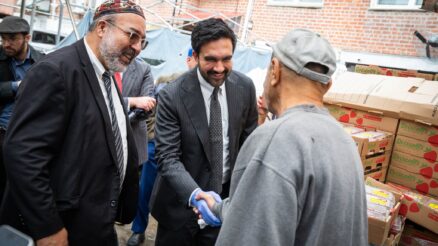
There are no comments yet
Why not be the first