
New Kids Community Schoolyards For Neighborhood Children, Sports, Exercise: In Manhattan Last Week, Brooklyn Later This Month
New Kids Community Schoolyards For Neighborhood Children, Sports, Exercise: In Manhattan Last Week, Brooklyn Later This Month
We previously covered the opening of a new schoolyard in Annadale on Staten Island. We asked the following questions of Trust for Public Land, in general about all of their community schoolyards:
-What is the turf made of? Is it natural or biodegradable?
-
Many configurations of artificial turf have been used but three general types are commonly used: one that uses infill for shock absorption on an aggregate base, one that uses infill for shock absorption on a hard base, and a third that uses a base pad for shock absorption.
-
Infill (also sometimes called top-dressing) can be made of a wide range of materials, including cork granules, coconut fibers, wood, walnut shells, natural or synthetic rubber particles, synthetic polymer beads, synthetic polymer foam particles, and sand. Rubber particles have been widely used for infill. Considerable research has shown that these particles—typically obtained by grinding up old tires—may contain toxic materials.
-
Researchers have differed on the extent to which these chemicals are taken up by children playing on artificial turf fields, and on the associated level of risk.
-
Due to these concerns, many governments now limit or ban the use of crumb rubber infill. TPL has not used crumb rubber infill in our projects for many years.
-Why is turf used instead of plants, such as native groundcovers?
-
Artificial turf has become a widely utilized surface in parks and schoolyards across the U.S., offering durability, reduced maintenance needs, and storm-water management benefits.
-
Artificial turf enables active play in settings where other surfaces may be impractical and is the most efficient multi-use intervention currently available for managing rainfall. By allowing water to flow through its surface and be detained in deep gravel-underlays, artificial turf reduces localized flooding and CSOs in communities with inadequate drainage infrastructure. Whether after a steady rain or a cloudburst event, artificial turf drains and dries much faster than grass fields – which typically turn to mud unless seasonally reseeded and rested — making it much more practical for year-round use in schoolyards with student populations in the thousands. In 2024, TPL published an in-depth analysis of the advantages, disadvantages, and considerations surrounding artificial turf in community spaces.
-
Ultimately, the decision to install artificial turf at schools and parks—like all major design decisions—belongs to the facility owner, be it a park department, city, school district or individual school. TPL is committed to sharing what we know with our community partners and design professionals and abiding by community decisions.
-Are there any native gardens or wild areas in the playgrounds?
-
Students are part of the design process and can vote on features they want to see included, such as garden beds and outdoor classrooms with tree cover.
-
TPL works to prioritize planting of native shrubs and trees.
-How is the rainwater captured or removed?
-
Many cities are trying to address neighborhood flooding by installing a combination of gray infrastructure like pipes and holding tanks, and green infrastructure like bioswales (heavily planted depressions in the soil). Community Schoolyards projects similarly deploy a number of water-capture strategies, from engineered soils and gravel beds beneath turf fields to roomy tree pits to rain gardens.
-
Artificial turf is highly pervious, meaning that stormwater can flow through the surface to a subsurface stormwater basin. Soil below artificial turf retains water during storm events and can be captured and held in underground storage to be redirected for alternative uses.
-
In New York City, our Community Schoolyards spaces capture an estimated 67 million gallons of stormwater a year, helping to prevent local flooding and combined sewer overflows.
-Are the trees planted native, and are they fruit or nut producing?
-
TPL prioritizes planting of native shrubs and trees. In NYC, we plant between 20 and 30 trees in every schoolyard we renovate.
-Do you add bee or butterfly attracting plants at any of the playgrounds you create?
-
Students are empowered to have a voice in the planning process so they can decide to create garden beds or outdoor classroom
-
Students at Alexander Adaire Elementary School in the Fishtown neighborhood of Philadelphia decided to design a schoolyard with a rain garden that attracts butterflies, trees, and an outdoor classroom to help teach students about nature and science.
-
At PS 41 in New Dorp, students designed a pollinator garden and to celebrate the opening of the schoolyard, released butterflies into the garden.
-Does your organization also create public playground spaces outside of school playgrounds?
-
Trust for Public Land works across the country to create parks and outdoor spaces for all, including community schoolyards, parks, and trails.
-
TPL has engaged hundreds of communities nationwide to advance the development of over 500 parks, putting a green space within a 10-minute walk of nearly 10 million people.
-
With help from our partners and supporters, TPL has created 350 community schoolyards and continue to lead the movement to transform our nation’s asphalt playgrounds into vibrant green spaces that are improving student education outcomes and community health and climate resilience.
Trust for Public Land Opens Vibrant New Community Schoolyard at The SEEALL Academy in Brooklyn
Trust for Public Land (TPL) today celebrated the grand opening of a newly revitalized Community Schoolyard at P.S. 180, The SEEALL Academy in Brooklyn. The project transforms what was once a worn, mostly asphalt playground into a vibrant, green, and welcoming space designed to benefit students during the school day and the entire neighborhood after hours.
The new schoolyard features a storm-water capturing turf soccer field, a running track, volleyball court and basketball practice hoops, colorful play equipment, an outdoor classroom, shade trees, gardens, and other permeable surfaces that reduce flooding and help cool the area. Designed with input from students, families, and educators, the schoolyard reflects the unique needs and character of P.S. 180 while offering opportunities for active play, creative learning, and quiet reflection. By continuing to keep the schoolyard open to the community during non-school hours, TPL ensures that this new green space serves not only the school but also thousands of residents who live in an area that has long lacked sufficient access to quality parks.
“Every child deserves a safe, welcoming place to play and learn outdoors, and today we are proud to deliver that for the students of P.S. 180 and the surrounding Brooklyn community,” said Tamar Renaud, New York State Director for Trust for Public Land. “This schoolyard is more than a playground—it’s a climate-smart community hub that will improve health, support learning, and bring neighbors together.”
This renovated schoolyard will provide over 28,000 residents with a park within a 10-minute walk, capture 1.7 million gallons of flood water a year, and the new 27 trees will provide cooling and shelter to families.
“As climate change threatens our city with stronger storms and more intense rains, we need to adapt and find new ways to relieve pressure on our sewers and keep our streets from flooding. Green Infrastructure playgrounds like the new one at P.S. 180 are crucial to our flood mitigation efforts,” said New York City Chief Climate Officer and Department of Environmental Protection Commissioner Rohit T. Aggarwala. “I’d like to thank our partners at Trust for Public Land for their hard work in transforming this site into a vibrant new community space, and all the students who helped design this wonderful new playground.”
The P.S. 180 schoolyard is part of Trust for Public Land’s nationwide initiative to reimagine school grounds as safe, healthy, and resilient green spaces. Across the country, TPL has transformed more than 350 schoolyards, creating dynamic outdoor spaces that boost student health and learning, reduce neighborhood heat, and absorb stormwater. Research has shown that access to green schoolyards can reduce stress, increase physical activity, improve focus in the classroom, and help close gaps in park equity—particularly in communities of color, where residents have access to significantly fewer parks than majority-white neighborhoods.
About Trust for Public Land
Trust for Public Land (TPL) is a national nonprofit that works to connect everyone to the benefits and joys of the outdoors. As a leader in equitable access to the outdoors, TPL works with communities to create parks and protect public land where they are needed most. Since 1972, TPL has protected more than 4 million acres of public land, created more than 5,504 parks, trails, schoolyards, and iconic outdoor places, raised $111 billion in public funding for parks and public lands, and connected nearly 9.7 million people to the outdoors. To learn more, visit tpl.org.

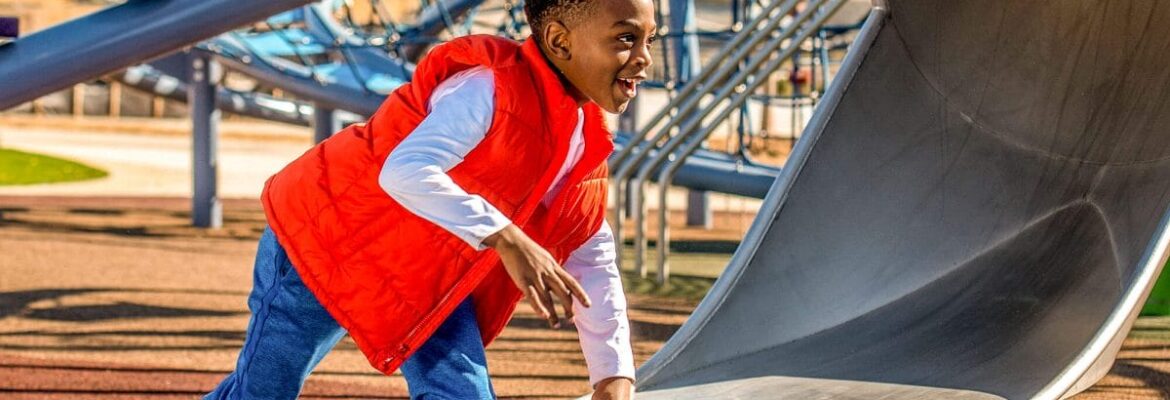
Banner Image: Kid at new playground. Image Credit – TPL

Trust for Public Land
The Trust for Public Land was founded in 1972 on the conviction that all people need and deserve access to nature and the outdoors, close to home, in the cities and communities where they live, as a matter of health, equity, and justice. While many conservation organizations set aside wildlands for biodiversity or habitat restoration, our founders sought to bring the benefits of parks and nature to the places, people, and communities that needed them most.
[…] Staten Island kids at I.S.7R also received a community schoolyard back in 2021, and there have been others opened in Manhattan and Brooklyn in recent years as well. […]