
OPINION: If Birth On American Soil (Or In New York Or Another State) Doesn’t Confer Citizenship, What Does? Multiple Views On Oral Arguments For SCOTUS Case
Below are several different opinions from organizations generally in support of the reading of the 14th Amendment that the SCOTUS Justices appear to be leaning toward (based on their expressed skepticism during oral arguments): it refers to birth on American soil as the prerequisite for citizenship. If being born on this soil does NOT confer citizenship, then what does? One generation? Two generations? 10 years? 10 months? Or, as the Executive Order determined, maybe not ever unless the parents are eventually granted citizenship? At this time, about 30-35 countries, primarily in the Americas, confer birthright citizenship. In European countries, citizenship is conferred based on the status of the parents and not where the child is born. Generally they must be born to parents that have been citizens for one or more generations. In the UAE, for example, in direct contrast to both the United States and Europe, almost no one who lives there is actually a citizen, since in that country it is based on nomination by royal courts or officials based on exceptional talent, investment, or long-term residency (often 30+ years). In other words, exceptional talent or a lot of money to invest in the country. We previously published CATO Institute’s view on this issue when the case was first brought.
The Supreme Court Should Affirm Birthright Citizenship
On his first day in office last year, President Trump signed Executive Order 14,160. That Order attempted to end birthright citizenship for children born in the United States to parents without permanent immigration status. Today, the Supreme Court will hear oral arguments in a case challenging the constitutionality of that order. And Cato has filed an amicus brief in support of the Order’s challengers, explaining how and why the Order contravenes the Fourteenth Amendment. The Court should affirm the lower court’s holding that the Order is unconstitutional.
The Fourteenth Amendment commands, “All persons born or naturalized in the United States, and subject to the jurisdiction thereof, are citizens of the United States and of the State wherein they reside.” The key debate in this case hinges on the meaning of the middle portion of that sentence: “subject to the jurisdiction thereof.”
The government argues that the phrase “subject to the jurisdiction thereof” in the Fourteenth Amendment requires that newborn children be subject to America’s political jurisdiction, not just regulatory jurisdiction. Political jurisdiction, in the government’s view, demands allegiance to the United States—and therefore domicile—for citizenship. The government argues that children of parents without permanent immigration status cannot be domiciled in the United States, so they are not born citizens.
But as our brief explains, this argument does not comport with the original public meaning of the Fourteenth Amendment. Contemporaneous definitions, writings of the time, and court precedent show that “subject to the jurisdiction thereof” only required that children be born under the United States’ authority (that is, be bound to follow US law). Because children of parents without permanent immigration status are under the authority of the United States and born in the United States, the Fourteenth Amendment grants them citizenship.
The ordinary public meaning of the text is corroborated by the Fourteenth Amendment’s purpose. In the past, the Court improperly limited this purpose in the Slaughter-House Cases (1873) and excluded those the Fourteenth Amendment meant to protect. We argue that this Court should avoid making that mistake again and affirm the broad purpose of the Fourteenth Amendment: to protect “all persons.” And the set of “all persons” includes the children of parents without permanent immigration status.
Our brief concludes with a rebuttal of another amicus brief in this case. Professor Ilan Wurman’s amicus brief provides an account of the common law of birthright citizenship and a purported application of originalism that pays insufficient attention to the Constitution’s original public meaning. We argue that a more faithful deployment of originalism cannot support Professor Wurman’s conclusions.
In the end, the Fourteenth Amendment guarantees citizenship to nearly all persons born in the United States, with exceptions far narrower than the Executive Order’s scope. The president cannot ignore, rewrite, or abandon that promise by executive order. The Supreme Court should affirm the judgment below and issue a judgment that respects the right of birthright citizenship that the Fourteenth Amendment guaranteed.
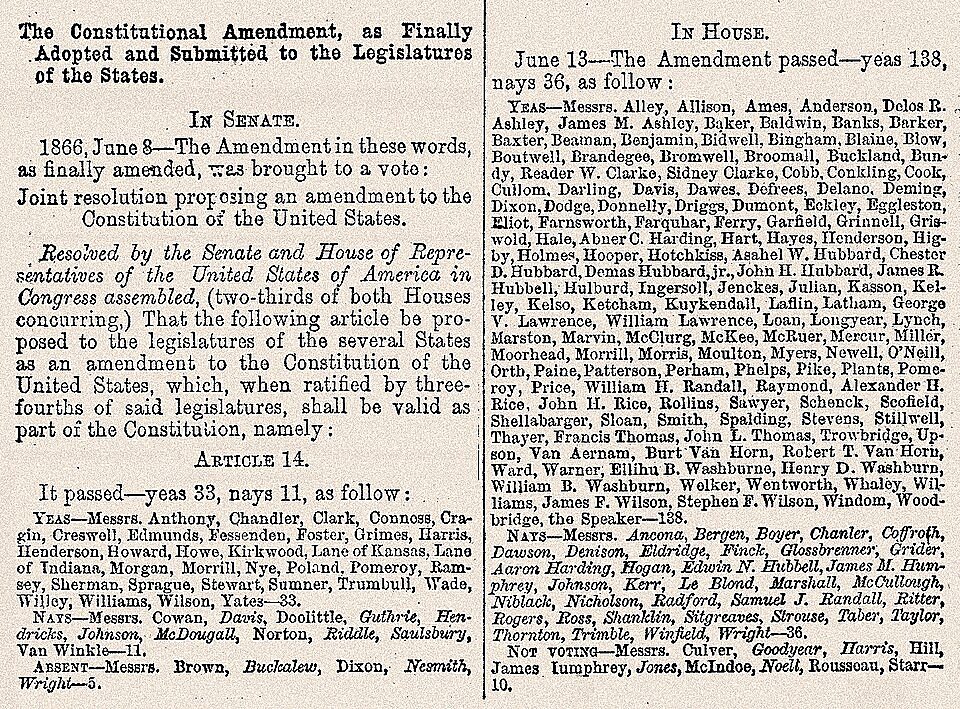
Full text of 14th Amendment. Image Credit – CATO Institute
Birthright Citizenship Shouldn’t Be Up for Debate
The text and history of the 14th Amendment are clear, yet the case is at the Supreme Court.
From the Brennan Center For Justice bby Michael Waldman
On Wednesday, the Supreme Court will hear a major constitutional case about birthright citizenship. We shouldn’t be debating this right now. But since the president chose to act with such striking disregard for the law, here we are.

Birthright citizenship is in the Constitution. The first sentence of the 14th Amendment reads, “All persons born or naturalized in the United States, and subject to the jurisdiction thereof, are citizens of the United States and of the State wherein they reside.”
This has been the law for more than 150 years. The amendment overturned the notorious Dred Scott decision, which said that even free Black Americans could not be U.S. citizens. The Supreme Court in 1898 confirmed the 14th Amendment’s plain meaning. In United States v. Wong Kim Ark, it ruled that children born here are citizens, even if their parents are not. That principle gave rise to generations of new Americans.
Donald Trump tried to Sharpie this out of the Constitution. A few hours after he took office, he signed an executive order purporting to deny citizenship to the children born here to non-U.S. citizens. Courts immediately ruled against the White House. Last summer, the Supreme Court stopped individual judges from issuing such nationwide orders, but it left open the possibility of class action lawsuits. Hence Trump v. Barbara, brought by the American Civil Liberties Union.
This is open and shut. Con law for dummies.
Grasping for arguments, Trump’s lawyers landed on this: The 14th Amendment’s “one pervading purpose” was to protect the children of former slaves, not anyone else. That reading puts aside the clear language of the amendment, along with a century and a half of history and tradition. It’s historical fan fiction, designed to appeal to an “originalist” Court.
Historians Martha Jones and Kate Masur, a member of the Brennan Center’s Historians Council, corrected the record in a key amicus brief. “When the Framers wrote birthright citizenship into the Constitution, they were not addressing only the status of former slaves,” they explained. “They were also remedying the eight decades of injustice imposed upon free people born in the United States, among them free Black Americans, including those who had never been enslaved.” What’s more, the historians note, “The Framers well understood that the Amendment’s broad terms would recognize and protect the citizenship status of the children of immigrants.”
One echo throughout history: We’ve seen the arguments against birthright citizenship before, and they were born of nativism and made by racists. In our Countering Originalism handbook, we call this a “negative precedent.” “Negative,” as in “really ugly.”
Our constitutional rights in 2026 should not just have to rely on the goings-on during the 1860s, when the amendment was drafted. For 150 years, hundreds of thousands of children born in the United States to noncitizen parents have proudly grown up as American citizens.
It’s an open-and-shut case, as I said. So why is this case happening at all?
Because Trump is forcing the issue. And the case offers a depressing window into how the Supreme Court helps drive, ratify, and legitimize extremist arguments. It has fired up an originalist-industrial complex to concoct historical evidence to buttress unjustifiable outcomes.
Trump didn’t dare do this during his first term. But after his “shock and awe” barrage of executive orders at the start of his second term, conservative scholars suddenly had to find it plausible, intriguing, worth a second look. Two top professors, Randy Barnett and Ilan Wurman, suddenly discovered a “puzzle” to solve. “Trump might have a case on birthright citizenship,” they found a way to write.
“A lot of people, when Trump first started talking about it, thought this is crazy,” conservative scholar John Yoo told The New York Times. Yoo thought Barnett and Wurman’s argument too, ahem, tortured, and instead made “the originalist case for birthright citizenship.” The vast majority of scholars agree.
I think the Court is highly likely to reaffirm birthright citizenship. But who knows? I thought it likely the Court would allow criminal prosecutions of former presidents, which is similarly anticipated in the Constitution. Here, the case is even clearer, since the law has affected the lives of so many people before now.
The willingness to chuck aside precedent as well as logic is a hallmark of the Roberts Court. This term, we brace for a demolition of the Voting Rights Act, a further grant of vast power to presidents (this time allowing them to command expert federal agencies that were made independent by Congress), and another ruling to undermine campaign finance rules. The Court stood up to block the unilateral imposition of tariffs and has shown some backbone on other emergency powers cases. But overall, bit by bit, it continues its project to remake the country.
As for birthright citizenship, it is one of the crown jewels of the U.S. Constitution. For a century and a half, the nation’s promise was that anyone born here, however humble their circumstances, is an American. Let’s hope the Court upholds that cherished principle. And let’s shake our heads at the fact that it has to.
U.S.-style birthright citizenship is uncommon around the world
The 14th Amendment to the U.S. Constitution says that “[a]ll persons born or naturalized in the United States, and subject to the jurisdiction thereof, are citizens of the United States and of the State wherein they reside.”
That broad language, granting U.S. citizenship automatically to virtually anyone born in the country, is now under challenge. The Supreme Court is considering whether President Donald Trump can, by executive order, limit “birthright citizenship” to children born in the U.S. to citizens or legal permanent residents.
Since a landmark 1898 Supreme Court decision, courts have generally held that the 14th Amendment covers everyone except children of foreign diplomats, members of occupying foreign forces or members of Native American tribes. Congress extended birthright citizenship to Native Americans by statute in 1924.
Thirty-two other countries around the world, most of them in the Western Hemisphere, have birthright citizenship laws that are substantially similar to the U.S., according to a Pew Research Center analysis. Another 50 or so countries have more limited variations of birthright citizenship.
This analysis examines the many ways that countries decide who is and isn’t a citizen and who can and can’t become one. It’s based on a dataset of national citizenship laws compiled by the Global Citizenship Observatory, a research project at the European University Institute’s Robert Schuman Centre for Advanced Studies.
Many countries have more than one way of acquiring citizenship, or different rules for different groups, so the categories discussed below can and sometimes do overlap.
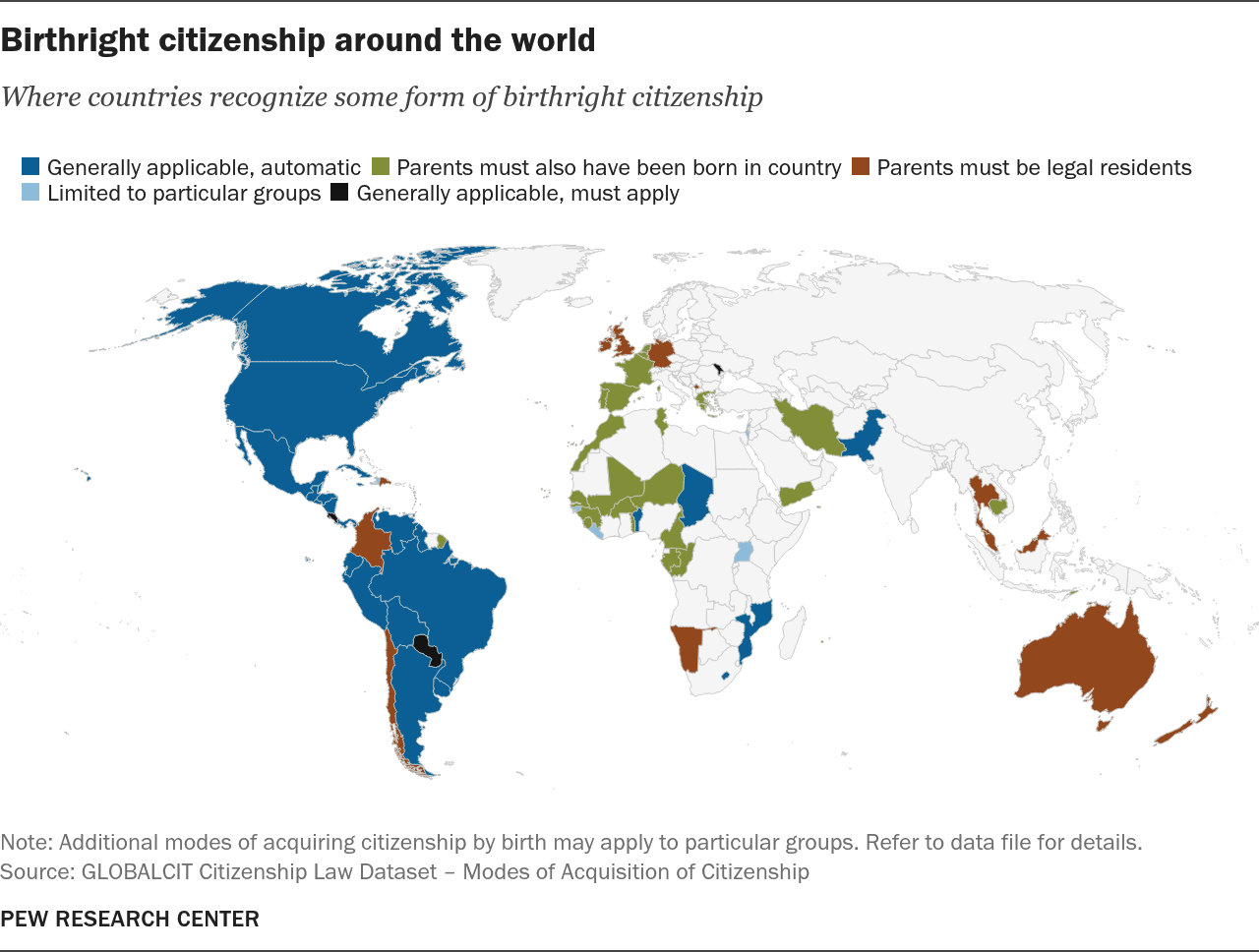
Many ways to gain citizenship by birth
In most countries, citizenship at birth is primarily determined by descent – that is, by the citizenship status of the parents. Most countries in the EUI dataset (156 out of 191) automatically confer citizenship on newborns within their territory only if one or both parents are citizens.
In 59 countries, at least some people can become citizens simply by being born there. In 52 of those countries, citizenship is acquired automatically. In the others, parents must apply for their children to be declared citizens, and officials have varying degrees of discretion in whether or not to approve those applications.
However, many countries restrict who can benefit from birthright citizenship. In 17 of the 59 countries mentioned above, citizenship isn’t extended automatically to children of noncitizen parents unless the parents are living in the country legally. In six other countries, birthright citizenship only applies to members of particular racial, ethnic or religious groups. (Guinea-Bissau, for instance, extends it only to children whose parents are citizens of a Portuguese-speaking country.)
That leaves 33 countries, including the U.S., where birthright citizenship is automatic and generally applicable regardless of the parents’ legal status.
There’s another group of 26 countries (including five of the ones mentioned above) that require two generations of in-country birth for birthright citizenship. That is, a child born in the country must also have one or both parents who also were born in that country, even if the parents never became citizens themselves. Nearly half (11) of these “second-generation” countries also restrict eligibility by parental residency status, gender or membership in a particular group.
Drew DeSilver is a senior writer at Pew Research Center.
DeSantis weighs in on SCOTUS birthright citizenship case: ‘Cheapens the process’
As the nation’s highest court weighs whether to greenlight Trump’s citizenship ban for certain U.S.-born babies, Gov. Ron DeSantis argued Wednesday that traveling to America to give birth “cheapens” the constitutional right to birthright citizenship.
“I don’t think [Reconstruction-era lawmakers] intended someone to just come here on a visit who’s foreign, have a kid, then go back, and then that kid becomes an American citizen,” DeSantis said during a press conference in The Villages. “That kind of cheapens the process when you make it a tourist thing.”
He referenced a new Pew Research study finding that 9% of U.S. births in 2023 were to mothers either illegally in the country or with temporary legal status.
“Is that something that we think is good for this country? I just don’t think that’s anyway that you run a successful republican system of government,” DeSantis said.
His comments coincided with U.S. Supreme Court arguments over whether President Donald Trump’s executive order revamping birthright citizenship guarantees is lawful.
Signed on his second day in office — and immediately blocked by the courts — the order would limit birthright citizenship to babies born to at least one parent who is a citizen or permanent resident.
Under this order, babies would not have U.S. citizenship if their parents are illegally in the country or only have temporary legal status.
This would be a massive upheaval for the 14th Amendment, which houses the clause that guarantees citizenship to those born in the United States.
“All persons born or naturalized in the United States, and subject to the jurisdiction thereof, are citizens of the United States,” the clause reads. It doesn’t apply to children of ambassadors or hostile invaders.
‘Quirky’ argument?
The Trump administration’s argument hinges on points ranging from the “jurisdiction thereof” provision, the clause’s carve out, and the origins of the amendment.
They argue that those illegally in the nation, or without permanent status, do not owe complete allegiance to the United States. To be subject to U.S. jurisdiction, parents must have a permanent home in the country, they say.
But Supreme Court justices on Wednesday expressed skepticism about some of these arguments. Chief Justice John Roberts said that expanding the carve out to children of undocumented immigrants struck him as “quirky,” CNN reported.
“Then you expand it to the whole class of illegal aliens who are here in the country,” Roberts said. “I’m not quite sure how you can get to that big group from such tiny and sort of idiosyncratic examples.”
The administration — along with DeSantis — also argues that the authors of birthright citizenship didn’t intend them to apply to modern immigration practices.
“The purpose was to clarify that Dred Scott should have won that case, and that he, as well as all the former slaves, were citizens of the United States,” DeSantis said Wednesday. “But then that has now been applied in ways that the framers of that provision would have never contemplated.
“Coming to America was a big in deal in 1865, 1866. You couldn’t just hop on a plane and get here, stay three weeks, and hop on a plane and go back to foreign countries. That wasn’t the way it worked,” he continued. “And so they weren’t thinking in terms of people flooding in in violation of the law.”
He added that it although the court may not rule in favor of the administration, DeSantis hopes “we’ll get some analysis because they really haven’t ever addressed this specific question.”
Supreme Court’s Decision on Birthright Citizenship Will Depend on Its Interpretation of One Key Phrase
An expert examines the arguments from both sides.
The Supreme Court on April 1, 2026, will hear oral arguments in Trump v. Barbara, the case that challenges the Trump administration’s efforts to bar the children of immigrants without legal status from birthright citizenship by reinterpreting the terms of the 14th Amendment.
In January 2025, President Donald Trump issued an executive order removing the recognition of citizenship for the U.S.-born children of both immigrants here illegally and visitors here only temporarily. The new rule is not retroactive. This change in long-standing U.S. policy sparked a wave of litigation.
When the justices weigh the arguments, they will focus on the meaning of the first sentence of the 14th Amendment, known as the citizenship clause: “All persons born or naturalized in the United States, and subject to the jurisdiction thereof, are citizens of the United States and of the State wherein they reside.”
Both sides agree that to be granted birthright citizenship under the Constitution, a child must be born inside U.S. borders and the parents must be “subject to the jurisdiction” of the United States. However, each side will give a very different interpretation of what the second requirement means. Who falls under “the jurisdiction” of the United States in this context?
As a close observer of the court, I anticipate a divided outcome grounded in strong arguments from each side.
Arguments for automatic citizenship
Simply put, the argument against the Trump administration is that the 14th Amendment’s expansion of citizenship after the eradication of slavery was meant to be broad rather than narrow, encompassing not only formerly enslaved Black people but all persons who arrived on U.S. soil under the protection of the Constitution.
The Civil War amendments — the 13th, 14th, and 15th — established inherent equality as a constitutional value, which embraced all persons born in the nation without reference to race, ethnicity, or origin.
One of the strongest arguments that automatic citizenship is the meaning of the Constitution is the long-standing practice. Citizenship by birth, regardless of parental status — with few exceptions, has been the effective rule since the time of America’s founding.
Advocates also point to precedent: the landmark case of United States v. Wong Kim Ark in 1898. When an American-born descendant of resident noncitizens sued after being refused re-entry to San Francisco under the Chinese Exclusion Act, the court recognized his natural-born citizenship.
If we read the Constitution in a living fashion — emphasizing the evolution of American beliefs and values over time — the constitutional commitment to broad citizenship grounded in equality, regardless of ethnicity or economic status, seems even clearer.
However, advocates must try to convince the court’s originalists — Clarence Thomas, Samuel Alito, Neil Gorsuch, Brett Kavanaugh, and Amy Coney Barrett — who read the Constitution based on its meaning when it was adopted.
The originalist argument in favor of birthright citizenship is that the phrase “subject to the jurisdiction” was meant to invoke only a small set of exceptions found in traditional British common law. In the Wong Kim Ark ruling, the court relied on this “customary law of England, brought to America by the colonists.”
One exception to birthright citizenship covered by this line of rulings is the child of a foreign diplomat, whose parents represent the interests of another country. Another exception is the children of invading foreign armies. A third exception discussed explicitly by the framers of the 14th Amendment was Native Americans, who at the time were understood to be under the jurisdiction of their tribal government as a separate sovereign. That category of exclusion faded away after Congress recognized the citizenship of Native Americans in 1924.
The advocates of automatic birthright citizenship conclude that whether the 14th Amendment is interpreted in a living or in an original way, its small set of exceptions does not override its broad message of citizenship grounded in human equality.
Opposition to birthright citizenship
The opposing argument begins with a simple intuition: In a society defined by self-government, as America is, there is no such thing as citizenship without consent. In the same way that an American citizen cannot declare himself a French citizen and vote in French elections without consent from the French government, a foreign national cannot declare himself a U.S. citizen without consent.
This argument emphasizes that citizenship in a democracy means holding equal political power over our collective decisions. That is something only existing citizens hold the right to offer to others, something which must be decided through elections and the lawmaking process.
The court’s ruling in Elk v. Wilkins in 1884 — just 16 years after the ratification of the 14th Amendment – endorses “the principle that no one can become a citizen of a nation without its consent.” By making entry into the United States without approval a federal offense, Congress has effectively denied that consent.
Scholars who support this view argue that the 14th Amendment does not provide this consent. Instead it sets a limitation. To the authors of the 14th Amendment, “subject to the jurisdiction thereof” conveyed a limit to natural citizenship grounded in mutual allegiance. That means if people are free to deny their old national allegiance, and an independent nation is free to decide its own membership, the recognition of a new national identity must be mutual.
Immigrants living in the United States illegally have not accepted the sovereignty of the nation’s laws. On the other side of the coin, the government has not officially accepted them as residents under its protection.
Over 150 years ago, with the embers of the Civil War still smoldering, members of Congress gathered to write the 14th Amendment. In its very first clause they wrote a single, straightforward sentence: “All persons born or naturalized in the United States, and subject to the jurisdiction thereof, are citizens of the United States and of the State wherein they reside.” In the generations since, this basic rule has been acknowledged to be as simple as it seems on its face; under the 14th Amendment, subject to only narrow exceptions, any person born in the United States is a citizen, no matter their parents.
President Trump wants to ignore all that. In January 2025, he issued an executive order which instructed the federal government to deny citizenship to any child born to parents who were neither citizens or lawful permanent residents (people with green cards). This executive order was swiftly blocked in every single court that heard a case against it. Today, the Supreme Court heard oral arguments in Trump’s final attempt to revive this effort to rewrite the accepted understanding of the 14th Amendment — and the justices sounded deeply skeptical of the Trump administration’s position.
The first major test of the simple words in the 14th Amendment came 30 years after it was drafted, at the height of anti-Chinese sentiment. In 1895, Wong Kim Ark, a young man born in San Francisco to Chinese immigrant parents — who were, under existing U.S. law, ineligible ever to become citizens themselves — returned to the United States after a short trip to China. On his return, a customs inspector in San Francisco refused to admit him and detained him instead. In a historic parallel to the Trump admin’s efforts to narrow the 14th Amendment, this government decision came after years of lobbying by anti-Chinese advocates who argued that children born to Chinese parents were “at the moment of birth subject to a foreign power” and therefore not covered by the 14th Amendment.
This 19th century effort to rewrite the 14th Amendment to exclude children of immigrants failed. A judge released Mr. Wong soon after, and in 1898, the Supreme Court affirmed in a landmark 6-2 decision that the plain text of the 14th Amendment meant what it said; all persons born in the United States are U.S. citizens, unless they fall within one of the narrow exceptions; children of diplomats who receive diplomatic immunity, children born to hostile soldiers of an occupying army, or children born to sovereign Native American tribes). Anyone else can gain citizenship at birth only through laws passed by Congress (for example, Congress made Native American birthright citizens in 1924).
This understanding of the law has persisted for 125 years, and during oral arguments on Wednesday, the Supreme Court expressed significant concerns with the Trump administration’s attempt to replace it with its own preferred interpretation.
President Trump’s Department of Justice resurrected a legal theory which was relegated to the legal fringes after its defeat in the Wong Kim Ark case over 100 years ago. Specifically, the Trump administration argues that to be “subject to the jurisdiction” means to be within the full “political” jurisdiction of a nation. Thus, in their view, the babies of undocumented immigrants and any lawfully present immigrants without green cards are not entitled to birthright citizenship, because their parents’ presence in the country is either temporary or banned.
During oral arguments, the government, represented by Solicitor General John Sauer, claimed that the drafters of the 14th Amendment sought only to offer birthright citizenship to children of enslaved people who for years had been denied citizenship under the pre-Civil War Dred Scott decision, in which the Supreme Court held that children of enslaved people born in the United States were not citizens by birth.
Sauer argued that the drafters of the 14th Amendment deliberately steered the United States away from the prevailing common-law rules of birthright citizenship that pre-dated the Dred Scott decision and instead aimed to limit birthright citizenship only to those whose parents were legally “domiciled” in the United States.
Domicile is a legal term; generally, it refers to someone’s intent to live somewhere permanently. Sauer argued that people living in the United States with nonimmigrant visas and undocumented immigrants who are in violation of civil immigration laws cannot legally become “domiciled” because their long-term presence is restricted by law, and therefore, their children should not acquire citizenship at birth in the United States.
This position was met with pushback, including from the more conservative justices. Chief Justice Roberts, the second justice to weigh in, suggested that the Trump administration’s arguments were “quirky,” and that the exceptions they were trying to carve out didn’t seem to follow from the exceptions that the Supreme Court acknowledged in Wong Kim Ark. When Sauer later argued that modern policy reasons like “birth tourism” justified a restriction on birthright citizenship, Roberts quipped, “It’s a new world, [but] it’s the same Constitution.”
Throughout his time at the lectern, Sauer also faced skepticism from Justice Gorsuch, who said that it was “striking” to him how infrequently the concepts of allegiance and domicile — the keys to Sauer’s arguments — were discussed during the congressional debates around the 14th Amendment. Gorsuch later drew attention to a lecture by Justice Marshall Harlan — years after he dissented in Wong Kim Ark — in which he expressly said that the court’s ruling in the case covered temporary visitors to the United States.
While most of the debate focused on the Trump administration’s claim that parents had to be “domiciled” for their children to acquire citizenship at birth, justices also pressed the government on the practical ramifications. Justice Barrett asked how babies dropped off at hospitals without any knowledge of who their parents are would be covered under the government’s rule, and seemed unsatisfied with the government’s response that the baby would be a citizen thanks to a law passed by Congress, asking “Yeah, but what about the Constitution?” Justice Jackson also asked Sauer to explain how it would be determined at birth whether a child was a citizen or not, with Sauer responding that Social Security systems would make a first determination and if any parent believed a mistake was made, they could sue.
Only Justice Alito seemed to openly support the government’s position, pushing Cecillia Wang of the ACLU on the fact that the Wong Kim Ark decision mentions domicile over 20 times. In response, Wang argued that this was limited to the facts of the case. Justice Jackson also pointed out that the repeated references to Wong’s parents as having been domiciled in the country may have been an effort by the justices to assuage fears of many Americans at the time who held anti-Chinese attitudes and believed no Chinese person could ever assimilate.
While the justices asked tough questions of both sides, more of them appeared skeptical of the government’s position. Justice Kavanaugh opined that he might agree as a policy matter that children of undocumented immigrants should not be birthright citizens, but also noted that other countries’ practices don’t directly impact U.S. law, and agreed that if the Court were to accept the traditional understanding of Wong Kim Ark — in line with the general principle of letting precedent stand — then “this is a short opinion.” (That line got a laugh from the audience.)
If the Supreme Court were to agree with President Trump’s theories, the ramifications would be severe. Every year, hundreds of thousands of children are born to undocumented immigrants and people present on nonimmigrant visas (such as H-1B visas). These children would no longer be citizens. Some might even be rendered stateless, depending on the status of their parents. Without citizenship, they would be born undocumented and even potentially deportable immediately on birth. This would even be true of children born to parents here lawfully on nonimmigrant visas, as immigration status does not pass down at birth and their parents would have to file new paperwork to get a visa for their baby. This could create a permanent American underclass of millions of immigrants.
The impacts would be felt by American citizens as well. After every birth, parents would have to gather their own paperwork and prove their own citizenship or immigration status to the federal government to have their child registered as a citizen. No longer would a birth certificate be the sole proof necessary. And the status of tens of millions of American citizens born since the 14th Amendment passed would also be thrown into question. After all, even though President Trump’s executive order itself only applied to people born after it went into effect — and the solicitor general denied that the administration was trying to strip existing citizens of their status — if the Supreme Court were to rule that the 14th Amendment didn’t cover them, they would be legally vulnerable to a future policy change.
For those who don’t want to see this parade of horrible come to pass, the justices’ skepticism of the administration’s arguments this morning was heartening — although nothing is certain with the Supreme Court, and oral arguments don’t always reflect the direction the court ultimately takes (a decision is expected by the end of June). But for many, the fact that this topic was even up for debate was itself a danger to basic constitutional rights, and a sign of how far the Trump administration wants to go in its war on immigrants.
Banner Image: US Constitution exhibit. Image Credit – National Archives Foundation


Staten Islander News Service Staff Writer
This byline indicates that this article was penned by a member/members of the Staten Islander News Organization office team. Our staff writers are the backbone of our newspaper, performing all sorts of important tasks like conducting interviews, investigating leads, besides writing the news stories you see.
There are no comments yet
Why not be the first