

America At 250: The New York Campaign With Staten Island As British Staging Ground
America 250: The New York Campaign With Staten Island As British Staging Ground
By Duncan Hennes
Editor’s note: Readers interested in a dramatization of this period made to celebrate America’s anniversary can learn about A Great Awakening, a film about the partnership between Benjamin Franklin and George Whitefield in 1770. NYC TLC unveiled a 250th anniversary commemorative medallion for NYC yellow cabs.
Staten Island, 1776
On this day 250 years ago the British invaded Staten Island.
It was a clear and crisp Saturday morning on June 29, 1776 when white specs appeared suddenly on the horizon. Ones and twos turned into dozens of full sails rounding in from the Atlantic. Lookouts on Staten Island and Long Island signaled to their counterparts on Manhattan, who sounded the alarm. Church bells rang in warning. George Washington’s batteries fired at the gathering fleet, but with little effect. Women and children dashed up Broadway for safety as horses brayed and carts toppled in the uproar.
“In a matter of hours, forty-five ships had dropped anchor inside Sandy Hook in the Lower Bay,” author and historian David McCullough wrote in his seminal book, 1776. “By sunset the enemy ships numbered more than one hundred.”
A Pennsylvania rifleman surveying the scores of masts and spars stated, “I declare that I thought all London was afloat.”

Ships in harbor. Image Credit – NYPL
Two hundred ships and thirty-two thousand British soldiers and their Hessian mercenaries made the journey to New York. It was the largest expeditionary force ever launched by Britain—or any nation—up until that point in history, and their aim was to quash the American Revolution.
The New York Campaign had begun.
Initial Joy
Staten Islanders on the whole were elated by the sight of the Royal Navy. Longstanding Crown grants had established an society of landholders on Staten Island. In addition to the sprawling manors bestowed upon the Billopps and Dongans, the Royal Governor of New York had granted 80-acre parcels to 166 farming families. These people had a stake in the New World. They toiled alongside enslaved hands, with the hopes of someday passing on their land and property to their children. Revolution threatened their way of life.
The Island’s patriarchs welcomed their red-coated brethren at the shoreline and invited the officers to dine in their homes. Posturing and self-serving, perhaps, but there was real relief in the sight of the scarlet and gold uniforms. British order had been restored.
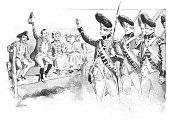
Source: “A Loyal Little Red-Coat: A Story of Child-life in New York a Hundred Years Ago,” by Ruth Ogden and illustrated by H.A. Ogden. Illustration titled, “British Redcoats Waving to American Loyalist Children”

For the British and Hessian soldiers, the warm feelings were mutual. The year of 1775 had been unkind to them. Lexington and Concord, Bunker Hill, Boston—at each turn, British troops were harassed, starved, and exposed to frigid temperatures. They had endured relentless fire marching from Lexington and Concord, withstood point blank volleys at Bunker Hill, and—worst of all—spent a winter in Boston.
From Boston, the British retreated to the balmy shores of Nova Scotia. More cold, more misery. It had been a lost year.
By comparison, and by any standard, Staten Island in the summer was a haven. Fresh meat and produce and a kind populace made the island the next best thing to home—likely better. And with each meal and night of sleep, the British grew more confident in the prospects of victory.

Map source: Library of Congress
Before the British, First the Americans
General George Washington had arrived with his army months before the British to prepare the city’s defenses. The task was nearly impossible. With her deep waterways, New York was a mariners’ dream and, conversely, a nightmare for the Continental Army, which had no navy.
Staten Island was vital to Washington’s preparations. In February 1776, he issued orders to drive all livestock and cattle from the island to New Jersey to avoid their capture by the enemy. Staten Islanders delayed and stalled the execution of the orders, using local committees to bog down the business until the British could arrive. Further urgent orders were issued in July 1776, but by then it was too late—the British landings had begun. The Continental Army had seized approximately 400 heads of cattle, but the vast majority of the island’s resources fell into British hands. To add insult to injury, Washington’s efforts had only served to enrage the local populace and push them further into the Loyalist camp.

Source: Jasper Francis Cropsey, “The Narrows from Staten Island,” 1868, oil on canvas, Amon Carter Museum of American Arts
Quartering and Billeting
Housing shortages became clear immediately after the British’s arrival. Staten Island’s population ballooned from 4,000 pre-war to 36,000 in a matter of weeks. Where to put all of these soldiers?
The British established posts on the island’s hilltops and around ferry landings; however, these garrisons consumed only a small portion of the sprawling army. The rest of the 32,000 British and Hessians stayed in tents, homes, inns, and taverns. An officer guided by a local Loyalist wrote in chalk on people’s front doors the number of soldiers each house could hold, usually between 10-20. Bunks were built in kitchens and front rooms of the homes.

Source: “A View of the Camp at Cox Heath, near Maidstone in Kent,” 1778, National Army Museum
Officers had better accommodations. They occupied full rooms or entire homes. General Howe, commanding officer, made his headquarters in a private home on the Kill Van Kull on the north end of the island.
Staten Islanders’ experiences housing soldiers depended upon the character of the individual soldiers staying within their four walls. Privacy was a memory. On the flip side, friendships were borne and courtships pursued. For good or bad, the war had reached their homes.
While most of the 32,000 troops departed after a couple of months to fight in Brooklyn, Manhattan, and White Plains, a rear garrison of approximately 1,500 troops remained on Staten Island for seven long years.
Conduct Unbefitting of Gentlemen—the Turning of the Tide
A point of historical contention is how Staten Island women fared under the occupation. In the summer of 1776, there were 34,000 men on the island, including 24,000 British soldiers, 8,000 Hessian mercenaries, and 2,000 Staten Island men and boys. Women were outnumbered 34,000 to 2,000—a ratio of 17:1.

Source: National Park Service
British orders from on high were to treat the populace with the upmost respect, but these orders at times fell upon deaf ears. As told by Lord Rawdon, a British officer:
The fair nymphs of this isle are in wonderful tribulation, as the fresh meat our men have got here [in Staten Island] has made them riotous as satyrs. A girl cannot step into the bushes to pluck a rose without running the most imminent risk of being ravished, and they are so little accustomed to these vigorous methods that they don’t bear them with the proper resignation, and of consequence we have most entertaining courts-martial every day.
Author and historian McCullough wrote that “the courts-martial were themselves proof that such conduct was no laughing matter to the British command.” Philip Papas countered in his book, That Ever Loyal Island: Staten Island and the American Revolution, that British abuses eroded loyalist sentiment and were key to turning the populace towards the cause of liberty.
Whatever justice was delivered was presumably cold comfort to the women who were raped and abused. Additional atrocities likely went unreported out of shame or fear of retaliation.
Local Spies
Families such as the Billopps, Seamans, Dongans, Connors, and Cortelyous supported the British. Some were true believers, while others were pragmatic—their wealth and status depended on British victory. Aaron Cortelyou, of present-day Cortelyou Avenue, was a British spy.
There were, however, rebel souls who counted themselves as patriots. Brothers Joshua and John Mersereau ran the Mersereau Spy Ring. Under cover of supplying the British army, the men led a ring of collaborators collecting information on troop numbers, positions, and strong points across Staten Island. John La Grange, a key member of the ring, delivered information by boat across the Arthur Kill to the Continental Army in New Jersey. Le Grange towed the information in a bottle tied with string to the stern of his boat, which could be cut if he were discovered.

Source: Judge Joshua Daniel Mersereau IV. Painting found in the Tioga Co. Historical Society Wellsboro, PA.
According to the National Park Service, the Mersereau Ring also played a role in uncovering turncoat Benedict Arnold. A member of the Ring identified the fake alias being used by British spymaster Major John Andre, who was coordinating with Benedict Arnold to surrender West Point. Major Andre was arrested and West Point—and perhaps the cause—was saved.
Victory
New York was Britain’s last stronghold in the American colonies. In 1783, seven years after they had first landed, the defeated British sailed for home.
Staten Islanders had their island and homes back, but much had changed. Families who supported the British cause had their properties confiscated; many left with the British for England or Canada. Those who remained had paid the price for freedom.
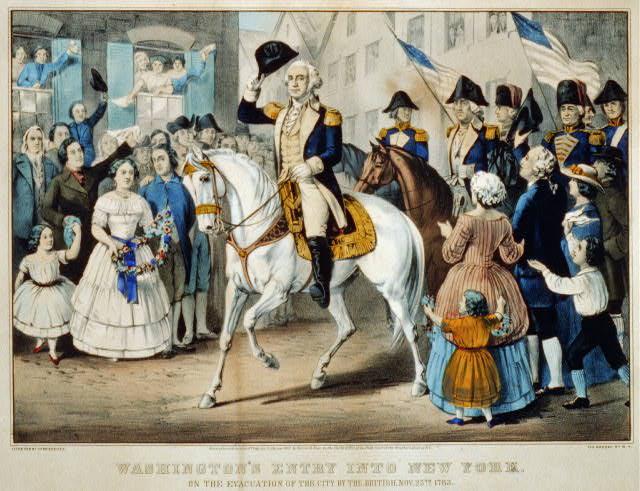
Source: Washington’s entry into New York: on the evacuation of the city by the British, Nov. 25th. 1783 by Currier & Ives, c. 1857, hand-colored lithograph, Library of Congress.
On the eve of our nation’s 250th anniversary, we can give tribute to our Staten Island forefathers who subverted the British occupation and fought for liberty. Many heroes’ names have been lost to history, but we can honor their legacy. We can remember their sacrifices and be grateful.
Banner Image: Washington’s entry into New York: on the evacuation of the city by the British, Nov. 25th. 1783 by Currier & Ives, c. 1857, hand-colored lithograph, Library of Congress



Duncan Hennes
Duncan Hennes is the author of Whispers of Liberty, a historical fiction novel about a Staten Island revolutionary spy, set to be published in January 2027.
There are no comments yet
Why not be the first