

Employee-Retention Tax Credit About To Expire January 31 – Rep. Malliotakis Urges Qualified Businesses To File As Tax Bill Works Through Congress
Q-Would the representative know if there are any bills planned to continue funding for this program (ERTC) past the January 31st deadline, or what the chances are that it will be left in the tax code?
A-The discontinuation of the ERTC has been negotiated as part of the bipartisan & bicameral Tax Relief for American Families and Workers Act, so if that bill is signed into law (which they are aiming to do before tax season), then any claims filed after Jan. 31 would not be considered.
Q-Also, what are the dates to which the program applies? Did it stop in 2021, or are there still businesses able to claim the credit into 2023?
- The bottom 20 percent of earners (those with incomes under $26,000) saw their federal tax rate fall to its lowest level in 40 years.
- Americans earning under $100,000 on average saw their taxes reduced 16 percent.
- Wages increased 4.9 percent in 2018 and 2019 – the fastest two year growth in real wages in 20 years.
- Unemployment and poverty rates hit a 50 year low, including all-time lows in unemployment for African Americans, Hispanic workers and those without a high school degree.
- The Child Tax Credit lifted 4.3 million people, including 2.3 million children, above the poverty line in 2018.

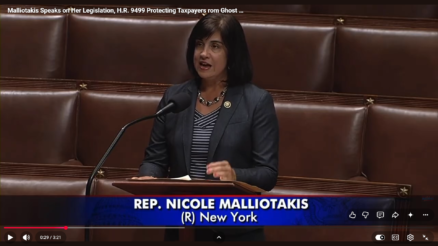

Congresswoman Nicole Malliotakis
Congresswoman Nicole Malliotakis was sworn in on January 3, 2021 to represent Staten Island and Southern Brooklyn. Prior to serving in the U.S. House of Representatives, Congresswoman Nicole Malliotakis was elected to the New York State Assembly on November 2, 2010, defeating a two-term incumbent. In the Assembly, she served as Minority Whip and the ranking minority member of the Assembly Committee on Governmental Employees. For five terms, Congresswoman Malliotakis fought to restore ethics in Albany, expand transit service in her district, improve programs for senior citizens, reform education and improve New York’s economic climate by reducing the tax burden on small businesses and residents. A cornerstone of her tenure was helping her community recover and rebuild following the devastation of Hurricane Sandy in 2012. In addition to advocating for these same issues in Washington, Congresswoman Malliotakis is acutely focused on securing New York’s fair share of federal mass transit funding, which would go towards expanding transportation services and easing traffic congestion, while also championing public safety by supporting our nation’s law enforcement officers. Congresswoman Malliotakis is the daughter of immigrants, her father from Greece and her mother a Cuban exile of the Castro dictatorship. She is currently the only Republican member representing New York City in Congress, representing a district spanning the boroughs of Brooklyn and Staten Island. She is a passionate advocate for animal rights and the strengthening of animal cruelty laws, and in her spare time, enjoys spending time with her chihuahua, Peanut.
There are no comments yet
Why not be the first