
New East River Park Ballfields, Delancey St Bridge As Part Of ESCR; Commissioner Caban Resigns; Opioid Prevention, Treatment Annual Budget Increased To $50M Due To New Settlement; Flood Mitigation Strategies: NYC Mayor
MAYOR ADAMS OPENS NEW EAST RIVER PARK BALLFIELDS, DELANCEY STREET BRIDGE AS PART OF EAST SIDE COASTAL RESILIENCY
ESCR Will Protect 120,000 New Yorkers from Flooding by 2026 Completion Date — On Time and On Budget
WATCH: Overnight Installation of New Delancey Street Bridge
Q: Is the bridge a direct part of the flood mitigation strategy?
A: The bridge doesn’t serve any flood control function, it’s just a better way for people to get across the FDR Drive.
Q: Do the flood gates have flashing lights and/ or make noise when they’re activated? And do they have sensors, like on garage doors, for example, to ensure they don’t close when something is in the way?
A: No. They’re required to have people observing them at the location when they’re operated. They’re not remote controlled.
To give you an idea, this is what one of the “smaller” swinging gates looks like. This one is 42-feet long and weighs 16 tons:
https://www.nyc.gov/site/ddc/about/press-releases/2023/pr-053123-Stuyvesant-Cove-Park.page
The sliding gate here in Asser Levy Playground is 79-feet long and weighs 45 tons. So these are definitely not like garage doors:
You can learn about the public artworks commissioned for some of these locations here.
NEW YORK – New York City Mayor Eric Adams today opened the new Ballfields 1 and 2 in East River Park — the first park areas that are part of the $1.45 billion East Side Coastal Resiliency (ESCR) to reopen to public use. Deputy Mayor for Operations Meera Joshi, New York City Department of Parks and Recreation (NYC Parks) Commissioner Sue Donoghue, and New York City Department of Design and Construction (DDC) Commissioner Thomas Foley welcomed New Yorkers back to the ballfields today, leading community members over the newly-constructed, ADA-accessible Delancey Street Bridge that spans the Franklin D. Roosevelt East River Drive.
“Keeping New Yorkers safe means building state-of-the-art projects to protect New Yorkers from climate change, while at the same time ensuring that New Yorkers have high-quality spaces to play ball,” said Mayor Adams. “That’s exactly what we’re doing here. We’re walking and chewing gum at the same time — fortifying our defenses and protecting our residents and city against sea level rise; safeguarding taxpayer dollars; and ensuring that we also get greener, cleaner, better public spaces in the process.”
“Our agencies are nothing if not creative in their efforts to protect New Yorkers from climate change and deliver needed public space. If that means building out, like the 34th Street esplanade, or up, as we’re doing here with ESCR, that’s what we’ll do,” said Deputy Mayor for Operations Meera Joshi. “When this is all complete, on time and on budget, this will be a beautiful, airy park that shows no trace of the level of complexity that went into its planning. It’s a testament to our efforts to ensure all our infrastructure does double duty.”
“Today’s unveiling of the Delancey Street Pedestrian Bridge and East River Park Ballfields represents more than just new infrastructure; it stands as a testament to our commitment to resilience and community well-being,” said NYC Parks Commissioner Sue Donoghue. “These projects not only provide crucial flood protection, but also create vibrant spaces for recreation, connecting our residents with their city and each other. They embody how integrating sustainability and innovative design can enhance our urban landscape and ensure a brighter, greener future for all New Yorkers.”

ESCR Delancey Br. ribbon. Image Credit – NYC DDC

“ESCR is not just about protecting 128,000 Lower East Side residents from flooding, it’s also increasing accessibility and making improvements to five important local recreation areas,” said DDC Commissioner Thomas Foley. “We’re happy to live up to our commitment to reopen this part of East River Park by the start of September little league season, and we remain on budget and on schedule to complete the entire project by the end of 2026. But even with this success, we know we can do better. Mayor Adams has called for alternate capital construction methods like progressive design-build for future resiliency projects, and we can save time and money that way if our current bill in Albany is signed into law.”
“The ADA-compliant Delancey Street Bridge and improved access points enhance the accessibility of the city’s public spaces for all New Yorkers, including those with disabilities,” said Mayor’s Office of People with Disabilities Commissioner Christina Curry. “These updates ensure that everyone can enjoy the park and its amenities, reflecting the importance of creating inclusive environments throughout the city.”
“As the climate has changed, so has our approach for keeping New Yorkers safe,” said Mayor’s Office of Climate and Environmental Justice Executive Director Elijah Hutchinson. “ESCR is an example of how we’re transforming our public spaces to protect New Yorkers, while also providing them with amenities like better ballfields and more green space that can be enjoyed for generations to come.”
“This latest phase of East Side Coastal Resiliency demonstrates New York City leading the way with double duty infrastructure, delivering critical upgrades that not only mitigate risk to protect residents but also enhance New Yorker’s quality of life with accessible waterfront recreation spaces,” said New York City Chief Infrastructure Officer Alison N. Landry. “I’m proud of collaboration across government on this project, and in particular DDC’s efforts with industry partners to implement capital process reform initiatives, saving taxpayer dollars and maintaining commitments to the community. With better tools, we can do better work to advance the city’s resiliency efforts, and I’m eager to see expanded alternative delivery legislation signed into law later this year.”
East River Park and Delancey Street Bridge
East River Park’s newly rebuilt Ballfields 1 and 2 now feature turf with an advanced drainage system for better maintenance, new stadium lighting for evening play, and new fencing around the perimeter. Through ESCR, new amenities are being added to the rest of the park, including upgrades to the amphitheater, ballfields, tennis courts, soccer and multi-use turf fields, track and field, basketball courts, playground, comfort stations, and picnic and barbeque areas. New passive-use areas will create enhanced spaces with grass and greenery, allowing expanded opportunities for relaxation and reflection along the East River waterfront. The Tennis House, Track House, and 10th Street Comfort Station are also being reconstructed.
The new $32 million, 215-foot-long Delancey Street Bridge is one of the new access points to the park being created by ESCR, and it replaces a much smaller bridge with steeper ramps that was not ADA-compliant. The bridge was manufactured in Italy, assembled in East River Park, and then installed in only one evening over the highway. In addition to the new Delancey Street Bridge, the Corlears Hook and East 10th Street Bridges will also be replaced with gently sloping entryways that will provide access for all New Yorkers, including those with disabilities.
East Side Coastal Resiliency
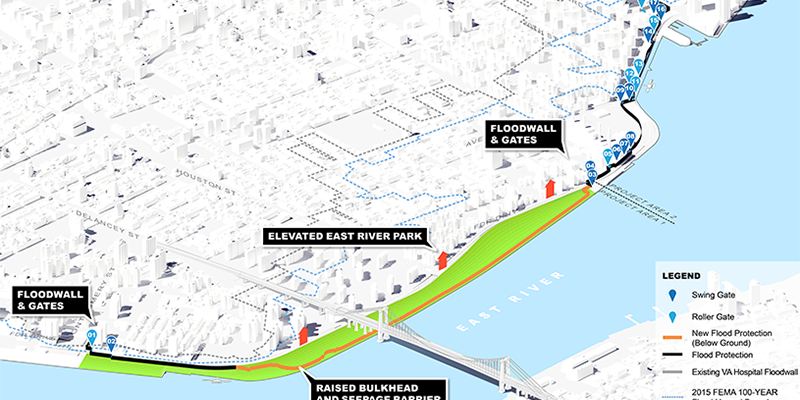
Most of the southern end of East River Park was closed in late 2021 when DDC began work on ESCR — a $1.45 billion project which is creating a flexible, 2.4-mile-long flood barrier on the Lower East Side from Montgomery Street up to Asser Levy Playground between East 23rd Street and East 25th Street. ESCR is employing raised parkland, floodwalls, berms, and 18 swinging or sliding flood gates to create a continuous line of protection against sea level rise and the growing threat of stronger, more severe coastal storms worsened by climate change. The project has been designed to improve waterfront access through reconstructed bridges and entry points and will also upgrade existing sewer systems to capture and manage precipitation during storms. The first floodgate — which is 42 feet long, 10 feet high, and 32,000 pounds — was installed in February 2022.

Floodgates are one piece of ESCR’s integrated flood protection system. Image Credit – NYC DDC
ESCR is making improvements to five recreation areas in total. Stuyvesant Cove Park has been rebuilt with new amenities and a combination of floodwalls and floodgates along its western edge. The 2.44-acre Asser Levy Playground — which is now intersected by a new floodwall and sliding floodgate — was partially rebuilt with extensive landscaping and new playground and basketball areas using resilient materials. Murphy Brothers Playground and Corlears Hook Park will also see improvements such as new landscaping, plantings, lighting, and playground equipment, with Murphy Brothers Playground expected to reopen this fall.
To the south of ESCR, DDC continues to make progress on Brooklyn Bridge-Montgomery Coastal Resiliency (BMCR) — the companion project to ESCR — which is currently installing flood gates along a 0.82-mile stretch of the Lower East Side from Montgomery Street south to the Brooklyn Bridge. BMCR is also creating numerous new recreation zones along its project area, such as open air seating, publicly-available fitness equipment, performance space, and more. Together, the two projects will form a 3.22-mile flood barrier when they are completed at the end of 2026.

MAYOR ADAMS DELIVERS AN ADDRESS [ON RESIGNATION OF POLICE COMMISSIONER CABAN]
Mayor Eric Adams: My fellow New Yorkers, earlier this week, I spoke to you about the ongoing investigations that have recently come to light. I was as surprised as you to learn of these inquiries, and I take them extremely seriously. I spent more than 20 years in law enforcement, and so, every member of the administration knows my expectations that we must follow the law. I also made clear that our administration will remain focused on delivering for the people of our great city and we continue to do that.
A short time ago I accepted the resignation of the NYPD commissioner, Edward Caban. He concluded that this is the best decision at this time. I respect his decision and I wish him well. Commissioner Caban dedicated his life to making our city safer and we saw a drop in crime for 13 of the 14 months he served as commissioner. In his time as part of the NYPD during our administration, we removed more than 18,000 illegal guns off our streets, had the lowest number of robberies in recorded history [ ] in our subway system[ ], and just had the lowest number of shootings above ground ever in [ ] recorded history in this city in [an] August.
To ensure crime keeps going down in our city today, I’m taking immediate action in appointing Tom Donlon as interim police commissioner. Tom is an experienced law enforcement professional who has worked at the local, state, federal, and international levels. He served as New York’s director of the Office of Homeland Security, ran the FBI’s National Threat Center, and the FBI-NYPD Joint Terrorism Task Force, and worked as the co-case agent investigating the 1993 Twin Towers bombing, as well as the attacks on the U.S. embassy in Africa and the USS Cole in Yemen by al-Qaeda. He is also a Bronx native. Tom joins a team at One Police Plaza that is relentlessly dedicated to public safety and protecting New Yorkers. That is why New York is the safest big city in the world and why it will continue to be. I thank Incoming Commissioner Donlon for stepping in during this critical moment.
As always, the men and women of the NYPD have my gratitude for their dedication and professionalism. I thank them for their command and their decision-making as we move forward and for the continued service that they deliver to all New Yorkers. Thank you, and God bless our great city and [our] bright future ahead. Thank you.
MAYOR ADAMS TO RAMP UP ANNUAL SUPPORT TO $50 MILLION FOR OPIOID PREVENTION, TREATMENT, FROM MAJOR SETTLEMENTS SECURED BY CITY OF NEW YORK, ATTORNEY GENERAL JAMES
Builds on 2022 Investments Made to Improve Substance Use Care in Behavioral Health and Emergency Department Settings, Expand Health Services at Syringe Services Programs, Support Grieving Families
NEW YORK – New York City Mayor Eric Adams today released the administration’s plans for applying $50 million in funding annually by Fiscal Year (FY) 2027 to combat the opioid addiction crisis New Yorkers continue to face. The funds — obtained through litigation efforts and settlements secured by both the New York City Law Department and the Office of New York Attorney General Letitia James — will support programming at the New York City Department of Health and Mental Hygiene (DOHMH), NYC Health + Hospitals (NYC H+H), and the Office of Chief Medical Examiner (OCME) and build on the city’s initial investments by focusing on supporting programs operated by community-based partners, which are critical allies in the work to prevent and reduce overdoses.
In January 2018, the City of New York sued manufacturers and distributors of prescription opioids to remedy the harms caused within the city by the misleading marketing and improper distribution of these drugs. Attorney General James filed a similar lawsuit in March 2019. Settlements reached by both the city and the state, as well as a court victory by Attorney General James, have provided the city with over $154 million to-date, which is expected to total more than $500 million by 2040. In June 2022, Mayor Adams and Attorney General James announced allocations for the first of hundreds of millions of dollars coming to New York City to combat the opioid crisis.
“Too many New Yorkers, and too many Americans, have been lost to the opioid epidemic,” said Mayor Adams. “For years, drug companies knowingly hooked patients in pain on powerful opioids, raking in billions of dollars even as they knew they were causing harm. But New Yorkers were never going to let them get away with this. Because of the City of New York and New York State Attorney General James’ lawsuits against these companies, we are helping communities heal from this crisis. I thank Attorney General James for her staunch determination to fight for the victims of this crisis and their families. Today’s announcement lays out a plan for the next round of investments that will bring us to $50 million annually and allow us to expand access to treatment through community-based partners, strengthen harm reduction programs, and . We will always fight to protect our people, families, and communities, and this much-needed settlement money will help us do just that.”
“For far too long, the opioid crisis has left a trail of devastation across New York, tearing families and communities apart,” said Attorney General James. “We made a promise to New Yorkers to go after the companies responsible for this crisis, and, once again, we are making good on this commitment and delivering funds for treatment and prevention efforts. From new resources at New York City’s hospitals to on-the-ground education efforts in the most vulnerable neighborhoods, the funds that Mayor Adams is distributing today will go a long way in supporting our most vulnerable communities. I thank Mayor Adams and his administration for their continued work to tackle this crisis and support all those who are struggling.”
“If it were not for COVID-19, the opioid overdose crisis would be the single biggest public health issue of our time,” said Deputy Mayor for Health and Human Services Anne Williams-Isom. “While the pandemic has calmed, the opioid issue continues to persist, touching tens of thousands nationwide and thousands of families here in New York City. The investments announced today build upon those made with the first tranche of funds and continue to bolster supports for substance use programming in the community, improving access to resources. We are also strengthening our grasp of the issue with investments in data infrastructure and laboratory work to speed up toxicology testing to inform our public health and law enforcement communities. Ultimately, this plan will deliver resources where they are most needed and build the systems of support to help every individual and family touched by this issue.”
“We continue to lose too many New Yorkers to opioid overdose deaths,” said DOHMH Commissioner Dr. Ashwin Vasan. “These funds will help keep our neighbors alive by providing critical connections to care in safe and supportive environments, access to treatment for opioid use disorder, and expanded access to life-saving overdose prevention services. DOHMH will continue to invest in a comprehensive approach, partnering with health care systems and trusted community organizations, and ensuring that all New Yorkers feel they can be a part of the solution to this public health crisis.”
“As the largest provider of behavioral health services in the city, our hospitals see thousands of patients each year who are battling opioid use disorder,” said NYC H+H President and CEO Mitchell Katz, MD. “The funds announced today will significantly expand our ability to reach more individuals in need, providing them with the critical support and treatment necessary to overcome addiction and reclaim their lives.”
“Timely and accurate data helps families cope with the loss of a loved one and gives our partner agencies crucial insights that inform strategies to prevent overdoses,” said New York City Chief Medical Examiner Jason Graham, MD. “These new investments will fortify our capacity to analyze information and deliver expedited results, while building on our outreach to grieving families expanded in prior investments. The overdose crisis is a multi-faceted emergency that must be approached from every possible angle to save lives.”
DOHMH Investments
DOHMH’s investments will total $24 million annually by FY26. In addition to the initial investment that supports expanded hours and syringe services programs at Overdose Prevention Centers, these funds will:
- Support wraparound services for syringe service programs, including on-site medical care, connections to health care and social services, and support for basic needs.
- Expand Relay, a non-fatal opioid overdose response program, to bring the total number of participating hospitals up to 17.
- Expand recovery support for people with current or previous substance use disorders, including employment coaching, community-based support, and life-skills training.
- Fund substance use disorder treatment providers to increase access to buprenorphine and methadone. In December 2023, the administration announced $3 million for providers on Staten Island to directly support the expansion of harm reduction, treatment, and recovery support services in the borough. Funds will be used for buprenorphine expansion, increasing outreach and engagement, and increasing care navigation services, among other services.
NYC H+H Investments
NYC H+H’s investments will total $22 million annually by FY27. In addition to the initial investment that supports substance use treatment and provider training across various settings in the system, these funds will:
- Add addiction counselors to support addiction in birthing units across all 11 public hospitals in the system. This critical work will help expecting families and their children at a time of high risk and promote the administration’s goals to decrease maternal mortality.
- Launch Addiction Response Teams, a new model that will provide expanded medical and behavioral addiction coverage, to three hospitals: NYC H+H/Harlem, NYC H+H/Jacobi, and NYC H+H/Queens. This model will provide rapid delivery of life-saving medications for opioid use disorder directly in emergency rooms and inpatient units, as well as immediate access to ongoing outpatient addiction services.
- Support the city’s plans, announced in March 2024, to open a health and substance use disorder clinic for pregnant and postpartum women and their families with an investment of $8 million. This clinic will offer pregnant and parenting individuals living with substance use disorders a safe and supportive place to access prenatal and post-natal care, addiction medicine, and behavioral health care.
OCME Investments
OCME’s investments total $4 million annually. In addition to the initial investment that supports the Drug Intelligence and Intervention Group, which offers tailored support for the families of drug overdose decedents by connecting them to critical mental health and social support services in the crucial window following an overdose death, these funds will:
- Support the hiring of additional scientists and support staff, provide new equipment and physical upgrades to the forensic toxicology laboratory, and allow for information technology improvements. OCME aims to reduce turnaround times by half over the next year to expedite answers for grieving families and data to partners in the public health system.
As of June 2024, the end of FY24, New York City had received $154 million in opioid settlement funds. The annual budget for FY24 was $33 million; an analysis of the impact of these investments can be found in the city’s most recent Opioid Settlement Funds Report issued in September 2024. Across programs, New York City has served thousands of New Yorkers and their families. The OCME’s Drug Intelligence and Intervention Group program has served 1,300 individuals. In FY24, syringe service programs that operate overdose prevention centers connected more than 6,600 participants with more than 25,000 services to reduce risk of overdose, provide supports, and referrals for treatment. Since beginning to receive opioid settlement funds, NYC H+H has provided comprehensive addiction consultations to 11,382 inpatient admissions through the Consult for Addiction Treatment and Care in Hospitals program and had 8,321 patient engagements with expanded substance use services at Street Health Outreach and Wellness vans. Earlier this month, through the , NYC H+H launched its cutting-edge addiction stimulation training for Emergency Department prescribers, the first of several training initiatives through this program.
This expanded funding comes at an urgent time. Despite a slight decline in U.S. overdose deaths in 2023, fatalities remain at crisis-levels nationwide. . Fentanyl continued to be the most common substance involved in overdose deaths, present in 81 percent of overdose deaths in New York City in 2022. Very recently, carfentanil has been identified in a small number of overdose deaths in New York City and has been found in trace or small amounts of samples tested by DOHMH’s drug-checking program.
Today’s investments will help New York City expand and build upon initiatives that save lives and provide access to treatment and other services. “Care, Community, Action,” the city’s mental health plan, highlights the needs of those at risk of an overdose and has set ambitious goals to reduce total overdose deaths across the five boroughs. Steps taken since its launch include expanding the Relay program to Brookdale Hospital Medical Center, expanding access to low-barrier treatment and harm reduction services, and increasing the availability of the overdose reversal medication naloxone, as well as fentanyl test strips to New Yorkers.
New York City also has the first two publicly recognized Overdose Prevention Centers in the nation, which provide a continuum of services to address basic needs and offer connections to treatment for people who use drugs. Since opening in November 2021, the two Overdose Prevention Centers have successfully intervened in more than 1,500 potential overdoses to reduce overdose-related injuries and deaths.
Today’s investment and all of the actions taken by Mayor Adams and the Adams administration to prevent overdose deaths also underscore the administration’s efforts to improve and extend the average lifespan of all New Yorkers through “HealthyNYC” to 83 years by 2030. HealthyNYC sets ambitious targets to address the greatest drivers of premature death, including chronic and diet-related diseases, screenable cancers, overdose, suicide, maternal mortality, violence, and COVID-19.
“I want to thank Mayor Adams for his dedicated efforts and Attorney General James for securing these essential funds to combat the opioid epidemic,” said New York State Assemblymember Charles D. Fall. “This $50 million annual support is a lifeline for New York City, particularly for Staten Island, which has been hit hardest by this crisis. By improving access to treatment and education, supporting our local organizations, and strengthening harm reduction initiatives, we can make significant progress in addressing this crisis. The enhanced data infrastructure will also enable us to tackle the opioid issue more effectively, ultimately saving lives and fostering a healthier future for our community.”
“As an assemblymember committed to improving public health and safety, I firmly believe increased funding for opioid addiction treatment and prevention programs is not just a necessity, but a moral imperative,” said New York State Assemblymember Eddie Gibbs. “New York City must invest in comprehensive solutions that address the root causes of addiction, provide effective treatment options, and support our communities in healing. Every dollar dedicated to combating this crisis is a step toward saving lives and building a healthier, more resilient city.”
“Congratulations and thank you to Attorney General James and Mayor Adams for successfully securing these opioid settlement funds and getting the money where it needs to go,” said New York State Assemblymember Sam Pirozzolo. “Opioid addiction is a leading public health crisis in New York City and every penny that can go towards saving lives is a wonderful thing.”
“Opioids are now involved in 84 percent of overdose deaths in our city, taking the lives of hundreds of our loved ones each year,” said New York State Assemblymember Jenifer Rajkumar. “As the daughter of doctors who worked in drug addiction medicine, I am deeply committed to partnering with all stakeholders to turn this situation around. In Albany, I worked to pass a budget allocating $90 million from the Opioid Settlement Fund for treatment and harm reduction across the state. Mayor Adams is now putting the city’s share of funds into action in our effort to end this epidemic for good. We will support intervention services including treatment, outreach, and aid for those harmed by opioids, as well as improved data collection. This work builds upon the $12 million investment we launched last year to address opioid abuse. Through this prudent spending, we will save the lives of all New Yorkers impacted by opioid addiction.”
“Increasing accessibility to opioid use disorder treatment gives New Yorkers help when they need it most and will save lives,” said New York State Assemblymember John Zaccaro, Jr. “Building partnerships with likeminded, community-based partners whose harm-reduction programs help so many, is vital to this effort. I strongly support the Adams administration’s efforts to secure $50 million in funding to make this a reality.”
“We have far too many opioid overdoses in the Bronx,” said Bronx District Attorney Darcel D. Clark. “Our community suffers from one of the highest rates of fatal overdoses in the nation. Supporting community programs will promote accessibility to treatment, education, and prevention services. Providing emotional support for grieving families is a vital step to helping them cope with the loss of their loved one, as well as a prevention measure. I applaud Mayor Adams for his wise allocation of the hundreds of millions of dollars that New York State Attorney General Letitia James secured from manufacturers and distributors who flooded the Bronx with these harmful drugs.”
“About two years ago, we determined that Staten Island would not be receiving any of the opioid settlement money, despite the fact there had been, and continues to be, too many lives lost to addictions and overdoses,” said Staten Island Borough President Vito Fossella. “We worked with the mayor’s office and other elected officials to change how the money would be distributed. Fortunately, we prevailed. As a result, Staten Island providers will now be receiving funding to help combat and reduce the opioid and other drug related issues here, especially for young people. We thank the mayor for hearing our case and helping to change a policy that would have hurt Staten Island.”
“The ongoing opioid crisis has had a disproportionate effect on many of our communities and has claimed the lives of too many of our residents,” said Bronx Borough President Vanessa L. Gibson. “Today’s announcement is a significant commitment to combating the opioid epidemic in our city. I want to thank Attorney General Letitia James and Mayor Eric Adams for their continued advocacy in support the emotional, mental, and physical well-being of New Yorkers struggling with opioid addiction and will ensure our municipalities have the tools to expand harm reduction services and treatment for our most vulnerable residents.”
“As the chair of the Council’s committee on hospitals and a registered nurse, I am deeply committed to addressing the opioid crisis that continues to devastate our communities,” said New York City Councilmember Mercedes Narcisse, chair, Committee on Hospitals. “I would like to praise Mayor Adams, as this $50 million annual investment is a critical step forward in our fight against opioid addiction. This funding will provide essential treatment and crucial support services and allow us to better understand and respond to the needs of those so severely affected by this crisis in real-time. I am delighted to support this initiative and remain dedicated to working alongside Mayor Adams, our health care providers and community organizations to ensure a healthier, safer New York City for all.”
“I am thrilled that this crucial investment in opioid prevention, treatment, and education is coming into fruition,” said New York City Councilmember Yusef Salaam. “The opioid crisis has been ravaging the nation, disproportionately affecting individuals and families in communities just like Harlem. This $50 million annual commitment secured by Mayor Adams and Attorney General James is the kind of city-state partnership that will not only save lives, but also restore hope to countless families affected by the scourge of these substances. I thank them for their leadership in helping build a future where every New Yorker has the support they need to overcome opioid addiction and reclaim their lives.”
“Opioid addiction is one of the most prevalent substance abuse issues facing New Yorkers,” said New York City Councilmember Lynn Schulman, chair, Health Committee. The investment of opioid settlement funds to support community-based programming to prevent and reduce overdoses, announced today, is critical to saving the lives of those most in need of intervention.”
TRANSCRIPT: MAYOR ADAMS ANNOUNCES NEXT GENERATION OF NEW YORK CITY’S INVESTMENTS IN FLOOD PREVENTION AND PREPARATION TO KEEP NEW YORKERS SAFE, PROTECT THEIR WALLETS
Deputy Mayor Meera Joshi, Operations: Good morning, thank you everyone for coming. The anniversary of Hurricane Ida is a solemn occasion. We mourn the lives of those lost across the region, but it’s also a time of conviction, a time of planning, a time of rolling up our sleeves and getting the work done to protect New Yorkers for an era of fast and furious rainfall.
We must be, and we are being, skillful and creative in how we protect our city. Every square foot of our city, from our basketball courts to our public parks, our highway medians, and yes, even the very pavement we stand on, must do double duty to protect homes and businesses around them. The reality is that our sewer system was built at the turn of the 20th century, and it’s done the lion’s work, a true feat of genius and engineering that has sustained New York through growth that no one could have predicted. It manages 2.7 billion gallons of water, or about 4,000 Olympic-sized swimming pools. But still, that’s not enough.
The number represents about 1.75 inches of rain per hour, what used to be called the five-year storm. Now it’s more like the several-times-a-year storm. Ophelia dumped over two inches per hour on our city, which meant flooded basements and inundated subways. During Ida, parts of the city got 3.5, almost twice what our system is built to handle. And while we complete crucial sewer and catch basin upgrades in our neighborhoods impacted by that terrible storm, we must think innovatively and turn New York City into a sponge to back up our sewer system and soak up the rainwater. Here to talk about our administration’s efforts to protect New Yorkers creatively and with conviction, our mayor, Eric Adams. Thank you.
Mayor Eric Adams: Thank you. Thank you to our entire team, Deputy Mayor Joshi and Rick. That’s all you guys think about, is making sure that we’re able to just secure our communities from the onslaught of these unpredictable weather patterns that we’re seeing.
Since day one, that’s what this administration has made clear. Our mission is to keep New Yorkers safe, and this is one of the most imperative parts of keeping New Yorkers safe, especially New Yorkers who simply cannot afford to move or rebuild every time extreme rainfalls, floods, low-lying areas and basement apartments. It is extremely expensive and impactful on these families, and when you think about it three years ago, when Hurricane Ida caused the heaviest rainfall in New York City recorded history and tragically claimed the lives of 13 New Yorkers, it was clearly a wake-up call for us all.
Our administration is working across all agencies, as you see here today, the different agencies that are present to make sure that we do everything possible to prevent the loss of lives due to extreme weather. That means doing everything we can, and we are doing that. When climate change causes stronger storms and more frequent extreme weather, investments like these are a key part of public safety and affordability and our strategies.
Investing in flood infrastructure saves lives and prevents property damage, particularly in low-lying, underserved areas. So every dollar we spend on flood infrastructure, we save $7 in prevented damage. That is why we are investing billions of dollars in expanded infrastructure technology and safety measures, ranging from sewer upgrade to coastal resilience projects to innovate green infrastructure solutions that will divert, absorb and manage tens of millions of gallons of excess stormwater. That sounds like my beat I like. That includes new drainage infrastructure right here in Queens Village.
A year ago today, these medians were concrete. They funneled millions of gallons of water into our sewers, and when our sewers could not handle it, that water ended up flooding basements and streets. Today, the green infrastructure can prevent 5 million gallons of flooding. I’m also proud that we have completed two major projects in the frequently flooded Queens community of Maspeth and College Point. Projects that have added miles of new sewers to water mains and catch bases in our city’s infrastructure.
The work is expanding the system drainage capacity to help manage where extreme rainfall exists, including heavy downpours that can put lives in danger, damage property, disrupt critical infrastructure and pollute New York’s waterways. In addition, we have broken ground on our first major Cloudburst management project at the New York City Housing Authority, South Jamaica Housing, and we’re really excited about this. And work is underway on additional projects in Parkchester, Morris Park, and in the Bronx, East New York, in Brooklyn, St. Albans, in Queens and more. We have expanded the successful Bluebelt waterways network that protects so much of Staten Island and invested in new technology that will help New Yorkers in case of emergency.
This week, the city installed a 200-foot flood net sensor in Louis-Simeone Park in Corona, putting us ahead of the schedule to install 500 sensors in flood-prone areas by 2027. We have moved forward with a clear focus, and we’re going to continue to ensure that we provide a safe battle against the inclement weather. No one does it better, no one better. I want to turn over to the teams that have continued to fight to make this happen. But again, deputy mayor, we want to thank you for what you have done, and our partners in Albany, Assemblywoman Jenifer Rajkumar, Assemblyman [David] Weprin, and our other partners that are here. Turning back over to you, D.M.
Deputy Mayor Joshi: Thank you. Now we’re going to hear from a man who has been working since day one to be creative in not just how we absorb water, but how we pay for absorbing water as well, because that is a challenge.
I also want to note that DDC is here as well. DDC is our amazing construction company, the personal construction company of the city, and they’re behind so many of our resiliency projects. And because of the tireless advocacy in Albany last session, once Governor Hochul signs our capital reform bills, we will be able to build even faster. So with that, I’d like to turn it over to Rit Aggarwala.
Commissioner Rohit Aggarwala, Department of Environmental Protection: Thank you, deputy mayor. Just to build on what the mayor and deputy mayor said, I am really proud of how far we’ve come over the last two years.
Two years ago, on that first anniversary of Ida, the mayor announced at an event we did together, that DEP and its partner agencies like DDC and the Mayor’s Office of Climate and Environmental Justice were going to undertake a comprehensive, multifaceted effort to bring stormwater resilience to the city. The reality, as you all know, is that our climate is changing faster than our infrastructure can keep up. And as a result, we are constantly playing catch-up, but we do so with the support of a tremendous team. Many of my colleagues from DEP are here today, and they work tirelessly on this on any number of fronts.
The plan we said we were going to do two years ago included a number of components, and the mayor touched on some of them. Maintaining our existing infrastructure so it can capture every gallon that it was designed for, improving our ability to understand what was going on during flooding events, increasing that sewer capacity underground, expanding our green infrastructure on the surface, and helping residents cope, because we know there’s going to be a time lag between how long it will take for us to upgrade our infrastructure and the flooding that people have to experience. And today, this package that we are announcing of the things that we have accomplished just recently—and as the mayor said, it’s a subcomponent of what we’ve done over the last two years—demonstrates that we’re moving forward on all of those fronts.
Last year, we cleaned roughly one-tenth of the entire sewer system. That doesn’t expand capacity, but it makes sure that we are getting every ounce of value out of the system that we have, and we’ll do just as much again today. As the mayor said, we’ve accelerated the deployment of these flood net sensors, so we now have 200 of these around the city. It’s available to the public. Any person anywhere can log onto the internet and have a real-time understanding of where there is flooding going on at those 200 locations. And one of the things we did in this administration was, originally, there was a plan to roll out these 500 in something like six years, and we have accelerated it. So we will be ahead of schedule with the full rollout of 500 of these sensors.
As the mayor said, we’ve been aggressively working to expand sewers where we can. That is the longest and most expensive effort. But just to put a fine point, these projects in Maspeth and College Point totaled a $238 million investment by this administration in protecting New Yorkers from flooding. We’ve broken ground, as the mayor said, on our first Cloudburst project. And what’s over here is the package that we give away.
This is the package, and Meera came with one of them, right, that we give away now to homeowners at a series of events that we’ve been holding all over the city to help them understand the kinds of things that they can do to protect themselves against flooding. It includes the flood barrier there, a sump pump, a flooding alarm, because, as we know, three years ago, many of the people who died during Hurricane Ida did so because they were in basement apartments and the flooding happened. So we think everybody, particularly in a basement apartment, needs to have a flood sensor, just like everybody needs to have a fire alarm at home.
We are delivering on all the things we said we were going to do. We are also aggressively seeking funding. And as the deputy mayor mentioned, one of the things that Mayor Adams and Deputy Mayor Joshi charged us with, collectively across the administration, is to get every dollar of federal money that we can possibly get. And I’m really pleased to say that when we apply directly to the federal government, they treat us very well. They appreciate the importance of these projects. We have received $124 million for Cloudburst projects in New York from the bipartisan infrastructure law, and we are awaiting final approval, but we’ve been told we’re in that final stretch on another $100 million. So that’s a quarter billion dollars that this administration has gotten from the bipartisan infrastructure law for the Cloudburst projects alone.
So it’s a comprehensive effort. We couldn’t do it without our partners like Tom Foley’s DDC, the great leadership that we’ve got at DEP, like Anastasios Georgelis, and where’s Angela, Angela Licata, our two deputy commissioners who oversee this, and the team of engineers and maintainers who design and build this. And they are hard at work because the other thing that we promised we would do two years ago, and it will be a multi-year effort, is a comprehensive engineering strategy for how we deliver citywide flood resilience. We issued our first public update on that earlier this year. It’s going to take several more years of engineers, but we have 75 engineers working day in and day out to plan that. So it is an all-hands effort, and I want to thank deputy mayor and Mayor Adams for your constant support on this.
Deputy Mayor Joshi: Thank you. Boy, everybody’s piled stuff on this podium. As the mayor mentioned, we couldn’t do any of this without the support of our electeds, especially those at the state level. So next I’d like to bring on Assemblymember David Weprin.
State Assemblymember David Weprin: Thank you, deputy mayor. Thank you, mayor. We don’t often get mayors in our district, and this part of Queens has traditionally been neglected, but certainly this type of money coming here is very well appreciated.
As was mentioned, we’re marking the third anniversary of Hurricane Ida. The consequences for so many residents in Queens, which cost the lives of 13 New Yorkers. I joined Mayor Adams two years ago when he announced a suite of stormwater infrastructure initiatives to make New York City more resilient to intense rainfall. And I’m pleased to have joined the DEP at a local town hall earlier this year to see how these efforts are being communicated to everyday New Yorkers.
I’m proud that the mayor has invested a historic $1.2 billion in vital anti-stormwater flooding, public safety infrastructure in all five boroughs, ranging from traditional sewer upgrades to innovative green infrastructure solutions and more. And similar investments in anti-flooding infrastructure have been shown to prevent seven times as much damage as compared to the original investment.
As the chair of the New York State Assembly Committee on Insurance, I’ve been working to find ways to keep property insurance rates down. Just last year, I hosted a public hearing to discuss the impact of severe weather events on policyholders. I will continue to implement and boost solutions for New Yorkers to offset the negative impacts of climate change related to severe weather events like Ida.
Mayor Adams today celebrated milestones in five of these major public safety projects. The New York City Department of Environmental Protection and New York City Department of Design and Construction completed major sewer upgrades at triple drainage capacity in College Points and doubled it in Maspeth, preventing that water from putting New Yorkers in danger of causing property damage. The city also this week installed its 200th flood sensor in Corona, Queens, putting the administration on track to reach Mayor Adams’ target of 500 flood sensors and well ahead of schedule.
Additionally, the city broke ground on the first cloudburst project at the New York City Housing Authority’s South Jamaica houses, which will keep nearly 3.5 million gallons of stormwater out of the sewer system each year. Finally, DEP completed a transformation of three acres of concrete medians in Queens Village, right here, into subsurface drainage chambers, engineered rock and soil, ornamental grasses and perennial wildflowers that can collectively manage 5 million gallons of stormwater that would otherwise continue to contribute to flooding. Once again, I want to thank Mayor Adams for all his investments in Queens, which in the past has often been neglected.
Deputy Mayor Joshi: Thank you very much, assemblymember. And I do want to just comment, we’ve used the word cloudburst a few times for those who aren’t familiar with the term and, you know, it is sort of a term of art, so lots of people aren’t familiar with it.
It’s basically when we take something like a playground or a basketball court, we make it a little bit deeper and we allow for it to hold water when there is a big storm. And then once the storm passes, the water can dissipate. And that way we don’t overburden our sewer system. So it’s the way our recreational facilities can also do double duty. It’s a really important technique. It’s a word used internationally, and we’re really excited to bring it to New York with a groundbreaking at the NYCHA houses, I think happening right now or imminently.
I’d like to next bring up Assemblymember Jenifer Rajkumar, who has been a stalwart advocate in the state for all of the construction work that New York City does.
State Assemblymember Jenifer Rajkumar: It’s always a good day when the mayor comes to Queens. The climate crisis is a reality, and it is our responsibility as citizens and government leaders to address it. And we have to win the war against climate change, and we have to win it fast. The past eight years were the hottest years on record. And the year 2023 was officially declared the hottest year in history.
We’re seeing the impacts, stronger storms, bigger downpours, more destructive floods. And by the end of the century, the 20 percent of our city that lies in a floodplain may actually be threatened by the rising sea levels. As was mentioned, three years ago Hurricane Ida took the lives of 13 New Yorkers. Most of them were immigrant New Yorkers from Queens who were trapped in basement apartments that flooded dangerously. This shows the toll of flooding on low-income immigrant communities, and it shows just how much climate justice and racial justice are interlinked.
The Adams administration has responded, investing in resiliency and in our diverse communities here in Queens. They have installed hundreds of flood sensors in Corona, broke ground on the first cloudburst project at South Jamaica Houses, and implemented a historic greening of Queens Village. I applaud these flood prevention initiatives, which will save lives here in Queens and around the city, including, hopefully, the 100,000 New Yorkers that live in basement apartments. This is government rising to the climate challenge, and it’s a life-or-death matter.
I also want to highlight how today’s green infrastructure investments are a good, common-sense use of our taxpayer dollars. Every $1 that we invest in flood hazard mitigation saves $7 in recovery costs. This is enormous savings for our city. The accidental city will never be a sustainable city. There must be thoughtful, deliberate planning and control to get to the true sustainability that we need, and that’s what we see here today with this team’s thoughtful and deliberative resiliency upgrades. So thank you to everyone here for all of your hard work to meet the climate challenge and to serve the people of Queens.
Deputy Mayor Joshi: Thank you very much. Next we’re going to hear from someone who will truly feel on a day-to-day basis the impact of this new greening of the Meridian. It is Kirby Lindell, vice president of Bell ParkManor Terrace. But before you speak, Kirby, we’d like to, if you could present, Kirby – this has a market value of about $300, this package – present you with your own flood prevention kit, sump pump, flood protectors, alarms. Enjoy. Hopefully, you don’t have to use it too often, but if you do, it’s there.
Kirby Lindell: Hi, it’s nice to see everyone. I didn’t expect to speak, but I am the vice president. I have been living in this community since I was three years old, so 1958. So I’ve seen everything that’s gone on with this mall. And in fact, sometimes we’ve had boats by Martin Van Buren when the flooding has gotten worse. But so far, since they put this in, the flooding has been great over there.
I am the vice president of this Bell Park Manor Terrace, 850 families on 47 acres of land. And we are very happy that we’re getting attention. We really do need attention here. And hopefully, this beautiful project will get a little bit more lush, and it’ll continue to be a beautiful sight. Anyway, we’re very grateful to have the mayor here. We don’t usually get to see the mayor. I’ve met you before when you were borough president. Anyway, so thank you so much, and we hope that we continue to get some attention in this area of Forgotten Queens. We desperately need attention here.
Mayor Adams: Thank you. A few on-topics.
Question: I have an on-topic question, maybe for Commissioner Aggarwala. You talked about everyone in a basement apartment should have one of these alarms. But part of the problem has been since Ida, the city has not had an accurate catalog of how many basement apartments there are. Do you have a current estimate of how many basement apartments there are in New York City? And if so, would you be making this type of package available to every single one?
Commissioner Aggarwala: So as you know last year, we finally succeeded in some successful legislation in Albany that would take the first step that would enable some standards to be developed for a subset of basement apartments around the city. We’re going to be working through that. The DEP and the Mayor’s Office of Climate and Environmental Justice are coordinating with HPD and our fellow agencies in how we think about the standards for legalization.
I can’t make a commitment that we’re giving these away to every one of those. We do not give away smoke detectors, for example. It’s just one of the things that’s a necessary safety feature. But it is something that we recommend that every basement ought to have one.
Question: Mayor Adams, hello, good afternoon. Reflect on how meaningful this equipment is in this moment in light of the devastation of Hurricane Ida. There were 13 people who died. We obviously, it was more than any of us obviously would have expected, and obviously this would have been life-saving to the 13 people who passed away, but what are your thoughts as we’re going into another anniversary of Hurricane Ida and what this progress has been made in this equipment that’s kind of redistributed? If you could just reflect on that.
Mayor Adams: I know, so true, and I remember with the former mayor going to some of the locations where people lost their lives and buildings were actually eroded because of the large amount of water. And the equipment, as the commissioner stated, we won’t be able to give it to every family but making people aware of what items they should have, particularly the sensors in the basement, having that sump pump. All of those items are important, and by sprinkling them out throughout communities they will become aware from their neighbors.
So this is really an each one, teach one, and show one moment so that we can empower communities to be part of what items should we be getting from those hardware stores and those other large stores where you can get these types of supplies. But it was devastating for all of us. It was unimaginable to lose 13 people from heavy rainfall. And it was really, we were already doing some great things under the previous administration, but we realized that we had to move at a faster pace because, as the Deputy Mayor Joshi stated, it was just coming so infrequently, just over and over again, so frequently I should say, and we had to be prepared for that.
Question: It may have been said earlier in the press conference, so I apologize, but what’s the funding source for this, just the regular city budget, or any, you know, the infrastructure dollars in addition to the budget?
Commissioner Aggarwala: So for the giveaway kits, or in general?
Question: In general, yes.
Commissioner Aggarwala: Okay, so DEP, we have a roughly $30 billion 10-year capital plan, and a little less than one-third of that is for sewer investments, and so that is where, for example, the Maspeth and College Point money came from. We have some money in our capital budget for the cloudburst projects, but as I said earlier, under the mayor and deputy mayor’s leadership, we’ve made this concerted effort to stretch that money with federal grants.
And so basically, we’re able to recycle the money, so we had enough money in the budget for five. If we can get five of them funded by the feds, that means we get to do 10, right? And that’s how we’re trying to stretch the money. But most of this really comes out of the capital budget that New Yorkers pay for through their water bill.
Mayor Adams: Okay, so we can excuse everyone else. They don’t have to be part of this. Thank you, everyone.
Question: Mayor, I wonder if we could talk about another kind of hurricane, a hurricane of rumors that the police commissioner giving this investigation that’s been going on is about to resign. Do you think he should resign? If you don’t, if you still have faith in him, and if you can guarantee that two months from now, he’ll still be your police commissioner? You know, I don’t think anything in life is guaranteed.
Mayor Adams: I would say this, when I chose Eddie, I chose him for his experience and what he brought after 30-something years of service. And so, you know, rumors are always out there, Marcia. You can never keep up with the rumors that you hear. It was nothing that came from me that fed those rumors at all. We have a job to do to continue to keep the city safe. We’ve done an amazing job in doing that, and we’re going to continue to make sure this remains the safest big city in America.
Question: We hear about this ongoing investigation in the Police Department that seems to expand every single day, where questions are being asked of your deputy mayor for Public Safety, questions are being asked by other people in the Police Department, including the brother of the police commissioner, and questions about [inaudible].
Mayor Adams: There’s no joy waking up and seeing any negative comments made about you in writing or anywhere, so there’s no joy. But we have a job to do. And in the name of the game, I say over and over again, stay focused, no distractions and grind. Folks, I’ve got to bounce.
Banner Image: East Side Coastal Resiliency Plan graphic. Image Credit – NYC DDC



There are no comments yet
Why not be the first