
Making College Unaffordable Again – When More Necessary Than Ever For Well-Paid Careers: Effects On Student Loans Of OBBBA
We previously covered this webinar before it occurred. You can read our story on it here. If you are a NYC resident, first you can contact EDCAP for help both before and after you have borrowed loans, free of charge. NYC also recently started the first-in-the-nation municipal student loan and college assistance program. It should also be mentioned that before the limits to PLUS borrowing, this type of loan was primarily determined by the parent’s credit history and income level, whereas the requirements for students through the federal programs was much looser. Basically, to qualify for a student loan, you must not be in default or arrears on any other federal student loan. But an actual stringent credit check is not required. For private student loans, there are fewer options for repayment if one is unable to find work in their chosen field, they are based on credit, usually of the co-signer, and they do not qualify for any forgiveness programs.
The information that follows was provided by Nancy Nierman | Assistant Director, Education Debt Consumer Assistance Program (EDCAP),Community Service Society of New York (CSS). Readers can also visit Rep AOC’s site to learn more about how the budget bill will impact specific groups.
The following are answers (in red) to our numbered questions about Federal Student Aid changes that are about to occur or will occur soon, which were based on the information in the video presentation, above:
New Yorkers who want free 1-1 counseling can contact EDCAP directly: https://www.edcapny.org/contact-us/
Having reviewed the video, we wanted to ask the following questions:
- Regarding the Social Security offset (or administrative garnishment): Does this affect any retired borrower who has gone into default? Is it also applicable to those on disability Social Security, and on those who rely on Social Security for their sole income?
The Federal government can take up to 15% of Social Security Retirement (SSR) or Social Security Disability Insurance (SSDI) if you default on a federal student loan, even if this is your only income. They can’t leave you with less than $750. (They cannot take SSI – Supplemental Security Income). They can do this administratively (without a court order).
- What is the criteria for this type of involuntary collections? How does someone end up in this situation?
After 270 days of missed payments, your loans are in default. Involuntary collections probably wouldn’t start until you’ve missed 360 days of payments or more. Once in default, there are several ways to get out (Loan Rehabilitation or Consolidation). Borrowers can get themselves out of default before involuntary collections start if they catch it early enough.
- How does someone find out if they are in that situation? Is everyone that is in the program listed in the Treasury Offset system?
Borrowers should get notices when they miss payments and when their loans go into default. A few months after you go into default, the loan is transferred from the non-default servicer to a debt collector (in most cases, that is Debt Management & Collections Systems). The Treasury Offset Program (TOP) is supposed to manage Social Security offsets and tax refund intercepts. Collections on student loans have been suspended for about 5 years. We’re not sure how they are going to process administrative wage garnishments, which to the best of our knowledge, have not started yet.
Is it correct that the RAP plan does not accrue interest? How does that differ from the plans previously available for income based repayment and economic hardship deferments?
Similar to SAVE, unpaid interest in the RAP plan will not accrue to borrowers’ accounts. IBR [Income Based Repayment Plan], PAYE [Pay-As-You-Earn], and ICR [Income Contingent Repayment Plan] don’t work that way. In those 3 plans, if the payment doesn’t cover the monthly interest (which is often the case when the balance is high and the income is moderate or low), unpaid interest is added to the account. That is why student loan balances often increase even when you make your required payments. In deferments, interest accrues on Unsubsidized loans only and capitalizes (gets added to principal), when the deferment ends. In general forbearances, interest accrues on all loans but does not capitalize when the forbearance ends. Note: COVID & SAVE forbearances, were special forbearances where interest did not accrue (until 8/1/25 in the SAVE forbearance).
- Are there any economic hardship deferments that will be available to new graduates, such as for disability or for persistent unemployment?
Borrowers who take loans disbursed prior to 7/1/27 will continue to have access to the economic hardship & unemployment deferments if they qualify. For loans disbursed on or after 7/1/27, the economic hardship & unemployment deferments will go away, and general forbearance will be limited to no more than 9-months within a 24-month period. There are other more specific types of deferment and forbearance that will continue to exist, but you must meet the qualifications (i.e., cancer or military deferments, National Guard Duty forbearance, etc.)
- It appears that there will be no plans available in the future where low-income borrowers will be able to make $0 monthly payments, whereas previously, the Income Driven Repayment plans offered a $0 payment option that could count as credit toward a forgiveness program. What does this mean for borrowers for whom a $10 monthly payment would be a burden, whether due to unemployment, caring for an unwell relative, or any number of other such situations?
If the borrower takes no additional loans on or after 7/1/26, they will still have access to PAYE and ICR until 7/1/28 and to the IBR plan and deferments & forbearances under current rules. For anyone who takes a loan on or after 7/1/26, there really is no option if they cannot make the $10 payments in RAP other than limited periods of time in forbearance or maybe one of the more specific deferments or forbearances mentioned above. If they are sick or disabled, they will still be able to apply for Total & Permanent Disability discharge.
- Will PLUS loan borrowers who are already in repayment be able to continue to access economic hardship deferments and other types of income driven payment plans? What does it mean that this will not continue in the future? Is there anything in place for those parents whose financial situation changes unexpectedly, due to illness or injury, for example, where they can no longer afford the standard monthly payment? Would such deferments and reduced payments have been available to them before the changes brought about by this new bill?
Forbearance & deferment rules are the same for Plus borrowers as for student borrowers. Plus borrowers who take no additional debt on or after 7/1/26 will still have access to ICR (until 7/1/28) and IBR.
- Are the PLUS loan changes (to repayment plan availability) applicable to all levels, including undergraduate and graduate, or are there different options between the two?
Parent Plus borrowers (who take loans for dependent student undergraduate school) will not have access to RAP. Parent Plus borrowers who take no additional debt on or after 7/1/26 will have access to ICR and IBR. They must consolidate first. (And current guidance says they must enroll in ICR and make 1 payment in ICR before transitioning to IBR). Parent Plus borrowers who take ANY loans on or after 7/1/26 must pay ALL their debt back in the Standard Plan. Graduate Plus borrowers who take no loans on or after 7/1/26 will have access to PAYE & ICR (up to 7/1/28), IBR or RAP (when it becomes available). Grad Plus borrowers who take ANY loans on or after 7/1/26 must pay all debt back in RAP or the new Standard plan. Parents cannot take Plus loans for graduate students.
- Will borrowers already in repayment who have been enrolled in current economic hardship plans be required to switch plans at a certain date into the RAP or Standard plan?
Not to my knowledge. Payment plan availability depends on your loan disbursement dates, not whether you’re in a deferment or forbearance.
- What is the limit to wage garnishment for active workers for the DOE accelerated collections? Is there a percentage they cannot exceed? Does this apply to all wages, and is there an income threshold?
They can take up to 15% of disposable income (gross income minus mandated deductions) but must leave you with at least 30x federal minimum wage per week (currently $217.50).
- Are there any types of deferment available with the new rules after the six months once school ends for a borrower?
The grace period is not going away (period that does not require payment for 6 months after you graduate, drop below half-time status or withdraw). For loans disbursed on or after 7/1/27, though Unemployment and Economic Hardship deferments will no longer be available and general forbearance will be limited, other more-specific types of deferment and forbearance will remain (i.e., military or cancer deferments, National Guard Duty forbearance,etc.)

- How is this expected to affect future college enrollment for those who do not come from families with sufficient resources to pay for their attendance (or who did not save in advance in anticipation of these changes for those with college aged students currently)? Is this expected to have a negative impact on the enrollment of such students?
Borrowers are going to have to find alternatives to Plus loan borrowing which, in most cases, will be private loans. But private loans usually require a cosigner, and some students may not have anyone in their family that will qualify. This will limit the pool of students who would otherwise be eligible to pursue more expensive degrees, particularly those in professional fields like law and medicine. Private loans can also be more difficult to repay as they don’t offer protections that can be found in the federal system like payment plans based on income or forgiveness programs.
Students with no access to private lending will have to seek out cheaper schools, scholarships, and grants or may not be able to pursue more expensive degrees at all.
Is this expected to have a negative impact in New York, or is the availability of TAP and a fixed tuition at SUNY and CUNY expected to offset this possibility?
TAP, Excelsior & Pell together may cover tuition at CUNY & SUNY schools, but TAP & Excelsior only cover tuition, not room and board. And this is only for undergraduate studies Pursuing masters and professional degrees will be a problem for a lot of students under the new rules.
- Are there any changes that you are aware of to the Pell Grant, in terms of amount of maximum award or qualifying income?
There are some changes to the Pell formula, but I don’t know the details.
13. Also, any student borrower whose loan was discharged under the administrative change during the Biden Administration where loans that had been in repayment over 25 years were discharged under one of the forgiveness programs, are those changes permanent?
-
- I think you’re asking if borrowers who got their loans discharged through IDR Forgiveness (after 20-25 years of making payments in an IDR plan) under Biden will have their discharges clawed back? If that’s your question, the answer is no. We’ve heard nothing about loans that discharged under Biden-era policies being reinstated.
And Parent PLUS loans used to be based on parents’ credit history and income when determining the loan amount. Is that still the case, only now there is an externally imposed cap on the amount that a bank can say they are eligible for?
-
- To the best of my knowledge, the OBBBA does not eliminate the need for a credit check on Parent Plus loans but I have not seen anything specifically written about this. These credit checks were never as stringent as those applied by private lenders and rarely impacted the amount of borrowing (which in the old system was allowed up to the cost of attendance). In the new system, there will be borrowing caps as we’ve discussed previously. We don’t know whether criteria for credit checking Plus borrowers will change under the new system and if that’s going to make it more difficult for Parents to even borrow up to the cap or if it will be similar to the current system. Those details will probably have to be worked out as they develop the regulatory text.
Following are some statistics about student loans, provided by Education Data:
Federal Student Loan Debt
About half of undergraduates borrow money from the federal government.
- 53.3% of undergraduate program completers use federal loans at some point.
- 54.7% of federal student loan debt is in Stafford Loans.
- 18.0% of federal debt is in subsidized Stafford loans; 36.7% is in unsubsidized Stafford loans
- 31.6% of federal student loan debt is in direct consolidated loans.
- 6.7% of student loan debt is from Parent PLUS loans borrowed by parents on behalf of their children.
- 6.8% of student loan debt is from Grad PLUS loans going to graduate or professional students.
- 0.2% of student loan debt is from Perkins loans.
- The federal government loans an annual total of $87.2 billion to all postsecondary students (including graduate and professional students).
- 28% of undergraduate students borrow federal loans.
- 61% of graduate students borrow federal loans.
Student Loan Debt by Race or Ethnicity
For more detailed research, read our report on Student Loan Debt by Race.
- Among bachelor’s degree holders, Black students are the most likely to borrow federal loans at 82.9%.
- Four years after graduation, Black or African American student borrowers owe $25,000 more than white or Caucasian borrowers owe for bachelor’s degrees.
- On average, Black or African American student borrowers owe $3,800 more than white or Caucasian borrowers.
- Four years after graduation, 48% of Black student borrowers and 17% of White student borrowers owe more than they initially borrowed.
- Among graduate students, 40% of Black students and 22% of White students accumulate debt for graduate school.
Following is the brief description of this webinar by Rep. AOC. If you are looking to just watch the slides, they occupy about the last nine minutes of the video:
On August 27th, the Office of Representative Alexandria Ocasio-Cortez and the Community Service Society of New York’s Education Debt Consumer Assistance Program (EDCAP) will be hosting a student loans webinar for student loan borrowers to learn about major changes to the federal student loan system that will be implemented over the next several years.
Speakers will be breaking down new policies, including the end of the SAVE Plan, new borrowing limits, changes to repayment and forgiveness options, and what borrowers can do now to prepare.
Whether you are in repayment, in school, or in default – this webinar is for you.
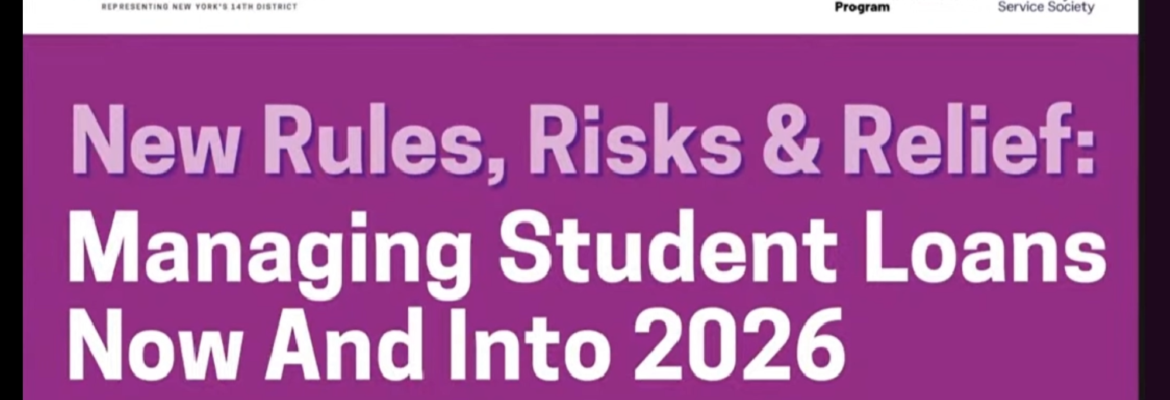
Banner Image: Webinar title screen. Image Credit – Rep. AOC


Staten Islander News Service Staff Writer
This byline indicates that this article was penned by a member/members of the Staten Islander News Organization office team. Our staff writers are the backbone of our newspaper, performing all sorts of important tasks like conducting interviews, investigating leads, besides writing the news stories you see.
[…] note: Readers may remember our previous article with the presentation from New York’s organization assisting fed… also organized and presented by Rep. AOC’s office. The representative also previously […]
[…] limit regardless of profession and were based on financial status rather than ability to pay) were covered in this webinar on the OBBBA’s effects on the affordability of college education. We have already covered the difficulties faced by Upstate New York’s Mennonite population, […]