

Brooklyn Tonight, Staten Island Tomorrow: Broad Spectrum Insecticide Spraying In Multiple Zip Codes – Concern For Backyard Bees, Butterflies
Editor’s note: According to the No Spray Coalition and Beyond Pesticides, during their successful case against the city’s chosen adulticide mosquito spraying campaigns, several facts were admitted to by the City. But little or no meaningful change has occurred. The lawsuit determined that they should be using alternative methods of control, such as ensuring ample ecosystems for the breeding of predators as well as utilizing larvicide dunks in waterways, and reducing breeding sites. Instead, the reliance has been and continues to be on aerial spraying of adulticide pesticides, which are not only ineffective but also have unintended consequences to bee, butterfly, and dragonfly populations. We have covered this issue in the past, including during our interview with Doug Tallamy, an ecology and wildlife expert.
From their page about this issue:
“Beyond Pesticides was a plaintiff, along with the No Spray Coalition, Disabled in Action, and Save Organic Standards, in a lawsuit against the City of New York around its pesticide spray program. We won that lawsuit against the City in 2006 when a federal judge ruled that the City’s spraying was a violation of the Clean Water Act. As part of the final settlement in 2007, the City admitted, signed and in writing, that the pesticides:
- may remain in the environment beyond their intended purpose
- cause adverse health effects
- kill mosquitoes’ natural predators (such as dragonflies, bats, frogs and birds)
- increase mosquitoes’ resistance to the sprays, and
- are not approved for direct application to waterways.
Beyond Pesticides has written this important, detailed letter to New York City Department of Health Commissioner Ashwin Vasan on critical issues with the way the pesticide spraying is being conducted and a path forward to improvement…
“A science-based, integrated, ecological strategy for managing mosquito-borne disease emphasizes increased monitoring and surveillance, elimination of breeding sites, enhancing habitat for mosquito predators, biological controls of mosquito larvae, and public education on source reduction. To ensure public safety from both mosquito-borne and pesticide-induced diseases, it is critical that the city strives to continuously improve its approach to insect-borne disease management and limit public exposure to nervous system toxicants, such as those being used…
‘It should be noted that adulticiding for mosquito management is the least-effective method for managing mosquitoes, since most of the spray does not hit the target mosquitoes but moves through the environment and air to exposure people, wildlife, and waterways.[2] It should also be noted that regular spraying leads to resistance in mosquito populations that are hit by the spray and result in adverse impacts to predator populations that help in management.[3]“
The original release by the Health Department:
HEALTH DEPARTMENT TO SPRAY FOR ADULT MOSQUITOES IN PARTS OF BROOKLYN AND STATEN ISLAND TO REDUCE RISK OF WEST NILE VIRUS
Trucks Will Spray Pesticide In Parts Of Brooklyn and Staten Island On The Nights Of September 9 and 11, 2025, Weather Permitting
NEW YORK — To reduce mosquito activity and the risk of West Nile virus, the Health Department will conduct adulticide treatments in Brooklyn and Staten Island. Trucks will spray pesticides in sections of Brooklyn beginning Tuesday, September 9, 2025, between the hours of 8:30 P.M. and 6:00 A.M. the following morning, weather permitting. In case of bad weather, application Brooklyn will be delayed until Wednesday, September 10, 2025, between the hours of 8:30 P.M. and 6:00 A.M. the following morning, weather permitting.
Trucks will spray pesticides in sections of Staten Island beginning Thursday, September 11, 2025, between the hours of 8:30 P.M. and 6:00 A.M. the following morning, weather permitting. In case of bad weather, application in Staten Island will be delayed until Monday, September 15, 2025, between the hours of 8:30 P.M. and 6:00 A.M. the following morning, weather permitting. The Health Department will use very low concentrations of Anvil®, Duet®, or MERUS® 3.
The risks of pesticides applied by the Health Department for mosquito control are low to people and pets. Some people who are sensitive to spray ingredients may experience short-term eye or throat irritation, or a rash. People with respiratory conditions may also be affected. To stay safe during spraying
• Stay indoors, whenever possible.
• Air conditioners can remain on. While unnecessary, you may wish to close air conditioner vents or choose the recirculate function.
After spraying
• Wash skin and clothing exposed to pesticides with soap and water.
• Always wash fruits and vegetables with water. The most effective way to control mosquitoes is to eliminate any standing water. New Yorkers are also encouraged to mosquito-proof their homes and take precautions when spending time outdoors. Reducing exposure to mosquitoes
• Use an approved insect repellent containing DEET, picaridin, oil of lemon eucalyptus (not for children under 3), or products that contain the active ingredient IR3535.
• Make sure windows have screens. Repair or replace screens that have tears or holes.
• Eliminate any standing water from your property and dispose of containers that can collect water. Standing water is a violation of the New York City Health Code.
• Make sure roof gutters are clean and draining properly.
• Clean and chlorinate swimming pools, outdoor saunas and hot tubs. Keep them empty or covered if not in use. Drain water that collects in pool covers.
Report standing water by calling 311 or visiting nyc.gov/health/wnv. For more information about West Nile virus, call 311 or visit nyc.gov.
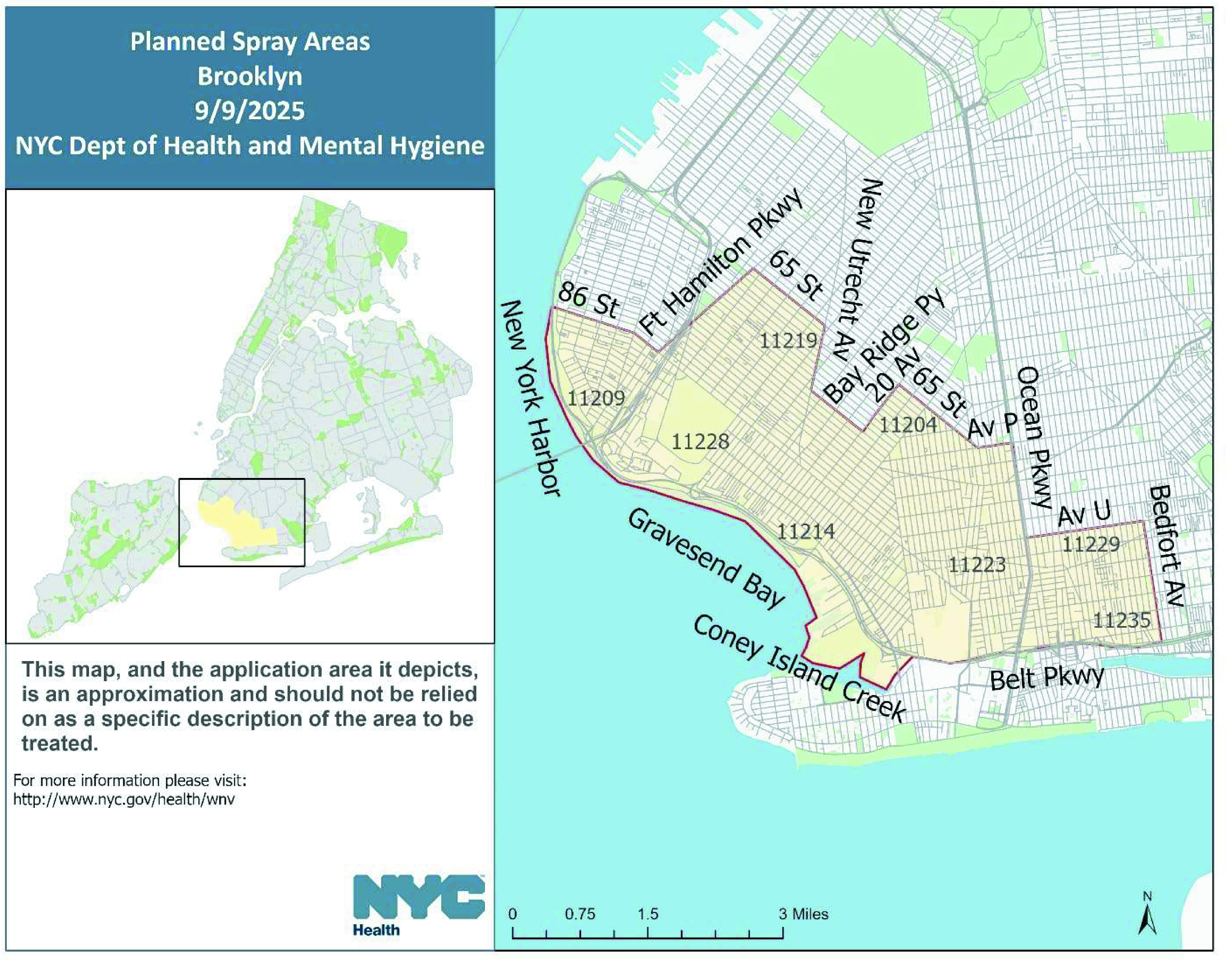
Locations of truck spraying in Brooklyn for Tuesday, September 9, 2025
| Borough | Neighborhoods | Boundaries | Zip codes |
| Brooklyn | Parts of Bath Beach, Bay Ridge, Bensonhurst, Brighton Beach, Dyker Heights, Fort Hamilton, Gravesend, Homecrest, Madison, Midwood, New Utrecht, Sheepshead Bay and West Brighton. | Bordered by New York Harbor, 86 Street, and Fort Hamilton Parkway to the West; 65 Street, New Utrecht Avenue, Bay Ridge Py, 20 Avenue, 65 Street, Avenue P, Ocean Parkway, and Avenue U to the North; Bedford Avenue to the East; Belt Parkway, Coney Island Creek, and Gravesend to the South. | Parts of 11204,11209, 11214, 11219, 11223, 11235, 11228 and 11229. |

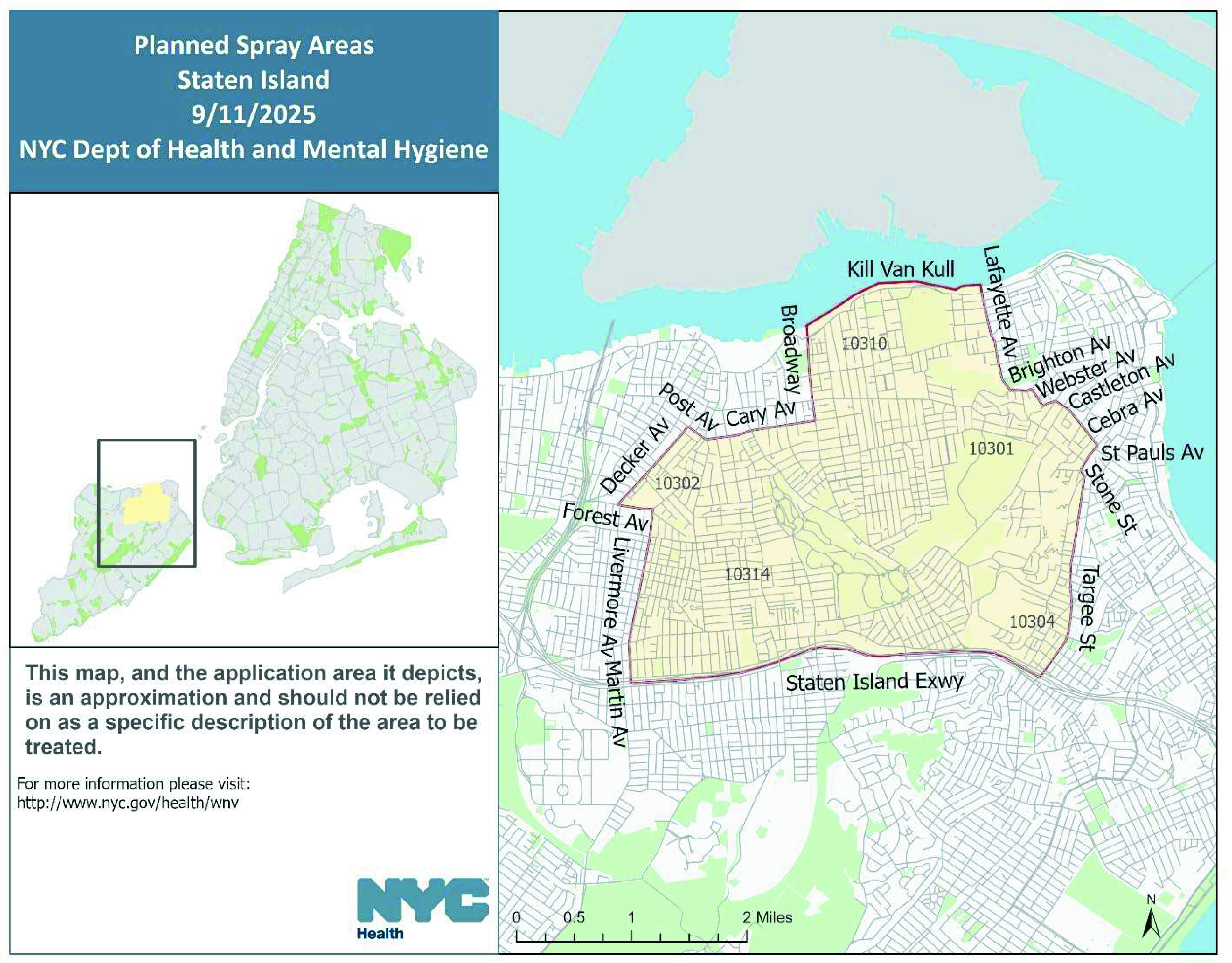
Locations of truck spraying in Staten Island for Thursday, September 11, 2025
| Borough | Neighborhoods | Boundaries | Zip codes |
| Staten Island | Parts of Castleton Corners, Edwin Markham Gardens, Fox Hilla, Mid Island, New Brighton, Park Hill, Port Richmond, Randall Manor, Tompkinsville, Silver Lake, Stapleton Heights, Sunnyside, Westerleigh and West Brighton. | Bordered by Martin Avenue, Livermore Avenue, Forest Avenue and Decker Avenue to the West; Post Avenue, Cary Avenue, Broadway, Kill Van Kull, Lafayette Avenue, Brighton Avenue, Webster Avenue, Castleton Avenue, and Cebra Avenue to the North; Saint Pauls Avenue, Stone Street and Targee Street to the East; Staten Island Expressway to the South. | Parts of 10301, 10302, 10304, 10310 and 10314.
|
Banner Image: Dragonfly nymphs, natural predators of mosquitos, which can be part of a strategy to keep populations under control. Image Credit – Clément Falize



Staten Islander News Service Staff Writer
This byline indicates that this article was penned by a member/members of the Staten Islander News Organization office team. Our staff writers are the backbone of our newspaper, performing all sorts of important tasks like conducting interviews, investigating leads, besides writing the news stories you see.
There are no comments yet
Why not be the first