
Yes, Virginia, There Is A Santa Claus: Reprint; Origins Of Real Santa Claus, Historical Figure Who Stood Up For Poor, Marginalized People
Annually, Staten Islander News republishes the famous letter to the editor sent to the New York’s The Sun newspaper, which pubished until 1950. You can read the letter from Virginia O’Hanlon to the editor asking if there is a Santa Claus. There was an autobiography of Santa Claus published decades ago, which can be found on Amazon. Whether it is fiction or not… Google’s AI says of Jeff Guinn, the author, “Jeff Guinn is a bestselling American author, former investigative journalist, and member of the Texas Literary Hall of Fame, known for popular history and true crime books (like Manson and The Last Gunfight), who also wrote The Autobiography of Santa Claus, a Christmas book blending history with legend from Santa’s perspective, commissioned after a journalist assignment led to a North Pole meeting.” Find it at many online retailers.
The full text of the letter and response:
THE EDITORIAL:
“DEAR EDITOR: I am 8 years old.
Some of my little friends say there is no Santa Claus.
Papa says, ‘If you see it in THE SUN it’s so.’
Please tell me the truth; is there a Santa Claus?
VIRGINIA O’HANLON.
115 WEST NINETY-FIFTH STREET.
“YES, VIRGINIA, THERE IS A SANTA CLAUS”
“VIRGINIA, your little friends are wrong. They have been affected by the skepticism of a skeptical age. They do not believe except they see. They think that nothing can be which is not comprehensible by their little minds. All minds, Virginia, whether they be men’s or children’s, are little. In this great universe of ours man is a mere insect, an ant, in his intellect, as compared with the boundless world about him, as measured by the intelligence capable of grasping the whole of truth and knowledge.
Yes, VIRGINIA, there is a Santa Claus. He exists as certainly as love and generosity and devotion exist, and you know that they abound and give to your life its highest beauty and joy. Alas! how dreary would be the world if there were no Santa Claus. It would be as dreary as if there were no VIRGINIAS. There would be no childlike faith then, no poetry, no romance to make tolerable this existence. We should have no enjoyment, except in sense and sight. The eternal light with which childhood fills the world would be extinguished.
Not believe in Santa Claus! You might as well not believe in fairies! You might get your papa to hire men to watch in all the chimneys on Christmas Eve to catch Santa Claus, but even if they did not see Santa Claus coming down, what would that prove? Nobody sees Santa Claus, but that is no sign that there is no Santa Claus. The most real things in the world are those that neither children nor men can see. Did you ever see fairies dancing on the lawn? Of course not, but that’s no proof that they are not there. Nobody can conceive or imagine all the wonders there are unseen and unseeable in the world.
You may tear apart the baby’s rattle and see what makes the noise inside, but there is a veil covering the unseen world which not the strongest man, nor even the united strength of all the strongest men that ever lived, could tear apart. Only faith, fancy, poetry, love, romance, can push aside that curtain and view and picture the supernal beauty and glory beyond. Is it all real? Ah, VIRGINIA, in all this world there is nothing else real and abiding.
No Santa Claus! Thank God! he lives, and he lives forever. A thousand years from now, Virginia, nay, ten times ten thousand years from now, he will continue to make glad the heart of childhood.”
For more information about this classic and famous newspaper editorial please see the following website:

https://www.newseum.org/exhibits/online/yes-virginia-there-is-a-santa-claus/
Wishing Everyone A Merry Christmas and A Happy New Year!
Enjoy the videos.
This Christmas tell your children the real Santa Claus story
Lisa Bitel, USC Dornsife College of Letters, Arts and Sciences
Santa Claus will soon be coming to town, bringing gifts to children.
Santa has several aliases, depending on the part of the world you live in. The English call him Father Christmas, the French know him as Père Noël, and Kris Kringle seems be a version of the Christkind, or Christ Child, who leaves treats for good German Lutherans.
In the Netherlands, he arrives in town on a steamboat or horse from Spain. On the night of Dec. 5, Dutch children put their shoes on the hearth – these days near the central heating duct – hoping that he will fill them with sweet rewards rather than a reprimand for poor behavior. The Dutch call him Sinterklaas – which has come into American English as ‘Santa Claus’ – short for Sint Nicolaas or St. Nicholas.
St. Nicholas and Santa Claus are historically the same man. But unlike the jolly figure who purportedly flies on a sleigh from the North Pole, the saint came originally from the balmy Mediterranean coast.
Who was St. Nicholas really?
As a historian of religions who has written books about ancient saints, I caution against reading accounts of saints’ lives as factual history. However, the earliest stories of St. Nicholas seem to correlate with histories and church documents of the period.
According to these early medieval texts, Nicholas was born around 260 A.D. into a Christian family. His birthplace was near the town of Myra, now called Demre, on the southwest coast of modern Turkey. At the time, Christianity was illegal under the Roman empire.
He studied to be a priest and spent time in prison for his beliefs. However, after Emperor Constantine legalized Christianity, Nicholas was elected Bishop of Myra.
During his lifetime, he became famous for defending his people against imperial taxes and other forms of oppression. According to the earliest document about Nicholas, from the fifth century, he prevented three loyal generals from unjust execution for treason.
A ninth-century Greek legend claims he revived three scholars who had been murdered and stashed in a pickling tub. He also saved three girls whose poverty-stricken father wanted to sell them into prostitution.
After his death, people believed that Nicholas continued to work miracles. His burial place, below the floor of his church, became a popular destination for pilgrims who begged Nicholas to relay their petitions to God.
Proof that Nicholas was listening, they believed, was in the “manna” – holy oil or water – that dripped from the tomb. Pilgrims took this manna home in little bottles or used rags to sop up the moisture that dripped from the saint’s tomb in its subterranean crypt. This was a common pilgrimage practice at Christian shrines.
Visitors to the coastal town of Myra spread Nicholas’ fame along sea routes across the Mediterranean. From there, word passed to the Latin West, and upriver to Russia. Soon, pilgrims from all over Christendom were journeying to Myra to seek the gifts of protection and healing from the saint, who was said to be especially attentive to children.
Italians steal the body
This pilgrimage was disrupted in the 11th century when Seljuk Turks invaded Anatolia. Christians feared that the Muslims who now governed Demre would disregard the saint’s tomb. So, one crew of pious Italian Christians decided to take action.
In 1087, three ships laden with grain set out from Bari, on Italy’s southeast coast, bound for Antioch. However, according to a monk named Nicephorus who wrote immediately after the event, their real mission was to steal St. Nicholas’ body.
In Antioch they heard a rumor that the Venetians too were planning a similar heist. The Barian sailors hastily sold off their grain and headed for Myra in search of St. Nicholas’ church. Priestly custodians there became suspicious when the sailors asked to see the saint’s body.
The Barians claimed that the pope had a vision directing him to fetch Nicholas to Italy. When the priests refused, they offered gold for the relics, but the offer “was tossed aside like dung.” Done with arguing, the Barians caught and bound the priests. Suddenly, a phial of manna fell to the pavement and broke. It seemed that St. Nicholas spoke to them: “It is my will that I leave here with you.”
So, the Barians broke through marble floor with picks and hammers. A delicious aroma filled the church as they opened the tomb. They found the bones swimming in a small sea of manna. They carefully wrapped the relics in a silk case brought for the purpose.
Nicephorus describes how they fled to their ship, pursued by outraged priests and a howling crowd of citizens demanding that they “give back the father who has by his protection kept us safe from visible foes.”
Yet the crew made it back to the harbor at Bari, where the townsfolk and clergy processed, singing joyous hymns, to greet the saint.
St. Nicholas gets a reputation
A new church was built for Nicholas in the court of the governor of Bari. A few years later, Pope Urban II — the one who would preach the First Crusade – formally enshrined the relics of the saint.
The Barians believed that manna continued to ooze from Nicholas’ coffin. And going by the claim on the basilica’s website, the belief persists to this day.
Within a decade of the saint’s arrival in 1087, the Basilica di San Nicola was one of Europe’s most popular pilgrimage destinations. May 9 is still celebrated as the day that Nicholas moved shrines or was “translated.”
For at least five centuries, the region, which includes Bari and its saint, was caught in constant wars for possession of southern Italy. In 1500, Bari fell into the hands of King Ferdinand of Aragon, whose marriage to Queen Isabella of Spain created a global naval power.
Because Nicholas was a patron saint of sailors, Spanish sailors and explorers carried stories of the saint wherever they went: Mexico, the Caribbean, Florida and other ports around the world.
Even the Dutch, who rebelled against Catholic Spain and formed a Calvinist republic in 1581, somehow maintained their devotion to Sinterklass. In other parts of Europe, St. Nicholas lost his feast day but his concern for children helped link him to the gift-giving tradition of another December feast day: Christmas.
How true is this story?
In the 1950s, Italian scientists examined the bones enshrined in the Basilica di San Nicola, seeking evidence of authenticity.
They found the skull and incomplete skeleton of a man, dating to around the fourth century. More recent technology has allowed experts to use the bones to reconstruct Nicholas’ face – he looks like an old Greek man with a broad, worn face. He lacks the rosy cheeks and Anglo-Germanic features of modern Christmas decorations, but like the Santa Claus of greeting cards, he was probably bald.
Turkish archaeologists now claim that the Italians stole the wrong body and that Nicholas’ remains never left Demre. They have discovered another sarcophagus dating to the fourth century in the same church, which they claim contains the saint.
Meanwhile, historians have suggested that the story of Nicholas’ translation is a fiction purposely created to advertise a new pilgrimage center in the 11th century. Although relic theft was common in the Middle Ages, grave-robbers often made mistakes or lied about the authenticity and source of their bones. Nothing in the shrine at Bari proves that the bones inside belong to the fourth-century Bishop Nicholas.

Delta News Hub/Flickr.com, CC BY
Still, this holiday season, when you tell your children about Santa Claus, why not include the tale of Santa’s well-traveled bones? And don’t forget the manna, which is believed to still flow in Bari.
Lisa Bitel, Professor of History & Religion, USC Dornsife College of Letters, Arts and Sciences
This article is republished from The Conversation under a Creative Commons license. Read the original article.
What are the origins of Santa Claus?
Darius von Guttner Sporzynski, Australian Catholic University
We’re all familiar with the jolly, white-haired and bearded overweight man who sneaks down chimneys on Christmas Eve delivering presents to children. But where did this come from?
With roots in Christianity, the origins of the world’s most beloved gift-giver transcend time, culture and religion.
St Nicholas
It all starts with St Nicholas, a man who lived in the fourth century. No credible historical sources can prove the facts of his life, but according to tradition, St Nicholas of Myra, later known as St Nicholas of Bari, lived during the reign of Emperor Constantine the Great.
According to tradition, he was born in Patara, a city in ancient Lycia in Asia Minor, part of what is now Turkey. Nicholas, who would later become the bishop of Myra, was known for his profound Christian faith and extraordinary compassion.
Although historical record does not provide detailed accounts of his life, tradition tells us he travelled to Palestine and Egypt in his youth, further cultivating his deep spiritual conviction.
Nicholas was orphaned when he was young and was left with a substantial inheritance. He chose to use this wealth to help the needy.
His most famous act of generosity was providing dowries for three impoverished sisters.
His acts of generosity meant when he was recognised as a saint, he was acclaimed the patron and protector of children.
St Nicholas Day
Rijksmuseum
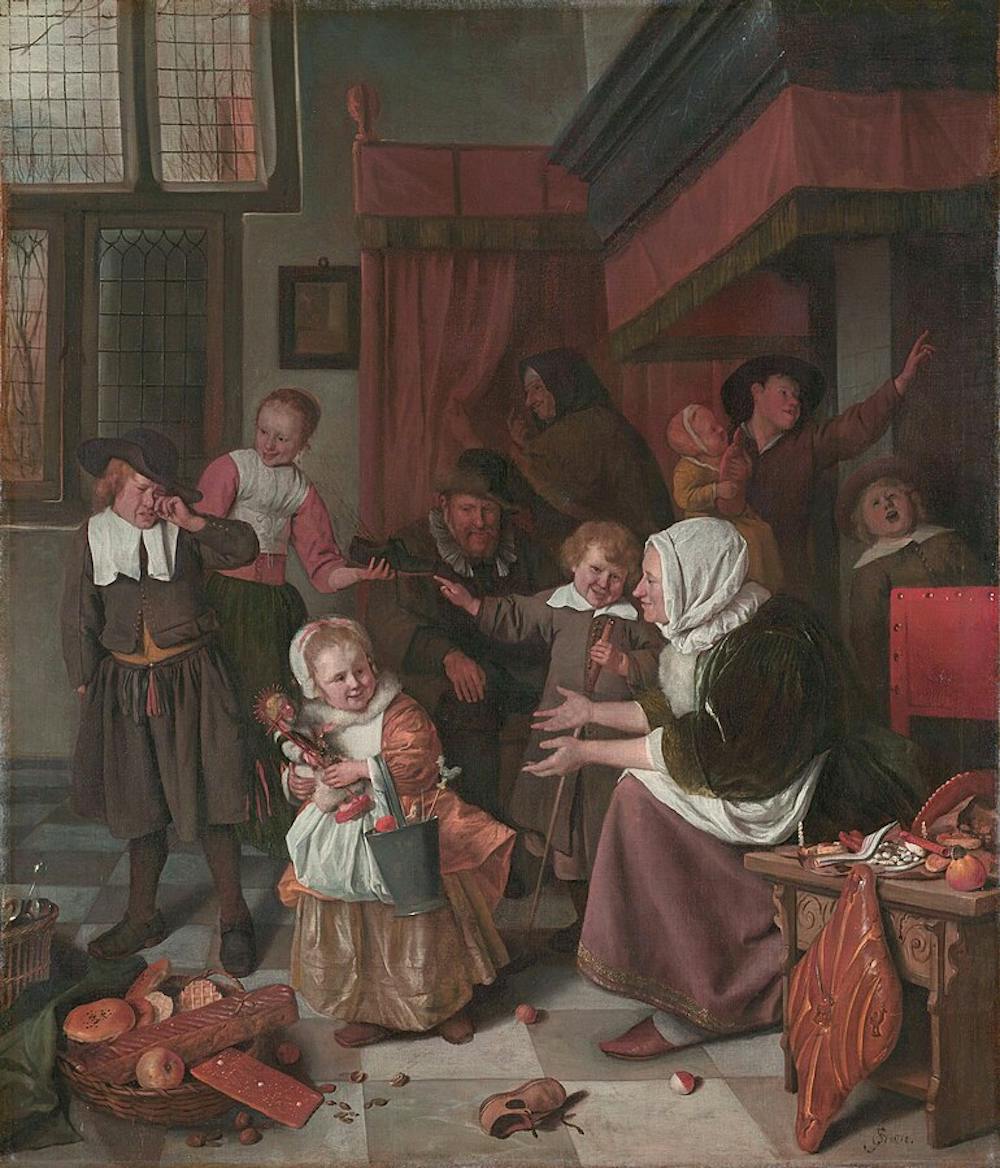
Across Europe, the legacy of St Nicholas’s charity and kindness sparked a variety of traditions, with December 6 becoming his feast day.
In France, particularly in regions such as Alsace and Lorraine, children would leave their shoes out for St Nicholas, hoping to find them filled with chocolates and gifts the next morning.
This tradition was accompanied by parades in which a donkey would pass through town streets, laden with baskets of biscuits and sweets for the children.
In Central Europe, particularly in Alpine regions, St Nicholas Day tradition merged gradually with unique local customs when the non-Christian population adopted Christianity as their religion.
Wikimedia Commons
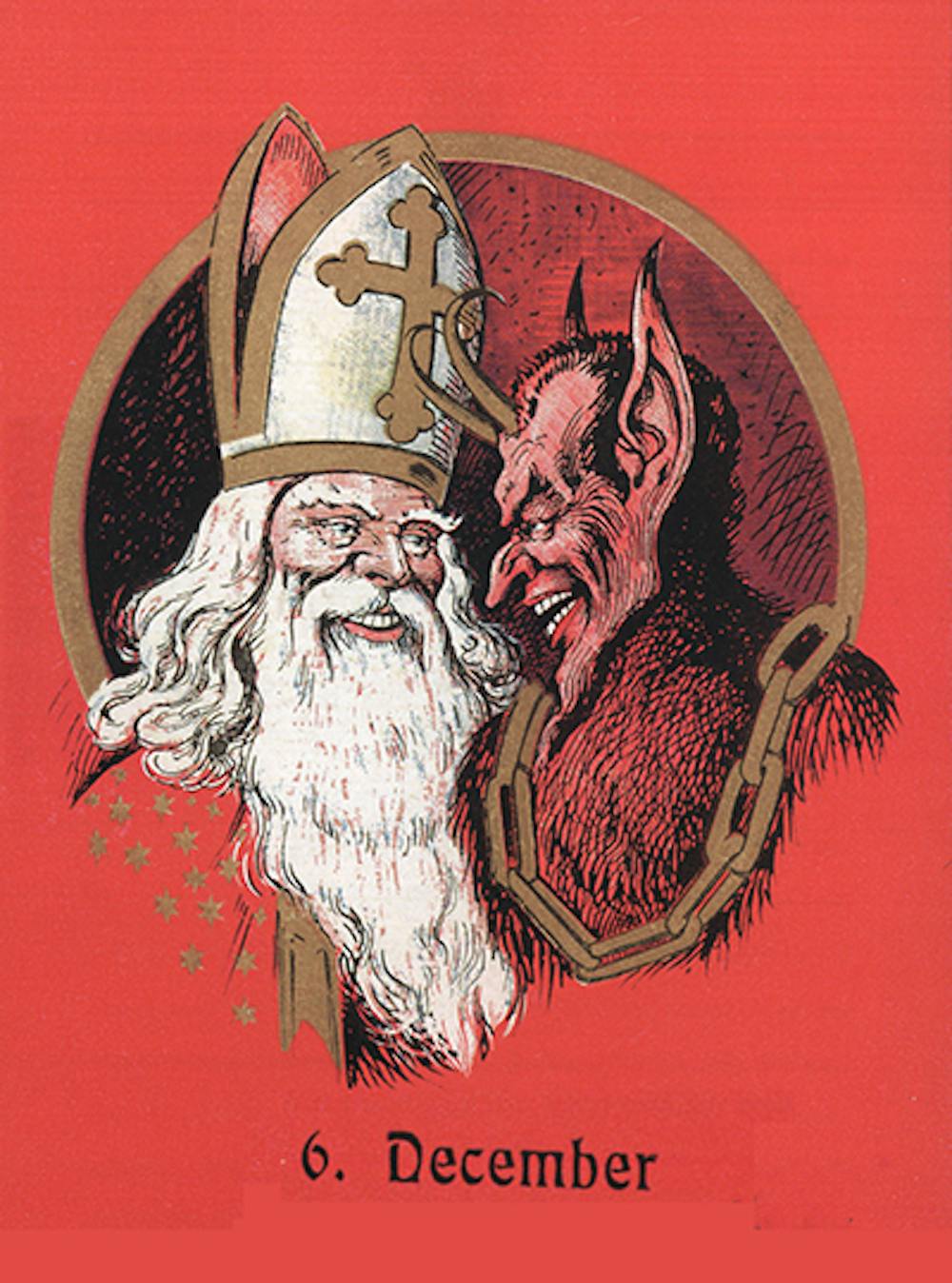
Here, St Nicholas not only rewarded well-behaved children with gifts but was also accompanied by Krampus, a fearsome figure who would “punish” those who had misbehaved.
This tradition underscored the contrasting themes of reward and retribution, integral to the local folklore.
In some regions of Poland, the earlier traditions centred on a figure called Gwiazdor. This “Star Man” dressed in sheepskin and a fur cap, with his face hidden under a mask or smeared with soot, carried a bag of gifts and a rod for naughty children.
The transformation into Santa Claus
The metamorphosis of St Nicholas into Santa Claus was a gradual process influenced by cultural and religious shifts.
In Germany and the Netherlands in the course of the 17th century, the practice of gift-giving in the name of St Nicholas began to take root. The Dutch called him “Sinterklaas”, a term that would eventually evolve into the English colloquial “Santa Claus”. This transformation first occurred in Germany and later spread to other European countries.

Wikimedia Commons
The tradition of St Nicholas was brought to North America in the 17th century.
By the 19th century, various iterations of St Nicholas were emerging in English-speaking communities across the world.
One of the first literary mentions of this figure in the American context was in Washington Irving’s 1809 book, Knickerbocker’s History of New York, which portrayed Nicholas flying in a wagon, delivering presents to children.
The red Santa suit and all related apparel, so familiar to us today, seem to be the invention of modern-day marketing in the English-speaking world.
Across Europe, St Nicholas’s outfit draws more on the traditional image of the saint, with clothes more closely resembling a bishop’s religious attire, complete with a mitre, the tall headdress.
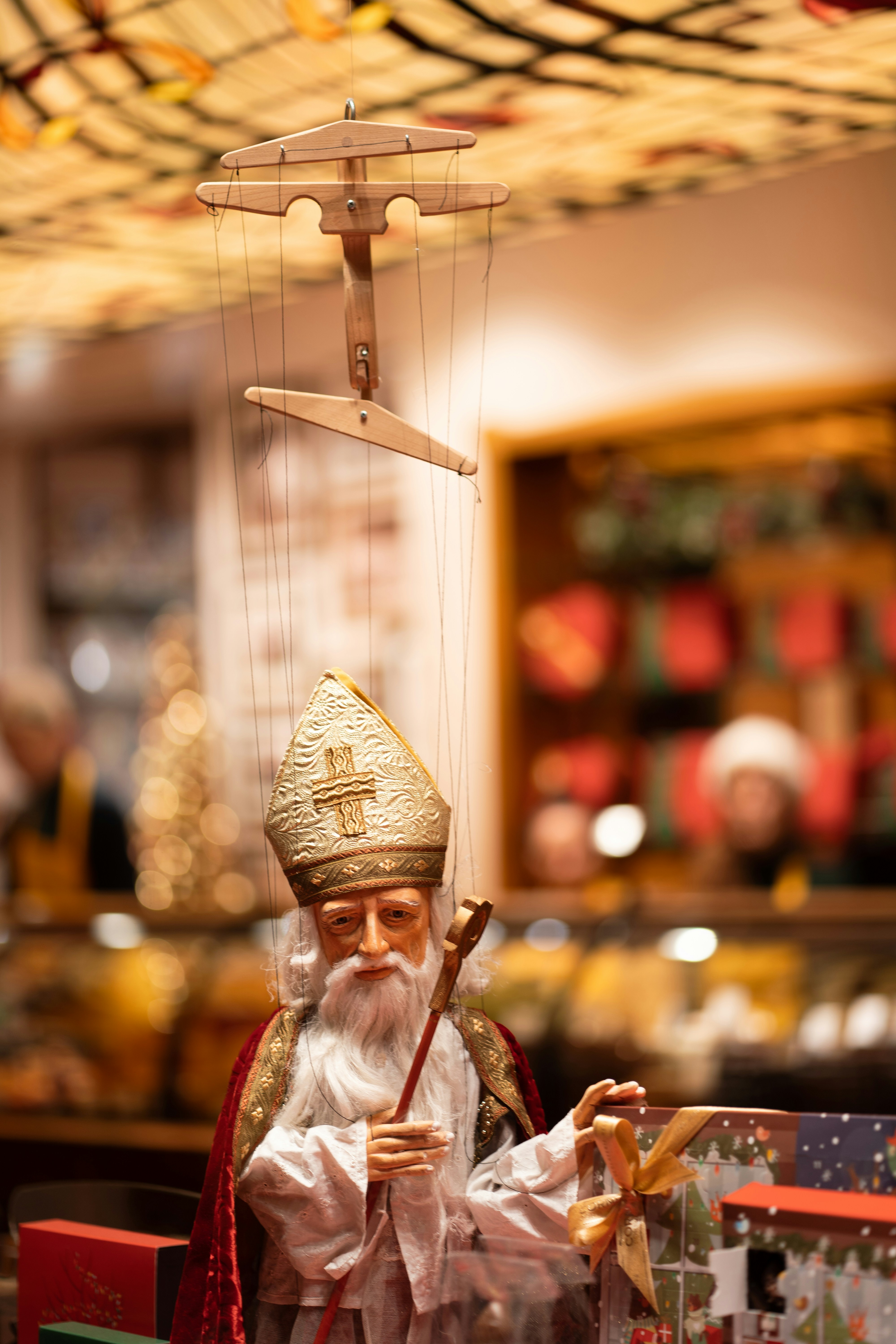
Image Credit – Mira Syniak
The legacy of St Nicholas and Santa Claus
Through centuries of transformation, the core values of St Nicholas – generosity, compassion, and the joy of giving – have remained intact in the figure of Santa Claus. He has gone from being a revered Christian saint to a beloved secular icon.

Wikimedia Commons
This evolution reflects the dynamic interplay of religious tradition and popular folklore. English-speaking Santa Claus, with his North Pole workshop, flying reindeer, and elves, may seem a far cry from the historical bishop of Myra. Yet he continues to embody the spirit of giving that characterised St Nicholas.
Today, thanks to global marketing and commercialisation, Santa Claus transcends religious and cultural boundaries.
The story of his origin, rooted in the life of St Nicholas, enriches our understanding of Christmas and connects us to a tradition that spans centuries and continents.
It reminds us that at the heart of these festivities lies a timeless message: the importance of kindness, generosity, and the spirit of giving.
Darius von Guttner Sporzynski, Historian, Australian Catholic University
This article is republished from The Conversation under a Creative Commons license. Read the original article.
Banner Image: Santa Claus. Image Credit – Alicia Slough



,_page_1.jpg)
.jpg)

Staten Islander News Service Staff Writer
This byline indicates that this article was penned by a member/members of the Staten Islander News Organization office team. Our staff writers are the backbone of our newspaper, performing all sorts of important tasks like conducting interviews, investigating leads, besides writing the news stories you see.
[…] Editor’s note: Yesterday, we covered discussions of the history and legends of Saint Nicholas, also known as Santa Claus. […]