
Staten Island Forgotten Once Again: 2-K Program Of NYC Schools Leaves This Borough Out While Giving Others One, Two Districts
Please see below the maps and details for the Borough President’s announcement about Staten Island not being included in the new 2-K pilot program, among with the Mayor’s announcement of the first pilot locations. It is true that Staten Island has the following characteristics:
- It’s the smallest borough
- It has geographically the largest school district (and uniquely only one for the whole Borough)
- It has fewer students and residents by orders of magnitude than any other borough, with a student population half the size of all of Manhattan, the next largest borough
- There are multiple neighborhoods that need these types of programs. These are areas with low income and high SNAP/WIC eligibility.
Perhaps a different metric could be used for the island, such as neighborhoods (zip codes don’t really all share the same income level or designation, so it would have to be something else).
Please see the charts and graphs below, generated by Gemini or from the Mayor’s Office, to see a visual representation of the school districts and their relative size to each other, the respective sizes and populations of the five boroughs overall with a pie chart showing their different population percentages of the whole city, along with Environmental Justice Communities and Federally Disadvantaged Communities.
Staten Island is considerably less dense than the other counties of New York City, but it still feels unfair to residents that their students, many of whom are from low-income families that could be helped by this program, have once again been left out. This comes on the heels of the push by Staten Island politicians for Staten Island’s secession, due in large part to being left out of programs like this that could bring great benefit to the island, or overall getting less than the borough contributes.

See below for citations for the data in this map*
Below is a map detailing the boroughs of New York City and their relative overall population size. This contrasts with the data in the map above, which covers only student populations:
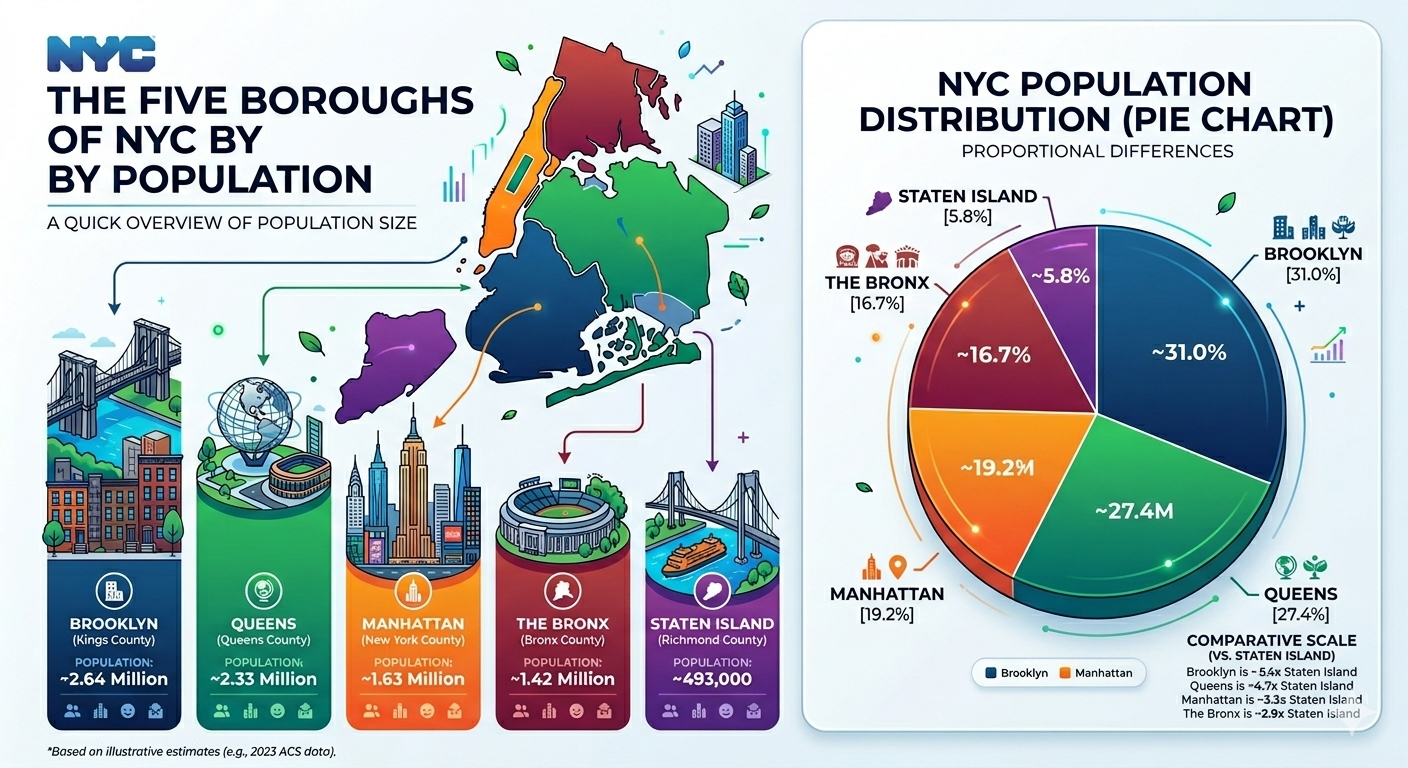
Data from multiple public sources including Wikipedia and City websites. Image created by Gemini
Here is the approximate total enrollment (K–12) for the districts selected for the 2-K rollout, alongside Staten Island for comparison. Staten Island is slightly larger than the largest chosen school district:
| District | Borough | Est. Student Population (K-12) |
| District 6 | Manhattan | ~18,000 |
| District 10 | The Bronx | ~42,000 |
| District 18 | Brooklyn | ~10,000 |
| District 23 | Brooklyn | ~8,000 |
| District 27 | Queens | ~39,000 |
| District 31 | Staten Island | ~54,000 |
As an alternative to using school districts as a standalone criteria, the City could include Staten Island’s lower-income districts, particularly those communities in zip codes 10304 and 10302, the former of which has a very low median household income and many SNAP recipients as well, indicating that this program would be especially helpful to these families:

For additional context, see below for a map of the borough organized with Environmental Justice Communities highlighted. The area in Graniteville was part of this definition, which is determined by state regulations. The green color indicates poverty level, with lightest green referring to highest income and darkest green as lowest income, with two shades in between. Environmental Justice Communities are defined as being on or off, so if the green is also bluish, that means it qualifies as both having lower income and being an EJC. Due to proximity to industrial areas and pollutants, some higher income areas are defined as EJCs as well.


NYC Mayor’s Office EJC tool screenshot, both demographic poverty level indicators and EJC indicators
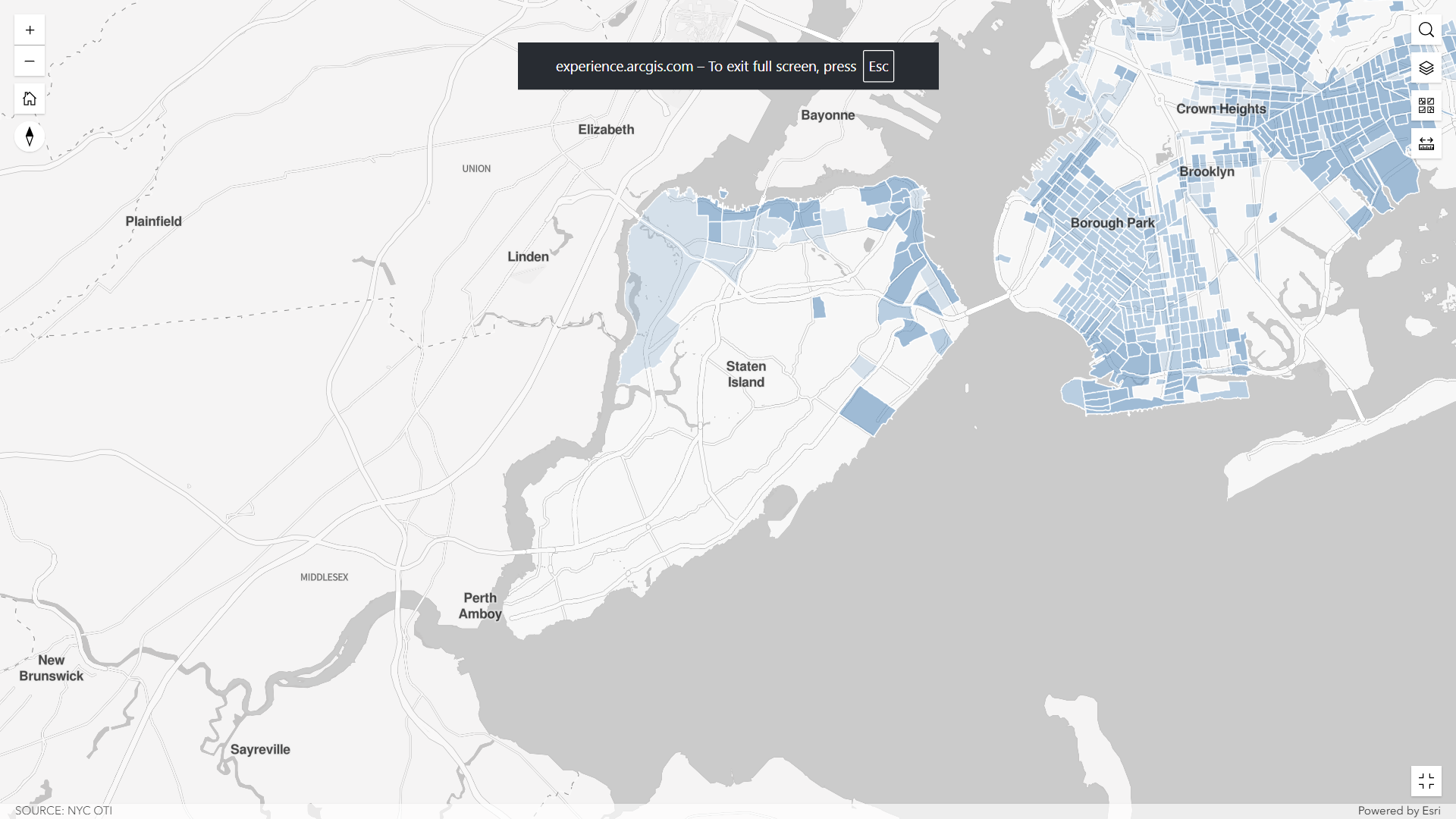
Environmental Justice Communities and Federally Disadvantaged Communities ONLY, income and poverty demographic data excluded. Darker blue is FDC. NYC Mayor’s Office

Legend for above maps. Credit – NYC Mayors Office
The below info is from AI. However, these arguments have little validity as you can see from the foregoing. The Island could also get a small area to participate in the pilot, dividing the district into neighborhoods, such as Mariners Harbor or Stapleton:
Why Staten Island was likely excluded from the start:
-
Capacity & Demand: District 31 is geographically massive but has a single district structure. The pilot targets specific high-need neighborhoods (like Brownsville in D23 or Fordham in D10) where the city is testing the infrastructure for 2-year-olds.
-
Pilot Scale: The 2-K program is launching with a limited number of seats (approx. 2,000). To maximize the “test” results, the city chose diverse pockets across four boroughs rather than a universal borough-wide rollout.
| Borough | Number of Districts | District Numbers | Est. Student Pop. (2024-25) |
| The Bronx | 6 | 7, 8, 9, 10, 11, 12 | ~190,000 |
| Manhattan | 6 | 1, 2, 3, 4, 5, 6 | ~135,000 |
| Brooklyn | 12 | 13, 14, 15, 16, 17, 18, 19, 20, 21, 22, 23, 32 | ~270,000 |
| Queens | 7 | 24, 25, 26, 27, 28, 29, 30 | ~245,000 |
| Staten Island | 1 | 31 | ~65,000 |
While it might be more challenging to include Staten Island, a different metric could be used – such as neighborhoods or FDCs. See below for some info from Gemini about 10304 and 10302 on the island, whose students could be added to the qualified list:
-
Zip 10304 (Stapleton/Park Hill): Features some of the lowest median household incomes on the island, often falling below $40,000, with significant enrollment in SNAP.
-
Zip 10302 (Port Richmond): High population density compared to the South Shore, with a median income significantly lower than the borough average of $98,290.
MAYOR MAMDANI AND GOVERNOR HOCHUL ANNOUNCE FIRST FOUR COMMUNITIES TO RECEIVE FREE 2-K SEATS
With Support from Governor Kathy Hochul, Four Communities Will Receive 2,000+ Free Child Care Seats for Two-Year-Olds this Fall
NEW YORK — TODAY, in a major step toward universal child care from six weeks to five years old, Mayor Zohran Kwame Mamdani and Governor Kathy Hochul announced the first four communities that will receive free 2-K seats this fall.
The four communities are:
- School District 6: Washington Heights, Inwood and Hamilton Heights as well as parts of Manhattanville
- School District 10: Fordham, Belmont, Norwood, Marble Hill, Morris Heights, Riverdale, Spuyten Duyvil, Van Cortlandt Village and Kingsbridge as well as parts of Kingsbridge Heights, Bedford Park, Mount Hope, Claremont- Bathgate & East Tremont
- School Districts 18 and 23: Canarsie, Rugby-Remsen Village, Brownsville and Ocean Hill as well as parts of East Flatbush- Farragut and Prospect Lefferts Garden-Wingate
- School District 27: Ozone Park, South Ozone Park, Richmond Hill, Woodhaven, Howard Beach and Rockaways as well as parts Lindenwood and Springfield Gardens North
First announced on day eight of the Mamdani administration alongside Gov. Kathy Hochul, 2-K is a cornerstone of the Mayor’s universal child care initiative. The program will provide free child care for two-year-olds in New York City to any family who needs it, regardless of zip code, income or immigration status.
The program will launch with 2,000 free seats this fall and expand to full universality within four years.
Earlier this year, Gov. Hochul committed more than $1.2 billion to support early childhood care and education in New York City, including $73 million to fund the first set of free 2-K seats. That investment will grow to $425 million next year. By fall 2027, 2-K is expected to serve approximately 12,000 children across all five boroughs, with the goal of reaching every two-year-old in the city at full implementation.
“Raising a child takes a village – and it takes a city government willing to step up and tackle the child care crisis head-on,” said Mayor Zohran Kwame Mamdani. “On day eight, we moved closer to making universal childcare a reality. This fall, 2,000 New York City two-year-olds will have a brighter future because of it. Launching free 2-K in these four neighborhoods is just the beginning of our work to put money back in New Yorkers’ pockets, strengthen our entire economy and help more families build their lives here.”
“Raising a family in New York shouldn’t feel like a luxury, and today we’re taking another significant step to deliver universal child care,” said Governor Hochul. “Earlier this year, Mayor Mamdani and I stood together to announce the state’s historic investment in New York City’s 2-K program, delivering free child care for two-year-olds across the City. This is how we make New York the best place to start a family and build a future – and we’re just getting started.”
“The launch of 2-K reflects our commitment to reaching families with the greatest need and building a system that grows to serve every child in every community,” said Schools Chancellor Kamar Samuels. “We are opening the doors for thousands of two-year-olds and their families, delivering free, full-day care and early learning and paving the way for bright futures from our students’ earliest ages.”
“After years of fighting for universal child care, we finally have a Mayor who’s fighting alongside us — and we’re seeing the impact of that,” said New York State Senator Jabari Brisport. “I look forward to continuing to work with Mayor Mamdani, parents, and child care providers to win full universal child care for every family in New York.”
“We have witnessed a significant rise in the cost of quality childcare, which has put immense stress on families,” said New York State Assembly Speaker Carl E. Heastie. “Affordable, reliable childcare is essential for families as they maneuver their day to day , making today’s 2-K announcement a step in the right direction. Initiatives like Universal 2-K and similarly 3-K enables more community members to enter or re-enter the workforce, launch businesses, and sustain employment. Thank you to Mayor Zohran Mamdani, Governor Kathy Hochul, and the legislature for ensuring that this became a reality. When we work together, we bring forth positive change keeping the families of New York first.”
“As a mother of four, advocate, educator and public servant who founded and operated a 24/7 child care center, I’ve lived the reality behind the ongoing basic needs that are compromised for childcare for those who don’t have enough to make ends meet. Guaranteeing universal 3-K and pre-K means New York chooses to invest in children’s most critical years, keep families rooted in their communities, and build an economy where raising a family doesn’t mean going broke,” said Assemblywoman Chandler-Waterman. “Millions of New Yorkers have been shut out from these benefits, and our economy has paid the price in lost families, lost workers, and billions in lost growth. Universal 2-K regardless of background, language barrier, income, or immigration status is a monumental step in removing the burden on families. While this is a needed step we must ensure that child care workers will be making a livable wage with fair working conditions. I am committed to working with all my school districts, especially with School District 18 where initial slots will be available, as we push the initiative, keep programs financially viable, and create high-quality, diverse learning environments where all children benefit.”
“I’m deeply grateful to Mayor Mamdani and Governor Hochul for recognizing the urgent need in Washington Heights and Inwood and selecting School District 6 as one of the first communities to receive 2-K seats,” said Manhattan Borough President Brad Hoylman-Sigal. “For so many Northern Manhattan families, the cost of child care is an overwhelming burden, and this investment will make a real difference in parents’ ability to work and in giving our youngest learners a strong foundation. Expanding access to free, high-quality care — regardless of income, zip code, or immigration status — is an essential step toward true universal child care, and I’m proud that District 6 is helping lead the way.”
“Families across South Queens and the Rockaway Peninsula have endured generations of systemic disinvestment in their children’s education, from a lack of funding for their schools to a lack of urgency in ensuring our youngest students are given the proper head start they deserve. With District 27 set to become the borough’s first 2-K district this fall, we are taking another seismic leap forward in righting the wrongs of the past and building an education system rooted in equity,” said Queens Borough President Donovan Richards Jr. “As the father of an elementary school student myself, I couldn’t be more excited for the freedom this program will deliver for our families — both for our kids and for parents who have been stretched thin by the cost of childcare. I look forward to working with the Governor, the Mayor and all our partners to ensure we deliver high-quality 2-K to every family in District 27 and, in time, beyond.”
“The 2-K districts announced today will provide direct relief to families that are bearing the brunt of the affordability crisis, and I am thrilled that Canarsie, Brownsville, and Ocean Hill are among the first communities to benefit from this historic expansion of childcare,” said Brooklyn Borough President Antonio Reynoso. “This is exactly the type of visionary change New Yorkers have demanded of their elected officials, and I thank Mayor Mamdani and Governor Hochul for delivering results.”
“This initial launch of 2-K in neighborhoods across the city is a critical next step toward full universal child care, and I thank Governor Hochul and Mayor Mamdani for their leadership in moving this forward. Together with the City Council, we are expanding opportunity for our youngest New Yorkers and delivering real support for working families across our city,” said Speaker Julie Menin.“I have long championed universal child care as essential to making New York more affordable and equitable. From advancing the Council’s Universal Childcare Act in 2022 to advocating for the opening of a new early education center on the East Side of Manhattan, we are laying the groundwork to lead the nation on childcare.”
“Protecting our city’s future starts with protecting our families,” said Council Majority Leader Shaun Abreu. “Mayor Mamdani’s commitment to expanding 2-K is an investment in working parents, in our youngest New Yorkers, and in the long-term strength of our communities. When families have stability and support, our whole city thrives.”
“Expanding access to free, high-quality early education is one of the smartest investments we can make as a city,” said Council Member Eric Dinowitz, Chair of the Education Committee. “I’m proud that District 10 is among the first communities to receive 2-K seats this fall. Universal child care strengthens working families, supports our youngest learners at a critical stage of development, and helps ensure that a child’s zip code, income level, or immigration status never determines their opportunity. I look forward to working with the administration and our local providers to make sure this rollout is strong, equitable, and delivers for Bronx families.
“One of the things we heard clearly at yesterday’s hearing on this administration’s path toward universal child care was the public’s call to rebuild trust, especially when it comes to keeping promises,” said Council Member Jennifer Gutiérrez, Chair of the Subcommittee on Early Childhood Education. “Announcing the first locations where 2-K will become a reality so quickly is a meaningful step in delivering on that commitment, and I’m encouraged to see some neighborhoods with the greatest need being prioritized. I look forward to continuing to work with the administration to expand this effort and ensure families across our city can access the care they need.”
“I commend Mayor Mamdani for delivering on his critical campaign promise to expand 2-K for working families, and I’m proud that our very own Community School District 23, serving Canarsie, Brownsville, and Ocean Hill, will be among the first to receive 2,000 2-K seats this fall,” said Council Member Sandy Nurse. “Childcare costs in this city are soaring to thousands of dollars a month, and working families just can’t keep up. Free 2-K will work to directly keep working families of color here.”
“Far too many families in our community are forced to make impossible decisions about their child’s education and care because of rising costs and limited access,” said Council Member Lynn Schulman. “Universal child care must begin with meaningful, targeted investments in neighborhoods that need it most. These new 2-K seats, some of which are slated for my district, are a critical step toward making early childhood education truly accessible and affordable for every family. I want to thank Mayor Mamdani and Governor Hochul for this major investment in our city’s families and the future of our kids.”
“Access to childcare allows New York families, local communities, and our city’s economy to function. Children – regardless of immigration status – need access to nurturing and quality care to thrive, while families rely on childcare to allow them the freedom to work, go to school, and so much more,” said Murad Awawdeh, President and CEO, New York Immigration Coalition. “Thanks to a partnership between Governor Hochul and Mayor Mamdani, NYC is now ushering in a new era now with the promise of free child care for two-year-olds in New York City. Today’s announcement is the beginning of a roll out that will support the city to achieve universal care and, ultimately, serve all families, regardless of legal status, across the city. We thank the Mamdani administration for recognizing the challenges faced by so many hardworking New Yorkers including immigrant New York families.”
“With today’s announcement, the Governor and Mayor demonstrated a clear commitment to tackling New York City’s affordability crisis,” said Rebecca Bailin, executive director of New Yorkers United for Child Care. “Thousands of parents throughout the city can breathe a sigh of relief knowing they will save tens of thousands of dollars each year once their child turns two.This announcement is also a testament to the power of organizing. Parents and would-be parents, desperate to build a city they can afford to raise their families in, came together to demand free child care for two-year-olds – and now, we’re seeing that vision become reality.”
“When our oldest was ready for 3-K last year, we couldn’t get a seat – and we had to literally pay the price for it with private day care,” said Suz Kroeber, parent leader with New Yorkers United for Child Care and a mom of 2 in Washington Heights. “This year, things are completely different. Mayor Mamdani’s administration has shown up for parents in a way we haven’t seen in years. Applying for Pre-K was easier, and knowing that 2-K will be there in our neighborhood when our youngest turns two will be a game changer. Instead of pinching every penny just to cover daycare, we can start thinking about saving for college or retirement. All we want to do is raise our kids in New York City. 2-K makes that possible.”
“As a working mom of 2, life is already a juggling act. When you can’t find childcare, it’s not just about missing work — it’s about missing out on opportunities, feeling like you’re failing both at home and at your job. But when my daughter finally turned three last month I was able to enroll her in a pre-k seat. It wasn’t just a convenience — it was a game-changer,” said Cynthia Norris, working parent of 2 and member of New York Communities for Change. “I’m grateful that the Mayor and the Governor have taken these major steps towards expanding childcare access so other families don’t have to go through what mine did.”
The initial four communities were selected based on economic need, projected child care demand, existing access gaps, provider capacity and readiness. These first 2,000 seats are designed to serve families in high-need neighborhoods while ensuring programs launch responsibly and sustainably, with inclusive access for children with disabilities and families in temporary housing, including shelters.
Services will begin in September 2026, with rolling enrollment throughout the fall to accommodate children turning two at different points in the year. In the coming days, the City will begin planning efforts with child care centers and family child care providers in these four communities. Additional details on participating providers will be released in the weeks ahead.
*The NYC School Districts: 2K Eligibility Data was generated based on data from the following sources:
-
**** NYC Department of Education (DOE): 2024-2025 Preliminary School Enrollment Overview. This covers the total citywide student population and the specific 32 Community School District divisions.
-
**** Office of the Mayor of New York City: Expansion of Early Childhood Education Initiative (2-K Pilot Program). This confirms the specific districts (6, 10, 18, 23, 27) selected for the fall rollout.
-
**** NYC Open Data: Demographic Snapshot by School District. This provides the specific enrollment numbers for individual districts (like the ~54,000 students in Staten Island’s District 31).
See below for abbreviated sources for the maps above generated by Gemini AI:
1. NYC School Districts & 2-K Eligibility Map
-
NYC Public School Enrollment (2024-2025): Data regarding the 906,000+ student population and borough-specific totals (like the ~190,000 in the Bronx) comes from the NYC Independent Budget Office (IBO) Education Snapshot.
-
2-K Pilot Selection: The designation of Districts 6, 10, 18, 23, and 27 for the “2-K” pilot program is based on official updates found in NYC Public Schools MySchools Admissions and Mayor’s Office announcements.
2. Staten Island Income & Targeted Needs Map
-
Median Household Income by Zip Code: The income levels (e.g., $36,216 for 10304 vs. the borough average of $98,290) are sourced from the U.S. Census Bureau’s American Community Survey (ACS), specifically the most recent 2023/2024 updates for Richmond County.
-
SNAP and Public Benefit Density: The concentration of SNAP recipients in the Stapleton and Port Richmond areas (10304, 10302) is tracked by the NYC Council Data Team and the Citizens’ Committee for Children of New York (CCC).
-
Environmental Justice (EJ) Communities: The identification of Jersey St, Bay St, and Targee St areas as high-need Environmental Justice zones is based on the EJNYC Report and Mapping Tool released by the Mayor’s Office in April 2024.
| Metric | Specific Source | Primary URL |
| Borough Enrollment | NYC IBO Snapshot | ibo.nyc.gov |
| District Boundaries | NYC Open Data | opendata.cityofnewyork.us |
| Income (10304/10302) | US Census ACS | census.gov |
| SNAP Enrollment | CCC New York / DSS | cccnewyork.org |
| EJ Areas | MOCEJ EJNYC Tool | climate.cityofnewyork.us |
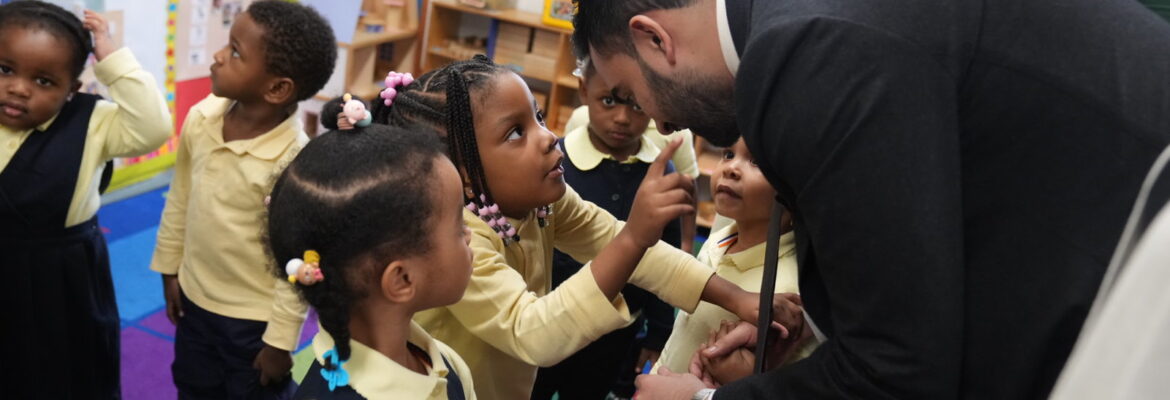
Banner Image: Mayor Mamdani reads to a 3-K class in Canarsie. Wednesday, March 4, 2026. Image Credit – Ed Reed/Mayoral Photography Office.


Staten Islander News Service Staff Writer
This byline indicates that this article was penned by a member/members of the Staten Islander News Organization office team. Our staff writers are the backbone of our newspaper, performing all sorts of important tasks like conducting interviews, investigating leads, besides writing the news stories you see.
There are no comments yet
Why not be the first