
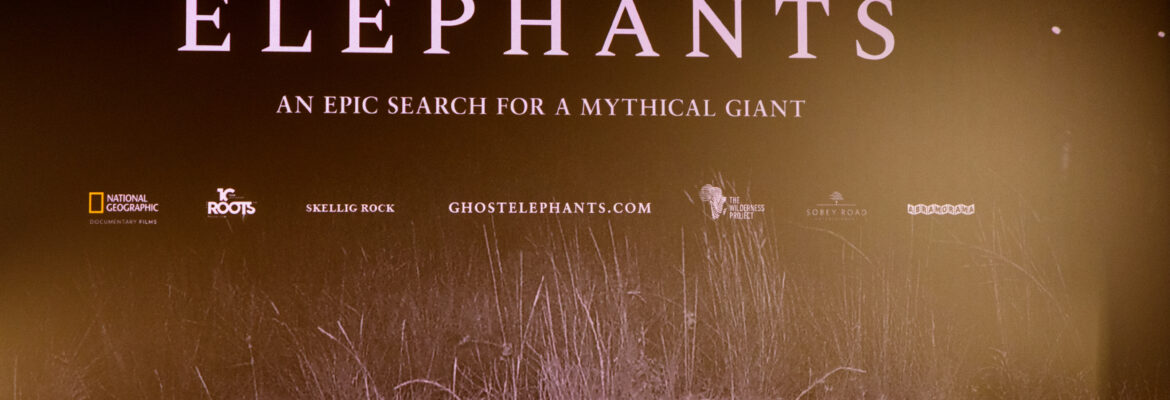
National Geographic “Ghost Elephants”: Must-See Movie Narrates Drastic Population Decline By Humans, Scientist Attempts To Find Descendants Of Smithsonian Giant Elephant In Modern Africa
National Geographic “Ghost Elephants”: Must-See Movie Narrates Drastic Population Decline By Humans, Scientist Attempts To Find Descendants Of Smithsonian Giant Elephant In Modern Africa
Below, see a video slideshow of photos from the film and the participants, along with pictures from the opening night, which also included a panel discussion with the filmmaker and the researcher that provided the expedition for the film.
This movie was excellent. It follows the journey of the scientist, Dr. Steve Boyes, who is a conservation biologist and National Geographic Explorer. He comes to realize, looking at the giant elephant hosted at the Smithsonian Museum (with its head and tusks reconstructed from much lighter material, as the original was too heavy to display. He believes, and sets out to prove, that the descendants of this particular elephant genetic line, which he calls Ghost Elephants, still exist today, perhaps in the depths of Angola on the African continent.
The journey of this scientist and his group of local guides and trackers is one where we learn a great deal about the lives of the people in these tribes which are still hidden from the modern world. These people are not known to Western societies. However, they are the ones that have the greatest likelihood of finding these elephants. However, it must be remembered that they are also hunters. Hunters have a different feel, a different smell, and will stand out to the elephants they are following. They did get more than I had expected. It had seemed like they might not actually ever catch a glimpse of these ancient animals.
The sadness of this film carried well the tragedy that was elephant hunting in the earlier parts of this century. It appears to have been around the time of the Vietnam War and that time period where it was culturally acceptable and applauded when a man hunted and killed a large and majestic elephant. Especially if it turned out to be a rare, prized find, it was considered noble and majestic to have killed it, especially for a scientist. They could take back the body and study it and reconstruct it in a museum for everyone to see. But it did not get to live its life. And the barbarism of that time, not of the scientists but of “game hunters,” was astonishing. I mean, seriously, wow, you killed that majestic elephant. You had a helicopter with a reloadable rifle, a guy on the ground with another gun, and you circle around and around the elephant, where it is completely cornered and trapped and running around in circles, and you ambushed it with this flying machine and were finally able to make it collapse and take it back as a prize.
And, of course, we cannot forget the ivory trade, which is now banned for ALL ivory in the United States, no matter if it is from a modern animal or from an ancient Woolly Mammoth tusk. The fields of elephant carcasses, all killed for their tusks and left to rot, was saddening. It was like what the Americans did to the buffalo. They just shot them for sport or to seem like they were in charge and the best ever, the most incredible person because they could shoot an animal to death. A being that has no gun, no defense against a gun, no way to fight back. Like, wow.
One thing I would point out is that they probably should have taken along someone who was a tracker but not a hunter. Because, as mentioned previously, it has been shown that animals of many types can tell the difference between someone there to hunt them and someone there to be a friend. If the expedition had included at least one person that fit that definition, they would have been much more likely to get even closer to the Ghost Elephant, which they did finally find. They were able to get samples of the poop and even found a hair, so that they had as much genetic material as possible, along with footage of the Ghost Elephant. It turns out, it is related to the one on display in the Smithsonian, after all.
This is definitely a Must-See Movie, and I would give it five stars. See below for more information about the film and the theatrical screening with discussion panel:


SYNOPSIS:
For over a decade, Dr. Steve Boyes, conservation biologist and National Geographic Explorer, has been in search of a mysterious, elusive herd of Ghost Elephants in the highlands of Angola, deep within its forests. From acclaimed director Werner Herzog (“Grizzly Man”), GHOST ELEPHANTS follows Boyes on an epic journey as he sets out with some of the best master trackers in the world, in pursuit of an animal long believed to be a myth.
SYNOPSIS
For over a decade, Dr. Steve Boyes, conservation biologist and National Geographic Explorer, has been in search of a mysterious, elusive herd of Ghost Elephants in the highlands of Angola, deep within its forests. From acclaimed director Werner Herzog (“Grizzly Man”), GHOST ELEPHANTS follows Boyes on an epic journey as he sets out with some of the best master trackers in the world, in pursuit of an animal long believed to be a myth.
ABOUT THE FILM
In the mist-covered highlands of Angola, deep within its forests, a mystery endures: the elusive ghost elephants of Lisima, the potential living descendants of the largest land mammal ever recorded. Steve Boyes, conservation biologist and leader of the National Geographic Okavango Wilderness Project, is determined to prove their existence.
In order to find these elusive elephants, Boyes and fellow National Geographic Explorer Kerllen Costa have teamed up with three KhoiSan master trackers: Xui, Xui Dawid, and Kobus. Refugees from a war-torn past who have faced considerable marginalization in southern Africa, the trackers return to their ancestral lands to succeed where advanced technology could not.
Directed, narrated and written by legendary filmmaker Werner Herzog, GHOST ELEPHANTS is a lyrical tale of survival, reconnection and the enduring power of ancient knowledge in the face of modern loss.
Complementing the film is the coffee table book “Okavango and the Source of Life” by Steve Boyes, releasing March 3 in tandem with the documentary. The book expands the journey beyond the screen, featuring more than 100 striking photographs, detailed maps, and Boyes’ personal reflections from years of grueling expeditions to the Angolan headwaters of the Okavango. It documents the same remaining waterways, communities and fragile ecosystems explored in the film, conveying the physical and emotional toll of navigating a wilderness long closed off by war.
With a foreword by Prince Harry, the Duke of Sussex and portraits of local traditional knowledge keepers, the book offers an intimate and visually rich companion to the cinematic experience. The “Source of Life” refers to the Angolan Highlands Water Tower, the lifeline that sustains the Okavango Basin across Angola, Namibia and Botswana. This vital system provides 95% of the water for the Okavango Delta supports people, wildlife and the ecosystems of seven African nations.
After meeting Steve Boyes, an unexpected project that felt like the hunt for Moby Dick, the White Whale, came at me with great urgency. Like many of my films, this is an exploration of dreams, of imagination — weighed against reality. The film took me to what the local tribesmen call the “Land at the End of the Earth.”
-Werner Herzog, February 2026
PARTICIPANT BIOS
STEVE BOYES
National Geographic Explorer and Conservation Biologist
National Geographic Explorer Steve Boyes has dedicated his life to conserving Africa’s wilderness areas and the species that depend on them through innovative and integrative methods. In 2015, Boyes launched the National Geographic Okavango Wilderness Project, a multiyear effort to explore and protect the little-known wilderness of the Angolan Highlands that provides over 95% of the water that sustains the Okavango Delta and the biodiversity of the greater Kavango Zambezi Transfrontier Conservation Area. His team’s efforts to advance scientific research, scale conservation efforts, and preserve traditional knowledge are supported by the Okavango Eternal partnership between the National Geographic Society and the De Beers Group. He is the founder and chairman of the Wild Bird Trust and The Wilderness Project, and a senior research fellow at the FitzPatrick Institute of African Ornithology (University of Cape Town). Boyes is also an author, TED speaker and storyteller. His films, “Into the Okavango” and “Ghost Elephants,” reveal the importance of vital ecosystems and the people, wildlife and biodiversity they nourish.
KERLLEN COSTA
National Geographic Explorer, Ethnobiologist and Environmental Anthropologist Kerllen Costa has dedicated his career to protecting Angola’s natural and cultural heritage. As the Angola country director for the National Geographic Okavango Wilderness Project, he has led scientific expeditions deep into some of southern Africa’s most remote rivers, while advocating for the powerful role of Indigenous ecological knowledge. Together with Boyes, Costa went on a mission to follow a mysterious herd of Ghost Elephants in the jungles of Angola. Their exciting adventures have been featured in National Geographic’s documentary “Ghost Elephants,” which premiered at the 2025 Venice International Film Festival. Costa was a recipient of the National Geographic Society’s 2024 Wayfinder Award.
FILM TEAM BIOS
WERNER HERZOG (Director / Writer / Narrator / Producer)
National Geographic Explorer
Born in Munich in 1942, Werner Herzog grew up as a child in a remote valley in the Bavarian mountains. Until age 11, he did not even know of the existence of cinema. He started to develop film projects from age 15 on, and since no one was willing to finance them, he worked the night shift as a welder in a steel factory during the last years of high school. He also started to travel on foot. He made his first phone call at age 17 and his first film at 19. He dropped out of college where he studied history and literature.
Since then, he has written, produced, and directed some 80 films, has published books of prose, staged about a dozen operas, acted in films, and founded his own Rogue Film School.
ARIEL LEON ISACOVITCH, G.S.C. (Producer)
Born and raised in Israel, Ariel Leon Isacovitch spent the last 20 years floating in different seas, with a mixed cultural background. His natural sense of curiosity led him to lay roots in South America. Isacovitch is the owner of The Roots Production Service with offices in Mexico, Chile, Argentina and Uruguay. A member of the advisory board of the U.S. initiative Green The Bid, Isacovitch helps to educate the film industry to be more sustainable. Since founding The Roots Production Service 10 years ago, he has been a partner and producer on Werner Herzog’s last five films.
See below for the advance screening announcement, from which the photos in the above slideshow have come:
NATIONAL GEOGRAPHIC DOCUMENTARY FILMS AND ABRAMORAMA UNVEIL TRAILER, COAST-TO-COAST THEATRICAL SIMULCAST, AND DISNEY+ AND HULU STREAMING DATE FOR WERNER HERZOG’S
GHOST ELEPHANTS
A NEW FEATURE DOCUMENTARY FROM THE LEGENDARY FILMMAKER, GHOST ELEPHANTS FOLLOWS NAT GEO EXPLORER STEVE BOYES ON A QUEST TO FIND THE LARGEST LAND MAMMALS EVER RECORDED
From Sobey Road Entertainment, The Roots Production Service and
Skellig Rock, Inc., GHOST ELEPHANTS Will Open in Select North American Theaters on Feb. 27, Air on National Geographic on March 7, and Stream Next Day on Disney+ and Hulu
‘Okavango and the Source of Life,’ a Coffee Table Book by Steve Boyes That Expands on the Journey Beyond the Screen, Will Be Released on March 3 in Tandem With the Documentary
(WASHINGTON, LOS ANGELES, NEW YORK) – National Geographic Documentary Films and Abramorama debuted the trailer for the feature-length documentary GHOST ELEPHANTS, directed, written and narrated by Werner Herzog (“Grizzly Man”) and produced by Ariel León Isacovitch and Herzog. Airing on National Geographic on Saturday, March 7, at 9/8c and streaming the next day, March 8, on Disney+ and Hulu, the film follows National Geographic Explorer Steve Boyes on an epic journey as he sets out with some of the last remaining master trackers in the world in pursuit of an animal long believed to be a myth.
On Thursday, Feb. 26, Abramorama will host a one-night-only GHOST ELEPHANTS nationwide theatrical simulcast screening event followed by a live Q&A panel with Herzog and Boyes. Executive producer Brian Nugent will introduce the 7 p.m. public screening at the AMC Lincoln Square in Manhattan and join the panel discussion that will be transmitted live to theaters nationwide via the Digital Cinema Distribution Coalition in coordination with Abramorama’s live event partner take2productions. Abramorama will release the documentary in select North American theaters beginning on Feb. 27. The film will also be released in select international territories, including Benelux (POM Benelux), France (Blue Note Films), Mexico (Daimon Cine), and Lithuania (Virtuoliai).
In the mist-covered highlands of Angola, deep within its forests, a mystery endures: the elusive ghost elephants of Lisima, the potential living descendants of the largest land mammal ever recorded. Steve Boyes, conservation biologist and leader of the National Geographic Okavango Wilderness Project, is determined to prove their existence.
In order to find these elusive elephants, Boyes and fellow National Geographic Explorer Kerllen Costa have teamed up with three KhoiSan master trackers — Xui, Xui Dawid, and Kobus — to succeed where advanced technology could not.
Directed, narrated and written by legendary filmmaker Werner Herzog, GHOST ELEPHANTS is a lyrical tale of survival, reconnection and the enduring power of ancient knowledge in the face of modern loss. The film premiered at the Venice Film Festival, where Herzog received the Golden Lion for Lifetime Achievement.
Complementing the film is the coffee table book “Okavango and the Source of Life” by Steve Boyes, releasing March 3 in tandem with the documentary. The book expands the journey beyond the screen, featuring more than 100 striking photographs, detailed maps, and Boyes’ personal reflections from years of grueling expeditions to the Angolan headwaters of the Okavango. It documents the same remaining waterways, communities and fragile ecosystems explored in the film, conveying the physical and emotional toll of navigating a wilderness long closed off by war. With a foreword by Prince Harry, the Duke of Sussex and portraits of local traditional knowledge keepers, the book offers an intimate and visually rich companion to the cinematic experience. “Okavango and the Source of Life” is available for preorder now via Disney Books.
GHOST ELEPHANTS is directed, narrated and written by Herzog. It is produced by Herzog for Skellig Rock, Inc. and Ariel León Isacovitch for The Roots Production Service. Sobey Road Entertainment is the producing partner with Brian Nugent, Andrew Trapani, Emerson G. Farrel, David Sze, David B. Kirk, Terrence Battle, Richard Sneider, Christopher White and Casey Graf as executive producers. For National Geographic Documentary Films, Carolyn Bernstein, executive vice president of Documentary Films, and Tim Horsburgh, vice president of Documentary Films, are executive producers. An Abramorama in partnership with National Geographic Documentary Films North American Theatrical Release. For more info, visit www.ghostelephants.com.


There are no comments yet
Why not be the first