
New York Senator: Student Loan Debt Relief, Standing With Unions, Tree Planting Funding For Underserved Communities, UAP Release, Second Ave Subway, Other Updates
Student Loan Debt Relief, Release Bronx Funding, Standing With Unions, 60 Days Of Iran War, Tree Planting Funding, Eliminating Pensions For Sex Offenders, Honoring “Donut Dollies” From Vietnam War, FTC Restrictive Covenants, Education Dept Support For Underprivileged Students, Tariffs Struck Again, UAP Release, Second Ave Subway.
Editor’s note: Planting of trees in underserved communities isn’t a frivolous act. There are many studies over the years and decades that have shown that greenspace, generally in the form of trees, parks, and woodlands, improves the cognitive health of youngsters, leading to reduced incidences of depression and other mental health challenges. Tree canopy isn’t just good for humans and their health, though. It is useful in restoring ecosystems and watersheds which have been damaged by pollution or neglect. The Tree Canopy Mapping Project by the Nature Conservancy has been tracking the increase in greenspace over the years throughout the City of New York. This leads to cleaner air and healthier people. The American Chestnut Tree, which organizations are seeking to restore after its decimation by a fungal disease, used to feed whole populations of animals, including birds, squirrels, ostriches, turkeys, and many other animals. Its loss has left a gaping hole in the self-sustainability of local ecosystems across the United States.
We previously covered the issues that the OBBBA would bring for student loan recipients who are unable to meet their obligations. There is no longer any path for them to continue to pay their loans without defaulting. See below for Senator Gillibrand’s virtual press conference about the issues facing student borrowers and the need for a change of course at the Education Department to support these students as they navigate the system which has been gutted and left unable to serve them:
GILLIBRAND LAUNCHES NEW EFFORT TO PRESS THE TRUMP ADMINISTRATION ON FEDERAL STUDENT LOAN RELIEF
New data suggests that over 640,000 student loan borrowers remain stuck in application backlogs for student loan repayment plans and loan forgiveness programs.
This backlog could force thousands of New Yorkers to default on their loans, creating further financial stress for working families already struggling amid rising costs.
Washington, D.C. – Amid a cost of living crisis that is crushing working families across New York, U.S. Senator Kirsten Gillibrand (D-NY) held a virtual press conference on her new efforts to press the Trump administration to provide relief to student loan borrowers.
Earlier this month, the Department of Education released new data indicating that over 640,000 student loan borrowers are stuck in application backlogs for Income-Driven Repayment (IDR) and Public Service Loan Forgiveness (PSLF) plans. While these applications are processed—which is taking months due to the backlog—borrowers are forced to watch their loans accrue interest, increasing their debt for no fault of their own.
Today, Gillibrand demanded that Department of Education Secretary Linda McMahon develop a plan to address the student loan backlogs immediately. She also demanded answers from the department about the impact of these backlogs on New Yorkers.
“Working Americans are already struggling to make ends meet as prices rise on everything from groceries to gas in President Trump’s economy. Adding thousands of dollars of student loan debt on top of these rising costs is a recipe for disaster for working New Yorkers,” said Senator Gillibrand. “The Trump administration must immediately address the backlog of student loan forgiveness and repayment applications and provide relief to student loan borrowers. I’m demanding answers about this backlog and its impact on New Yorkers, and I’ll keep pressing the administration until the backlog is resolved.”
About 43 million Americans nationwide have student loan debt, including over 2.4 million New Yorkers. In total, New York borrowers owe nearly $100 billion in student loan debt, meaning that the average New York borrower has about $40,000 of debt.
The IDR and PSLF application processing backlog follows the Trump administration’s move earlier this year to terminate the Saving on a Valuable Education (SAVE) Plan, which had helped millions of student loan borrowers lower their monthly student loan payments. The termination of the SAVE Plan will force millions of borrowers to submit applications for new repayment plans, causing the application backlogs to grow further and increasing wait times even more.
Full text of Gillibrand’s letter to Secretary McMahon can be found here.
Here are some of the senator’s quotes during her virtual press conference about student loan debt relief and the lack thereof that student borrowers are currently facing. Many of them have no ability to pay without this relief and are in danger of defaulting on these loans, which could haunt their financial opportunities for decades:

AT 1:24 – ON THE HARM OF PRESIDENT TRUMP’S MISMANAGEMENT OF KEY LOAN RELIEF PROGRAMS LIKE IDR AND PSLF:
GILLIBRAND SAID: “These vital programs offer a lifeline that helps borrowers stay afloat. Unfortunately, the Trump administration’s mismanagement has caused massive backlogs of applications for both of those plans, leaving more than half a million borrowers in a devastating limbo. Those applicants are being forced to wait months or even years for a decision, watching interest pile up on their loans in the meantime.”
AT 2:58 – ON WHO WILL FACE LOAN DEFAULTS FROM THE TRUMP ADMINISTRATION’S BACKLOGS:
GILLIBRAND SAID: “These are Americans who went to school in hopes of opening doors for themselves and their families. Americans who attend years of medical school and accrue massive debt to do so in pursuit of the skills they need to save lives. Americans who become teachers so they can educate the next generation about the concept of the American dream, only to be let down by that very dream.”
AT 3:20 – ON THE IMMEDIATE NEED TO ADDRESS BACKLOGS IN FORGIVENESS AND REPAYMENT APPLICATIONS:
GILLIBRAND SAID: “New York borrowers deserve better than the Trump administration’s chaos and negligence. I’m demanding that the Trump administration immediately address the backlog of student loan forgiveness and repayment applications. Eligible borrowers must receive the decisions that they are entitled to in a timely manner, and we must do everything we can to support those who have been forced to delinquency or default on their loans while they wait. I’ll keep pushing the Trump administration until this matter is reserved and all borrowers are supported.”

GILLIBRAND, SCHUMER LEAD BRONX CONGRESSIONAL DELEGATION IN CALL FOR TRUMP ADMINISTRATION TO RELEASE $156.5 MILLION IN BRONX STATIONS ACCESSIBILITY UPGRADE FUNDING
New York, NY – Today, U.S. Senator Kirsten Gillibrand (D-NY), ranking member of the Senate Appropriations Subcommittee on Transportation, Housing and Urban Development, along with Senator Charles Schumer, Congresswoman Alexandria Ocasio-Cortez, Congressman Adriano Espaillat, and Congressman Ritchie Torres called on U.S. Department of Transportation (DOT) Secretary Sean Duffy to swiftly complete the agency’s review for an All Stations Accessibility Program (ASAP) grant that the MTA was selected for to improve accessibility in Bronx subway stations so individuals can continue to safely use New York’s world-class public transportation system. The MTA was selected for the grant nearly two years ago and remains the only grant awardee that has yet to receive the funds.
In the letter to Secretary Duffy, the members underscored the critical importance of releasing the ASAP grant funding, “The Americans with Disabilities Act (ADA) requires that public transportation be accessible to people with disabilities. However, infrastructure built before the passage of the ADA in 1990, like much of the New York City subway system, must be retrofitted to be fully accessible to people with disabilities.” The ASAP grant’s central purpose is to fund state and local capital projects to meet or exceed ADA accessibility standards at train stations, which remain low in New York City with only 32% of train stations being fully accessible.
While this grant for $156.5 million was announced nearly two years ago, the money “remains unobligated and in limbo under the new internal grant review process DOT imposed upon itself at the start of this Administration to review already announced and awarded, but not yet obligated, grants to ensure compliance with its new policies and executive orders,” the members wrote.
The members closed by urging a swift review of the grant, underscored by the fact that DOT recently issued a third Notice of Funding Availability (NOFO) for ASAP, making $686 million in FY 2025 and FY 2026 IIJA advance appropriations funding available. The NOFO states that ‘if more funding becomes available for the program before projects are selected, FTA may add it to the total funding available for award under this NOFO.’ We are concerned this caveat leaves the door open for DOT to cancel the FY 2024 award MTA successfully competed for and provide it to another recipient applying for the new NOFO.”
The full letter can be found HERE.

Image Credit – Senator Gillibrand
New York, NY – Today, U.S. Senator Kirsten Gillibrand (D-NY), ranking member of the Senate Appropriations Subcommittee on Transportation, Housing and Urban Development, along with Senator Charles Schumer, Congresswoman Alexandria Ocasio-Cortez, Congressman Adriano Espaillat, and Congressman Ritchie Torres called on U.S. Department of Transportation (DOT) Secretary Sean Duffy to swiftly complete the agency’s review for an All Stations Accessibility Program (ASAP) grant that the MTA was selected for to improve accessibility in Bronx subway stations so individuals can continue to safely use New York’s world-class public transportation system. The MTA was selected for the grant nearly two years ago and remains the only grant awardee that has yet to receive the funds.
In the letter to Secretary Duffy, the members underscored the critical importance of releasing the ASAP grant funding, “The Americans with Disabilities Act (ADA) requires that public transportation be accessible to people with disabilities. However, infrastructure built before the passage of the ADA in 1990, like much of the New York City subway system, must be retrofitted to be fully accessible to people with disabilities.” The ASAP grant’s central purpose is to fund state and local capital projects to meet or exceed ADA accessibility standards at train stations, which remain low in New York City with only 32% of train stations being fully accessible.
While this grant for $156.5 million was announced nearly two years ago, the money “remains unobligated and in limbo under the new internal grant review process DOT imposed upon itself at the start of this Administration to review already announced and awarded, but not yet obligated, grants to ensure compliance with its new policies and executive orders,” the members wrote.
The members closed by urging a swift review of the grant, underscored by the fact that DOT recently issued a third Notice of Funding Availability (NOFO) for ASAP, making $686 million in FY 2025 and FY 2026 IIJA advance appropriations funding available. The NOFO states that ‘if more funding becomes available for the program before projects are selected, FTA may add it to the total funding available for award under this NOFO.’ We are concerned this caveat leaves the door open for DOT to cancel the FY 2024 award MTA successfully competed for and provide it to another recipient applying for the new NOFO.”
The full letter can be found HERE.

With Teamsters Local 118 in Rochester. Image Credit – Sen. Gillibrand
ON MAY DAY: SENATOR GILLIBRAND STANDS WITH LABOR ACROSS NEW YORK STATE
Gillibrand Stands with Teamsters Local 118, IBEW Local 43, and NYSUT in Union Visits
New York, NY – Today, U.S. Senator Kirsten Gillibrand, stood with labor leaders and advocates at the Teamsters Local 118 in Rochester, the International Brotherhood of Electrical Workers (IBEW) Local 43 in Syracuse, and the New York State United Teachers (NYSUT) conference in Albany.
During the visits to Rochester, Syracuse, and Albany, Gillibrand urged the swift passage of the Faster Labor Contracts Act, which would require employers to come to the negotiating table quickly and ensure that they engage in good faith negotiations with unions.
“Everything from groceries to gas costs more now than it did before President Trump took office, and American workers are feeling the pinch,” said Senator Gillibrand. “Instead of focusing on lowering costs and helping people get ahead, President Trump has spent his time launching a full-frontal assault on organized labor. In the face of these attacks, we must not back down, which is why the passage of the Faster Labor Contracts Act is so critical. Every step forward for the American worker – from every weekend off to every safe workplace and every living wage – came because workers showed up, fought back, and refused to be silent.”
Teamsters Local 118 is a Rochester, New York-based labor union representing approximately 4,300 members in the Rochester and Finger Lakes region. Its members work across various industries critical to the region’s supply chains and public infrastructure, including transportation, warehousing, food production, and public sector jobs.
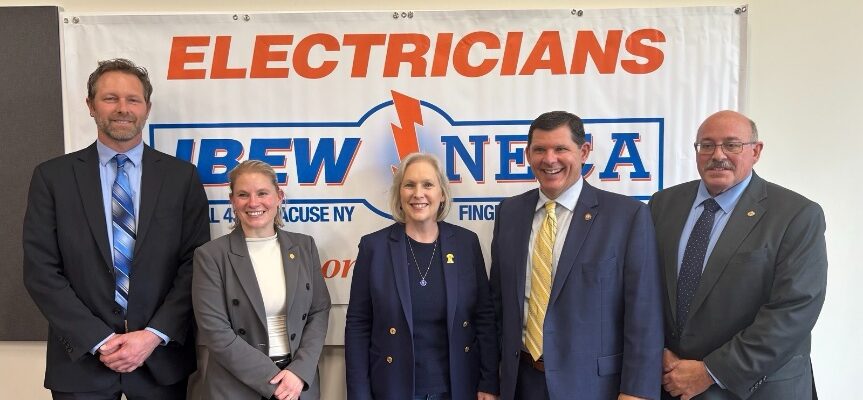
IBEW Local 43 in Syracuse represents more than 1,500 skilled and trained electricians, apprentices and technicians throughout Central New York, including Cortland, Herkimer, Madison, Oneida, Onondaga, Oswego and parts of Cayuga, Chenango, Otsego, Tompkins and Wayne counties. Gillibrand visited their Central New York Technical Alliance training center, which offers an apprenticeship program for the next generation of electricians.
NYSUT is a federation of more than 1,200 local unions representing nearly 700,000 classroom teachers, teaching assistants and aides, custodians, nurses, bus drivers, and professional staff who work in, or are retired from, New York schools, colleges, and healthcare facilities. Today, Gillibrand spoke at their Representative Assembly, NYSUT’s annual policy convention.
“On behalf of IBEW Local 43, I thank Senator Kirsten Gillibrand for visiting today and for her strong support of the Faster Labor Contracts Act. This common-sense legislation protects workers’ right to not only organize, but to secure a first contract in a timely manner,” said IBEW Local 43 Business Manager & Financial Secretary Alan Marzullo. “We appreciate Senator Gillibrand’s leadership and remain committed to working together to strengthen the middle class across our region.”
“As NYS Assembly Labor Chair, I am proud to stand in solidarity with Senator Gillibrand, Teamsters Local 118 and labor leaders to echo the call for passing the Faster Labor Contracts Act. This act is necessary not only to protect hardworking Americans from Trump’s attacks on organized labor, but to provide meaningful recourse when employers refuse to negotiate in good faith,” said Assemblymember Harry B. Bronson. “At a time when the cost of living is out of control, the collective voice of workers ensures middle-class wages and benefits so people can make ends meet. Let’s pass the Faster Labor Contracts Act so every worker, in every workplace has equitable opportunity to fight for the rights they deserve.”
“As a former union president, I’ve sat across the table and fought for every dollar, every benefit, and every protection working people deserve,” said NYS Senator Chris Ryan. “I know firsthand that the hardest part isn’t just forming a union—it’s securing that first contract. This legislation is about making sure workers aren’t left waiting while employers drag their feet. I’m grateful to Senator Gillibrand for her leadership and for fighting on behalf of Central New York workers to move this forward. When people stand together to demand fairness, the law should stand with them—and the Faster Labor Contracts Act helps ensure that the promise of collective bargaining becomes a reality, not a delay.”
Senator Gillibrand has had a longstanding partnership with organized labor. As a champion of bills such as the Protecting the Right to Organize (PRO) Act and Never Forget the Heroes: James Zadroga, Ray Pfeifer, and Luis Alvarez Permanent Authorization of the September 11th Victim Compensation Fund Act, Gillibrand has been a leader in the Senate, urging her colleagues to pass bipartisan legislation that would bolster and protect New York State workers.
This week, Senator Gillibrand sent a letter to the Department of Defense condemning the termination of collective bargaining agreements for American Federation of Government Employees (AFGE) members at Fort Drum and the Defense Finance Accounting Services (DFAS) in Rome. While this administration continues to actively work against unions, Senator Gillibrand is continuing to fight for them.
Her legislative priorities remain focused on:
- Strengthening collective bargaining and ensuring workers have a seat at the table without fear of retaliation;
- Protecting federal funding and ensuring the long-term solvency of the WTCHP and VCF for 9/11 first responders and survivors;
- Safeguarding union jobs and supporting the development of pathways to economic mobility, including through pre-apprenticeship and apprenticeship programs;
- And advocating for paid family leave and affordable child care, longtime priorities that have both New York State and New York City governmental support.

With International Brotherhood of Electrical Workers (IBEW) Local 43 in Syracuse. Image Credit – Sen. Gillibrand
GILLIBRAND STATEMENT ON THE 60-DAY MARK OF PRESIDENT TRUMP’S UNAUTHORIZED WAR IN IRAN
Washington D.C. – Today, on the 60-day mark of President Trump’s unauthorized war in Iran, which has caused costs to soar for American families and spiked gas prices at unprecedented levels compared to the last four years, U.S. Senator Kirsten Gillibrand, a member of the U.S. Senate Armed Services Committee, released a statement:
“Today marks 60 days of President Trump’s illegal war with Iran– and it is no coincidence that it also marks the day Americans are feeling the sharpest pain at the pump and at the store. Gas has hit the highest prices in four years, up more than $1.30 a gallon since the president launched the war,” said Senator Gillibrand. “Every trip to the grocery store, every commute to work, every school drop-off costs more because of a war that American families never asked for. As I told Secretary Hegseth yesterday, a majority of Americans disapprove of the war, evidence he quickly dismissed by continuing to cover for President Trump. The American people never asked for this war. 60 days in, the administration owes them a straight answer: what are we doing in Iran, and when does it end?”

Image Credit – Senator Gillibrand
GILLIBRAND, COLLEAGUES ANNOUNCE PLAN TO ACCELERATE TREE PLANTING IN UNDERSERVED COMMUNITIES
The Neighborhood Tree Act would authorize $2 billion for urban tree-planting programs
Washington, D.C. – U.S. Senator Kirsten Gillibrand (D-NY), along with Senator Cory Booker (D-NJ), announced the Neighborhood Tree Act, legislation to provide federal funds for tree-planting programs in urban and underserved communities.
The Neighborhood Tree Act would establish the Neighborhood Tree Fund at the U.S. Department of Agriculture and authorize $2 billion in federal grants for tree-planting programs nationwide. According to the EPA, trees and vegetation in urban areas can offset heat island effects, reduce energy use, improve air quality, reduce stormwater runoff, and enhance quality of life. Recent polling indicates that 73% of Americans wish their neighborhood had more trees.
“New York families deserve clean air, access to green space, and lower energy bills,” said Senator Gillibrand. “As the price of fuel rises for working Americans, the Neighborhood Tree Act would bring shade and reduced energy needs through expanded tree-planting programs in New York and across the county. I am proud to be introducing this important piece of legislation, and I look forward to working with my colleagues to get it passed.”
The bill is endorsed by American Forests, Holden Forests & Gardens, the National Audubon Society, the National Wildlife Federation, the Sierra Club, the Trust for Public Land, and the Western Reserve Land Conservancy.
The Neighborhood Tree Act would:
- Establish the Neighborhood Tree Fund and authorize $2 billion in federal grants
- The Neighborhood Tree Fund would be administered by the USDA.
- Eligible grantees would be: states, tribal governments, local governments, and local community tree and volunteer organizations
- The Secretary of Agriculture would give priority to entities that propose projects that:
- Serve low-income areas or communities with a lower tree canopy percentage and higher temperatures than surrounding areas;
- Support climate mitigation and resilience;
- Advance community-led urban forestry, tree-based local food production, reduce urban heat, and improve public health and environmental outcomes.
- The bill would also expand the National Urban and Community Forestry Advisory Council from 15 to 16 members and require that one member of the council be a resident of a low-income community.
The legislation is also cosponsored by Senators Andy Kim (D-NJ), Tammy Duckworth (D-IL) and Ed Markey (D-MA) and Representatives Shontel Brown (D-OH), Doris Matsui (D-CA), Mike Thompson (D-CA), Emilia Sykes (D-OH), Dina Titus (D-NV) and Delegate Eleanor Holmes Norton (D-DC).
Full text of the Neighborhood Tree Act can be found here.

Image Credit – Senator Gillibrand
SENATORS GILLIBRAND AND ERNST INTRODUCE BIPARTISAN BILL TO ELIMINATE FEDERAL PENSIONS FOR SEX OFFENDERS
Washington, D.C. – U.S. Senators Kirsten Gillibrand (D-NY) and Joni Ernst (R-IA) reintroduced the No Taxpayer-Funded Pensions for Sex Criminals Act, bipartisan legislation to prohibit convicted sex criminals from collecting federal pensions.
Under current law, federal employees convicted of sex crimes, including against children, remain eligible to collect their pensions, even from a jail cell. The senators introduced this legislation to ensure that hard-earned taxpayer dollars are not spent supporting convicted sex criminals who betrayed the trust of the people they served.
“It’s outrageous that federal employees convicted of sex crimes are eligible to collect their taxpayer-funded pension,” said Senator Gillibrand. “The bipartisan No Taxpayer-Funded Pensions for Sex Criminals Act ensures that no hard-earned taxpayer dollars are spent supporting criminal sex offenders. I’m proud to support this commonsense bill that will provide much-needed accountability.”
Senators Gillibrand and Ernst previously worked together on the Military Justice Improvement and Increasing Prevention Act to create a more professional and transparent military justice system for serious crimes, including rape and sexual assault.
Additionally, Senator Gillibrand successfully passed her bipartisan Ending Forced Arbitration of Sexual Assault and Sexual Harassment Act in 2022. This crucial legislation prevents perpetrators from being able to push survivors of sexual harassment and sexual assault into the secretive, biased process of forced arbitration. Senator Gillibrand also leads the bipartisan Tax Fairness for Survivors Act, which would remove the federal tax penalty on settlements, awards, and judgments paid to survivors of sexual harassment and sexual assault

Image Credit – Senator Gillibrand
SENATORS GILLIBRAND AND TILLIS PASS RESOLUTION TO HONOR “DONUT DOLLIES” FOR WARTIME SERVICE
Volunteers offered recreational activities, emotional support, and a sense of home to troops in combat zones during WWII, the Korean War, and the Vietnam War
Washington, D.C. – Today, U.S. Senators Kirsten Gillibrand (D-NY) and Thom Tillis (R-NC) announced Senate passage of their resolution commending the “Donut Dollies” for their patriotic service and steadfast support of United States service members in combat and honoring their extraordinary contributions to troops’ morale and well-being during wartime.
“The Donut Dollies are a vital part of our nation’s history, and they deserve recognition for their bravery and selfless commitment to service,” said Senator Gillibrand. “These young women put their own lives in danger to aid our troops in combat zones, providing service members with emotional support and a sense of home in some of the most difficult conditions imaginable. I am so grateful that we were able to pass this vital resolution and properly honor the Donut Dollies’ contributions.”
“The Donut Dollies served our troops in some of the most dangerous conditions imaginable, bringing comfort, connection, and a reminder of home to those far from it,” said Senator Tillis. “Their courage and compassion lifted morale on the front lines and left a lasting impact on generations of servicemembers. This resolution honors these extraordinary women for their selfless service and ensures their contributions to our nation are never forgotten.”
Background:
During World War I, Salvation Army volunteers known as the “Doughnut Lassies” served near the front lines, providing coffee, doughnuts, and comfort to American troops, inspiring the later Red Cross “Donut Dollies” programs. During World War II, the Korean War, and the Vietnam War, American Red Cross volunteers traveled to bases and combat zones to boost morale by offering refreshments, recreation, and a connection to home. From 1965 to 1972 alone, more than 600 Donut Dollies served in Vietnam through the Supplemental Recreational Activities Overseas program, reaching hundreds of thousands of service members and often traveling by helicopter or convoy into dangerous areas. Military leaders credited their work as essential to maintaining troop morale. This resolution recognizes their courage, sacrifice, and lasting impact on generations of American troops.
Text of the resolution is available HERE.

Image Credit – Senator Gillibrand
GILLIBRAND, CANTWELL, WYDEN, BOOKER PRESS FTC ON ANTI-COMPETITIVE BUSINESS PRACTICES THAT EXACERBATE FOOD INSECURITY AND RAISE GROCERY PRICES
Washington, D.C. – Today, U.S. Senators Kirsten Gillibrand (D-NY), Maria Cantwell (D-WA), Ron Wyden (D-OR), and Cory Booker (D-NJ) pressed the Federal Trade Commission (FTC) on the need to crack down on anti-competitive restrictive covenants that exacerbate food insecurity and raise grocery prices.
Restrictive covenants are legally binding conditions written into property sale, purchase, and lease agreements that can be used to block a competitor’s access to a local market. They are particularly prevalent in the grocery industry, allowing grocers to prevent their competitors from opening in their storefronts after they have closed down. This can perpetuate food insecurity, increase food prices, and create food deserts.
In a letter to FTC Chair Andrew Ferguson, the senators asked the FTC to focus its attention on the impact of anti-competitive restrictive covenants on food prices, as well as communities’ access to food and medicine.
“When grocers leave a community, anti-competitive restrictive covenants further cement the harm caused by the initial loss of the store, leaving consumers without ready access to food or more exposed to high food prices with fewer choices to seek better deals,” the senators wrote. “Additionally, when a grocery store closes, communities often lose a neighborhood pharmacy, and anti-competitive restrictive covenants can prolong pharmacy deserts.”
The senators added, “Americans are struggling with rising prices, and anti-competitive corporate lawfare should not be a reason costs stay high.”
Gillibrand has been a leader in the fight against food insecurity. Last year, she reintroduced the Healthy Food Financing Initiative Reauthorization Act, legislation to fund a USDA program that offers loans and grants to incentivize grocery stores to establish locations in areas where residents lack easy access to fresh food retailers. She has also introduced legislation to increase SNAP benefits and help those with high medical and housing costs qualify for the program and to combat food insecurity among older Americans.
The full text of the letter can be found here or below:
Dear Chair Ferguson:
For decades, large retailers have used anti-competitive restrictive covenants—written into property sale, purchase, and lease agreements—to block competitors’ access to a local market. These restrictive covenants prohibit competitors from purchasing or leasing commercial real estate. As a result, storefronts are left empty, small businesses are boxed out from opening in certain locations, consumers have fewer options, and companies corner regional markets and drive-up prices.
Large retailers’ use of restrictive covenants has been especially prevalent in the grocery industry. Significant square footage and parking requirements limit the number of suitable properties available in a given area for grocers, especially in developed or urban areas, and the anticompetitive effects of restrictive covenants only exacerbate these constraints. The impact of these anti-competitive covenants on consumers is further heightened in the grocery industry because grocery store competition is local. In the FTC’s recent and successful challenge of the Kroger-Albertsons merger, data “showed that on average, more than seventy percent of defendants’ sales are drawn from within five miles of a store,” which the district court found “support[ed] the drawing of small, local geographic markets.” Fed. Trade Comm’n v. Kroger Co., No. 3:24-cv-00347, 2024 WL 5053016, at *23 (D. Or. Dec. 10, 2024).
Across the country, anti-competitive restrictive covenants have shut out grocers from operating in locations where consumers would have otherwise frequented their stores and benefited from their presence in the community. In Woonsocket, Rhode Island, only one supermarket services roughly 45,000 people due to anti-competitive restrictive covenants set by competitors. Among those stores with restrictive covenants was a Walmart store that closed in 2011. For six years, Walmart prevented competitors from moving into the location, while the property sat vacant. When Walmart finally sold the building in 2017, it included a “25-year restrictive covenant prohibiting the property from being used for a grocery store or supermarket.” The restrictive covenant also prohibits the property from being used for “a wholesale club operation similar to that of Sam’s Club.”
On the West Coast, the 2016 closure of an Albertsons grocery store created a food desert in the Birchwood neighborhood of Bellingham, Washington. Yet when Albertsons later sold the property in 2018, it included a deed restriction that would have prevented a grocery store from operating in the space until 2038. Albertsons ultimately removed the deed restriction after the Washington Attorney General opened an investigation into whether Albertsons had violated Washington’s antitrust laws.
When grocers leave a community, anti-competitive restrictive covenants further cement the harm caused by the initial loss of the store, leaving consumers without ready access to food or more exposed to high food prices with fewer choices to seek better deals. Additionally, when a grocery store closes, communities often lose a neighborhood pharmacy, and anti-competitive restrictive covenants can prolong pharmacy deserts.
Lower income communities are more vulnerable to these closures and the reduction of competition. A recent report from the Federal Reserve Bank of Atlanta found that “[p]oorer, more concentrated markets experience larger and more persistent food price shocks, amplifying the burden on low-income households.”3 That burden may be growing as the latest round of tariffs and the ongoing conflict in Iran threaten further spikes in grocery prices.
Americans are struggling with rising prices, and anti-competitive corporate lawfare should not be a reason costs stay high. Given the ongoing impacts of anti-competitive restrictive covenants on communities across the country, please provide answers to the following questions:
- Does the FTC consider covenants restricting the use of land by competitors an unfair method of competition?
- Is the FTC able to regulate anti-competitive restrictive covenants through existing authorities?
- Has the FTC collected data on the use of anti-competitive restrictive covenants? a. If so:
-
- Has the FTC collected data on the impact of anti-competitive restrictive covenants on consumer prices, including food prices?
-
- Has the FTC collected data on the impact of anti-competitive restrictive covenants on consumers’ access to food and medicine?
-
- Has the FTC collected data regarding the impact of anti-competitive restrictive covenants by large grocery chains on market share?
-
- Has the FTC collected data on the impacts of anti-restrictive covenants on small businesses?
I ask that you respond to these questions by no later than May 15, 2026. I look forward to your response.
Sincerely,

Image Credit – Senator Gillibrand
GILLIBRAND, SCHUMER CALL ON EDUCATION SECRETARY MCMAHON TO RESCIND AND REISSUE TRIO GRANT ANNOUNCEMENTS
Senators Sound Alarm about “Fundamental Shift” in Program Mission
New York, NY – Last week, U.S. Senator Kirsten Gillibrand (D-NY) and Senator Charles Schumer called on U.S. Department of Education Secretary Linda McMahon to rescind and reissue the TRIO Talent Search and Educational Opportunity Center (EOC) program grant announcements and extend the current grants for another year. This comes after the Education Department announced that these grants, which have historically focused on strengthening the college pipeline for underprivileged students, would shift focus to push these students into the trades, among other drastic changes to the programs.
TRIO Programs are federal outreach and student services grants designed to support low-income, first-generation college students and individuals with disabilities, ranging from middle school to post-baccalaureate studies. Talent Search programs target middle and high school students, and EOC programs focus on adults, displaced workers, and veterans seeking to enter or return to postsecondary education.
The grant announcements that the administration posted in March 2026 fundamentally compromised program mission and capacity, risking critical service interruptions for current students. New York State has a substantial TRIO Talent Search footprint, serving 8,081 students in FY2025 with a grant total of $4,654,218. New York also had three EOC projects in FY2025 with $809,549 in grant funding.
In a letter to Secretary McMahon, the senators underscored the importance of the programs in their current forms, writing, “TRIO has led to higher rates of college enrollment, completion, employment, and compensation for more than 6 million graduates since 1964.”
The senators continued, “Elevating non-college pathways within a program historically designed to increase college enrollment and completion conflicts with TRIO’s established statutory purpose and does a disservice to the students facing barriers to higher education that the programs are intended to serve.”
Gillibrand and Schumer warned that the Education Department’s new framework constitutes a direct assault on college access, effectively dismantling the TRIO mission by slashing national capacity by more than half, prioritizing state-level “mega-grants” over local expertise, and introducing a high-stakes lottery system that threatens to leave students in rural and underserved areas in “service deserts” without support. The new applications shift the programs’ focus away from TRIO’s statutory mission of promoting college access for low-income and first-generation students. Instead, the requirements emphasize apprenticeships and technical education as alternative routes to economic mobility. The senators pointed out that while apprenticeships and technical education have inherent value, those goals should be accomplished via other mechanisms rather than cannibalizing the funds that promote college access for low-income and first-generation students.
The senators closed by highlighting the time-sensitive nature of this request, as the current grants are set to expire on August 31, 2026. They wrote that this raises the imminent risk of service lapses, warning, “If the applications are not adjusted or reissued immediately, the potential expiration of current grants poses an immediate threat to the academic and financial guidance that students and adult learners depend on, particularly as they navigate the critical fall enrollment window.” The announcements undercut the core mission of the programs that have provided life-changing educational opportunities to Americans across the country.
The full letter can be found HERE.

Image Credit – Senator Gillibrand
GILLIBRAND STATEMENT ON TRUMP’S TARIFFS BEING STRUCK DOWN YET AGAIN IN FEDERAL COURT
Washington, D.C. – Today, after the Court of International Trade ruled that President Trump’s global 10% tariffs were unlawful, U.S. Senator Kirsten Gillibrand released the following statement:
“Once again, Donald Trump’s price-hiking tariffs have lost in court. It’s time for the president to abandon these illegal tax hikes that are squeezing American families, who are already struggling to pay for groceries, gas, and health care thanks to his destructive policies. The Trump administration must immediately refund the cost of these tariffs to the American people and focus on lowering the cost of living, not seeking new ways to raise it.”

I joined the West Side Campaign Against Hunger in NYC to help distribute food to families in need and fight against the Trump administration’s cuts to food assistance.
GILLIBRAND STATEMENT ON RELEASE OF UAP FILES
Washington, D.C. – Today, after the Trump administration announced its release of files related to unidentified anomalous phenomena (UAPs), U.S. Senator Kirsten Gillibrand released the following statement. Gillibrand has long championed UAP disclosure and transparency, and in the FY2024 National Defense Authorization Act, she secured language to require that the government declassify UAP records, with limited exceptions for national security purposes.
“Transparency is the only path to truth. For years, I have fought to declassify and release UAP files, including by successfully passing legislation requiring government disclosure of UAP records. I am encouraged that the administration has finally heard my call and the call of millions of Americans to begin unsealing these files. This is another important step, but there is much more work to do. I will continue to fight to ensure the administration finally meets its legal obligation to the American people.”

I joined the West Side Campaign Against Hunger in NYC to help distribute food to families in need. Image Credit – Sen. Gillibrand
GILLIBRAND ANNOUNCES $1 BILLION IN FUNDING FOR SECOND AVENUE SUBWAY EXTENSION AND GATEWAY HUDSON TUNNEL
New York, NY – Today, U.S. Senator Kirsten Gillibrand, ranking member of the Senate Appropriations Subcommittee on Transportation, Housing and Urban Development (THUD), announced $307 million in funding for the Second Avenue Subway Extension project and $700 million for the Gateway Hudson Tunnel project. This funding, allocated through the Federal Transit Administration (FTA) Fiscal Year 2026 Capital Investment Grants Program, was provided by the enacted FY26 THUD appropriations bill. Gillibrand secured this funding for both projects and fought for new provisions in the bill to force the Trump administration to execute funding for the CIG program by detailing which projects to fund and at what amounts. She also included a provision requiring the United States Department of Transportation (USDOT) to allocate CIG funding no later than 120 days after enactment of the FY26 THUD appropriations bill.
“New Yorkers have waited decades for the completion of the Second Avenue Subway Extension into East Harlem and the Gateway Hudson Tunnel,” said Senator Gillibrand. “These critical infrastructure projects are the lifeblood of our economy, and once complete, they will deliver the safe, reliable and accessible public transportation system that our commuters and families deserve.
“I secured this $1 billion investment and authored strict provisions requiring USDOT to follow the law and release this funding. No more excuses and no more delays.
“For too long, the Trump administration has played political games with our infrastructure, using New Yorkers and our hardworking union laborers as pawns. By forcing the administration to execute this funding, we are putting an end to the delays and ensuring that federal dollars are used for their intended purpose: building a stronger New York.
“I will never stop fighting to protect New Yorkers from targeted political attacks that harm working families and threaten our economy. I am committed to bringing home every federal resource necessary to modernize our infrastructure, create good-paying jobs, and ensure that New York remains the public transportation capital of the world.”

I joined the West Side Campaign Against Hunger in NYC to help distribute food to families in need. Image Credit – Sen. Gillibrand
Banner Image: With International Brotherhood of Electrical Workers (IBEW) Local 43 in Syracuse. Image Credit – Sen. Gillibrand



[…] note: Staten Islander News has previously covered Senator Gillibrand’s statements on gas prices and the recent increases we have seen, which are continuing to rise. The senator traveled to multiple gas stations in Upstate New York […]
[…] note: We have previously covered unions in New York City, including the recent strike by the MTA workers on the Long Island Railroad. You can also see our […]