
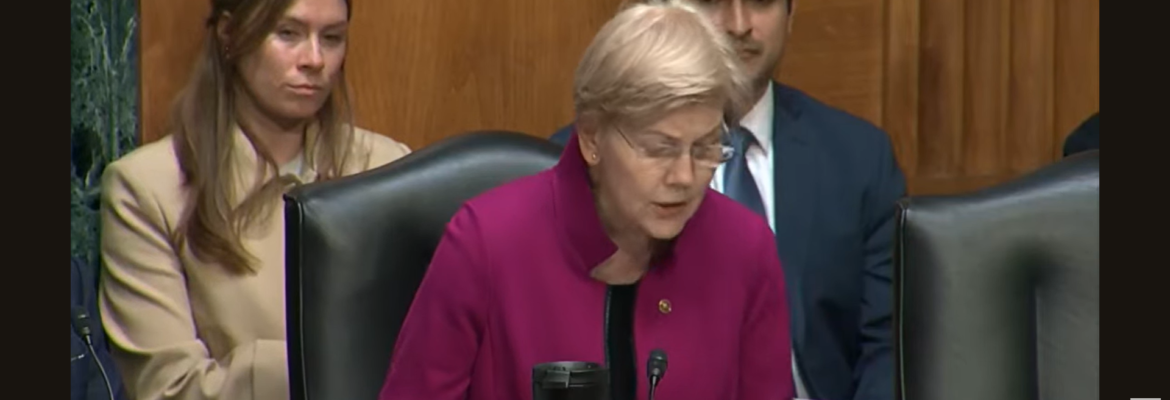
OPINION: Americans, New York City Residents Not Suffering From An Affordability Crisis: It’s A Hoax – Witnesses Testify Before Banking, Housing, Urban Affairs Senate Committee
The hearing, shown above, brought witnesses and contention from both sides of the aisle. Senator Kennedy during his turn kind of insulted each of the witnesses, which he then apologized for. He said something to the effect of the bankers were there to represent the banks, the realtor was there to benefit real estate businesses, and the person who was the most aware of issues affecting low income people had been dishonest about her background, and that because she had worked for President Biden, she was a Democrat socialist and had an agenda that was a secret. No one was there to represent ordinary working Americans.
At one point, a senator demanded that someone show him an example of a time when a state lowered interest rates artificially where it worked to be helpful. This was a silly, lighthearted moment in which everyone had a laugh as he pretended Senator Warren wasn’t answering him.
Interestingly, there are some statements made that oppose each other that cannot be true. It can’t be true both that 97% of Americans experienced a tax cut with the OBBBA AND that the average household paid $1,200 more in higher costs during the same time period. They can’t both have made such savings on taxes and incurred such costs, so someone isn’t being truthful.
One Republican senator, who specializes in not letting witnesses answer, asked Dr. Morgan what the average price of eggs was in grocery stores. When she responded that it was about $7, he replied that it was in fact $2.19, which is less than ‘under Biden,’ when the price was around $4 or so. It’s uncertain where these numbers actually came from, but Attorneys General from multiple states won a settlement just recently against egg producers for ‘price fixing’ practices driving up the price of eggs, which we’ll be covering this week. It seems he got this number from one of the many websites out there comparing Presidents Trump and Biden that may or may not be accurate, and when you look at the list, it’s easy to see how to cherry pick it, since even from this likely biased site, most of the items are MORE expensive under President Trump – but not eggs.
Meat of every type is much more expensive now than it was under President Biden (but this senator didn’t mention that number – its $5.55 vs $6.89). So are lemons, milk, lettuce, coffee, chicken, beans, and beer. Only eggs and bread and butter are less. So the high protein, necessary essentials cost more – just like it seems. Baby formula wasn’t on that list, but that difference is 125% in 2026 vs 1997 according to the US Bureau of Labor Statistics. It did jump in 2022 to one of the highest ever numbers under President Biden, when there was a major supply shortage for infant formula, but its price increase has continued. All of these are much more essential than eggs.
And whereas the differences in price (or the ‘spread’) is quite large on the higher cost numbers, where it has gone down, the difference is a pittance. Usually a few cents, except for eggs.
And when this same senator claimed that the price of OIL is lower TODAY under President Trump than it was under President Biden, undoubtedly most people at home watching laughed. Yeah right. It’s over $4 a gallon (a number that was mentioned in the same hearing). And in fact, today, about a couple of weeks later, a barrel of oil costs $82.50, which is more than under President Biden. In November 2024, when the election was happening, the price of oil was $70. While it was higher during the first two years of that term, it has spiked very much higher since then, as seen in the official charts linked here. Before the failed ceasefire, back in April, the price was $110 per barrel. So oil is clearly higher under this President.
The same senator also claimed that President Trump’s cumulative inflation rate in the first eighteen months of his presidency is lower than President Biden’s inflation rate for his entire presidency. However, there isn’t a pandemic happening right now in the first eightheen months, whereas that’s what President Biden had to deal with in that time period. It was as the pandemic was still going strong and had decimated large segments of the economy – many of which haven’t recovered. When eighteen months are compared to eighteen months, President Trump is the fourth highest. This inflation info comes from some random Instagram account that Factcheck was able to get in touch with. They’ve done a diligent job breaking down why this isn’t true or significant and shouldn’t have been a major focus of the hearing – due to its inaccuracy among other things. It sounds great, but it’s not real.
People watching this hearing who are in law or in public speaking or in debate can see that it’s apparently just a show to get sound bites. Not only do many Republicans not let the witnesses even answer (calling into question the whole purpose outside of showmanship), but everything is about making statements that sound too good to be true, and they often are. This is on both sides in some cases. In addition, it makes zero sense that the witness’ answer counts toward the time each senator has, which makes it so these games are needed. Otherwise they won’t even have their questions asked. If they paused the clock for the witnesses to speak, it would be a much more sensible endeavor – and useful too, instead of just wasting time and money on hearings that reveal nothing.
Regular Americans have seen their cost of living rise while their wages have not. At the same time, corporations and their CEOs and board members have raked in massive profits and bonuses for themselves, keeping the money flowing from the bottom to the top.

It’s interesting to note that they all laud the passage of the housing bill that just came out of the Senate, which may have the effect of making it faster and easier to build housing – or it may do nothing, since it’s a top down approach that doesn’t really fix the underlying problems – including forcing regular Americans into bidding wars with institutional buyers with deep pockets which is driving up real estate costs across the US.
They say no more red tape, environmental review, or other safeguards that allow communities to grow in a natural way, rather than at the complete whim of the builders or even lawmakers. If it was up to construction and real estate people, there wouldn’t be a tree left in America that wasn’t surrounded on all sides by houses and businesses – and the tree would have been planted there by humans not nature. That tree also won’t support the ecosystem that existed before they cut down the forest to make the newest home construction.
If you don’t believe that, just look at New Jersey, where towns all over New Jersey must follow the Mt Lauren Doctrine, where every town must build a certain amount of affordable housing to be in compliance, thus ‘revitalizing’ downtown, which can sometimes lead to gentrification, where lower income residents can no longer afford to live there and it becomes the next bustling city where costs of living rise as everyone moves to this town to occupy the houses now built. Tax base rises, tree canopy shrinks, quality of life dwindles, rinse and repeat.
Environmental review processes exist for a reason: so there isn’t runaway construction without infrastructure – and so that future generations will have a planet to live on. The number one driver of climate change reversal: soil microbes and plants in that soil, without chemicals to kill them. They drawdown more carbon than all other methods combined. Without environmental reviews, every city in the US will eventually look like the thick, smoky haze full of buildings that New York City was in the 70s and 80s – thick with smog and asthma.
The hearing announcement and information follows, including one witness’ written testimony:
THE COMMITTEE ON BANKING, HOUSING, AND URBAN AFFAIRS will meet in OPEN SESSION, HYBRID FORMAT to conduct a hearing entitled, “The Affordability Agenda.” The witnesses will be: Ms. Lindsey Johnson, CEO, Consumer Bankers Association; Mr. Kevin Brown, President, National Association of Realtors; and Mr. Cody Carbone, CEO, Digital Chamber; and Dr. Julie Margetta Morgan, President, The Century Foundation.
Witnesses:
- Ms. Lindsey Johnson
CEOConsumer Bankers Association
- Mr. Kevin Brown
PresidentNational Association of Realtors
- Mr. Cody Carbone
CEODigital Chamber
- Dr. Julie Margetta Morgan
PresidentThe Century Foundation
Below is the written testimony from Julie Margetta Morgan, of The Century Foundation:
JULIE MARGETTA MORGAN TESTIMONY BEFORE THE SENATE COMMITTEE ON
BANKING, HOUSING, AND URBAN AFFAIRS HEARING TITLED “THE AFFORDABILITY AGENDA” WASHINGTON, D.C.
June 23, 2026
Chairman Scott and Ranking Member Warren, thank you for inviting me to testify before the committee today. My name is Julie Margetta Morgan, and I am the President of The Century Foundation. As a public policy think tank dedicated to improving the lives of all Americans, The Century Foundation has been acutely focused on how rising costs are affecting working families.
While President Trump is calling affordability a hoax or a “fake word,” American families are dealing every single day with a cost of living crisis that Donald Trump promised he would fix.1 Alarmingly high prices on everything from gas and electricity to health insurance and rent are driving families deeper into debt and making the American economy more and more fragile. President Trump has already made clear that he does not think at all about Americans’ financial situations,2 but it is not too late for Congress to step in to lower costs and rein in the rampant corruption that has hijacked our government to serve the interests of the wealthy. Today, I will provide insights from The Century Foundation’s research on working families’ financial situations and some thoughts on how this Committee could develop a real affordability agenda that meaningfully eases the squeeze that so many families are feeling right now.
High Prices Are Pushing American Families to the Brink
On the campaign trail, Donald Trump promised to make America affordable again. From his first days in office, he has gone back on that promise, layering one price hike on top of another. The President’s disastrous approach to tariffs cost American consumers an average of about $1,700, increasing the prices
on a wide variety of must-have items, from groceries to school supplies to construction materials.3 The Trump administration and Republicans in Congress pushed through massive tax cuts for the wealthiest Americans, paid for by increasing the cost of healthcare, higher education, energy, and food for ordinary families. While the wealthiest Americans got a boost from the Republican tax bill, middle-income families got very little out of the deal, and the lowest-income households actually lost ground, as the cuts to Medicaid and food assistance identified to pay for the ultra-rich’s tax cuts will cost the lowest-income families about $1,200 a year.4
A pointless and illegal war with Iran is keeping gas prices at nearly $4 per gallon countrywide and has cost families an estimated $100 billion to date, including $60 billion in fuel-related costs.5 According to Moody’s Analytics, the cost increases due to the war with Iran completely offset any benefits families may have seen from the tax cuts mentioned above. And while families have been reeling from these unplanned expenses, they have also seen their utility bills spike due to the explosion of AI data centers, lax regulation of monopoly utility providers, and grid infrastructure that is under stress.6
Prices are only one side of the equation on affordability; wages are the other. Here, the Trump administration has waged relentless attacks on workers while making them collateral damage of his reckless economic policies.7 Since returning to office, the President has directly cut the wages of particular groups, including home health workers, farmworkers, and federal contractors; taken steps to make it easier for employers to misclassify their employees; and wreaked havoc on the agencies responsible for ensuring that workers can exercise their rights to collectively bargain and address discrimination in the workplace.8 And while job gains have accelerated in the last few months, 2025 was the worst year for job growth since 20209—the last time Trump was President. Perhaps most disturbingly, the Trump administration has also effectively cut wages of all workers,10 as the war in Iran that has caused inflation to outpace wage growth11 for the first time in three years, wiping out all of the wage gains since he came back into office.
The Century Foundation’s research shows that the cumulative impact of these policies has been disastrous for working families. Three in ten Americans have reported delaying or skipping medical care due to cost, and about half have had to tap into savings to meet their day-to-day expenses. In one survey, 25 percent of respondents reported that they or someone in their household has skipped meals to save money in the past year.12 The cost of living squeeze has hit working class families especially hard: working-class voters are more than twice as likely as college-educated voters to delay or skip medication (30 percent versus 14 percent) and are nearly twice as likely to skip a meal (41 percent versus 23 percent). They are also more likely to delay medical care (34 percent versus 21 percent), tap into savings (54 percent versus 36 percent), and reduce retirement contributions (39 percent versus 26 percent). These results are in line with other recent polls that show that less than half of Americans can afford access to quality health care, and that cost of living is the top concern among American families.13
On the Trump administration’s watch, some of the top financial stressors for ordinary families have become even less affordable, like healthcare, housing, transportation, and child care. New car prices hit record highs, health insurance premiums have spiked, with massive increases for those who seek coverage through the Affordable Care Act (ACA) marketplaces due to the failure to extend the ACA tax credits.14 At a time when child care costs more than rent in the majority of states, the Trump administration has only caused more chaos for parents, freezing federal funding for child care in several states and repealing rules that capped the cost of co-payments under the Child Care and Development Fund.15 Home prices rose again in the last year, and rent and mortgage payments both remain alarmingly high: mortgage payments on the median-priced home are still almost twice what they were just six years ago.16
Financial Institutions Are Compounding the Affordability Crisis
American families cannot afford to absorb these high prices, and as a result, they are increasingly turning to debt to make ends meet. But debt is not a panacea for the high cost of living: instead, it only obscures our ability to recognize families’ struggles while trapping households in a spiral they cannot escape.
America’s consumer debt spiral has gotten too big for policymakers to ignore. Almost 5 percent of outstanding consumer debt is delinquent, the highest since 2017.17 Outstanding credit card balances stand at around $1.25 trillion, with delinquency rates of more than 13 percent—the highest level since the Great Recession.18 Student loan delinquencies shot up under the Trump administration, from nearly zero to about 25 percent.19 Now, one in four student loan borrowers with a payment due is delinquent, and one out of every five (9 million borrowers) is in default. Auto debt has exploded. At the end of 2025, nearly 86 million Americans together carried $1.68 trillion in auto loan or lease debt, and new borrowers are taking on larger and longer loans to manage the high cost of cars. Bankruptcy filings increased almost 12 percent between 2025 and 2026.20 Home foreclosure filings are up 26 percent from last year, and are the highest they’ve been since 2020.21
Auto, credit card, mortgage, and student loan debt are the largest tranches of consumer debt, and as a result they draw a lot of attention from economists and policy experts. But working class families have been forced to turn to a number of other high-cost, risky products to make it from one week to the next. The use of short-term point of sale “buy now, pay later” loans has grown significantly in the last few years, and these are not the no fee, pay-in-four products of just a few years ago: the Federal Reserve estimates that about 37 percent of buy now, pay later loans have a non-zero APR, and many have terms of more than thirty days.22 Paycheck advance loans—short-term loans offered to workers who need credit to make it from one paycheck to the next—are now embedded into major HR and payroll platforms like ADP and BambooHR.23 The CFPB estimated that the APR on a typical employer-partnered paycheck advance loan is a whopping 109.5 percent.24 Medical debt, including specialty credit cards and installment loans, will continue to grow as healthcare costs rise and consumers struggle with high cost, low coverage insurance plans.25
Researchers and policy analysts tend to study different types of credit in isolation, and as a result, it can be hard to get a clear picture of the overlap of these trends. The Century Foundation’s research with Protect Borrowers shows that in many cases, consumers—particularly those with limited financial resources—are stacking different kinds of consumer debt in a precarious game of financial Jenga. For example, our examination of auto debt found that borrowers who take on auto loans see significantly higher and faster credit card balance growth, regardless of income level. Borrowers who take on longer auto loans to keep monthly payments low are also carrying monthly credit card balances that are 190 percent of their monthly income.26 Research from the Consumer Financial Protection Bureau (CFPB) found that consumers who take on buy now, pay later loans are more likely to hold higher balances on other types of credit, including credit cards, student loans, and personal loans.27
This mountain of debt is disastrous for American families, and it’s disastrous for the U.S. economy as well. But this story has winners in addition to losers, and some of them are represented at this very hearing. Large financial institutions and fintechs have made an artform out of filling the gap between families’ financial obligations and their means.
For example, a recent analysis from the Consumer Bankers Association identifies the rising cost of housing, healthcare, food, and transportation as the drivers of increased credit card debt, and it
characterizes credit cards as the “shock absorber” that families use to bridge gaps between their paycheck and their stack of bills.28 But that shock absorber now comes at an incredibly high price. Interest rates hover around 24 percent on general purpose credit cards at large banks and 31 percent for private label cards.29 That’s nearly double the rate charged a decade ago. Though borrowing costs for card issuers fluctuate, research from the Consumer Financial Protection Bureau shows that APRs have increased at a greater rate than their borrowing costs, and issuers’ APR margins on general purpose cards have increased steadily over time.30 The Federal Reserve Bank of Philadelphia reports that interest rate margins are at an all-time high.31 As a result, credit card issuers benefit not only from the higher cost of goods, but also from cardholders’ inability to pay for those goods. And they’re benefiting to the tune of billions of dollars: in 2024 alone, Americans paid more than $160 billion in credit card interest charges.32
The same pattern plays out in auto finance, private student lending, specialty rental and medical credit cards, paycheck advance loans, home equity investment contracts, and more. While consumers are posting record-high delinquencies, some financial companies are posting record-high revenues.33 The potential to profit from consumers’ inability to afford high prices appears to be luring large businesses to enter into profit-sharing arrangements with financial institutions, or to engage in direct lending services themselves. Airlines have received a lot of attention for their shift toward a finance-centered business model, but the same could be said for many large retailers deriving significant revenue from private-label credit cards, or healthcare providers that have shifted into financial services like United Health’s Optum. Just a few weeks ago, the Trump administration recommended that health insurers offer loans to customers who cannot afford the high cost of premiums or deductibles.34
There are two important conclusions from observing the extent to which families are using high-cost credit to weather this cost-of-living crunch. First, it puts Americans’ frustrations with the Trump administration and high costs in context. Policymakers are focused on the cost of a gallon of gas today, but millions of Americans are still paying off last week’s tank of gas, plus more than 20 percent interest on those fuel costs. We can’t really resolve the cost of living crisis without addressing the mountain of debt it has created. Second, it draws attention to the extent to which finance costs are a key driver of the affordability crisis, an increased burden on family budgets that rivals the combined impact of high gas and
grocery prices. As a result, policymakers can improve affordability simply by addressing profiteering and predatory practices in the financial services sector. President Trump himself seemed to acknowledge the role of financial institutions in the affordability crisis when he promised to lower credit card interest rates earlier this year. However, the President has never followed through on that promise, and we estimate that it’s costing cardholders $368 million per day in excess interest.35
Families Are Drowning in Debt and Need Relief
Families cannot keep their heads above water forever. Yet many leaders, including the President himself, are either more interested in finger-pointing than providing real solutions, or too captured by industries that benefit from the current environment to step in on behalf of working families.
Given the role that financial institutions are playing in compounding families’ affordability woes, there is plenty that this Committee, and banking regulators, could be doing to dramatically reduce families’ financial burdens. I want to commend the Committee, and particularly Chair Scott and Ranking Member Warren, for recognizing the acute need to address housing affordability in this country and for advancing the 21st Century ROAD to Housing Act. This bipartisan package is bringing major reforms to the housing market that will boost housing supply and lower costs for families across the United States. But I believe this Committee could do much, much more.
For example, this committee has jurisdiction over the CFPB, an agency that can be a key tool in ensuring affordability. However, Republicans in the House and Senate have stood by while the Trump administration demolished it. The Consumer Financial Protection Bureau has returned $21 billion to consumers defrauded by predatory companies. It gave Americans a place to go when they were concerned about a financial institutions’ conduct and needed help to resolve a complaint. It put cops on the beat to ensure that financial institutions were following the law. Over the last several years, the CFPB finalized rules that saved consumers billions by cracking down on extractive and predatory practices, including setting reasonable limits on credit card late fees and preventing coercive use of credit reports to collect on medical debts.
When Donald Trump took office, he shifted the agency from serving the public to serving industry. The Trump administration shut down virtually all supervision and enforcement activity, giving companies the green light to break the law. It issued corporate pardons to financial institutions that had been caught violating federal law. And, working with Republicans in Congress, it rolled back major rules and guidance on credit card late fees, bank overdraft fees, and paycheck advance loans, and cut the CFPB’s budget nearly in half.36 These actions not only make life less affordable, but they also signal to average Americans that the government is not on their side.
President Trump recently nominated Brian Johnson, an executive at Capital One—a bank that has saved billions of dollars through the Trump-era CFPB’s corporate pardons and the rollback of pro-consumer rules—to now lead the CFPB. This nomination offers the committee an opportunity to ensure that the CFPB reverses the culture of corruption and corporate capture that has taken root there in the past year and a half and starts working on behalf of the public once again.
This committee also has the power to advance legislation that would save consumers billions of dollars by placing reasonable limits on the financial products on which the majority of consumers rely. I know this committee has spent a considerable amount of time on cryptocurrency legislation, but only 15 percent of the lower-income households suffering most acutely from the affordability crisis have ever interacted with cryptocurrencies, and the CLARITY Act still does not sufficiently address scams, which are the biggest risk average families face when it comes to cryptocurrency. Meanwhile, 36 percent of non-college, working-class Americans report using buy now, pay later. Nineteen percent report using loans to make it from paycheck to paycheck. More than 40 percent of all Americans are unable to pay off their credit cards and carry a balance from month to month.37
President Trump announced earlier this year that he would limit the interest rates on credit cards to 10 percent temporarily. According to polling by Data for Progress, nearly two-thirds of voters favor a 10 percent credit card interest rate cap.38 Despite bipartisan support for a cap both in the public and in Congress, there has been no real progress. To the contrary, the Trump administration has actually increased costs for consumers by at least $10 billion a year by abandoning a CFPB rule limiting credit card late fees and supporting efforts to block states from imposing limits on interest charges.39 The rules of the road for credit cards are a fundamental affordability issue: consumers shouldn’t have to borrow to pay for their groceries, but they shouldn’t have to pay 20 percent interest on those groceries, either.
Reasonable limits on credit card interest rates, measures to promote competition for smaller banks that offer lower rates, and better options for consumers trying to manage their debt would all improve financial stability for households across the country.
The Committee could similarly impose stronger protections for consumers using short-term credit, particularly high interest loans marketed as “buy now pay later.” In addition to imposing protections on the cost of loans, it is long overdue for Congress to take a close look at how financial institutions use individuals’ private financial data to try to drive purchase behavior or to bolster their profits. The Committee could also address the expansive and predatory industry that has risen up around medical debt, making medical billing and collections more fair and accurate, and alleviating the crush of outstanding medical debt. Our country desperately needs an overhaul of its approach to healthcare, and closing off providers’ and insurers’ ability to coerce families into paying debt they do not owe is a critical component of that.
Private student loans are another area that deserves close attention. Last year, Republicans in Congress, under pressure from private lenders like Sallie Mae, limited certain federal student loans, exposing more students to the private student loan market. Now, families are turning to high-interest private loans with few protections. We have seen this story play out before, and American families are still trying to get out from under decades-old predatory loans accrued during the last private student loan boom.40
These reforms could meaningfully change the playing field for working families, reducing their monthly bills. They could shift the incentives for financial institutions away from siphoning profits through junk fees, tricks, and traps. However, unless President Trump puts an end to his willful and reckless actions that drive up costs for ordinary Americans while enriching himself and his peers, families are going to continue to fall behind and both our economy and our democracy will suffer.
Banner Image: Hearing still. Image Credit – US Senate


[…] note: Interestinly, in a Senate hearing about affordability for everyday Americans, the price of eggs was brought up several …, including by a senator attempting to make the point that egg prices and cumulative inflation are […]
[…] note: The recent Senate hearing on the ‘affordability crisis’ currently affecting low and middle i…, which became law on July 21st of 2026. Now that the framework has been passed, the budget must […]
[…] also in need of assistance putting food on the table. Many will also lose their food aid, and, as one of the senators in a Repubican-led hearing on the economic effects of the Trump presidency le… and many are even more food insecure now than they were just a year ago. Events such as this one, […]