
NYC Retired Paraprofessionals – Including Staten Islanders – Pensions Benefits Reduced, Causing Financial Hardship, Based On New Interpretation Of Legal Language: IMPORTANT UPDATE
Update today (Saturday): TRS has stated that all affected paras will be granted a deferment until December 2026, but they must file immediately. From Marianne Pizzitola:
We have updated our website for the paras. They MUST – immediately – file the appeal and request a deferment of the reduction to 2027 and if they do it will be approved.
We are happy to report that the United Federation of Teachers has now stepped in regarding the issue of paraprofessionals having their pension benefit cut in half. In their cease and desist letter, the UFT points out that the Teachers Retirement System is NOT legally required to recoup these losses or to reduce the benefits, particularly if it will cause hardship (which, in all of these cases, it has or will).
To provide a timeline of the evolution of this story: We learned about this issue from Marianne around the 6th of August. We reached out to the Mayor’ Office upon learning about it, who declined to really take part in the developing issue, as they are only members of the TRS Board, and not in charge of it. We also reached out to the TRS, who provided us with the same standard statement they had provided to other outlets. See below the update from Michael Mulgrew for the text of that letter.
Thanks to the advocacy of the three organizations helping this small number of affected, disabled, retired paraprofessionals, quoted in their press release below – who were injured on the job through no fault of their own and not from negligence – the union president has written to the members, advising them to immediately ask for an appeal, and they will be granted a delay in deductions until at least October. There has been a letter sent from the UFT’s legal team to the Teachers’ Retirement System (TRS) telling them to stop this publicly embarassing task, which is NOT REQUIRED under current statute – for the City, not the state, since when it comes to the state, it is statutorily required – of collecting these backpayments and reducing the affected pensions. Any paraprofessional who is affected has been told – directly by the UFT president Michael Mulgrew, as quoted in part below – to file the appeal with the TRS that they are receiving (from the TRS) with the first section pre-populated for the first question as regards the error, either via regular mail or via email. See below for part of the text of an email sent to these disabled retirees.
From the letter sent to the affected retirees, headed as from Michael Mulgrew:
If you have not already filed an appeal of TRS’ decision to reduce your accidental disability retirement pension payments and seek repayment for past overpayments, we encourage you to do so now.
Below is a sample TRS appeal form for you to use as a guide when filling out your appeal. We are also including some important information about the timeline and process for filing.
Important appeal information
- You have 90 days from the date of the letter you received from TRS in June to submit your appeal. [UFT] recommend that you file your appeal no later than Aug. 31, 2026. [Note: This UFT recommendation is NOT the official date. All paras have until 90 days from the date of THEIR initial TRS letter]
- If possible, you should mail your appeal via certified mail, return receipt requested. [note: This can be done at the post office, and the letters can also be mailed via other providers, as long as they provide tracking information]
- You are responsible for filing your own appeal, as each appeal must come from an individual member. However, the UFT is available to assist any member who needs help. Please reach out to us at the contact information [included in the email].
- Part A:
- Fill in your demographic information.
- Part B:
- For question 1, it will say: TRS CALCULATION ERROR. Leave this part as is when you print out the form. You do not need to add anything.
- For question 2, you can use this sample text as your answer:”I am disabled and unable to work. If my disability pension is reduced by any amount, or if I have to repay any alleged overpayment, it will cause significant financial hardship. I am barely able to make ends meet on the current amount of my disability pension, let alone a repayment or reduction. I have spent all of the funds I have received to date on life’s necessities. Reducing my disability pension or seeking repayment in any amount will seriously and harmfully affect my ability to house and feed myself. It is simply not practicable for me to repay any amount or to have my pension reduced. Please maintain my originally calculated payment amount while this appeal is pending.”
The original statement we received from the Teacher Retirement System of NYC:

TRS is communicating with a small number of retirees whose accident disability retirement allowances were calculated incorrectly due to a statutory misinterpretation. We deeply regret the error and the hardship that will result for the affected retirees.
TRS was advised by the New York City Law Department that we are required by law to correct calculation errors including the amount of future retirement benefit payments for these retirees. TRS is doing everything possible within our legal responsibilities and fiduciary obligations to reduce the impact on our members. Specifically: The total cost recovery amount is limited to three years’ worth of overpayments, regardless of how long the retiree was overpaid; prior overpayments are to be recovered gradually, by deducting 1% from the retiree’s future payments; and we have provided each retiree with an appeal form that can be filed to stop the cost recovery plan due to financial hardship or other factors.
TRS is committed to handling this regrettable situation as compassionately and responsibly as possible.
We then additionally asked the following:
Are you able to share the link to the appeals form with us? Several retirement organizations have been contacted by many who could benefit from this program, but they might not have received the form. Also, let me know if the form can be shared with our readers.Is there a phone number affected people can call if they need the form but didn’t get one, or if they need other assistance? Are you aware of any financial aid programs that these recipients might be qualified for due to the benefit reductions?Also, it looks like the appeal is only for the 1% future deduction, where the recalculation reduction based on the incorrect statutory interpretation is not appealable. Is that correct? I want to make sure I read that correctly.
TRS is contacting all affected retirees individually by phone and letter; our contact includes a special phone number for additional support as well as the appeal form. The form and number are not published.
Your understanding of what is appealable is correct.
According to reporting by The City Reporter, the Teachers Union threatened to file suit against the TRS:
“We are currently exploring a legal challenge as well as changes through the legislature. TRS made the error and it went unchecked for 20 years,” Michael Sill, the UFT secretary, said in a statement. “Our paraprofessionals are the victims here and should not be the ones to pay for the agency’s error.”
The Letter From The Law Firm Representing UFT, is below, and it is quite clear that this decision should be immediately reversed, as it is not legally required:
From Cohen, Weiss, and Simon, LLP:
Dear Members of the Teachers’ Retirement Board:
This firm represents the United Federation of Teachers (“UFT”). We write concerning the decision by the Teachers’ Retirement System of the City of New York (“TRS”) to recoup claimed accident disability pension overpayments made to a small group of paraprofessionals and to reduce their pensions going forward in perpetuity. These paraprofessionals suffered serious injuries while at work and, for years, have been making critical life decisions based on a pension allowance calculated and provided by TRS. Now, TRS seeks to recoup overpayments and reduce future disability pension payments by approximately 50 percent. The recoupment and reduction will cause an extreme hardship to these individuals, many of whom are permanently disabled or otherwise unable to work because of their workplace injuries.
As you may be aware, in and around June 2026, TRS informed a group of approximately 180 accident disability paraprofessional retirees that TRS had miscalculated their pensions. TRS explained that it had used an incorrect formula, erroneously basing the pension benefit calculation on two-thirds of their final average salaries rather than one-third. TRS acknowledged that it was TRS’s error and that the paraprofessionals would suffer “hardship” as a result. Nevertheless, TRS stated that it would implement the reduction “at the end of this month” and would recoup the alleged overpayments for the previous three years by reducing the paraprofessionals’ retirement allowance by an additional 1% per month. These paraprofessionals had been receiving benefits under the current formula for years, some for more than 20 years.
Paraprofessionals are the backbone of the New York City public school system. They support students with mental and physical disabilities, provide small-group instruction, and ensure
daily classroom stability. They are involved in every part of special needs students’ days, from making sure that they get on the bus and are fed during the day, to modifying lessons for them, ensuring they are physically and emotionally prepared for learning, and creating a safe school environment. It is extraordinarily difficult work for extremely modest pay. But paraprofessionals do it every day because they love and believe in their students.As demonstrated by the experiences of the paraprofessionals whose disability pensions TRS plans to reduce, their work is highly dangerous and can unexpectedly end their careers. To give only a few examples:
1. One paraprofessional had to jump over a child who unexpectedly popped up in their way. The paraprofessional catapulted themselves over the child so as not to harm them and fell so hard that they fractured a shoulder.
2. Another paraprofessional was attacked by a student and suffered a concussion and broken bones. They continue to struggle with memory loss and mobility issues.
3. In another instance, a paraprofessional was assaulted by a student and underwent two surgeries as a result. Sixteen years later, they are still in the care of an orthopedic specialist due to the injuries.
4. Another paraprofessional had to take an accident disability pension after they cracked their spine on a chair as they were flipped over. They underwent emergency spinal surgery, followed by two additional major surgeries on their neck and spine. They have nerve damage in both hands and feet, as well as in their right leg and left arm.Although their injuries vary, the vast majority of the paraprofessionals who are receiving an accident disability pension were harmed while caring for special needs students. And all of them were, and are, in dire
need of financial support following their injuries.Subsequent to each injury, over more than twenty years, TRS informed the paraprofessionals that they were entitled to an accident disability pension calculated based on two-thirds of their final average salary. The paraprofessionals have relied upon this retirement allowance, often for decades, ever since. They have also made important life decisions based on TRS’s calculations, deciding where to live and how to manage their expenses on limited incomes.
TRS need not – and should not – take the onerous, punishing, and publicly embarrassing step of recouping the overpayments and reducing future disability pension benefits. Unlike the statutes governing other New York State and City public employees’ retirement systems, the statute governing TRS does not require TRS to correct errors and adjust payments. For example, when the New York City Employees’ Retirement System (“NYCERS”) discovers that a participant is erroneously being overpaid, the NYCERS is statutorily mandated to “correct such error” and, “as far as practicable,” adjust their payments so that the “actuarial equivalent of the benefit to which [they were] entitled shall be paid.” N.Y.C. Admin. Code § 13-182.
But there [is] no equivalent provision for the New York City Teachers’ Retirement System. See id. § 13-501, et seq.
TRS is thus wrong to assert, as it did to these paraprofessional disability retirees, that it is “required to take corrective action.” It is not. Under its governing laws, TRS has discretion to ensure that those the least able to afford it are not subject to financial harm due to TRS’s own mistake. Moreover, even if the statutory provisions governing other retirement systems applied to TRS (which they do not), TRS should still exercise its discretion not to reduce the paraprofessionals’ benefits — these are low paid workers who have devoted their professional lives to taking care of the neediest students, and it is not “practicable,” indeed, it would be unjust, to cut their retirement benefits cut in half, in some cases after they have received them for 20 years.
We implore TRS to exercise its discretion and not seek to recoup overpayments or reduce benefits in this case. Only a limited group (approximately 180) of paraprofessionals are at issue, and the problem will not compound in the future. Moreover, these individuals—generally the lowest paid in the City’s schools—were injured through no fault of their own while taking extreme care to manage a vulnerable and difficult population. As you know, given the low pay paraprofessionals receive, even with the erroneous “higher” pension benefit, most still struggle to make ends meet. A reduction of 50 percent of their benefits will be catastrophic, likely jeopardizing their ability to access basic necessities needed for their and their families’ health and well-being.
TRS’s misguided attempt to fix its own mistake penalizes extremely low-paid public servants who, while caring for a vulnerable and difficult population, were injured in the line of duty. Over more than two decades, they have relied on TRS for their and their families’ livelihoods. In an effort to resolve this matter amicably, quietly, and without public fanfare, we ask that TRS forgo its plan to recoup the alleged overpayments and continue paying the paraprofessionals the retirement allowance they have been receiving.
Please contact me no later than August 19, 2026, to discuss this matter. Thank you for your attention to this matter.
Sincerely
From our conversation with Marianne Pizzitola, we learned:
Pension bills are not negotiated in the city for the last several decades; instead all pension law is dne by the state. There is a “Home Rule Message” that must be passed by the City in order for a state bill to get final approval. This applied to the 2002 pension bill that is the source of this quandary. Sometimes, in interviews, labor relations says they’re negotiating with the unions or the city, and this means that they are applying the “Home Rule Message,” by convincing the City to accept or reject something that their union supports. So in plain language, the unions agree to support legislation, then they have to get the city support for the Home Rule Message.
This all seems to stem back to RSSL 605, which is an old law, been around since 2002, that was never amended for paras. The bill applies only to “teachers,” which would leave paras out. Sometimes paras are treated as administrative professionals, but in the hiring language, they are teaching assistants. However, in this bill, the language is faulty. It seems to have been passed without being actually read or debated in a meaningful way, and was passed under different UFT leadership. Basically, the reason this is an issue is that since paraprofessionals were not explicitly named in the legisative language, then they default to the Workers’ Compensation Law language, which is what the issue is stemming from.
When the Mayor’s Office asked that all City offices find ways to save money, the actuary went through this legislation and found that the paraprofessionals had been left out of the langauge and thus were being paid too much. So they demanded that the Teachers’ Retirement System be ordered to correct the error going forward and back in time as well.
Some paras got less than a month’s notice before their pension payments dropped from 2/3 ending salary to 1/3. There was language in the law that says that if you are eligible for Workers’ Comp, whether you have received it or not, your pension benefits payments drop to 1/3 of final salary. Teachers don’t get Workers Comp because they get something called “Line Of Duty Injury (LODI) payments” instead of WC, so the rules for WC didn’t apply to them. That’s part of the justification for the pension adjusting law in 2002 (quoted in blue below).
When a para, on the other hand, received WC, they would have a 100% offset, meaning that their pension would decrease dollar-for-dollar, based on the WC payments. However, WC normally lasts for about ten years, after which payments stop, so at that point, they would get the higher amount added back into the pension so they are still receiving the same amount.
Some additional background for clarification:
It has been postulated that the intent was give teachers 2/3 because they are not eligible for comp and Paras 2/3, but if they receive comp (since they are eligible) offset the pension 100% by what comp pays them. This is how other pensions, like EMS is. EMS gets a ¾ disability pension. If they are getting comp payments, NYCERS offsets what they pay dollar for dollar. If that ever changes, Comp notifies the EMS member and they give the letter to NYCERS, who increases what they pay so they always get 3/4. Pension.
But the way the law is, paras get 1/3 BECAUSE they are eligible for comp. Even if it doesn’t equal 2/3 when added. And it doesn’t allow for circumstances if the para isn’t collecting or they are and it ends. It was poorly done.
A UFT treasurer is said to have told paras they are allowed to collect 2/3 and comp – because teachers are allowed to sue the employer. This was said during UFT pension consults. Teachers also get LODI – Line of Duty Injury Pay – whereas Paras do not. That means they are paid when hurt at work.
The simplest solution would be to consider paraprofessionals pedagogs (ie. equivalent to teachers since they’re assistant teachers when hired (also in writing). Then they get LODI too, which will equal 2/3 pay until pension kicks in.
The political pension solution
Senator Scarcella-Spanton has expressed her support for legislation to permanently fix this issue, and Councilmember Morano, from Staten Island, attended the rally on Thursday to celebrate introduction of a Council bill related to retirees insurance benefits and guaranteeing them from the City-level. The current Speaker allowed this bill to be reintroduced in a more traditional way, and is not hostile to the retired workers.
Unfortunately, this issue with the paraprofessionals is not something the City can step in to fix on its own. This is a State issue. The State would have to call a special legislative session, since the current year’s session ended back in the early summer, and this is an election year, so no representatives’ seat is guaranteed, unless they are running unopposed.
The law would simply need to be amended to change the language to say ‘teachers and teacher assistants’ or ‘teachers and paraprofessionals’ instead of just ‘teachers.’ This could be done in the current legislative session if the TRS insists on continuing its efforts to recoup these losses from these disabled retired workers.
At one point, the former UFT president (the one who was in office in 2002) had stated that forcing teachers to take a smaller payment for their pension if they collect Workers’ Compensation it to put them in poverty. Instead of getting 2/3 they were getting 1/3, so this was changed. But it was only changed for teachers themselves, not all educators or paraprofessionals, who assist teachers and are essential to the functioning of a school.
The law from 2002, states the following, in Section F:
f. If the retirement system determines that such member was physically or mentally incapacitated for performance of gainful employment as the natural and proximate result of an accident not caused by his own will-ful negligence sustained in the performance of his duties in active service while actually a member of the retirement system, and the memberis a teacher not within the coverage of section three of the workers’ compensation law or an employee in group twenty of subdivision one of such section, the retirement allowance shall equal two-thirds of such member’s final average salary.
Here is the Justification Section, which mentions that teachers hurt on the job would have poverty wages if not excepted by this law to receive 2/3 instead of 1/3. Since this is the case, this should especially apply to paraprofessionals, who tend to have a much lower salary. Here is the justification:
JUSTIFICATION: At present, Tier IV basically pays an accident disability allowance of one-third of final average salary in addition to any benefits payable under Workers’ Compensation. Thus, for most public employees hurt on the job, the Tier IV benefit and Workers’ Compensationprovide about two thirds of final average salary. However, since New York City teachers are not covered by the Workers’ Compensation Law, they must live at one—third of final average salary, often bringing them below the poverty level.
This bill changes accident disability payments to teachers injured in the performance of duty to two—thirds of final average salary, with no additional benefits to be paid by Workers’ Compensation. Enactment of this legislation will correct a serious inequity in the present system of compensating teachers hurt in the line of duty.
From Marianne Pizzitola, of the NYC Organization of Public Servce Retirees, in a press release issued when they first became aware of this occurence with the retired paras. This is before the UFT made their position known and sent the letter to the TRS, as shown above:
Fix Para Pay is a slate of active and retired UFT Paraprofessionals advicating for better wages to be negotiated by their union. Fix Retiree Benefits is a slate of active and retired UFT members advocating to protect and improve the conditions for UFT retirees. NYC Organization of Public Service Retirees is an organization of over 200,000 municpal NYC retirees founded to protect retirees’ healthcare and other benefits from diminishment in retirement.
Together, we stand with our retired paraprofessionals today. The NYC Teachers Retirement System (TRS) contacted over 180 retired paras and advised them they “made a mistake” when their pension was calculated some more than 15 years ago. Not only are they reducing their pension by half, they are clawing back the alleged overpayment for the last three years.
You have watched the UFT argue that active paraprofessionals are making an unlivable wage and even declare war on the Mayor if he doesn’t sign into law the bill in the City Council to give them a $10,000 ‘respect check’ of Non-Pensionable income. Well, a pension that is 2/3 of that salary is unlivable, and now to take more than half of that away from them when they came to rely on that money is criminal. The UFT told these paras when they called, that there was nothing they can do. The UFT has been silent on this issue; that needs to end today. TRS already cut these retirees pensions in half beginning with the July pension check.
We are collectively demanding that they amend the Retirement and Social Security Law they amended in 2002 under then President Randi Weingarten and correct this injustice, and TRS must pass a resolution not to claw back any alleged overpayment.
Since the time of the above information, her organization, and the others, have reached out to politicians, UFT leadership on multiple occasions, TRS, and news media outlets, including community media.
We reached out to the Mayor’s Office, and were told that this is not something they are commenting on at this time. They are not getting involved. However, upon being asked about it by a reporter at a press conference, he has since stated that the office is looking into it and actively following up on the situation.
“The city is one of many parties when it comes to the stewarding of these pensions and, to my knowledge, the Law Department has come forward and identified this as a mistake that took place over many, many years,” Mamdani said at an unrelated press conference. “We are going to keep a close eye on it and make sure that we are following up.”
We spoke with several of the retirees in candid conversations to learn more about the actual dollar amounts being discussed here. Two were in Situation A, and one was in Situation B, as described below. Every single one of them is a resident of this City, or in some cases they were but have moved away either for financial reasons or because of health issues. Many aging people have reported that their arthritis improves when they move into warmer temperatures. Some also believe that it is warm desert air that accomplishes this, but some have moved to Florida for a similar reason. The cost of living in both of those places, with the ability to remain in one’s own home as long as possible, is much lower and more feasible, particularly since the pension and disability or social security payments follow you where you go, and, unlike while you were employed with the City, do not require you to be a resident of New York to get them.
Situation A:
Prior to this change, their social security income was $1,400, and their pension benefits, after fees, were $1800 per month. Now, after the reduction, their total pension payment is $800 per month. She had Workers’ Comp payments for about ten years, after which she applied to have her pension total changed to reflect the 100% matching, mentioned in the bill above. After this reduction, her bills have not decreased, but her income has significantly changed. She would even qualify for SNAP, HEAP, and other financial assistance programs available for elderly residents, which also allow people to apply remotely. However, if she does file this appeal, she will have until October to prepare. She has a condo in Florida, which has maintenance fees, and she has an apartment in Queens that she really likes and would like to be able to keep. If this pay cut goes through, she will be unable to continue to afford both.
Situation B:
This paraprofessional was paid at a higher level, maybe was a special education director, but for whatever reason, her departing income from her job was higher, and she receives Social Security of around $2,500. On top of that, she received her disability pension without going through the Workers Compensation program. Her pension income was $1,700, after all of the reductions and fees for other services including medical costs (such as SHIP which is part of their heathcare costs). After this change, when it goes into effect in October (she already knew about the available extension for hardship until October and had applied for it), her pension income will be only $800 after fees and deductions. She has a mortgage to pay, car payments, food bills (with recent inflation, these have become harder to afford), and she is very stressed over how she will manage all of it on a significantly reduced income.
We also reached out to the TRS, and Marianne and retirees have finally heard from the UFT regarding this situation (see first paragraph). There has been much noise made about this issue, as these retirees are standing up for themselves and asking to be heard. In this particular instance, this is a political matter. There is a deferment that could be enacted, to defer this for a year or more while the legislation becomes a reality.
Remember, the New York State Legislature is finished for the current session, and there is an election in November, which may lead to some leaving and some newcomers. Many are on board to fix this now, so it probably needs to be done before November or December. This is especially the case since those who are able to file for an extension to the application of this rule which has been announced to be everyone in the 183 affected retiree group, and will expire in October for most of these people. So the law needs to be changed before then. It needs one line to be changed, in Section F, above, to say ‘teachers and paraprofessionals.’
This is in the purview of Governor Hochul to accomplish, and it would not be without precendent. It has been done before for similarly pressing issues.
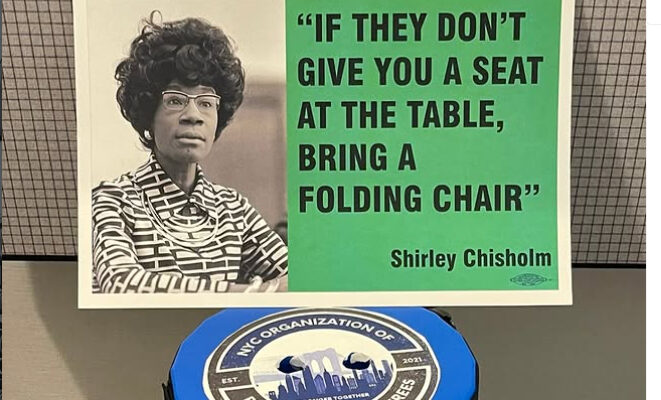
Banner Image: Shirley Chisholm quote. Image Credit – NYC Retirees



Staten Islander News Service Staff Writer
This byline indicates that this article was penned by a member/members of the Staten Islander News Organization office team. Our staff writers are the backbone of our newspaper, performing all sorts of important tasks like conducting interviews, investigating leads, besides writing the news stories you see.
[…] at this hearing can sign up to testify in Zoom or in-person at this link. The controversial rollout is an evolving situation, with a much less clear end than the one for the paraprofessionals … In that case, it was completely ridiculous what was being done to these elderly, disabled […]
The first pension cut for the 183 disabled paraprofessionals was with the JUNE 2026 check. I know… because I’m one of the 183 paras adversely affected by this horror, and I was one of the first to be notified by the Teachers Retirement System. They called me on June 9, 2026 and my pension check was reduced by nearly $1,000 on June 30, 2026. I’m hoping this will be resolved to our satisfaction. If not, many of us will be at risk of homelessness in the not so distant future.