
In NY, NJ, CA Wage Theft Of Employees Is A Felony – Other States No Accountability, Repercussions
Editor’s note: If you’re surprised to learn that wage theft isn’t really much of a crime around the country, you aren’t alone. Most people would think it’s a no brainer: you steal wages from your employees, your business is fined and the wages are returned. You might even go to jail if it’s willful or negligent or fraudulent. But that’s not the case in most states. In most places, employees have no recourse and no way to recover the money they weren’t paid and hold their employer accountable. The burden of seeking redress leaves many people to whom this happens to just walk away without their wages.
Fortunately, those who live in New York, New Jersey, and even California are unique in that they already have the protections described below, to a certain extent. It is difficult to prove intent sometimes, but there are routes to report and recover wages in New York, and there are some who have been prosecuted for wage theft. Most notably, several app companies have had to pay withheld wages and tips due to the legal battles waged by the State Attorney General, whose job it is to take over the legal fight for someone who cannot do it themselves and are, in fact, part of a much broader class or group of person affected. For instance, a drinks app was allegedly withholding tips from its independent contractor-classified workers. AG James was able to secure a lost wages settlement and injunctive relief from the company (where part of the agreement is that they change their policies).
For those who are confused as to how the decision is made whether a worker is an employee or an independent contractor, the question since companies like Amazon got involved, where their drivers are not employed by them and they have no liability for the contractor’s actions (such as if they withhold tips or force workers to keep illegal hours – it is not the responsibility of Amazon – even thogh drivers wear their uniform, use their app to report deliveries and to be guided around to said deliveries, and the trucks they drive are emblazoned with Amazon logos and marketing messages on every side). But, they are not employees of Amazon. The unionization drive that began at the Staten Island warehouse, does not cover truck and delivery drivers, even though they come to the same warehouse every morning. The same is the case for Uber and Lyft. They control where the drivers are, and they even have them ‘on-call,’ where they could be given a fare at any moment, and for the longest time they were able to avoided classifying their drivers as employees. At this point, New York has been enforcing their wage and salary laws, though it is really restricted to unemployment eligibility and tax payment. New Jersey, on the other hand, agressively enforces laws related to employee classification for Uber and Lyft drivers, and they are treated as employees under state law, which means all employee related taxes must be paid, not just unemployment. Things are changing slowly at the state level.
New Jersey has caused delivery drivers and rideshare drivers as employees, while New York is a little behind New Jersey in this area, but that is changing quickly. Pretty much if a driver classified as an independent contractor applies for employment related benefits, they’re increasingly being seen as entitled to such. For the drivers of the logo trucks, the drivers status as employees of some secondary company isn’t really cutting it in these states. It’s only a matter of time before their battles are finally settled and these workers are classified properly, with correct liability placement. So if, for instance, a secondary contracted employee is injured on the job due to negligence, they’ll be able to sue Amazon, the behemoth with all the money, not just some little small business truck providing company. Because it is Amazon that gets all the benefit from these drivers and these agreements. What company doesn’t love avoiding employee taxes, which are usually around 7% of the total wages. The worker is responsible for the other 7% that makes up the 14% total. When an employee is misclassified, the entire 14% burden is shifted onto them – along with cost of gas, tolls, car maintenance, etc. Reclassifying them would make such jobs actually workable for the average worker, whereas now there is a sustainability issue in that workers must take on more hours to make a decent living. Once wages are fair, they’ll be able to afford basics and more, while now many of them have difficulty doing so.
GILLIBRAND ANNOUNCES BILL TO MAKE LARGE-SCALE WAGE THEFT A FELONY NATIONWIDE
Washington, D.C. – Ahead of Labor Day, U.S. Senator Kirsten Gillibrand (D-NY) announced the Don’t Stand for Taking Employed Americans’ Livings (Don’t STEAL) Act, which would make large-scale wage theft a felony nationwide. Representative Seth Magaziner (D-RI-02) and 28 cosponsors have introduced companion legislation in the U.S. House of Representatives.
“Working Americans deserve to take home every penny that they have earned, and employers who cheat their employees out of hard-earned wages must be held accountable,” said Senator Gillibrand. “Ahead of Labor Day, I am proud to announce this bill to bring the punishment for wage theft in line with other forms of criminal theft. This is commonsense legislation to help protect workers, and I am determined to get it passed.”
“It is outrageous that in the United States of America, someone can face jail time for stealing a television but get only a slap on the wrist for stealing wages from a worker’s paycheck,” said Representative Magaziner. “I am grateful to Senator Gillibrand for leading the fight in the Senate to make wage theft a federal crime and hold accountable bad actors who cheat working people out of their hard-earned pay. I look forward to working with her to pass the Don’t STEAL Act in both chambers and get it signed into law.”
Wage theft takes many forms, including employers refusing to pay promised wages, paying subminimum wages, failing to pay for all hours worked, or not paying overtime premiums. Every year, over $15 billion is stolen from workers by their employers. In 2025, the U.S. Department of Labor recovered more than $259 million in back wages and damages owed to 176,957 workers, representing just a fraction of wage theft that occurred that year. This kind of wage theft impacts workers across industries and of all income levels, but it has a more profound impact on low-wage workers, who can least afford to bear the cost of lost earnings.
The Don’t STEAL Act would help protect workers by strengthening penalties for wage theft, bringing them in line with other forms of criminal theft under federal law. Under this legislation, employers who willfully fail to pay wages, deny overtime, or steal tips will face misdemeanor or felony charges depending on the severity of the violation. Currently, wage theft is treated at most as a misdemeanor.

The Don’t STEAL Act also brings penalties for wage theft in line with other common forms of theft under federal law. Today, employers who commit willful wage theft can be fined no more than $10,000. This bill eliminates that cap and requires fines to be proportional to the amount of wages stolen.
This legislation is endorsed by 15 organizations, including AFL-CIO and several other labor unions. Senator Gillibrand plans to formally introduce the Don’t STEAL Act when the Senate returns to session later this month.
The full text of the legislation can be found here.
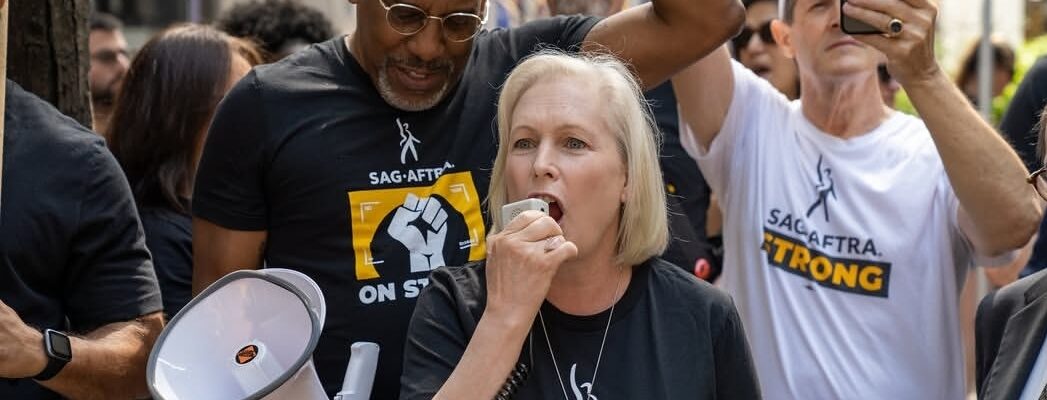
Banner Image: Senator Gillibrand stands with unions. Image Credit – Sen. Gillibrand



There are no comments yet
Why not be the first