

New York Senator Gillibrand Talks Withholding Heating, Energy Assistance, Impacting Low-Income New Yorkers, Disaster Recovery Funding Restored, Canada Tariffs
Below is a video from the senator’s recent press conferences about the Medicaid cuts coupled with changes in guidance to states for implementing the Americans with Disabilities Act, which courts have held to mean that individuals with disabilities who can’t work must be allowed to remain in their own communities. The senator talks about these changes, along with other topic related to healthcare, economic strain on local families, and the Canada tariff war. While the changes may not immediately impact people with disabilities (and many individuals on Medicaid will lose their coverage after November, so after the upcoming election), over time it might lead to fewer prosecutions on behalf of that population by the Department of Justice, causing them to have to advocate for themselves. According to Special Needs Answers: “The DOJ’s decision does not automatically end a person’s Medicaid home- and community-based services or prevent someone from seeking community-based care…. States may review their home- and community-based services, including eligibility rules, waiver programs, service limits, provider networks, and funding.” This video also contains press conferences regarding Low Income Heating Assistance, Canadian tariffs and import bans, along with a brief conversation with Secretary Rollins about SNAP cuts at a recent Senate hearing.
See below the video for an Instagram graphic showing the eighteen states that have pledged to continue these gains for those communities. As expected, New York and New Jersey are both on the list:
We have discussed in previous articles how the insurance premium subsidies have also been ended, and due to cuts in the OBBBA, New York is no longer able to offer free health insurance to residents with low- moderate income. There are some who will drop health insurance coverage altogether, while others will purchase a more bare-bones plan and hope they don’t get sick. However, there are certain situations where health insurance is an absolute necessity for the health of a person – referring here to maternity care. It is a well-proven fact that maternity care visits – of any kind, whether with an OB/Gyn (obstetrician / gynecologist), a midwife, or even a doula – once or twice (or more frequently) prior to the big day of labor and delivery improves outcomes. Of course, someone who takes the time to prioritize care during that critical phase is more likely to have a better outcome and to advocate for themselves. There was a study recently that determined that a patient with an advocate in a hospital situation – whether that is a spouse, sister, mother, mother-in-law, father, father-in-law, grandparent, or a city- or state-provided advocate – the outcomes are improved. The patient will get better care – across the board. This is also the case for primary care physicians involving family members in their own patients’ care. From the study about family member involvement in patient care: “Family engagement in care has emerged as an important aspect of critical care medicine [1,2]. Family members play a valuable role in the intensive care unit (ICU). Family may provide physical and emotional support to their loved ones, act as surrogate decision makers, and even directly participate in care (i.e., delirium detection and re-orientation, mobilization activities, feeding) [3]. As a result of the important role that families play in providing care, critical care professional societies have operationalized family engagement practices into their care standards. In the Society for Critical Care Medicine’s clinical practice guidelines, the “F” for “Family engagement and empowerment” has been incorporated into the ABCDEF care bundle [4].”
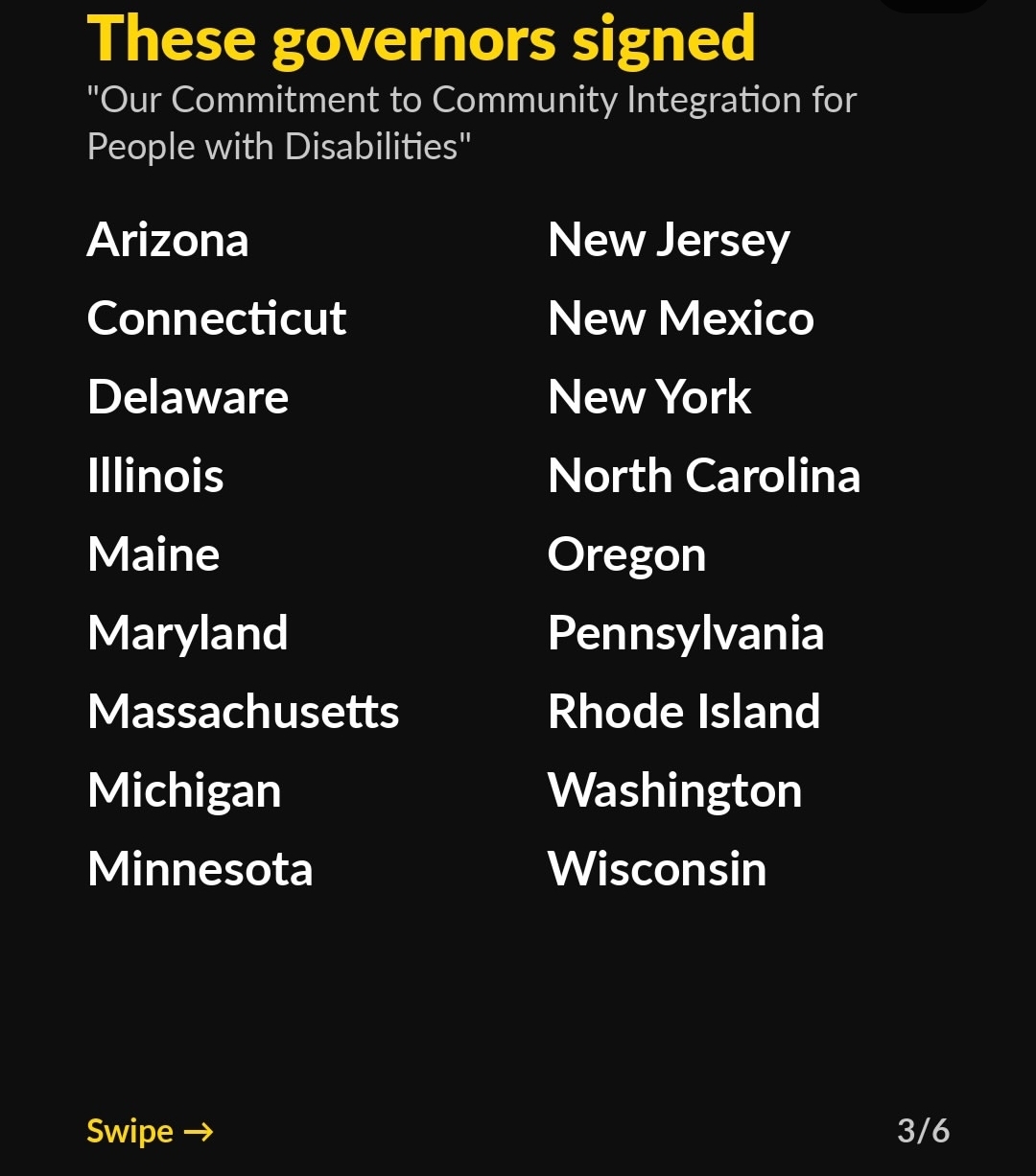
Governors pledging to uphold disability rights. Image Credit – Alison Access

Explanation. Image Credit – Alison Access
The Energy Assistance funding mentioned here was finally restored:
FOLLOWING GILLIBRAND DEMANDS, FEDERAL GOVERNMENT RELEASES HEAT ASSISTANCE FUNDING TO NEW YORK STATE
New York, N.Y. – Today, following the federal government’s release of funding for the Low-Income Home Energy Assistance Program (LIHEAP), U.S. Senator Kirsten Gillibrand (D-NY) issued the following statement:
“I am relieved that the federal government has released heating assistance funding, allowing New York State to make these funds available to help New Yorkers heat their homes,” said Senator Gillibrand. “New Yorkers need relief now more than ever as temperatures drop and fuel prices soar because of President Trump’s war with Iran. I was proud to fight for the swift release of these funds, and I will continue working to make sure that New Yorkers have the assistance they need to stay warm this winter.”
President Trump’s war with Iran has caused the price of oil to skyrocket, with prices currently hovering near $100 per barrel. That has driven the average cost of heating oil in New York up to $6.21 per gallon—a 67 percent increase from this time last year. As temperatures drop below freezing in New York, this cost increase is putting massive strain on New Yorkers’ budgets, making it hard for many to heat their homes.

LIHEAP is a federally funded program that helps low-income households pay utility bills, address energy crises, and lower costs by improving home energy efficiency through weatherization. Last year, over 1.1 million in New York households received LIHEAP assistance to help them stay warm.
Funding for LIHEAP was appropriated by Congress in the Continuing Appropriations and Extensions Act, 2027 in September. After the funding was appropriated, Senator Gillibrand demanded that the Trump administration immediately release it to states for distribution to Americans in need.
New York is slated to receive an estimated $356 million in LIHEAP funds.
AMID SKYROCKETING FUEL PRICES AND DROPPING TEMPERATURES, GILLIBRAND TO HOLD PRESS CONFERENCE DEMANDING RELEASE OF HEATING ASSISTANCE FUNDING
Washington, D.C. – Tomorrow, Thursday, September 17 at 10:45am, U.S. Senator Kirsten Gillibrand (D-NY) will hold a virtual press conference to demand that the Trump administration release funding for the Low-Income Home Energy Assistance Program (LIHEAP) ahead of the cold winter months.
Last week, the price of crude oil rose to $100 per barrel for the first time since July—a direct result of President Trump’s war with Iran. That has driven up the average cost of heating oil in New York up to $6.14 per gallon, which is a 66 percent increase from this time last year.
At the same time, President Trump’s administration has yet to release the LIHEAP funding that helps New Yorkers heat their homes in the fall and winter, which was appropriated by Congress in the Continuing Appropriations and Extensions Act, 2027 earlier this year.
As temperatures begin to drop, Senator Gillibrand is demanding that the administration immediately release this funding.
GILLIBRAND, SCHUMER ANNOUNCE OVER $1.4 MILLION IN DISASTER RECOVERY FUNDING FOR NEW YORK STATE
New York, NY – Today, U.S. Senator Kirsten Gillibrand, a member of the Senate Appropriations Committee, and U.S. Senator Chuck Schumer announced $1,466,049 in Federal Emergency Management Agency (FEMA) grants for New York State. This federal funding will support ongoing disaster relief and recovery efforts following the COVID-19 pandemic and other severe weather and fire events across the state. Of these funds, more than $1 million is dedicated to repairing critical infrastructure damaged by severe weather and fires, and more than $400,000 will reimburse hospitals and health networks for pandemic-related emergency measures.
“As New York continues to face the impacts of severe weather and disaster events, as well as continued costs associated with pandemic recovery, I am proud to deliver this critical federal funding for communities across the state,” said Senator Gillibrand. “These grants will be used to repair infrastructure across our cities and reimburse medical facilities for emergency measures they took to combat COVID-19. I will keep pushing for funding that helps ensure New Yorkers are protected from further catastrophes.”
“From helping communities recover from the COVID-19 pandemic to repairing infrastructure after severe storms, this $1.4 million in FEMA funding will support communities across New York,” said Senator Chuck Schumer. “I’ve long fought to ensure New Yorkers have the resources they need to recover from catastrophes, and I’m proud to deliver this funding today to help build a safer, more resilient future for New York.”
The offices of Senator Gillibrand and Schumer will continue to monitor the distribution of these funds to ensure they are delivered efficiently to the impacted communities.
| Recipient | Region | Allocation | Project Description |
| Town of Lyme | North Country | $156,195.78 | This grant will fund road base, subbase, surface and other related components repair or replacement as a result of severe storms, straight-line winds, and flooding. |
| St. Barnabas Hospital | New York City | $241,157.40 | This grant will fund emergency measures to support healthcare facilities as a result of the COVID-19 pandemic. |
| Archdiocese of New York | New York City | $181,738.74 | This grant will fund emergency measures taken to prevent the spread of COVID during the COVID-19 pandemic. |
| New York State Department of Environmental Conservation | Statewide | $261,490.34 | This grant will fund bridge repair as a result of severe storms and flooding. |
| Town of Hamden | Southern Tier | $294,773.51 | This grant will fund road base, subbase, surface, culvert, embankment and other related components repair or replacement as a result of Tropical Storm Debby. |
| New York State Division of Homeland Security and Emergency Services | Hudson Valley | $330,692.96 | This grant will fund costs for firefighting activities as a result of the Jennings Creek Fire. |
| Total | $1,466,048.73 |
AHEAD OF IMPORT BAN ON SOME CANADIAN PRODUCTS, GILLIBRAND DEMANDS PASSAGE OF BILL TO REPEAL AND REFUND PRESIDENT TRUMP’S TARIFFS AGAINST CANADA
Gillibrand’s Legislation Would Also Halt The Import Ban On Certain Canadian Dairy Products, Alcohol, and Other Goods, Which Is Set To Go Into Effect Next Week
Washington, D.C. – Today, U.S. Senator Kirsten Gillibrand (D-NY) held a virtual press conference demanding passage of her legislation to curb President Trump’s costly trade war with Canada. This comes less than a week before a sweeping import ban on Canadian dairy products, alcohol, and motorcycles is set to take effect.
Senator Gillibrand’s legislation, the Banning Antiquated Duties and Delivering Equitable American Levies (BAD DEAL) Act, would repeal all tariffs levied under Section 338 of the Tariff Act of 1930 and refund Americans for all duties paid under this authority. This includes President Trump’s 50% tariffs on Canada as well as his forthcoming import ban on Canadian goods.
“President Trump and Republicans promised to lower costs and make life more affordable, but they’ve used their total power in Washington to make life more expensive than ever,” said Senator Gillibrand. “Let’s be clear: the latest tariffs and impending import ban on Canadian goods are a bad deal for New York families. I’m doing everything I can to halt these tariffs and lower costs for New York families.”
President Trump’s trade war with Canada is driving up prices and harming New York families. Canada is one of New York State’s largest export markets for both goods and services, and the state imports more than $20 billion annually from Canada. Already, New York families have spent over $5,500 more due to President Trump’s tariff chaos and other reckless policies. The new 50% tariffs on Canada are projected to cost businesses and households across the U.S. up to $10 billion annually.
Senator Gillibrand introduced the BAD DEAL Act last week alongside Senator Peter Welch (D-VT). Senators Jacky Rosen (D-NV) and Amy Klobuchar (D-MN) also cosponsor the bill, and Rep. Brad Schneider (D-IL-10) introduced companion legislation in the U.S. House of Representatives in August.
Senator Gillibrand has opposed President Trump’s tariffs since the start of his administration and worked tirelessly to get the American people their money back. Last year, she joined 14 of her colleagues in introducing the Small Business RELIEF Act to end Trump’s Tariff Tax and refund small businesses their duties paid. In March, she and her colleagues introduced the Small Business Liberation 2.0 Act to exempt small businesses from another set of Trump-imposed tariffs and refund what they had already paid.
The full text of the BAD DEAL Act can be found here.
Regarding the above tariff information, Senator Gillibrand held a virtual press conference:
Today, U.S. Senator Kirsten Gillibrand (D-NY) held a virtual press conference to demand immediate passage of her legislation to curb President Trump’s costly trade war with Canada. The press conference came less than a week before a sweeping import ban on Canadian dairy products, alcohol, and motorcycles is set to take effect.
Gillibrand’s legislation, the Banning Antiquated Duties and Delivering Equitable American Levies (BAD DEAL) Act, would repeal all tariffs levied under Section 338 of the Tariff Act of 1930 and refund Americans for all duties paid under this authority. This includes President Trump’s 50% tariffs on Canada as well as his forthcoming import ban on Canadian goods.
Already, New York families have spent over $5,500 more due to President Trump’s tariff chaos and other reckless policies. The new 50% tariffs on Canada are projected to cost businesses and households across the U.S. up to $10 billion annually.
Banner Image: Senator Gillibrand at local food pantry. Image Credit – Sen. Gillibrand


There are no comments yet
Why not be the first