
Senate Hearing Focuses On Minnesota ICE Surge From Local, National Officials – NJ Senator Requests Details Of New Jersey 6 Yr Old Wandering Streets: UPDATED
Senate Hearing Focuses On Minneapolis ICE Surge From Local, National Officials – NJ Senator Requests Details Of NJ 6 Yr Old Girl Found Wandering Streets Unattended
See our previous article about the murder of Alex Pretti, along with another about Minneapolis Mayor Jacob Frey from when the situation started. This article was from Death Penalty Action requesting congressional clarification regarding extra judicial executions.
Below, you can see an interview with the six year old girl from Morristown New Jersey who went out to get lunch for himself and his daughter, but never came back as he was arrested on his way there. The girl’s mother was at work at the time, and she went to her neighbors to ask for help:
This hearing can be viewed in its entirety at this link.
While there were some Democrat lawmakers at the hearing, organized by Senator Rand Paul, it was led by and consisted mainly of Republican senators and one member of the House, also a Republican. While the Minnesota Attorney General was being questioned, several of the senators yelled at him and made accusations as yet unproven of alleged fraud that he himself had committed. He was also asked about topics completely unrelated to the subject of this day’s testimony. There was no call for decorum at this conduct, which might be called berating the witness, and it would be considered completely inappropriate in a court of law, which this is not.
According to the Minnesota law officials, there was little coordination between local and state officials despite repeated attempts on multiple matters including finding and arresting criminal immigrants and investigating the shooting deaths of Renee Good and Alex Pretti (the former of which the AG claims to have been stonewalled on and investigation has been canceled at the federal level – leading many federal prosecutors to resign from DOJ in protest).
There was a strange thread of whataboutism running through the hearing, where Republicans wanted to know why there was no similar public outcry like that of Renee Good and Alex Pretti as to the murders of Laken Riley, a blonde haired young college student killed by an undocumented immigrant, among a few other headline cases. We’ve reported on the death of Debrina Kawam, a homeless New Jersey woman set on fire and killed as she slept on a subway car in the city. The firestarter was an illegal immigrant as well.
However, the publicly discussed basis of the surge appears to be that prisoners aren’t being released from prisons into ICE custody for deportation if there’s a final order of removal from a judge, after they’ve completed their sentence. The local officials said that they follow the law, and that criminals of all types must serve their sentence first and then they contact ICE. They also previously said there are only 300 undocumented immigrants in their prisons across the state, not 1,300+, as DHS has said. In addition, the commissioner of corrections in MN said that if DHS or ICE asked them to assist in an arrest, they would do so and help facilitate that to the extent possible. They did point out, though, that they don’t actually have the manpower or budget to do this kind of thing routinely, whereas DHS received $190B, with $75B earmarked for ICE and the rest for CBP, in the budget bill passed last year.
There are only 1,700 police officers in the whole state, while the surge included about 3,000-4,000 officers from ICE, which is about twice as many. This was described as chaotic by many who experienced it, and New Jersey’s senator repeatedly asked if this same tactic would be deployed again or if they had learned it might not be the best policy. It was also Mr. Lyons’ idea to do it in that way, and he didn’t rule it out as a possibility for the future.
In a strange interchange between Senator Johnson and AG Ellison, the senator wanted to know if the AG had encouraged people to protest and exercise their first amendment right, as well as to put themselves in harm’s way to do so. Throughout the discussion, the attorney general maintained that he was fully in favor of the first amendment right to protest, and that he had and would continue to encourage people to express their views.
Senator Johnson pretty much outright blamed the Attorney General’s encouraging people to protest and record ICE operations as the cause of the deaths of Renee Good and Alex Pretti, going so far to say that had he not told people to speak up and record, those deaths wouldn’t have happened. It was the Attorney general’s, not the agent’s involved, fault that those two protesters were killed.

It should also be noted that there is no investigation into the ICE agent that killed Renee Good, but there is an investigation into the mayor and governor of Minnesota for encouraging people to obstruct government operations.
During the second portion of the testimonies, no one yelled at the ICE or DHS officials called to testify, though notably absent was Kristi Noem, the congressionally approved Secretary of DHS, who made statements that, as these long-time police officials said as a general rule, may have biased the investigations into the murders of Renee Good and Alex Pretti (only the second of which is actively being investigated by FBI, despite public pressure). She would not agree to provide testimony or answer questions despite being invited to do so.
In addition, as New Hampshire’s senator points out and mentioned above, DHS has billions of dollars in added spending already approved under the budget deal reached months ago that ended the longest government shutdown in history.
The DHS official who testified did agree that commonsense reforms, such as applying rules that local police departments use, might be acceptable for their officers. These rules include not wearing masks, wearing name tags, badges, and proper uniforms, and possibly body cams, though this was not directly stated (most jurisdictions require these cameras on police to protect the public from abuse).
Interestingly, the head of ICE responded to a question about officers drawing their guns before a threat has been established as existing. Such a practice aligns with their training when they’re trying to apprehend an undocumented immigrant with a final order of removal. This appeared to be whether or not that order was associated with a criminal history. This is different from the way police are trained, as they rarely approach a civilian situation (like a traffic stop) with guns drawn. They’re often visible on belts or holsters but not in hand. As the senators pointed out, this in and of itself, even without anything else such as swarms of officers converging on a person, would escalate a situation.
The former police officer now in charge of ICE, Todd Lyons mentioned that flyers were found distributed in Minneapolis that advise White people to put their bodies in front of undocumented immigrants and obstruct their arrests. This, however, may be referring to materials released by the Episcopalians. A bishop of this faith is said to have made such suggestions, and he also made public statements that his congregation members should have their wills in order, along with putting their own bodies in the way in protection of the weak, including their undocumented (or in the process of becoming documented) neighbors and community members. This may not have been intended for widespread public distribution but rather for church members.
It should be noted that this particular church has a long history of defending those being persecuted, regardless of by whom. It could also have been in reference to flyers posted by an account on Twitter advising businesses to simply refuse them service or to sabotage their property when brought in for service:

ICE flyer. Image Credit – Minneapolis Spring
It was also mentioned that there are classes being given in how to ‘obstruct’ ICE and DHS. There have in fact been many lessons, both online and in person (including one attended by the Minneapolis school superintendent whose story we brought you yesterday) about knowing your rights. That’s rights as a concerned bystander as well as for undocumented immigrants. Even they have rights by being on US soil, as the courts (including SCOTUS) have held over and over – that it is the land that confers the rights and all are subject to, and protected by, the US Constitution. They can protest, they can record, and they can even coordinate a boycott or organized refusal of service where applicable. This occurred with the Hilton Hotels in Minnesota refusing to register ICE agents in rooms in their hotels, after which the hotel was defranchised.
However, what’s occurred in the ICE raids recently is a new way of operating that’s been overwhelming and unexpected: surging officers to grab people on their way to drop off their kids at school, stopping them driving to work, intercepting them in their driveways and using their kids as bait, or even entering homes without a judicial warrant (in violation of the Fourth Amendment) – including arresting bystanders and kids caught in the middle. So these classes, while possibly helpful, are not very effective when an undocumented person from Minnesota is flown to a Detention Center in Texas or Louisiana in hours and given no access to a lawyer, a phone call, or even sufficient food, as the Irish man so detained has shared This person has a valid work permit, and has been in the United States for over twenty years, is married to a US citizen, has no criminal record at all, and has owned and operated a business here. But he is still in an ICE Detention Center in Texas since September, where he told the Irish Times the conditions were like a concentration camp, with not enough food, solitary confinement, no access to the outdoors, and other alleged abuses. This same type of story has been released many times with both citizens and non citizens alike, as we’ve previously reported.
The senator from New Jersey, Senator Kim, asked about the 6 year old girl who was left alone on the street crying for her father after ICE agents arrested her father while he was buying groceries. Mr. Lyons agreed to follow up with him with further details, and we’ll reach out for details about this occurrence, which happened in Morristown. Apparently, after her father was taken (some reporting has said the dad ran away from her and the mom wouldn’t open the door and that’s why they lost track of the girl – but there isn’t video of the arrest or subsequent moments), this 6 year old girl was wandering the streets asking for her father until neighbors took her and brought her to family members. UPDATED: The girl’s story would indicate that these statements from other news outlets were not true. Her mother was not home, she was at work. And according to statements from the father, he told the ICE agents arresting him that his six year old daughter was alone in the house as he was caring for her. They did not send someone to take care of her, and her mother was at work. She was alone for about two hours before coming outside and asking strangers for help. See the video above for the story of what happened in the six year old girl’s own words.
See below for Senator Paul’s opening statement from this hearing:
Dr. Paul Delivers Opening Remarks on Federal-State Immigration Enforcement in Oversight Hearing
Washington DC – Chairman Rand Paul (R-KY), Chairman of the Senate Homeland Security and Governmental Affairs Committee, convened an oversight hearing where he examined the level of cooperation between federal, state, and local officials to enforce immigration law.
During his opening remarks, Dr. Paul emphasized that effective immigration enforcement depends on clear coordination and honest communication between all levels of government. While reaffirming his support for U.S Immigration and Customs Enforcement’s mission to remove dangerous criminals, Dr. Paul stressed that restoring the confidence of the American people in their government requires transparency, clear standards for use of force, and accountability at every level of government
Remarks as prepared:
Today we will examine how immigration policy is carried out at the federal, state, and local levels in Minnesota, and whether failures of coordination or communication contributed to the events that followed. Any time an American citizen is shot in the streets of this country, it is a tragedy. That is true whether the individual is a private citizen exercising constitutional rights or a law enforcement officer performing official duties. Loss of life demands scrutiny, not spin.
In Minnesota, sharply conflicting accounts have emerged. State and local officials tell one story. Federal officials tell another. Depending on the media source, the public may hear only one side. This hearing exists to evaluate the facts, not to defend a narrative.
We will hear from two panels. First, leaders from Minnesota will describe conditions on the ground, the level of cooperation with federal authorities, and how tensions escalated. Second, leaders from CBP and ICE to explain the challenges of conducting enforcement operations under intense public scrutiny. We have also heard repeated claims that Minnesota, or Minneapolis in particular, is a so-called “sanctuary” jurisdiction.
That term is often used loosely and means different things to different people. State and local officials dispute that characterization, while federal officials cite limits on cooperation. Not every state operates the same way. We need to understand what cooperation actually looked like in Minnesota. We need to know whether communication failed. And we need to determine whether this was a failure of policy, coordination, or leadership on one side or both.
In a free society, filming government officials in public is a constitutional right. It is not an act of aggression. If Americans are led to believe that exercising that right places them at risk of lethal force, public trust collapses. At the same time, federal officials made public statements implying that firearms are prohibited at protests. Those statements were later clarified.
The First and Second Amendments are not suspended during periods of unrest. When officials speak imprecisely about constitutional limits, especially in volatile moments, they risk inflaming situations rather than stabilizing them. Law enforcement officers perform difficult and dangerous work, and the vast majority do so honorably. But when a shooting occurs, the proper response is not to dismiss concerns or rush to judgment.
Traditionally, officers are removed from the line while an independent review examines the facts. That process protects both the public and law enforcement. What we must avoid, on all sides, is inflammatory rhetoric. Declaring “nothing to see here,” or rushing to label a U.S. citizen a domestic terrorist before the evidence is established, undermines trust and escalates already volatile situations. Both parties have weaponized the term “domestic terrorist” to target those with opposing views and it must end.
Many Americans have seen the videos. Many see an individual retreating. Many see someone attempting to assist a woman on the ground before being seized from behind. Reasonable people may disagree about what those videos show, but the truth must be determined by evidence, not narrative.
I support Immigration and Customs Enforcement, and I believe dangerous criminals should be removed from our communities. In order for ICE to be successful they must restore public trust. We must acknowledge when federal agents are placed in chaotic crowd-control situations, the risk of tragedy increases.
At the same time, state and local decisions that limit cooperation affect how and where federal enforcement is carried out. Escalatory statements from any level of government only make matters worse. Reports that cooperation in Minnesota is improving and that agents will return to their normal assignments are encouraging.
Restoring trust, however, requires more than assurances. It requires independent review, clear standards for the use of force, and honest accountability. A government that values liberty must be willing to examine its own actions. That is how we protect civil liberties. That is how we support law enforcement. And that is how we prevent future loss of life.
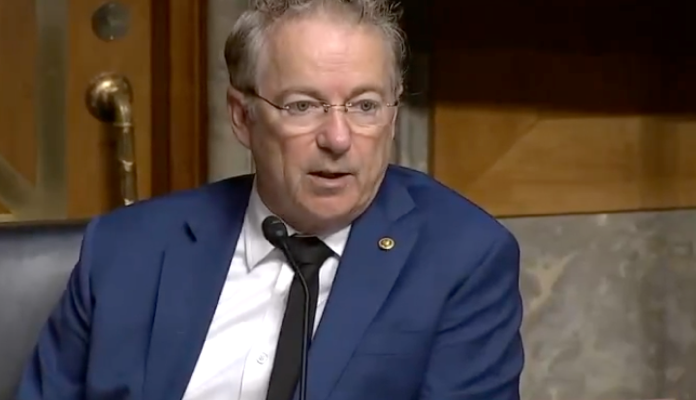
Banner Image: Senator Paul at hearing. Image Credit – Sen. Paul



Staten Islander News Service Staff Writer
This byline indicates that this article was penned by a member/members of the Staten Islander News Organization office team. Our staff writers are the backbone of our newspaper, performing all sorts of important tasks like conducting interviews, investigating leads, besides writing the news stories you see.
[…] We’ve been following the occurrences in Minnesota over the last couple of months, including a Senate Hearing convened by Senator Rand Paul of Kentucky to try to get some answers as to why two American citizens have been killed along with many others injured or illegally […]
[…] their pay. For comparison, DHS received $89.8 billion in FY 24 (we are now in FY25). We also covered the Senate hearing on the situation in Minnesota were armed and masked ICE agents came … to that state and began conducting arrest operations. They also killed two American citizens and […]
[…] Editor’s note: For readers unfamiliar, across the bridge from Staten Island, in Newark New Jersey, a fight has been going on at a detention center. Run by for-profit company GEO, detainees there allege that they’ve received wormy or rotten food in insufficient quantity, been denied essential medical care, including post-miscarriage care for a fetal death that occurred while in custody, along with other human rights abuses shared with Senator Booker by those who suffered them firsthand (see the YouTube video here). Days ago, there was an incident inside the center where tear gas and ‘less-lethal’ weapons were used. Until several days ago, ICE agents were said by the governor to have been using batons, tear gas, and rubber bullets regularly night after night during protests in support of the hunger strike and detainee demands. Keep in mind that, according to Senator Booker and Senator Kim, Jersey’s senators, both of whom were finally allowed access after days of requests (and Sen Kim was tear gassed himself after emerging), the conditions were classified by them as inhumane, horrific, and disturbing. The state of New Jersey was able to get DHS/ICE to agree to allow the state police exclusive responsibility for crowd control at these protests, which have been for the most part peaceful, albeit with a more boisterous and assertive crowd likely to push past barricades and yell at officers, the latter of which is fully protected – even if they use expletives. The governor mentioned, in the video linked above, that she was activating the police and partners in order to avoid a situation like that seen in Minnesota. […]
[…] were enacted, since non-citizens can receive a driver’s license. It did not pass, at 48-50. Chairman Paul recently hosted a hearing on ICE surges in Minnesota, and now a similar series of incidents is apparently occurring in New Jersey, where groups of […]