

OPINION: CATO Institute Says California’s Billionaire Tax Won’t Help – But Maryland Is Already Benefitting From That Exact Tax, Making A Case Study Through Present Time
See below for point-counterpoint on this topic, including an article from CATO Institute about the letter written by Nobel Prize Winners, contrasted with an article by the Insititute on Taxation and Economic Policy that discusses the millionare tax as a positive and ne5 gain for Maryland, where it has already been instituted as a graduated income tax increase on income above a certain amount. The CATO Institute’s position on several matters below makes a number of assumptions. First, that TANF (Temporary Assistance For Needy Families), passed in the 90s by President Clinton, was a net positive, and that forcing people to work to receive welfare and health insurance will save taxpayers money. While it may ‘save money,’ it will do so by purging the rolls of welfare and Medicaid due to the onerous requirements, and will not have the effect of getting people back to work. It has also been proven many times over, including the times we are presently living through, that ‘trickle down economics’ doesn’t actually work. Giving the wealthy more money does keep that money at the top, parked in their bank accounts, not providing gains for anyone else. And the idea that billionaires paying for political campaigns is a neutral or positive thing is patently ridiculous. Those billionaires pay all that campaign money because it works. It makes politicians do the bidding of wealthy donors and not ordinary Americans. But all someone has to do to disprove much of what is said here is to visit one of the many homeless tent cities that have sprung up because removing the money from the economic engine – or from the workers responsible for the production – makes it so that hard working people cannot survive. Bad economic policies have made this worse already, with families being squeezed from all directions.
Not Even Nobel Prize Winners Can Save the ‘Billionaire Tax’
Six Nobel Prize-winning economists recently signed a letter urging Californians to pass Proposition 40, the one-time 5% tax on the wealth of the state’s billionaires.
You can usually tell a controversial idea like the “billionaire tax” is bad when proponents start trotting out teams of Nobel Prize winners to defend it.
If the idea really were that good, you wouldn’t need more than one Nobel laureate to make the case. The “tell” is when they quote half a dozen, as if there were a Nobel Prize for groupthink.
Six Nobel Prize-winning economists recently signed a letter urging Californians to pass Proposition 40, the one-time 5% tax on the wealth of the state’s billionaires.
The letter is wrong about everything, from the history of wealth taxes to the proceeds California can expect the tax to provide.
The letter calls Prop. 40 “the first-ever tax on billionaire wealth enacted anywhere in the world.” Governments have taxed billionaires’ net wealth for decades.
Twelve European countries imposed annual net wealth taxes in the 1990s. They raised very little revenue, cost a lot to administer, pushed investment out of their countries, and were politically unpopular. All but three of the European wealth taxes have been repealed.
The letter claims that California billionaires paid income tax equal to just 1.6% of their wealth gains. This is also misleading. 1.6% is not an income-tax rate. It is income taxes paid divided by an increase in estimated asset values, much of it unrealized.
We don’t tax gains on paper. Not for the rich, and not for the middle class. If we did, homeowners would have to pay a tax every year that their home went up in value, even if they were still living in it.
The wealthy actually pay heavy taxes. That’s why when a Biden-era US Treasury study estimated tax payments by wealth, the results showed the wealthiest Americans paid total tax rates of almost 60% of annual income, the highest of any group. And roughly double the rate of the average taxpayer.
Then there is the promised $100 billion in new tax receipts. California’s nonpartisan Legislative Analyst’s Office does not endorse that number, estimating that the tax could raise “tens of billions,” while also reducing state income-tax revenues on an ongoing basis as wealthy taxpayers move away.
The Nobel laureates assert that “it is unlikely any significant number of billionaires successfully cut ties with the Golden State” before the Jan. 1, 2026, effective date of the tax.
But Sergey Brin, Larry Page, Peter Thiel, Don Hankey, Travis Kalanick, Steven Spielberg, and David Sacks all reportedly left before the cutoff. Stanford University economists Joshua Rauh and Benjamin Jaros found that nearly 30% of the expected taxable wealth left California before the measure even qualified for the ballot.
California may dispute some of these moves, but taxpayers will also dispute the tax’s legality. Prop. 40 could be unconstitutional in as many as eight different ways.
The Nobel laureates’ letter says Prop. 40 would help offset “massive funding cuts” to California’s Medicaid (Medi-Cal) program.

But many of the so-called “cuts” actually save the state money by adding work or volunteer requirements to receive government health benefits.
In real terms, federal subsidies to California are projected to decline slightly from their pre-pandemic high over the next decade. But even after the “cuts,” a Hoover Institution analysis concluded that “federal spending on Medi-Cal will be 50% higher in 2034 than in 2019.” That is far from a massive cut.
And rising billionaire wealth does not demonstrate these taxpayers have “extraordinary” political power, as the letter’s authors claim. Billionaires do own media properties and fund political campaigns, but spending on either side of the political aisle often cancels itself out.
The authors point out that Sergey Brin has spent $100 million against Prop. 40. Yet Tom Steyer spent more than $220 million of his own money running for governor on a platform that included the wealth tax.
More fundamentally, rising billionaire wealth is not evidence that anyone else has been made poorer. Wealth at the top is overwhelmingly ownership of productive businesses, not piles of money stolen from the rest of the economy. Roughly three-quarters of the assets of the richest 0.1% are ownership stakes in businesses that employ workers, produce goods and services, and finance new investment.
Strip away the Nobel credentials, and the letter’s case rests on a series of claims that don’t hold up. Prestigious signatures don’t change the arithmetic.
Californians deciding on Prop. 40 should weigh the evidence. And on the evidence, the likeliest result is not a windfall for health care spending, but a smaller tax base and a higher tax bill that falls on everyone who stays.
Maryland Gov. Wes Moore’s Tax Plan Boosts Revenue, Increases Fairness
Maryland Gov. Wes Moore put forward a tax reform plan that would make the tax system fairer, simpler, and better able to meet the state’s needs.
The proposed changes to the income tax ask more of those at the top and provide an average tax cut for those earning less. Our analysis shows that more than three-fourths of the new revenue would come from the wealthiest 20 percent of households. And 80 percent of the revenue from the rate, bracket, and capital gains changes would come from the top 1 percent of households, those earning, on average, more than $2 million annually.
Nearly 65 percent of households would see a tax cut and those cuts would primarily go to middle and low-income households. Just 20 percent of Maryland households would pay more, and most of those earn more than $169,700 a year. And a big chunk of the new revenue (40 percent) would come from the state’s wealthiest 1 percent. When considering the local impacts, the proposal is even more progressive.
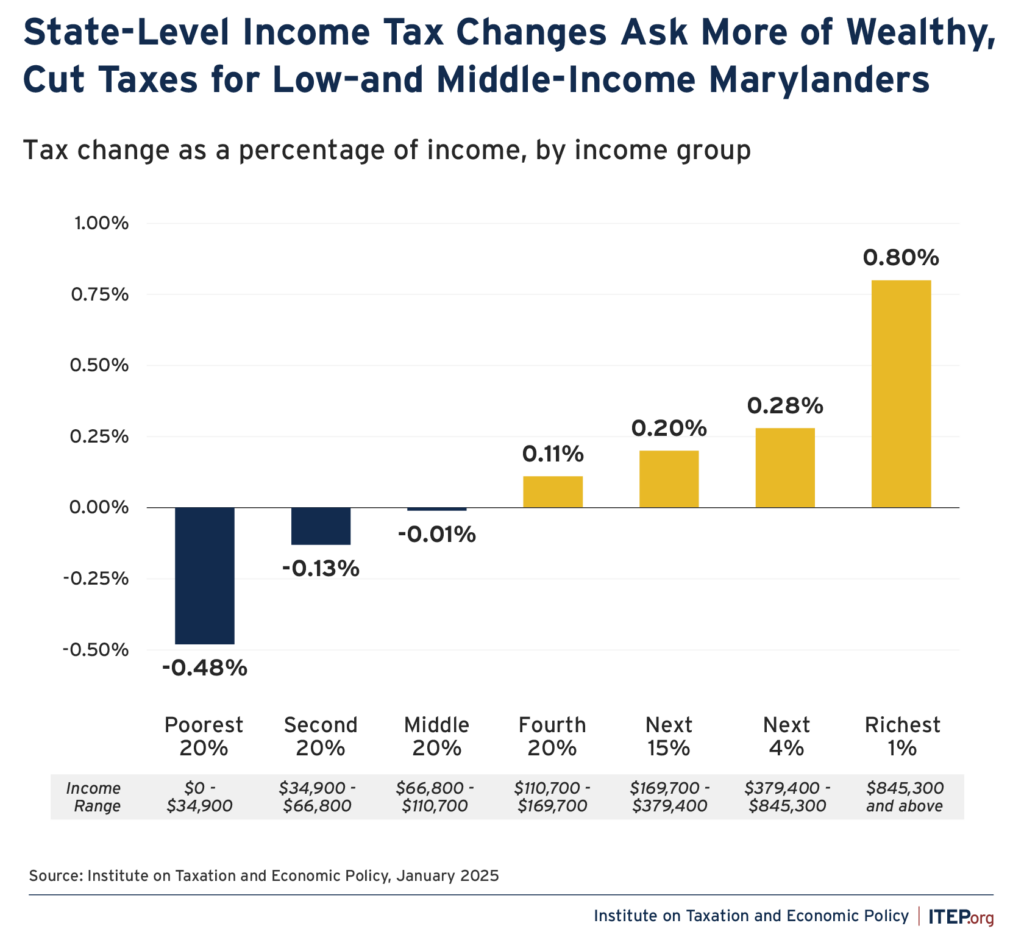
The wealthiest 1 percent of Maryland taxpayers are currently the least-taxed income group in the state. This plan asks more of those at the top.
Under current law, the top 1 percent of Maryland taxpayers pay 9 percent of their income in total state and local taxes, the lowest of any income group in the state. By comparison, the poorest 20 percent of Maryland taxpayers pay 9.6 percent of their income in total taxes and working-class families in the middle 60 percent pay 11.3 percent.
Under the governor’s plan, the top state income tax rate – now 5.75 percent — would rise to 6.5 percent on household incomes over $1 million (or $1.2 million for married couples), with a smaller increase on incomes over $500,000 ($600,000 for married couples). For incomes over $350,000, an additional 1 percent tax would be levied on profits from the sale of stocks and other assets – a provision that will mostly affect the wealthiest households.
Deductions would be simpler and more favorable for middle- and low-income taxpayers.
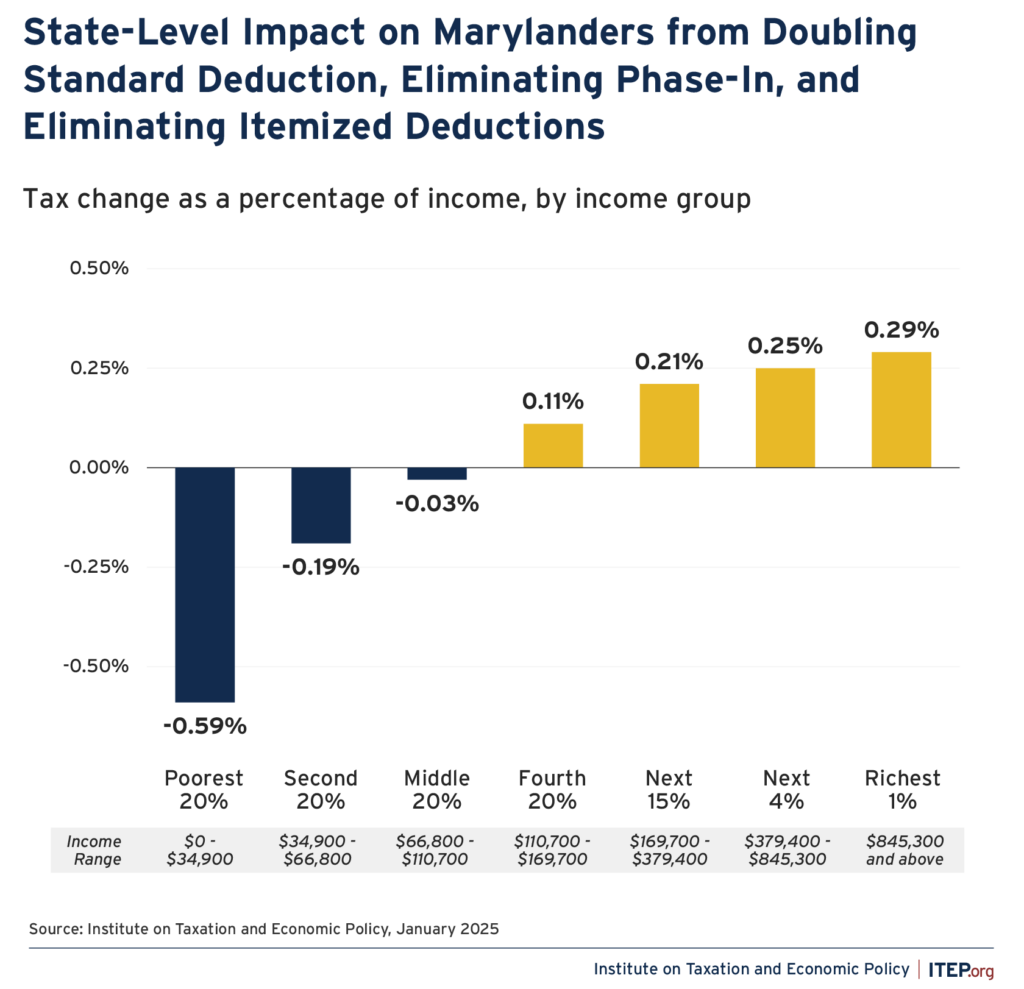
Most Maryland taxpayers already use the state’s standard deduction, but it is small and contains a gradual phase-in that reduces the deduction for low-income households. The governor’s proposal doubles the standard deduction and eliminates the phase-in while disallowing Maryland taxpayers from carrying their federal itemized deductions over to their state return.
Itemized deductions at the state level overwhelmingly favor upper-income households, complicate the tax code, and are poorly targeted as our colleagues point out in this report. These changes would provide a net tax cut for most Marylanders: about 65 percent of households would see a cut, and about 78 percent of the decrease will go to the bottom 80 percent of households. The revenue loss would be offset by a tax increase on the wealthiest Marylanders; about 20 percent of households would see an increase, with 71 percent of the increase paid by the top 20 percent of households.
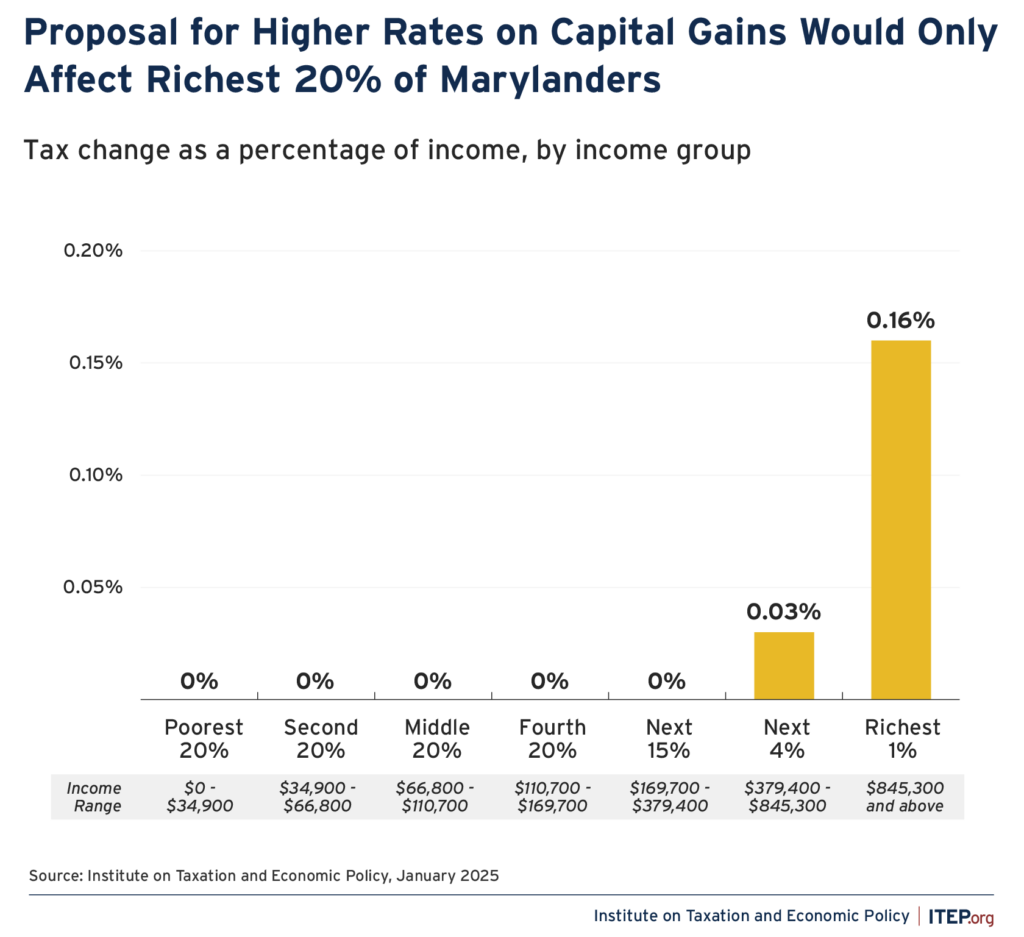
Income from wealth would be taxed with higher rates on capital gains.
The plan would raise taxes on wealthy families by charging higher rates on realized capital gains if the household’s federal adjusted gross income exceeds $350,000. Capital gains income overwhelmingly flows to a small number of wealthy, white families; higher state tax rates on capital gains increase parity in taxation of wealth versus work. All or nearly all of the households who would see an increase are in the top 20 percent, and about 86 percent of the increase would come from those in the top 1 percent.
Some families with children would get a new tax break.
State child tax credits help families make ends meet. Maryland’s $500 Child Tax Credit for children under age 6, currently available only to families with incomes below $15,000, would be extended to families with incomes slightly above that threshold, with the amount gradually decreasing as incomes rise.
Other significant changes in the governor’s package include:
- A long-running loophole for corporations would be narrowed. Maryland is now among a minority of states that allow corporations to avoid tax by shifting profits to out-of-state affiliates. The governor’s proposal would have Maryland join 28 other states plus the District of Columbia that require “combined reporting” to require corporations and their affiliates in other states to file a combined return.
- Large estates would pay more tax. Estate and inheritance taxes are among the very few tools for states to reduce the concentration of wealth in the hands of a few families over generations. Under current law, the wealthiest Marylanders can pass $5 million to their heirs tax-free before estate tax is owed; the governor’s proposal would reduce the exemption to $2 million.
Key state budget priorities would take less of a hit. The additional revenue from the plan, an estimated $819.5 million according to state estimates, is insufficient to avert spending cuts that the governor has proposed elsewhere in his proposal. But the tax changes would allow the state to make smaller budget cuts than are otherwise needed.
As legislators consider the proposal, they should improve the governor’s plan in several ways to make it more progressive and raise more revenue so that budget cuts don’t have to be so large.
- The General Assembly should set aside the governor’s proposal to reduce the state’s corporate tax rate over time. This approach mostly benefits out-of-state shareholders and does little to bring jobs and investment to Maryland communities.
- The proposal to enact combined reporting should be expanded to encompass not just U.S.-based affiliates but also affiliates in other countries, a practice known as worldwide combined reporting. This policy, which outright stops the incentive for multinational corporations to game revenue departments and shelter their profits in tax havens overseas, is a proven and effective
- Finally, the state should retain its inheritance tax, perhaps using the revenue for further improvements to the state Child Tax Credit, which can be an effective tool to reduce child poverty.
Banner Image: Immigrants pay taxes, billionaires don’t. Image Credit – Meg



CATO Institute
For more than 40 years, Cato has led the charge for liberty in our nation and around the world. The Cato Institute is a public policy research organization—or think tank—that creates a presence for and promotes libertarian ideas in policy debates. Our mission is to originate, disseminate, and advance solutions based on the principles of individual liberty, limited government, free markets, and peace. We make liberty come alive for people by sharing our research and ideas in clear language, free of jargon. We find common ground and work with individuals and groups across the political spectrum in order to build a society that is freer, happier, and more prosperous. We hope you will join us.
There are no comments yet
Why not be the first