
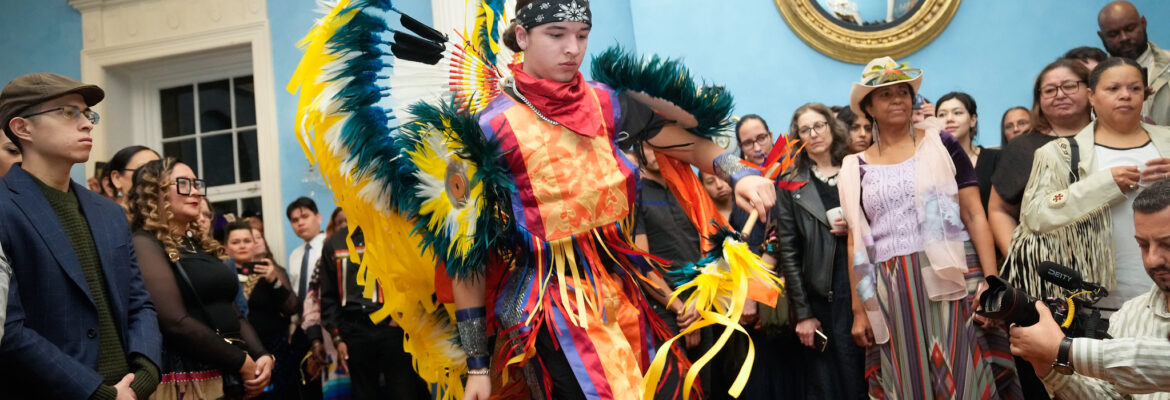
Historic Affordable Housing Plan, Investments In Infrastructure; Celebrates Native American Heritage, Culture; Historic Labor Agreements Covering Capital Projects; Appointed NYPD Commissioner Jessica Tisch; Hosted Community Conversation; In-Person Media Availability: Mayor Adams Updates
Editor’s note: Last week, Mayor Adams celebrated an agreement with the Governor to advance a historic plan to build affordable housing and invest in infrastructure and housing, announced historic labor agreements covering over $1 Billion in capital projects, celebrated Native American heritage and culture, appointed incoming NYPD Commissioner Jessica Tisch as well as appeared with her on Wolf Blitzer’s The Situation Room, hosted a community conversation in Jamaica Queens, took questions from the media in his weekly in-person media availability, shared update on November 2024 Financial Plan for New York City
MAYOR ADAMS ANNOUNCES HISTORIC LABOR AGREEMENTS COVERING OVER $1 BILLION IN CAPITAL PROJECTS TO DELIVER CRITICAL INFRASTRUCTURE, TRANSFORM WILLETS POINT, AND SECURE LOCAL JOBS AND APPRENTICESHIP OPPORTUNTIES
PLAs Cover Over $1 Billion of Transformational Capital Projects and Set Framework for Future PLA Negotiations Over Nearly $50 Billion of Upcoming Projects
PLAs Support Fair Wages, Community Hiring, Investments in M/WBEs; Promote Efficient Project Completion
NEW YORK – New York City Mayor Eric Adams today announced two Project Labor Agreements (PLAs) with the Building & Construction Trades Council of Greater New York (BCTC) that will cover more than $1 billion in construction projects throughout the term of the agreements, including generational infrastructure improvements in Willets Point. These historic PLAs will allow the city to complete capital projects more effectively and efficiently, connect more underserved New Yorkers to quality union career and apprenticeship opportunities through community hiring, and strengthen the city’s commitment to minority- and women-owned businesses (M/WBEs). Covered construction projects will include green infrastructure improvements and repairing the city’s sewers, roads, and bridges. Mayor Adams also announced that the New York City Economic Development Corporation (NYCEDC) has signed a letter of intent with BCTC, to negotiate in good faith additional PLAs for the Hunts Point Produce Market, the Kingsbridge Armory redevelopment, and the Science Park and Research Campus (SPARC) Kips Bay projects — a cumulative $1.88 billion in construction work. The PLAs announced today also establish the framework for future negotiations with the BCTC for upcoming PLAs that could cover as much as $50 billion of future capital construction projects. These PLAs will cover design-build projects, new construction projects, and renovation projects of city-owned buildings and structures. BCTC represents more than 100,000 tradesmen and tradeswomen across New York City and consists of local affiliates of 15 national and international unions.
PLAs enable the city to establish fair wages, benefits, and safety protections for workers, and provide opportunities for workforce development, while controlling construction costs and ensuring the timely completion of projects. Today’s announcement will allow $800 million in planned infrastructure projects across the city to be completed using design-build delivery, an innovative method where the design and construction are under a single contract. These projects range from improvements to critical below-grade infrastructure, roadway and waterfront reconstruction, and new greenway projects — all projects with complex site conditions that will benefit from site investigations and constructability input from contractors during the design development. A separate PLA will support the administration’s historic $270 million investment in the transformation of Willets Point. They also include the largest-ever commitment to investing in M/WBEs, and for the first time, they incorporate Community Hiring goals to ensure that job and apprenticeship opportunities are made available to workers living in New York City Housing Authority (NYCHA) housing or a ZIP code where at least 15 percent of the population lives below the federal poverty threshold.
“These agreements, covering more than a billion dollars in work, are a win-win-win: good union jobs for New Yorkers; faster, better, and more efficient capital projects; and billions of dollars of investment in communities that went ignored for decades,” said Mayor Adams. “But we’re not stopping with these projects — and we’re not stopping at just $1 billion. These agreements give us a framework for future agreements covering another $50 billion in projects. That means tens of thousands of good-paying jobs for our union brothers and sisters and hundreds of projects delivered on time and on budget for New Yorkers. My thanks to Gary LaBarbera, BCTC, and the hard-working New Yorkers who put their blood, sweat, and tears into building a better city for all.”
“Through our collaboration with the Building & Construction Trades Council on these Project Labor Agreements, we are not only investing in world-class infrastructure but also creating thousands of good-paying union jobs that will benefit New Yorkers for generations,” said First Deputy Mayor Maria Torres-Springer. “Our administration is committed to driving economic growth, creating jobs, and building a more resilient city for the future. I want to thank our labor partners and everyone involved in securing these historic PLAs, which will help lay the foundation for a stronger, more equitable New York.”
“Strong project labor agreements are a key ingredient in supporting the workforce that delivers infrastructure to our city, and so much more,” said Deputy Mayor for Operations Meera Joshi. “They enable us to unlock the promise of design-build delivery tools that we advocated for over the past several years, meet our commitments to project timelines, and manage costs. With a range of these agreements, we will be able to expedite projects to improve our sewers, roads and bridges — meeting the demands of climate change and population growth across all five boroughs.”
“Transformational development and green infrastructure upgrades will reinvigorate our communities and bring much-needed stability and economic stimulus to all New Yorkers; but the full scope of benefits from these capital projects can only be unlocked through project labor agreements that will guarantee thousands of good-paying union careers for workers from surrounding neighborhoods,” said Gary LaBarbera, president, Building & Construction Trades Council of Greater New York. “We are grateful for these historic commitments and collaboration from Mayor Adams and NYCEDC, as we must ensure that our city’s hardworking people, including our tradesmen and tradeswomen, are provided fair wages and accessible pathways to the middle class that will allow them to reinvest in their communities and support their families in the foreseeable future. We look forward to working with NYCEDC further so that our members may take advantage of these opportunities and play a role in completing these upcoming projects that will modernize and improve our city for generations to come.”
Today’s announcement will allow the city to utilize more efficient project delivery models across the city, shaving months and years off capital project timelines and saving taxpayers millions of dollars. Specifically, this PLA enables the city to use design-build, which allows a single entity to be responsible for both project design and construction, whereas historically, the city has completed capital construction projects by separately awarding design and construction contracts. This improved coordination allows the city to complete capital projects faster and more efficiently. Thanks to this agreement, the city intends to use design-build delivery for a $150 million greenway along the East Side Coastal Resiliency project in Lower Manhattan, a $40 million deep sewer manhole project in Brooklyn, a $240 million bridge and roadway improvement project on Belt Shore Parkway in South Brooklyn, and a $100 million waterfront dock and bulkhead reconstruction project at the Port Richmond and Rockaway Wastewater Resource Recovery Facilities in Staten Island and Queens, respectively.
The Willets Point transformation — which Mayor Adams announced in November 2022 with NYCEDC, New York City Councilmember Francisco Moya, Queens Borough President Donovan Richards, the New York City Football Club (NYCFC), and Queens Development Group — will deliver this new, resilient infrastructure, as well as the largest 100-percent affordable housing project in 40 years, over 20,000 square feet of retail space, a 250-key hotel, and the city’s first soccer-specific stadium that will be privately financed by NYCFC.
Today’s Willets Point PLA will facilitate the use of union labor to deliver districtwide infrastructure, including resilient sewers, new streets, and 150,000 square feet of public open space. This infrastructure is being delivered as part of the Adams administration’s generational commitment to improve conditions in Willets Point and to support forthcoming development in the area.
The transformation of Willets Point is expected to generate over $6 billion in economic impact over the next 30 years. The total transformation will create over 14,000 construction jobs and over 1,500 permanent jobs, in addition to adding 2,500 affordable homes and 150,000 square feet of public space. New York City has made a significant investment in the Willets Point neighborhood under Mayor Adams’ leadership, including remediating close to 200,000 tons of contaminated soil and infrastructure investments such as new streets, signage, sidewalks, curbs, trees, lights, drainage, stormwater management, water mains, hydrants, sewers, and utilities. Additionally, because Willets Point is in a flood-prone area, the city is taking a holistic approach that centers on resiliency by raising key infrastructures and buildings out of the 100-year floodplain to protect from future storms.
In December 2023, Mayor Adams and city officials broke ground on the first 880 units of affordable housing at Willets Point, expected to be completed by the end of 2026. The next batch of affordable homes to be built as part of Phase 1 are 220 units designated for low-income seniors.
Mayor Adams’ vision for the transformation of Willets Point builds on core goals in his “Rebuild, Renew, Reinvent: A Blueprint for New York City’s Economic Recovery” and “Housing Our Neighbors: A Blueprint for Housing and Homelessness,” including leveraging neighborhood infrastructure investments to catalyze equitable community development and creating housing opportunities in neighborhoods with strong access to jobs, transit, schools, parks, and other amenities. It also builds on the administration’s track record of advancing generational projects to build and reinvent neighborhoods in all five boroughs, including the Kingsbridge Armory in the Bronx, the Staten Island North Shore Action Plan, SPARC Kips Bay in Manhattan, the South Brooklyn Marine Terminal, and more.
These efforts are part of a broader Adams administration commitment to build a more inclusive economy for all New Yorkers. In September, Mayor Eric Adams and New York City Mayor’s Office of Talent and Workforce Development (NYC Talent) announced nearly 8,500 job-seeking New Yorkers were connected to employment, free training, and workforce development resources over six months through the “Jobs NYC” initiative. Jobs NYC is a multi-pronged citywide effort to reduce barriers to economic opportunities and deliver workforce development services directly to communities across the five boroughs that are experiencing high unemployment. In June, the city announced significant progress on its moonshot goal to deliver 30,000 apprenticeships by 2030. First announced in the 2023 State of the City, apprenticeships create economic mobility through career pathways to good-paying jobs in a variety of sectors and industries.
“The work being done at Willets Point is a generational opportunity to transform what was once a dumping ground into a new vibrant community that is a model for public-private partnership,” said NYCEDC President and CEO Andrew Kimball. “Alongside our partners at Queens Development Group II, Turner Construction, AECOM, and the Building & Construction Trades Council of Greater New York, we are showing our commitment to increasing union labor and providing New Yorkers with prevailing wages across the city. We are also working with our partners at BCTC to lay the groundwork for future PLAs for some of our biggest projects throughout the five boroughs, including at the Hunts Point Produce Market, the Kingsbridge Armory redevelopment, and SPARC Kips Bay.”

“The Adams administration is using every tool at its disposal to prioritize New York City’s greatest asset: its talent,” said NYC Talent Executive Director Abby Jo Sigal. “The most recent PLAs increase the quality of opportunities for those currently employed in the construction industry, and through the incorporation of Community Hiring workforce and apprenticeship goals, the city is increasing equitable access for more New Yorkers looking to begin their careers in this critical sector, which will help make our city’s economy more prosperous and inclusive.”
“DDC’s design-build pilot program is reducing the timelines for major public projects by years, and Project Labor Agreements are critical to maintaining that success and building on it in the future,” said New York City Department of Design and Construction (DDC) Commissioner Thomas Foley. “Effective PLAs minimize project disruptions and they help us access a skilled and diverse workforce so we can complete culturally competent projects all over the city. We look forward to continuing the great design-build work on both our public buildings and infrastructure projects.”
“DEP congratulates the Adams administration on these labor agreements which will ensure that important infrastructure improvements keep moving forward to keep New Yorkers safe, while expanding job opportunities for members of the city’s underserved communities,” said New York City Department of Environmental Protection (DEP) Commissioner and Chief Climate Officer Rohit T. Aggarwala. “DEP is proud of the work we’ve already done regarding green infrastructure installations, along with sewer and water upgrades. We look forward to continuing our partnerships as the city works to improve neighborhoods, including Willets Point in Queens, Kingsbridge in the Bronx, and Staten Island’s North Shore.”
“DOT is proud to support the development of Willets Point by investing in improved infrastructure for Queens residents. We thank Mayor Adams for his leadership and vision for this transformative project,” said New York City Department of Transportation (DOT) Commissioner Ydanis Rodriguez. “DOT is committed to providing safe, sustainable, and efficient transportation options for Queens residents and visitors to this growing sports and entertainment destination. As part of these efforts, we are advancing the Queens Waterfront Greenway to bridge gaps in the bike and pedestrian network, and in 2023, we completed a bus priority project on Northern Boulevard, extending to 114th Street, to enhance access and connectivity for communities in and around Willets Point.”
“These new Project Labor Agreements will ensure that the city continues to deliver on large construction projects more efficiently and cost-effectively, saving much-needed taxpayer dollars for constituents.” said New York City Chief Business Diversity Officer Michael J. Garner. “Moreover, essential workforce development wins negotiated by the Building & Construction Trades Council of Greater New York, ongoing investments in our M/WBEs, and the incorporation of Community Hiring goals makes this a true win for everyone involved. Transformative capital projects like Willets Point will benefit from more efficient project delivery, which will ultimately add more local employment and homeownership opportunities along with other citywide economic benefits. Mayor Adams is following through on his commitment to building a more inclusive economy for all New Yorkers.”
“Project Labor Agreements ensure public construction projects benefit working-class New Yorkers by establishing fair standards for workers and ensuring quality and efficiency in project execution,” said New York City Office of Community Hiring Executive Director Doug Lipari. “Incorporating Community Hiring into the PLAs will increase these benefits by connecting more working New Yorkers in search of opportunity to quality career pathways in the construction industry. We are grateful to the BCTC for their partnership and look forward to our continued collaboration on future PLAs.”
“New Yorkers deserve efficient and effective delivery of capital projects that improve their neighborhood infrastructure and provide neighborhood amenities, and Project Labor Agreements are a critical tool to unlock these projects at scale,” said New York City Chief Delivery Officer Alison N. Landry. “Thank you to BCTC for partnering with the city to develop these modern agreements that support our capital process reform initiatives like design-build delivery. Beyond establishing consistent standards and streamlining administrative requirements, these PLAs reflect the city’s commitment to reducing barriers for entry and creating good-paying jobs in the construction industry — essential for building our future, together.”
“Billions of dollars in critical infrastructure projects were unlocked because of these agreements announced between the city and BCTC today,” said New York City Director of Capital Projects Development Elizabeth Matamoros. “I’m proud of our efforts to develop a modern approach with these agreements and lay the groundwork for future agreements that support more flexible, efficient delivery of our city’s infrastructure projects. In expanding entry points to construction workforce by incorporating Community Hiring, we’re ensuring that our public projects serve all New Yorkers, from those who work on the projects to those who enjoy the end results.”
“These Project Labor Agreements will enable the city to build world-class infrastructure, provide good-paying, union jobs for thousands of New Yorkers, and support M/WBEs” said Mayor’s Office of Policy and Planning Policy Director Marc Heinrich. “I thank the Building & Construction Trades Council for their incredible partnership.”
“Today we begin a once in a generation transformation of Queens,” said New York State Assemblymember Jenifer Rajkumar. “After negotiations and community engagement that spanned three mayoral administrations, we are commencing the historic redevelopment of Willets Point, bringing housing, economic empowerment, and unprecedented vibrancy to the neighborhood. The transformation will deliver 2,500 units of affordable housing, almost 15,000 jobs with living wages and benefits, 650 public school seats, and a new soccer stadium and public space. This demonstrates the tremendous things we can achieve when all stakeholders work together to shape the future of our city.”
“The historic project labor agreements announced today will guarantee fair wages and benefits for those who will be working on some of the most critically important construction projects our city has ever seen,” said Queens Borough President Donovan Richards Jr. “By securing an agreement covering the transformational Willets Point redevelopment project — which includes thousands of units of affordable housing and New York City Football Club’s new, all-electric stadium — we are improving the lives of tens of thousands of people by creating immense economic opportunities and by putting money in the pockets of so many hard-working Queens residents.”
“As Chair of the Committee on Economic Development in the City Council, I am incredibly proud of this landmark agreement,” said New York City Council Majority Leader Amanda Farias. “This victory for the Building & Construction Trades Council represents a major step forward in creating sustainable, unionized job opportunities for New Yorkers. By securing over $1 billion in Project Labor Agreements, the Council is not only advancing critical infrastructure projects but also opening pathways to the middle class through fair wages, job security, and apprenticeship programs. This agreement ensures that the benefits of New York City’s growth are shared equitably, providing lasting opportunities for economic mobility and stability for working families across our city.”
“These Project Labor Agreements are a significant step forward for equity, opportunity, and infrastructure in New York City,” said New York City Council Majority Whip Selvena N. Brooks-Powers. “With investments that prioritize fair wages, community hiring, and pathways to union careers for underserved New Yorkers, including residents of NYCHA, this initiative embodies a commitment to creating transformative, sustainable change. I look forward to working with the administration to ensure we see the impact of these agreements in communities like Willets Point and beyond.”
“From the moment we announced the plans to bring 2,500 units of affordable housing, a school, retail, and a soccer stadium to Willets Point, I knew we needed our brothers and sisters in labor to build this new neighborhood. They are the most highly trained and skilled workforce and I know they will get the job done right. We are in the midst of a once-in-a-lifetime project creating a new neighborhood at Willets Point and this historic labor agreement ensures that families can not only live here but thrive. By creating thousands of quality jobs that support hardworking New Yorkers and their loved ones,” said New York City Councilmember Francisco Moya. “We’re not just building homes; we’re building hope, opportunity, and a stronger New York City because our city is a union town!“
“On behalf of the New York Building Congress, I want to congratulate the city and the Building & Construction Trades Council of New York on these exciting Project Labor Agreements for over $1 billion in capital projects,” said Carlo A. Scissura, president and CEO, New York Building Congress. “Our city is stronger because of the hardworking people who dedicate themselves to building our skyline from the ground up, and the PLAs signed today will ensure the creation of more than 100,000 of good paying union jobs with strong benefits for workers and their families. I thank the mayor, Gary LaBarbera, and all officials who helped get us to the finish line, and I look forward to getting shovels in the ground and working together to continue revitalizing our city.“
“Project Labor Agreements are a great mechanism to enable unionized building trades to capture work while offering best in class services to construction companies,” said John Jovic, business manager, Heat & Front Insulators Local 12. “We all recognize that union labor is one of the leading pathways to the middle class. Additionally, we recognize that there are no other cities as great as New York when it comes to supporting union labor, and all of us in the Building Trades sincerely appreciate the collaboration and dedication it takes to make these agreements happen! Accordingly, I would personally like to thank Mayor Adams, Andrew Kimball, and all of our partners who support union labor in New York City.”
“These historic Project Labor Agreements represent a significant step forward for both the workforce and the communities of New York City,” said Felice Farber, executive director, Subcontractors Trade Association. “As subcontractors, we are proud to support these agreements, which will bring critical infrastructure improvements and a wealth of new opportunities to union trades. By including provisions for fair wages, benefits, and safety, as well as a commitment to minority- and women-owned businesses, these PLAs will ensure that all New Yorkers benefit from the city’s growth. This is more than just building infrastructure; it’s about building stronger, more equitable communities across the city.”
MAYOR ADAMS ANNOUNCES MORE THAN 15,000 APPRENTICESHIP OPPORTUNITIES CREATED IN LESS THAN THREE YEARS
More Than 15,000 New Yorkers Now Able to Launch Careers Because of Apprenticeship Programs — More Than Halfway Toward City’s Moonshot Goal of 30,000 by 2030
City Invests $1.8 Million to Diversify New Apprenticeship Programs, Bringing Total Adams Administration Investment in Apprenticeships to More Than $15 Million in Public and Private Funds
NEW YORK – To mark National Apprenticeship Week, New York City Mayor Eric Adams announced that the city has delivered more than 15,000 apprenticeship opportunities in less than three years — more than halfway to the administration’s moonshot goal of creating 30,000 apprenticeships by 2030. The commitment was first laid out in Mayor Adams’ 2023 State of the City address and, with this milestone, the city is well ahead of schedule.
“The future of New York City’s workforce is brighter because of the millions of dollars in investments we are making to ensure our young people have training for permanent employment,” said Mayor Adams. “Our mission is to make New York City a safer, more affordable city, and through expanding job opportunities, we are doing just that. These apprenticeships offer on-the-job training with employment opportunities in high-demand careers, and they create a pipeline of talent for employers who are investing in our communities. We are eager to welcome these apprentices into our workforce, and together, we will continue to build a strong and vibrant New York City economy.”
“This administration has made good on its promise to increase apprenticeship opportunities, and this milestone is a testament to the hard work of our public- and private-sector employers,” said First Deputy Mayor Maria Torres-Springer. “The range of apprenticeship opportunities ensures that New Yorkers of all backgrounds can access meaningful employment opportunities that tap into their diverse experiences and interests.”
“The Adams administration has embraced apprenticeships because they are a proven strategy for training and equipping workers with the right skills to succeed in a variety of sectors and professions,” said Deputy Mayor for Strategic Initiatives Ana J. Almanzar. “As we celebrate National Apprenticeship Week, I’m particularly proud of our efforts to integrate apprenticeships into our public schools, ensuring that young people can connect their classroom learning with on-the-job experiences in real time. This type of ‘career-connected learning’ is a win-win: it equips students with valuable workplace skills and provides employers an opportunity to shape the next generation of workers.”
“Every New Yorker needs a pathway to a good job, and apprenticeship opportunities make that path wider for more and more people,” said Deputy Mayor for Health and Human Services Anne Williams-Isom. “We see this in health care, in particular with our Nurse Residency Program, and in the sector more broadly where opportunities will expand in the coming years. Importantly, these positions are adding to the diversity of the sector’s workforce as we work to not only create more paths to good jobs, but also continue to have our industries reflect the communities they serve.”
“Our announcement of 15,000 apprenticeships by the end of 2024 is a powerful demonstration of the city’s commitment to building on ramps to economic mobility and ensure that employers can tap the talent they need to thrive,” said New York City Mayor’s Office of Talent and Workforce Development (NYC Talent) Executive Director Abby Jo Sigal. “I am honored to join with our public-and private-sector employers, and many other partners, whose collective commitments to apprenticeships have helped us reach this impressive milestone, halfway to our 30×30 moonshot goal, ahead of schedule. Investing public and private resources into apprenticeships for the city’s diverse talent in high-growth sectors and family-sustaining occupations that power our city is a winning proposition for jobseekers, employers, and our economy, and how we will build on this momentum to reach 30,000 apprenticeships by 2030.”
This accomplishment comes as the Adams administration celebrates National Apprenticeship Week — created by the U.S. Department of Labor — with NYC Talent and New York City Public Schools bringing together a diverse group of youth apprentices working across public- and private-sectors to participate in a roundtable discussion and networking event. The event was held in collaboration with CareerWise, which currently partners with New York City Public Schools to place high school juniors and seniors into paid three-year apprenticeships. CareerWise has placed 527 of the city’s public-school students in apprenticeships at both public-and private-sector employers since June 2022, with 151 apprentices at city agencies and 376 at private employers.
Apprenticeship opportunities in New York City have overwhelmingly focused on the construction industry and other skilled trades. The Adams administration’s Apprenticeship Accelerator aims to expand apprenticeship opportunities into new industries and to serve diverse populations with entry points for on-demand jobs that fuel the city’s economy, including the green economy, health care, and other sectors. Of the more than 4,000 health care apprentices, 83 percent are women and 79 percent identify as people of color. The CareerWise youth apprentices are 92 percent people of color, 50 percent women, and 100 percent attend Title 1 schools.
The amount of non-construction apprenticeship programs grew by 62 percent including new programs in health care, technology, culinary, and public service.
Some highlights of this tremendous growth include:
- 4,000 more health care apprenticeships now than there were in 2022.
- A nearly 2,000 percent increase in the number of apprenticeships in technology since 2022 to 429.
- A nearly 2,300 percent increase in the number of apprenticeships in professional services and youth grew, from 22 to 527.
Apprenticeship takes collaboration and commitment across sectors and in partnership with both public and private partners. New stakeholders — including Fortune 500 companies, public sector agencies, and educational institutions — are stepping up to create more apprenticeship opportunities.
“We are proud to celebrate National Apprenticeship Week by reaffirming our commitment to building bridges between education and real-world experience for students across New York City,” said Public Schools Chancellor Melissa Aviles-Ramos. “These programs are not only pivotal in preparing our students for future careers, but also in building a more inclusive workforce that reflects the diversity of our city. By opening doors to new industries and offering hands-on experiences in the public and private sectors, we’re setting our young people on pathways to success and strengthening the talent pipeline for generations to come.”
In October, the Apprenticeship Accelerator launched the “Apprenticeship Community of Practice” that will come together to put forward solutions on how the city can expand apprenticeships and identify challenges, as well as how the community can address them.
Members include:
- Higher education
- Non-profit and for-profit training providers
- Employers
- Labor unions
- Apprenticeship intermediaries
- State regulatory bodies
- Social service providers
- Community based organizations
These recent announcements to increase apprenticeship opportunities reflect the Adams administration’s broader economic vision to build a more inclusive economy that offers robust pathways to opportunity for economically disadvantaged New Yorkers. In September, Mayor Adams and NYC Talent announced nearly 8,500 job-seeking New Yorkers were connected to employment, free training, and workforce development resources over six months through the “Jobs NYC” initiative. Jobs NYC is a multi-pronged citywide effort to reduce barriers to economic opportunities and deliver workforce development services directly to communities across the five boroughs that are experiencing high unemployment.
NYC Talent and the New York City Department of Small Business Services (SBS) will continue holding regular hiring halls, with the next one on December 12 in Manhattan. To register for the hiring hall and to find job opportunities, free training, and employment resources, New Yorkers can visit the Jobs NYC website.
In August, NYC Talent announced expanded workforce services for New Yorkers with disabilities and celebrated a hiring milestone for this group. Earlier this summer, Mayor Adams announced the city’s first-ever community hiring effort, which will leverage more than $1.2 billion in city contracts to create job opportunities for underserved New Yorkers.
In February, Mayor Adams unveiled a first-of-its-kind plan to grow the city’s green economy and best position New Yorkers to benefit from the nearly 400,000 projected “green-collar” jobs in New York City by 2040. Additionally, last year, Mayor Adams announced “Pathways to an Inclusive Economy: An Action Plan for Young Adult Career Success,” an over $600 million action plan to bolster the city’s talent ecosystem.
“Apprenticeships are a proven strategy for recruiting, training, and retaining a highly-skilled and diverse workforce that greatly enhances the NYPD’s positive presence in our nation’s largest school district, which serves nearly 1 million young people,” said New York City Police Department Interim Commissioner Thomas G. Donlon. “This avenue for expanding job opportunities and advancing careers also showcases this administration’s unwavering commitment to building a prosperous future for New York City.”
“The Department of Finance has welcomed a talented group of young people to serve in our agency, and we are excited to continue to mentor and equip them with the essential skills for a thriving career,” said New York City Department of Finance Commissioner Preston Niblack. “This important apprenticeship program creates a pathway to public service, and we look forward to seeing these young stars grow into tomorrow’s leaders in the city workforce.”
“Apprenticeships are a powerful lever for creating equity of opportunity for New Yorkers,” said SBS Commissioner Dynishal Gross. “Given the centrality of this mission to SBS’ work, we applaud the Mayor’s Office for Talent and Workforce Development for leading the effort to increase the number and type of apprenticeships available to New Yorkers from every community. We’re proud to deliver this work, in partnership, during National Apprenticeship Week and every day.”
“The New York City Mayor’s Office of Media and Entertainment is dedicated to creating and sustaining a local and diverse workforce to support our city’s world-renowned creative sectors, including theatre and live performance,” said New York City Mayor’s Office of Media and Entertainment Commissioner Pat Swinney Kaufman. “To that end, we are proud of our ongoing support for the Theatrical Workforce Development Program, a groundbreaking partnership with the International Alliance of Theatrical Stage Employees that provides paid hands-on training and mentorship with some of the live performance industry’s top working professionals. To date, we’ve seen 114 fellows placed with theaters and on tours. We look forward to finding ways to expand and duplicate this successful model throughout the different sectors of the entertainment industry, and to support this administration’s mission to provide opportunities, apprenticeships, and good-paying jobs for all New Yorkers.”
“We owe it to younger generations of New Yorkers to provide wide open opportunities for them to find meaningful, quality jobs in the sectors that make our city great, including the cultural sector,” said New York City Department of Cultural Affairs Commissioner Laurie Cumbo. “We’re so proud of the many programs that provide pathways into good-paying jobs in our iconic creative sector for New Yorkers from diverse backgrounds, and we applaud our partners in government and the private sector for making these amazing strides toward fostering a vibrant, inclusive economy that gives all residents access to the opportunities they deserve.”
“NYC Health + Hospitals is investing in our nurses like never before, with new career pathways, mentorship programs, and fellowships,” said NYC Health + Hospitals Chief Nursing Executive and Senior Vice President Natalia Cineas, DNP, MSM-N, MBA, RN, NEA-BC, FAAN, FADLN. “We are proud to have enrolled over 2,300 registered nurses in our Nurse Residency Program over the last five years, giving our early career nurses a way to develop their evidence-based practice and clinical skills, while gaining experience in our city’s public hospitals and nursing homes. New Yorkers considering a career in health care should consider NYC Health + Hospitals.”
“My first job through the Summer Youth Employment Program helped me learn and develop the most important characteristic: a strong work ethic,” said New York City Department of Youth and Community Development Commissioner Keith Howard. “As we celebrate National Apprenticeship Week, I thank Mayor Adams for setting such an ambitious goal to create these employment opportunities, particularly among women and New Yorkers of color. It helped me — and will continue to help New York City youth.”
“Apprenticeships are a critical component of The City University of New York’s efforts to help thousands of our students make swift, successful transitions from the classroom into the workforce,” said The City University of New York (CUNY) Chancellor Félix V. Matos Rodríguez. “National Apprenticeship Week provides an opportunity to affirm CUNY’s commitment to sustain and expand this important work, helping more New Yorkers attain their career goals and ensuring that a greater number of employers are benefiting from their talent.”
“By investing in the city’s apprenticeship infrastructure, we can accelerate more talent into in-demand, family-sustaining careers,” said Kiersten Barnet, executive director, New York Jobs CEO Council. “Earn-and-learn models drive economic mobility forward while giving employers expanded access to a robust talent pipeline with the skills needed for the jobs of tomorrow. Our members are committed to expanding career pathways and we commend the city of New York for their leadership in creating a more prosperous city for all.”
“We are pleased to see New York City achieve its goal of 15,000 apprenticeships by the end of 2024, a key step in creating equitable opportunities for young adults,” said Marjorie Parker, CEO and president, JobsFirstNYC. “At JobsFirstNYC, we continue to advocate for diverse approaches that break down barriers to economic mobility. This milestone not only marks significant progress but also opens doors for thousands of young New Yorkers to gain valuable skills and experience. By connecting young talent with career pathways, we’re transforming lives and strengthening New York City’s economy. This achievement reflects our commitment to ensuring all young adults have the resources and opportunities to build successful careers.”
“As a large organization with over 15,000 employees reporting to our U.S. headquarters here in New York City, we are thrilled to embrace, support and champion these apprenticeship opportunities,” said Alysia Renee Steinmann, managing partner, Ernst & Young (EY) Americas Greater New York. “Our talent pipeline has broadened to include college students from numerous community colleges within CUNY who have successfully aligned to this model and joined EY full-time in various roles that they previously would not have been eligible for.”
“Alternative career pathways like apprenticeships create opportunity and more equitable economies,” said Francheska Feliciano, director, the Aon Apprenticeship Program. “Forward-leaning companies across America need to recognize that talent exists outside the standard pool of job applicants. By offering an earn-while-you-learn mix of education, work experience, and mentorship, the Aon Apprenticeship Program removes financial and other barriers and attracts experienced people that may not have previously seen us as an option.”
“Nurse Residency Programs are the foundation of a thriving nursing workforce, and providing new nurses with the skills, support, and confidence to transition into clinical practice, these programs help shape compassionate and capable caregivers,” said Beth Oliver, DNP, RN, FAAN, chief nurse executive, senior vice president, Mount Sinai Health System Cardiac Services. “Programs such as the Nurse Residency Program, not only foster professional development but also create a strong sense of community, teamwork, and commitment to excellence in patient care.”
“As we celebrate National Apprenticeship Week, the commitment made by Mayor Adams to create 30,000 new apprenticeships is a powerful example of how workforce development can drive opportunity and innovation,” said Brent Parton, president, CareerWise. “Apprenticeships are a key solution to equipping young people with the skills they need to thrive in the modern economy, and this ambitious pledge is a step toward creating a more inclusive and resilient workforce for tomorrow. By expanding access to apprenticeships, we are building a future where opportunity is within reach for all. Apprenticeships give opportunity to not only our young people, but also employers looking for young talent like New York City Ferry, New York City Presbyterian, and Ralph Lauren that just signed on this year to grow their talent pool through youth apprenticeship.”
“I believe in youth apprenticeship,” said Chris Grant, New York City Public Schools graduate. “My own apprenticeship has given me so much, that I want to tell all high school students about the opportunity whenever given the chance. I went from a kid interested in graphic design to a full-time product designer working for a Fortune 500 company in New York City.”
“Theatre is ingrained in New York City’s DNA—it drives tourism, creates jobs, and strengthens businesses and communities in all five boroughs,” said Roundabout Theater Interim Artistic Director Scott Ellis. “Thanks to our industry partners, and especially the steadfast commitment of the International Alliance of Theatrical Stage Employees (IATSE), the Theatrical Workforce Development Program creates meaningful job access to the industry for our fellow New Yorkers and connects arts organizations across the city with skilled and experienced technicians. We are deeply grateful for the support of our partners in local government and proud to work alongside the city to promote opportunity and keep the arts strong through this essential program.”
“The hospital community is grateful to New York City for developing the Citywide Nurse Residency Program, and to Mayor Adams for his strong continued support of it,” said Tim Johnson, senior vice president, Greater New York Hospital Association (GNYHA) and member, New York City Workforce Development Council. “This important program helps newly graduated nurses embark on a career working in hospitals and has made the transition to hospital-based nursing much more successful. GNYHA applauds the city for its commitment to the Nurse Residency Program and is proud to have been a part of its development.”
“I was deeply honored to have had the opportunity to attend the Nursing Residency Program alongside our incredible team of nurses,” said Gary Terrinoni, president and CEO, The Brooklyn Hospital Center. “As a healthcare leader, I recognize that our nurses are the backbone of our organization, and their commitment to patient care is truly inspiring.”
“We’re excited to be offering New Yorkers healthcare career pathways,” said Daniel Bustillo, deputy executive director, 1199SEIU Training and Employment Funds, and member, New York City Workforce Development Council. “Apprenticeships are one of the innovative earn and learn models that increase opportunities for education and good-paying jobs.”
“Reaching the milestone of 15,000 apprenticeships is a testament to the power of collaboration and the city’s commitment to expanding equitable pathways to economic opportunity,” said Gregory J. Morris, CEO, New York City Employment and Training Coalition (NYCETC). “At NYCETC, we envision a New York City where every individual—regardless of background—has access to the skills, training, and opportunities needed to thrive in our economy. Apprenticeships are a cornerstone of this vision, serving as a vital bridge between talent and opportunity while fostering diversity across industries. This achievement not only reflects progress toward the 30×30 moonshot goal, but also aligns with NYCETC’s mission to strengthen the workforce ecosystem, ensuring that all New Yorkers can actively participate in and benefit from our city’s economic growth and innovation.”
“New York City’s achievement of creating more than 15,000 apprenticeship opportunities is a testament to the power of collaboration and vision,” said Plinio Ayala, president and CEO, Per Scholas. “Per Scholas is honored to partner with the NYC Talent Apprenticeship Accelerator to help drive this success by equipping New Yorkers across all five boroughs with the skills they need to thrive in tech careers. We look forward to continuing to work alongside employers and community partners to create equitable pathways to opportunity and strengthen the city’s workforce.”
“Apprenticeships are essential to building an inclusive economy and equipping New Yorkers for the jobs of the future,” said Pursuit CEO Jukay Hsu. “As the first NYS Department of Labor Registered Apprenticeship provider in software development serving low-income New York City adults, we’re proud to support the city’s ambitious 30×30 moonshot goal by expanding tech apprenticeships. Tech sector jobs pay more than 1.5x the average NYC salary and accounted for 25 percent of the city’s job growth over the past decade. Tech apprenticeship pathways not only provide underserved communities with life-changing career opportunities but also help drive long-term economic resilience.”
TRANSCRIPT: MAYOR ADAMS ANNOUNCES HISTORIC LABOR AGREEMENTS COVERING OVER $1 BILLION IN CAPITAL PROJECTS TO DELIVER CRITICAL INFRASTRUCTURE, TRANSFORM WILLETS POINT, AND SECURE LOCAL JOBS AND APPRENTICESHIP OPPORTUNITIES
First Deputy Mayor Maria Torres-Springer: Good morning, everyone. Thank you for joining us today for such an important and historic announcement. My name is Maria Torres-Springer, I’m the first deputy mayor for the City of New York. But before I get started, I think we should all thank God for the rain that has come to our city. We need more of it, but it’s something to be very grateful for today.
I am so pleased to be here with Mayor Eric Adams, with so many colleagues across the administration, with our partners in elected office, and, of course, with BCTC President Gary LaBarbera. We can clap for him. And all of our distinguished partners to celebrate a truly transformational moment for our city. Today, we are advancing New York City’s vision for inclusive growth, one that lifts up the working people of the city. We are taking bold steps to ensure that our city’s largest and most ambitious capital projects will be completed with high-quality union labor, creating thousands of jobs, and fostering economic opportunity in communities that need it most.
Today is possible because since day one of this administration, our next speaker really insisted that we not just think about growing our economy, but we do it in a way that results in good-paying jobs for New Yorkers across the five boroughs in ways that lift up their families and lift up neighborhoods. And so, without further ado, the 110th mayor of New York City, Mayor Eric Adams.
Mayor Eric Adams: Thanks so much, First Deputy Mayor Maria Torres-Springer. And this is just a really exciting moment for me. Anything we do in our lives is both professional and is personal. There’s just a personal narrative. Gary and I have known each other for such a long time, and we have been engaged in this work, and I’ll desire his spirit and energy. He believes in unions. He believes in unions, and he believes in ensuring that the people who built this city can afford to work and live in this city. And he has compassionately shared that with me in our journey from the days of state senator to borough president and now the mayor of the City of New York.
And he knows my compassion about diversifying the workforce, making sure that we have a workforce that’s reflected in what this city looks like. And he has pushed towards that. And the intersectionality of our relationship has allowed us to sit down and come up with good ideas of how to get this done. And so, to stand here next to Gary means a lot to me, and I appreciate your work and your commitment throughout the years.
A blue-collar mayor. This is a blue-collar city. Those men and women who stand behind us with their hard hats on, or those who are on these job sites, they’re not asking for handouts. They are asking to give the right salaries and benefits that they deserve for their families. You can’t build luxury high-rises and affordable housing, when the men and women who are putting the shovel in the ground cannot participate in that success.
And today, as the first deputy mayor indicated, we are taking a giant step forward on ensuring that we are going to continue to build in this city, and nothing is going to distract us or get in the way of our success of expanding this city. Drive by Willets Point. If you drive by Willets Point, you will see how far we’ve come from the days of seeing a blighted community where it was just no roads and just repair shops and salvage shops.
Now, it is going to be a place where community is going to thrive and grow, a soccer stadium, a school, outdoor spaces, 2,400 units of affordable housing. That is what you call getting stuff done, and I want to thank both the Borough President Donovan and Councilman Moya for both having a vision in the borough of Queens. As they say, Queens get the money, and you’re seeing that every day as they continue to build.
And this administration will always stand with working people. I’m clear on that, and those who make life in this city possible every day. So today, I’m proud to announce that the City of New York has reached two project labor agreements with the Building and Construction Trade Council that will cover more than $1 billion in construction projects, including generational infrastructure improvements in Willets Point, where we’re building a brand-new neighborhood, as I indicated, and it is going to be part of a union-built community, and that is crucial.
These agreements support fair wages and put working-class New Yorkers first, and they use our city’s purchasing power to connect underserved New Yorkers to quality union careers and apprenticeship opportunities through community hiring. The jobs created and wages paid for these projects will stay right here in New York City. It will be built in New York City. The benefits in New York City, the wages in New York City, the recycling of the economy is right here in our city.
And this includes NYCHA. As you know, we included NYCHA in our overall housing plan, and we’re going to continue to ensure that NYCHA reaches its full potential. As well as those zip codes that have been forgotten for far too long, this city has overlooked far too many communities like in Willets Point, and we are saying we’re all part of the improvement of this city.
And so we want to connect New Yorkers to good-paying jobs and career opportunities, specifically to a career that supports their family, a career that gives New Yorkers the chance to work with dedicated teams and dreams of big solutions to big problems, a career that transforms lives, creates communities, and builds for the future. We want to support local jobs and promote and protect local economic growth.
That is why we are hiring from our communities and hiring union workers. And that is why these agreements also have ambitious M/WBE goals, because our minority women-owned firms have been passed by for these projects for decades. And hats off to our Chief Diversity Officer Michael Garner, and what he continues to do in this area.
These agreements also mean that we will be able to build and complete projects faster and more efficiently by reducing bureaucracy, cutting red tape, and minimizing delays. This is government working better for our people, with our union brothers and sisters, and that is what city dollars should be doing, creating opportunities for New Yorkers who need them most and putting community first.
But we’re not stopping with these projects, and we’re not stopping at just $1 billion. We’re working on labor agreements for another $2 billion in generational projects, including our life science center in Kips Bay — hats off to Andrew Kimball, job well done. Redeveloping the Kingsbridge Armory, which many people stated it could never be done. Congressman Espaillat and the team up there, we’re finally getting it done with the partnership of the governor, and reinventing the Hunts Point Produce Market in the Bronx, a partnership with Councilman Salamanca.
And these agreements gives us a framework for future agreements covering another $50 billion in projects. That means tens of thousands of good-paying jobs for our union brothers and sisters, and hundreds of projects delivered on time, on budget, for New Yorkers. We know we can’t get things done in this city without unions. The Building and Construction Trade Council and the rest of our brothers and sisters in organized labor keep New York strong.
We’re making sure our union members get the wages, rights, and respect they deserve, and delivering on our vision for a more livable, affordable city. We’re ensuring that New York City is not only the greatest city in the world to live, but also one of the greatest places to work. And as a mayor, probably one of the few mayors, not the only, that had a union card, I know what today means to all of us. Job well done, Gary. Thank you very much.
First Deputy Mayor Torres-Springer: Thank you so much, Mayor Adams. Through these agreements, we’re ensuring that New Yorkers will continue to benefit from this model of inclusive growth as we move forward with so many ambitious plans. And I’d like to echo your thanks to the Building and Construction Trades Council of Greater New York for their leadership and partnership in making this a reality.
I think together, we’re proving that public works, fair wages, and community investments can truly go hand-in-hand. And so now, it’s my pleasure to introduce BCTC’s champion for working families and sustainable growth, the tireless president of BCTC, Gary LaBarbera.
Gary LaBarbera, President, Building and Construction Trades Council of Greater New York: Good morning, and Maria, thank you for that kind introduction. Mr. Mayor, first of all, thank you for your very kind words, and I want to assure you, and I think you know this, I feel the same way toward you. We have a very long relationship, and I want to say, number one, that Mayor Adams is a blue-collar mayor. And we’ve had many conversations over the years about the intersection, how can we accomplish multiple goals? And the project labor agreements and utilization of the project labor agreements do that.
Project labor agreements make projects more efficient. They actually save money to the capital plan and the capital budget, which creates more opportunity. We also have historic provisions in project labor agreements to reach into underserved communities and bring people into the building trades through our pre-apprentice and direct entry programs and our recruitment programs. And this is a pathway into the middle class. This is just not a construction job. It is a pathway into the middle class, building a stronger middle class, a stronger blue-collar middle class.
And this mayor has demonstrated time and time again his commitment to efficiencies for the city, as well as taking into consideration creating good union jobs. Again, pathways into the middle class. As you heard in the mayor’s comments, this is just the beginning. We are doing things that have never been done before with the mayor’s leadership in terms of these project labor agreements, the horizontal project labor agreement never existed before the Adams administration.
EDC projects that were mentioned, again, thank you, Andrew Kimball, under project labor agreements. He mentions the stadium, project labor agreements. The infrastructure second phase at Willets Point, project labor agreements. Now, these project labor agreements not only are an important workforce tool, but they also take serious consideration into the M/WBE community.
There was a time, I have to say this, there was a time that there was the sense that the M/WBE community and the unions could not work together. And thanks to Mayor Adams’ leadership and his constant commitment to this, and Chief Diversity Officer Michael Garner, we are in the process of conversations on how we are going to connect these M/WBE contractors with all the unions.
We think we can accomplish two things at the same time. We can exactly accomplish workforce development, creating good union jobs and pathways into the middle class, and also supporting M/WBEs to come into this work and hopefully eventually through a mentorship program become good union contractors. And that’s what the city needs. So this is a win-win all around. And again, all the things that we’ve mentioned today are really historic.
And I have to attribute it to Mayor Adams’ commitment and leadership, again, to the City of New York, but in his heart as a blue-collar mayor to working people, working men and women in this city, and his support for organized labor. So, Mayor Adams, thank you for everything that you’ve done and what you’ll continue to do. And I am honored and proud to stand with you today. Thank you.
First Deputy Mayor Torres-Springer: Thank you so much, Gary. As you mentioned, the agreements being signed today are certainly about a number of jobs that are associated with this type of work. These are the strong commitments on M/WBE and the strong commitments on community hiring, legislation, of course, that we fought really hard to get in Albany just a couple of sessions ago.
One of the agreements, as the mayor mentioned, is for the next phase of infrastructure for the incredible set of projects that we have in Willets Point, really building a whole new neighborhood. So our next two speakers have been so instrumental in making sure that we didn’t just get it right this time, because the project there has been around for a while, but really in many ways in record speed. And so it’s my honor to first introduce the Borough President of Queens, Donovan Richards.
Queens Borough President Donovan Richards: Thank you, Maria, and I couldn’t be prouder to be here this morning. And first, let me start by thanking both Mayor Adams, Councilmember Moya, who’s been on this journey for a long time, to Gary. And, you know, I would start by saying vision is the art of seeing what’s invisible to others. And this is visionary. And this is historic, this morning, this announcement.
But for something historic like this, I couldn’t be prouder to be back at City Hall. I miss this place on some days. But what we are building at Willets Point is nothing short of transformational. The 100 percent largest affordable housing development in New York City since the 1970s. An all-electric soccer stadium that will create hundreds of good-paying jobs and give Queens its own professional soccer team. A hotel, 80,000 square feet of retail space, three acres of public open space. This is going from what we considered and what was called the Valley of Ashes to a Valley of Opportunity.
This project is historic in every sense of the word and will change thousands of lives for Queens residents. But when we talk about what amenities this project has, it’s easy to lose sight of who we’re actually building for. While Queens was and is and always will be a union town, first and foremost. Also, one of the things I want to point out in being close to Corona is we can’t criminalize our way out of poverty. And this is a response to many of the issues we see systemically that have impacted this community for decades.
So that’s what makes this such a momentous day. Because we won, our union brothers and sisters won, and our families won. And as the mayor alluded to, this is not about a handout. It’s about a hand up for the residents of this community. And we won because Willets Point will be built with 100 percent union labor, 100 percent. We won because we are making unprecedented investments in community hiring, supporting M/WBEs and creating jobs and apprenticeship opportunities for our neighbors.
And we aren’t simply looking for sports contact. Our communities are looking for M/WBE contracts. I want to thank Michael Garner, who’s going to do this work for us to make sure we reach these stated goals. I’ve always said that economic development must be rooted in community development. It’s not enough to just build a building. You have to build up the community around that building. And that means creating jobs, boosting wages and investing directly in the families who call the community home.
With these PLAs, we’re putting money right into the pockets of Queens residents working at Willets Point. We’re creating an avenue for families to put food on the table, to put a roof over their heads and start to build generational wealth through a union job. And to me, that’s just as important as the number of housing units we’re building or how many seats are going to be in the soccer stadium.
To the mayor, to our union brothers and sisters, it’s been an honor to work with you on this project. To Councilmember Moya again, this is really a great day for Queens. We certainly scored a goal for the world’s borough. Congratulations to all.
First Deputy Mayor Torres-Springer: Thank you so much, borough president. But perhaps there is no one who has been a greater champion of the transformation that is happening in Willets Point than our next speaker. And so I just want to thank him for all of that leadership and for the very critical vote he’s about to take in just a few short minutes, and so let’s make sure we’re efficient here. But Councilmember Francisco Moya.
City Councilmember Francisco Moya: Thank you. Good morning. Thank you, Maria. Thank you for everything that you do. Thank you for making our city the greatest city in the world for all your great work. But I also have to thank you for being the person that took the step stool out so I don’t feel so bad while I’m up here on the podium.
Good morning, everyone. I am Councilmember Francisco Moya, and it’s an honor to be here today for this historic announcement. It’s a milestone, not just for Willets Point, but for the future of New York City. And I want to start off by thanking Mayor Adams, my partner and friend, and someone who has shown his leadership in making sure that this agreement becomes a reality.
I also want to thank my brother, Gary LaBarbera, the president of the Building Trades and Construction Trade Council for Greater New York. Gary, who shares my vision, I went to him about 20 years ago and I said, Gary, I think this is a possibility. And he was like, okay, Moya, I’ll listen to you. I’ll listen to you. But it has happened. Today is a great day for you, but more importantly, for the great advocacy and support that you give to all your members, the union members that are here standing behind us today. God bless you all. To all my brothers and sisters in labor, thank you for what you do. Thank you for building the greatest city in the world and making it the safest city when we go and we construct brand new neighborhoods like the one in Willets Point.
So when I first stepped into the City Council, my mission was to create a real path towards affordable housing in Queens. Today, we’re making that vision a reality by building the largest 100 percent affordable housing development New York has seen in 40 years. What makes this moment even more remarkable is the commitment to ensuring this project is built by the most highly trained, safest, and skilled workforce in our city. And that is our union brothers and sisters. Yes.
This isn’t just about constructing infrastructure. It’s about creating stability and opportunity for working middle class families. It’s about paychecks that support mortgages that put food on the table and provide a future for thousands of New Yorkers. By building a union, we’re tackling what truly matters, ensuring families can live and thrive in this community, creating thousands of quality jobs that allow workers to support their loved ones.
We’ve been given a once in a lifetime opportunity to build an entirely new neighborhood, and we’re doing it the right way. This is a win for our city’s working families and for Willets Point. And for all of that, I want to thank again Mayor Adams, I want to thank Maria, I want to thank Andrew, I want to thank Michael, I want to thank the entire team here at City Hall for the great work and vision of making this a reality. I want to thank my colleague in government, Borough President Richards, for being a great partner throughout this process and making sure that not only Queens gets the money, but Queens gets a championship.
NYCFC playing the crosstown derby this weekend against a team that likes to say they’re from New York, but they’re really from New Jersey. So let’s go, boys in blue. Thank you. But we’re not just building homes. We’re building hope, opportunity for a stronger New Yorker. And with that, I thank you. And let’s continue to be scoring goals for New York City. Thank you. God bless you all.
First Deputy Mayor Torres-Springer: Thank you so much, councilmember. Today’s announcement represents the hard work of so many across different sectors. And it also, of course, represents the hard work of our colleagues in city government. And so I want to, in particular, thank President Andrew Kimball of the Economic Development Corporation. Also, DDC Commissioner Tom Foley is here.
Of course, the amazing deputy mayor for operations, Deputy Mayor Meera Joshi, and the teams that negotiated these PLAs with BCTC to such a successful conclusion. We’ve talked a couple of times about the fact that these PLAs represent historic and meaningful commitments to M/WBEs. And so to speak more about that, I’d like to welcome our Chief Business Diversity Officer, Michael Garner.
Michael Garner, Chief Business Diversity Officer, Mayor’s Office: Good morning. This is a great day in the greatest city in the world. You know, it is often said that unsuccessful people, they’re blinded by problems because they have an inability to focus on solutions. But I’ll tell you that under this Get Stuff Done, Adams administration, Mayor Eric Adams and Gary LaBarbera are two leaders who focus on solutions and are not blinded by problems.
And let me say that this is one city, and we’re focusing on making sure that everybody has the ability and prosperity. Queens borough president, who has one of the largest construction projects in his borough, and he focuses on M/WBE, and that’s at the JFK Airport, the $19 billion project that’s happening, transforming JFK Airport.
And so we want to make sure that these PLAs are cost effective. They have the ability for the City of New York to build their projects safely, timely, on budget and inclusive of M/WBE goals. And why is that important? Because M/WBEs now have the ability to usher their workforce into good paying jobs, good paying benefits. Access to contracts equals job creation in those communities of color who have historically been shut out. It also equals homeownership opportunities for the business owners, better education opportunities and healthcare options for their respective families.
I’ve started out by saying that this is a great day in the greatest city in the world. Let’s move forward in a way where everyone is going to share in the prosperity. Build union, build faster, build better. Thank you.
Question: [Inaudible] about the hiring of these jobs and just the execution of Mets-Willets Point?
Mayor Adams: Do you want to do that?
First Deputy Mayor Torres-Springer: Yes, I’m happy to. So if folks haven’t been to Willets Point, there’s already an enormous amount of work that has happened. One of the things that we did in this administration with the mayor’s leadership is to accelerate the affordable housing. So that has started. The PLA today is for public infrastructure so this now will allow us to do that work over the course of the next few years in ways that really allow us to complete the full transformation of the neighborhood.
But overall, we’re still on track, right, Andrew, to have the stadium open by the 2027 season. And so I’ll remind folks that that’s 14,000 construction jobs altogether. On community hiring, so this is really important because we sought legislation that would allow us to allocate a certain percentage, in this case, 30 percent of those jobs to NYCHA residents or individuals who are living in areas with high poverty.
And so it’s built in now into these agreements and we are going to be able to start connecting New Yorkers to those opportunities. For those opportunities and so many others, I want to direct New Yorkers to jobs.nyc.gov so that they see both apprenticeship opportunities, other construction opportunities, and more information about what we’ve done on community hiring.
Question: I guess to bounce a little bit off Justin’s question, when can we expect a ground-breaking for the soccer stadium? I don’t know if the lease has been signed yet.
Deputy Mayor Torres-Springer: Soon, any day now.
Question: And additionally, I know you said the 2027 season. I know it was supposed to be in place, wishful thinking, for the 2026 World Cup. Is it the fiscal year? Is that different for the seasons for soccer? Is there a delay in it? I’m just confused.
First Deputy Mayor Torres-Springer: No, no delay, no delay. Andrew, do you wanna?
Question: So how is it gonna be?
Andrew Kimball, President & CEO, New York City Economic Development Corporation: Thanks, absolutely no delay. The plan has always been to have it ready for the 2027 season. We’re incredibly proud to be co-hosting the World Cup in 2026, another enormous accomplishment of the Adams administration, leveraging billions of dollars of economic impact. It will be fantastic for the city to show at that time that we are building our first privately-financed professional soccer stadium for the world’s sport in the world’s borough. So we’re very excited.
Question: I just wanna say a few words about, I know they just announced the name of the soccer stadium. If that’s correct, CBS, what was it?
Mayor Adams: Is it the Councilman Moya Stadium?
City Councilmember Moya: I repeat, I am not the spokesperson for the soccer stadium. It’s Etihad, yes. And that’s been their partnership for years. Yeah, great. And like I said, this Saturday, five o’clock, come en route for the boys in blue against New Jersey. And let’s bring that MLS Cup back home to New York.
Question: I have two sets of questions. The first one, could you just explain a little bit why, like what a PLA is a little bit, basically why it’s advantageous for the city to sign one? It seems like wages, M/WBE requirements, they’re negotiated on a project by project basis all the time. I thought Design Build was a state tool that was like authorizing the state budget that the city was already using. So can you just explain kind of basically what is a PLA and why do you sign them?
First Deputy Mayor Torres-Springer: Absolutely. So the city has signed PLAs before, but what is transformational about what we’re announcing today is that for infrastructure related to an economic development project, and because we are not losing time, we did get the authority for Design Build. We want to build those projects. So now we have the PLA that will allow us to do a few things. And I want to be very clear about the goals of PLAs.
They are a great tool to ensure cost-effective, efficient, and safe capital project delivery. Through PLAs, we promote fair wages and benefits by ensuring labor harmony, right, on critical projects. And importantly, and this is, I think, the signature of the Adams administration, is that we’re making sure that they also allow in a very meaningful way for aggressive workforce development efforts like community hiring and expanding apprenticeships. So those are the components that make for a PLA, and we are using this tool as aggressively as possible in this administration.
Question: How does it save money, and do you have to have a PLA to use Design Build? Is that like a requirement?
First Deputy Mayor Torres-Springer: For the city’s Design Build program, that is the commitment that we are making. That’s right. Do you want to talk more about? Sure. Do you want to add more about PLAs and how they work for infrastructure projects?
Question: How does it save money?
LaBarbera: They’re efficient, and so it actually brings the cost of the project down. And the beauty of that is this money comes. If you don’t mind.
First Deputy Mayor Torres-Springer: No, go ahead.
LaBarbera: Yeah, just capital dollars. That goes back into more construction projects. So it’s like an ecosystem.
Question: Otherwise, you would have to negotiate with each individual union and like you would just.
LaBarbera: Right, and that’s the other thing, right? So it’s an agreement that’s signed by the affiliates of all the building trades in the City of New York. So it’s a very efficient method of delivering construction projects.
[Crosstalk.]
Commissioner Thomas Foley New York City Department of Design and Construction: Yeah, so Commissioner Tom Foley, DDC. So in order for us to utilize Design Build on our growing portfolio, so that’s why we have a PLA. Specifically, there’s a number of projects that have been identified that will be breaking ground in 2025 with this amazing announcement today. And our growing Design Build program is really setting the stage throughout the country. So we’re absolutely delighted to be here.
Question: One super quick follow up. The city, you mentioned this 100 percent affordable housing building in Willets Point. I know the council has tried to pass legislation before mandating union labor on affordable housing projects. Are like 100 percent affordable projects financed by the city covered in this PLA or will they be? And is there anything like new about that?
First Deputy Mayor Torres-Springer: No, not for this particular project. But here’s what the mayor and BCTC have been working on is to show, and we did an announcement of this earlier in the year, a workforce housing fund that would capitalize affordable housing projects and use and ensure that these are good paying jobs that I think will help prove a model.
So we’re really excited about that partnership and we can reshare that press release. But there’s always a balance between ensuring that public expenditures and subsidies on affordable housing have us build as much affordable housing as possible and that where it is possible, and I think we’re showing today, we are turning over every stone to find those opportunities for good paying union jobs.
Question: You mentioned that there have been PLAs in the past. Can you explain what’s new or different about this one other than being, Willets Point, is it the Design Build component?
First Deputy Mayor Torres-Springer: Yes, so it is, because of the Design Build authority that we got, this is a PLA for that body of work. It is historic for the Economic Development Corporation, not just on Willets Point, but on all the projects that the mayor mentioned, SPARC Kips Bay, Kingsbridge Armory as well, and Hunts Point Produce Market, a real framework for how to do this type of work in partnership with BCTC, and the community hiring and M/WBE goals. I really can’t stress enough, that is what is new and meaningful, and really tied to the mayor’s values since we started in office.
Question: If City of Yes passes, will you be looking to implement more PLAs in those projects?
First Deputy Mayor Torres-Springer: I’ll say if the City of Yes passes, we will have done so much to bring relief to New Yorkers across the five boroughs.
Question: I just want to ask one more question. Just in terms of saving money with the scheduling, is there a kind of gauge or estimate on how much money the city saves using a PLA like this?
LaBarbera: Well, you can determine that, number one, by schedule, and the Design Build piece also. It’s a very efficient delivery model. Design Build, rather than design-bid-build, creates schedule efficiencies. So there is, you know, it depends on the project, depends on the scope of the project, but the fact that the delivery systems are advancing projects quicker, obviously spending less money, less duration and less expense.
Question: Is there a numerical value on this that you can estimate? Like how much money this would save the city in this case?
LaBarbera: Well, yes, what I can tell you is on one of the earlier project labor agreements that was a $4 billion city PLA, the feasibility study demonstrated it’s worth $347 million worth of savings. That’s a fact.
Question: [Inaudible]
LaBarbera: So, it’s about 10 percent.
First Deputy Mayor Torres-Springer: Thank you.
TRANSCRIPT: MAYOR ADAMS HOSTS RECEPTION TO CELEBRATE NATIVE AMERICAN HERITAGE
Commissioner Sideya Sherman, Office of Equity and Racial Justice: Hello, good evening everyone. Alright, I know everyone’s having a good time. And I’ll be brief. My name is Sideya Sherman, and I’m with the Mayor’s Office of Equity and Racial Justice. It’s really, really an honor to be here tonight. I echo Commissioner Palma’s remarks from earlier. This is a beautiful room, and this is a beautiful celebration. And I’m so, so thankful to be here with you tonight to celebrate Indigenous culture and history.
As we celebrate 400 years of the anniversary of our great city, we must always remember that Indigenous communities were stewards of this city and of this land long before all of us. For centuries, the Lenape people and other Indigenous peoples across our country have developed thriving societies with deep connections to the land, advanced systems of governance, and rich cultural traditions.
The contributions of Indigenous communities and people have helped shape who we are today. And it’s crucial that we continue to teach this history and embrace a more expansive understanding of the American story, recognizing and respecting all contributions. I proudly serve as New York City’s first chief equity officer, but the work I do is not new.
Indigenous communities and knowledge systems have long recognized the importance of equity and sustainability, fostering practices that are increasingly relevant today and offer us strategies for confronting many of our global challenges. So today we stand together, not only to reflect on the past, but to do the ongoing work that’s needed to decolonize our thinking, as well as decolonizing our understanding of American history, culture, and progress.
Only by confronting our past, building mutual understanding, building connection through our shared experiences, can we continue to push our city forward. And so as we celebrate this evening and we enjoy these amazing festivities, let us be guided by a commitment to inclusion over exclusion, to truth over erasure, and to honoring the living, evolving cultures of Indigenous people across our city and our country. And so with that, it is my great honor to introduce our mayor, the 110th mayor of New York City, Mayor Eric Adams. Thank you.
Mayor Eric Adams: Thank you so much. And I think what the commissioner is saying, I want to thank the commissioner for the work that she’s doing and the commissioner of Human Rights that’s here as well.
You know, many years ago when I was a young rookie police officer, one of my colleagues learned later in life that her mother was not her mother. That her mother that she was raised with, she learned that– removed her from the hospital. And her true mother never had the opportunity to experience her.
They kept her away from her. And when she became of age, she was so used to, as any child would do, that was nurtured by a parent, that she identified the woman who kidnapped her as her natural mother. And when her real mother found her, she was unwilling to embrace her. And that’s where we are in our life journey.
There have been so many lies that we have heard and we have experienced. And instead of, as the commissioner stated, instead of go seeking the truth and being honest by the truth, many of us would rather embrace those who colonized and those who kidnapped and those who distorted and those who destroyed. We owe it to our ancestors. It doesn’t matter if it’s here in New York City with what the Lenapes are fighting for, or what I experienced when I stood on the shores of Africa and looked out the door of no return, realizing that the countless number of our ancestors were pulled from our motherland and put in the halls of slave ships to come to the South, Central America, Brazil and other parts. And many of us are uncles and aunties and cousins and nephews.
But because of the colonization that experienced, we are now denying our existence. And I say no to that. And as the mayor, my role as mayor is to be substantive and symbolic. The substantive aspect is I must make the city safe. I must educate the children. I must do all the things that we return in our economy and make sure that this city continues to thrive and grow. But there’s a level of symbolism. The symbolic aspect is just as important.
The number of countries that were able to raise their flags down at Bowling Green for the first time ever from the time we became mayor. This is the first time you are being celebrated in the diversity of our indigenous people. You are being celebrated right here at Gracie Mansion. That has never happened before. Never happened before. Those who have been locked out are now emerging to make sure that others are not locked out. That’s the role that I must carry out.
And to the young people, don’t assimilate to the point that you deny the heritage that you come from. Be proud of it. Fight for it. Stand up for it. You can be part of America without abandoning your culture. And in fact, that’s what the country tells you. This is the only country on the globe where you’re told do not do away with your culture, but in fact embrace it and stand tall for that.
Our schools need to give the real history of the contribution of your family members. It needs to tell a real story of how you were displaced off your land and moved and how the Mohawks and others built some of the tall buildings that we see here today. There’s a rich culture that you have. But in order to really make sure that culture stays alive and you breathe oxygen into it, you’ve got to immerse yourself in it. And you must be proud of who you are. That’s why I walk and talk the way I do.
I’m proud of being the second African American mayor in the greatest city on the globe. But this great city is your city. This was your land. And you need to make sure that those who have left your tribes and gone on to become lawyers and other experts, yes, they should ensure that their lives are filled with prosperity, but they need to come back and fight for some of those treaties that were denied. Use your legal skills to reclaim what is rightfully yours. That’s the goal that we must accomplish. Even Gracie Mansion. That’s all right with me. Because as long as you have it, I know I’m going to have a place to sleep.
And so I want to reflect on a longer history of this land and honor those who lived here before us, including, as I stated, the Lenape tribes who first walked the woodland trail that became Broadway and built a thriving civilization that endured for thousands of years before the Dutch arrival. And during that time when you occupied this land, we didn’t have to worry about holes in our ozone layer.
We didn’t have to worry about global warming. We didn’t have to worry about the extensions of animal. You took enough to give back. You showed us how to live the right way. And as well as during America’s 250th anniversary in 2026 and the 400th anniversary, we’re going to ensure that the Lenape’s history is part of that. That is my responsibility and obligation.
New York City is rich in Native American history and culture and an immigrant community that includes the indigenous people from Mexico, Peru, Ecuador, and Guatemala, as well as Dominicans, Cubans, and Puerto Ricans who identify with their rich Indian heritage. Our indigenous people have contributed so much more than history. And so those who come here from distant shores must realize that they are all part of this family that we are celebrating today here at Gracie Mansion. You grace us with your presence. You grace us with what you do. And over 200,000 New Yorkers of Native American ancestry will continue to be part of New York’s story.
Tonight, we gather here to celebrate our long history, our shared future, and I want to honor Lenape Nation, not just for their contribution to our city, but their creating it in the first place. You are the original New Yorkers and you are here to stay. And as long as I am mayor, I’m going to lift up and proudly acknowledge what you have done for this city and for this country.
Congratulations to you on this proclamation. This proclamation is going to be placed here at Gracie Mansion so those who walk through will see how important it is to our city and it states in the conclusion, whereas we work to provide a better tomorrow for New Yorkers, it is essential that we continue to educate ourselves about and learn lessons from the darkest chapters of the past. The city is taking steps to confront this land’s history of colonization, displacement, and genocide and to repair generational harms. We are striving to build bridges between our municipal government and Lenape diaspora communities across the United States and Canada. Native American Heritage Month offers a wonderful opportunity for diverse New Yorkers to deepen our understanding of Native American culture and stand in solidarity with our indigenous partners.
This proclamation of Lenape Heritage Day, officially recognized New York City, [Lenapehoking], as the ancestral homeland of the Lenape people and it demonstrates our commitment towards a sustained partnership with and support of Lenape communities. Together, we’re forging a brighter, more inclusive, and equitable future for all. I, Eric Adams, mayor of the City of New York, also always be known as Lenape Land. Thank you very much.
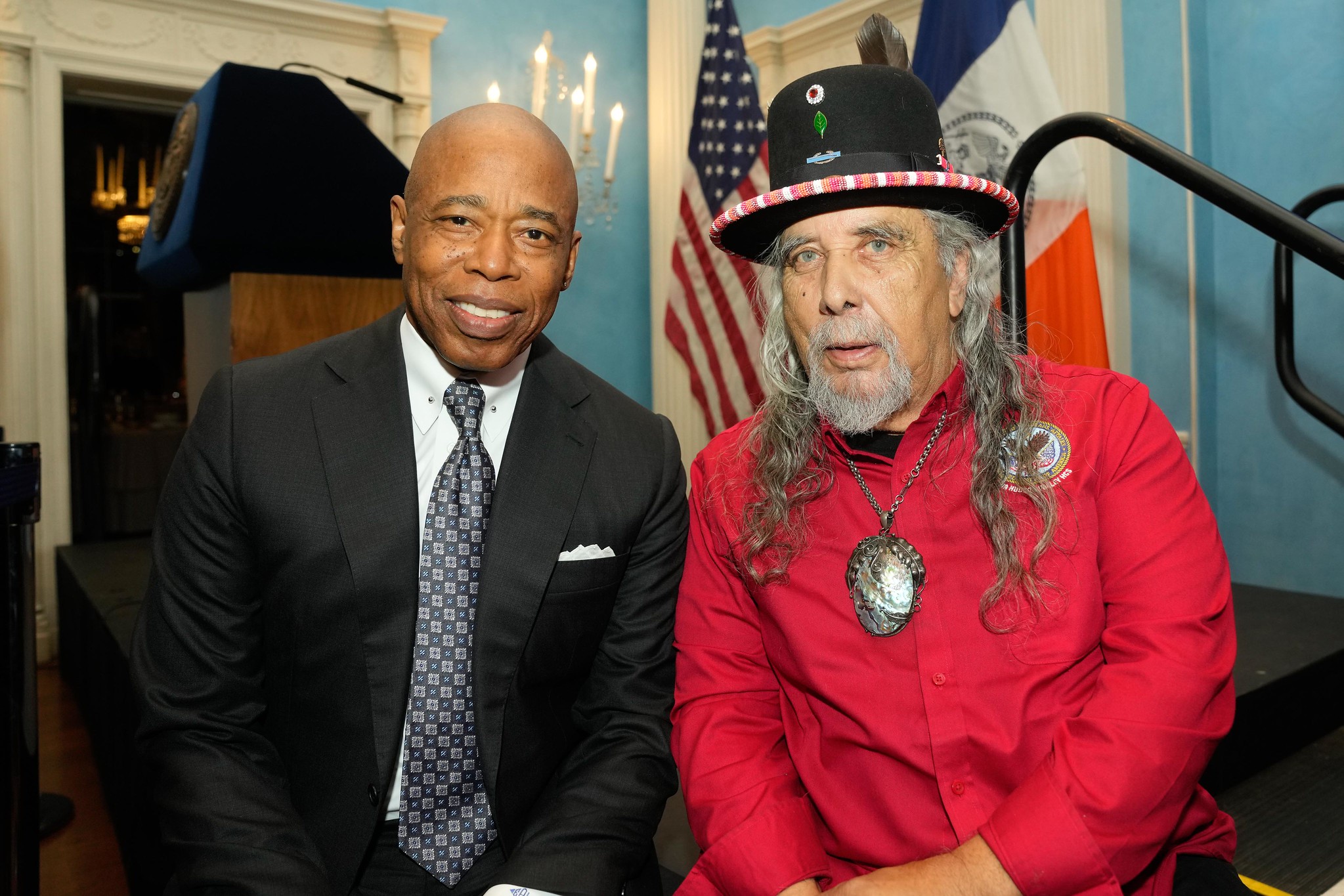
New York City Mayor Eric Adams hosts a reception to celebrate Native American heritage at Gracie Mansion on Wednesday, November 20, 2024. Image Credit – Michael Appleton/Mayoral Photography Office
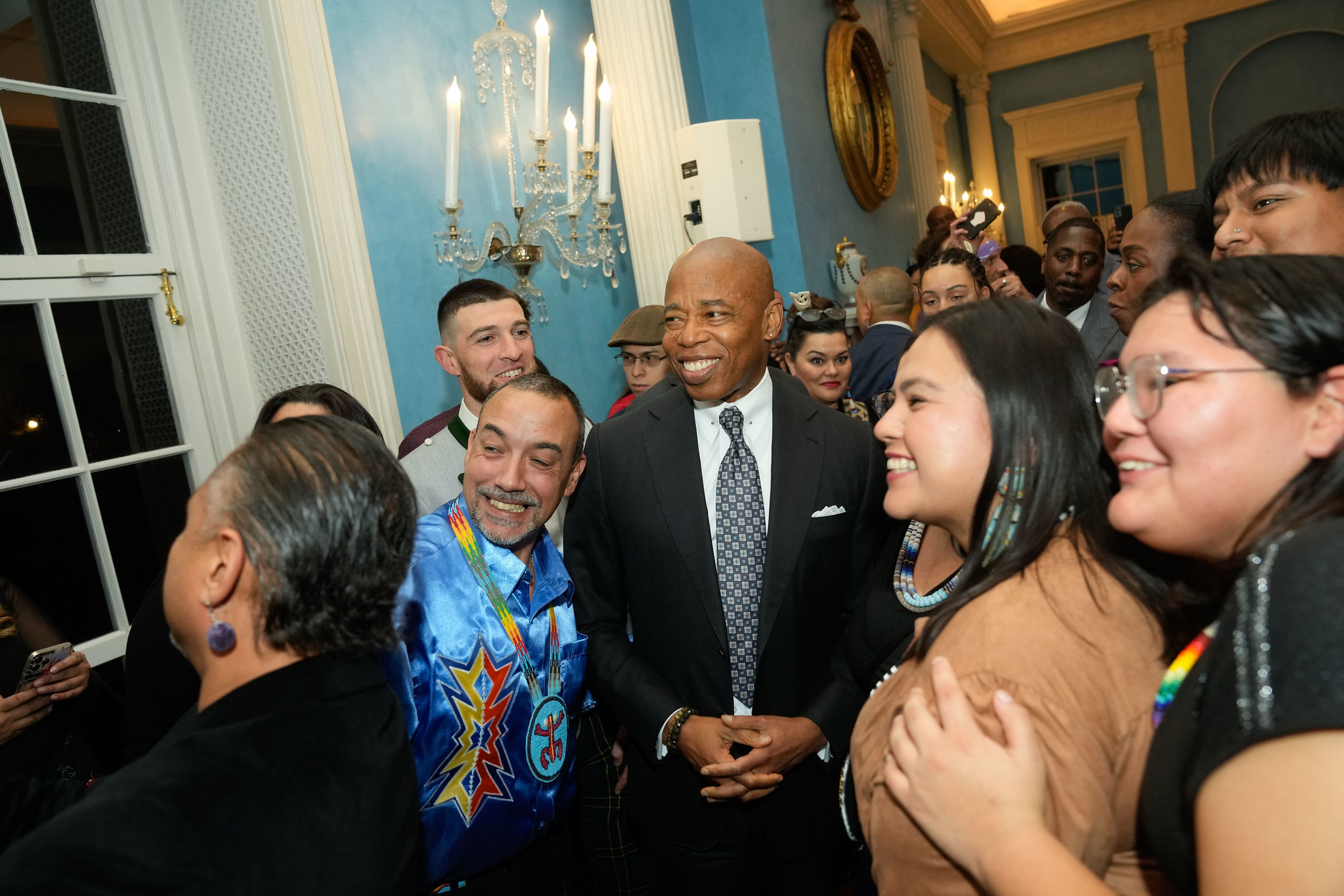
New York City Mayor Eric Adams hosts a reception to celebrate Native American heritage at Gracie Mansion on Wednesday, November 20, 2024. Image Credit – Michael Appleton/Mayoral Photography Office
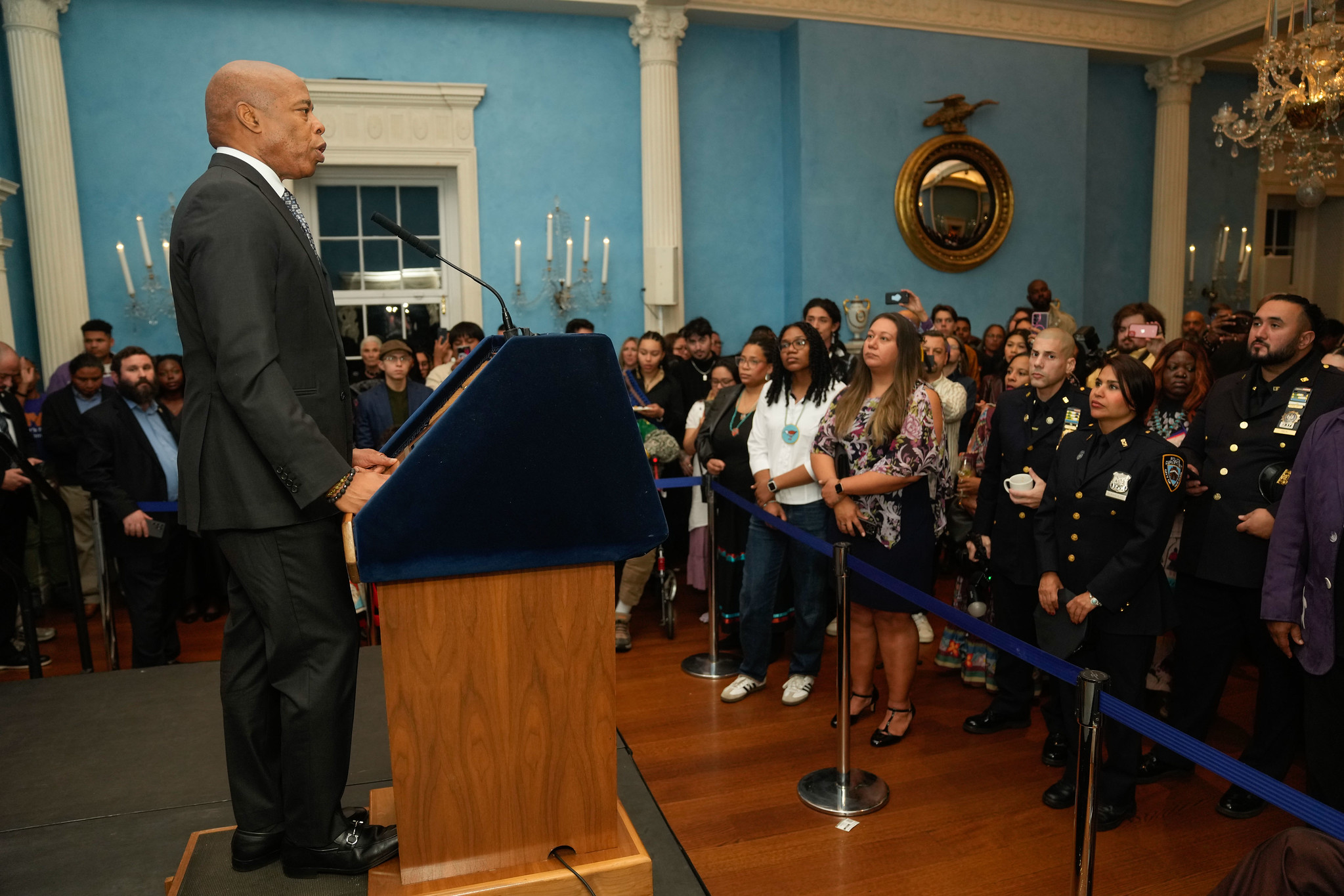
New York City Mayor Eric Adams hosts a reception to celebrate Native American heritage at Gracie Mansion on Wednesday, November 20, 2024. Image Credit – Michael Appleton/Mayoral Photography Office

New York City Mayor Eric Adams hosts a reception to celebrate Native American heritage at Gracie Mansion on Wednesday, November 20, 2024. Image Credit – Michael Appleton/Mayoral Photography Office

New York City Mayor Eric Adams hosts a reception to celebrate Native American heritage at Gracie Mansion on Wednesday, November 20, 2024. Image Credit – Michael Appleton/Mayoral Photography Office

New York City Mayor Eric Adams hosts a reception to celebrate Native American heritage at Gracie Mansion on Wednesday, November 20, 2024. Image Credit – Michael Appleton/Mayoral Photography Office

New York City Mayor Eric Adams hosts a reception to celebrate Native American heritage at Gracie Mansion on Wednesday, November 20, 2024. Image Credit – Michael Appleton/Mayoral Photography Office
MAYOR ADAMS AND GOVERNOR HOCHUL CELEBRATE AGREEMENT TO ADVANCE HISTORIC PLAN TO BUILD AFFORDABLE HOUSING, INVEST $5 BILLION IN INFRASTRUCTURE AND HOUSING
New York City Council Subcommittee on Zoning and Franchises and Committee on Land Use Vote to Approve City of Yes, Most Pro-Housing Set of Zoning Changes in City History
Proposal Will Build up to 80,000 New Homes Over Next 15 Years, Invest Billions Towards Critical Infrastructure Updates
NEW YORK – New York City Mayor Eric Adams and New York Governor Kathy Hochul today celebrated an agreement on the “City of Yes for Housing Opportunity” proposal, a historic zoning proposal to enable the creation of a “little more housing in every neighborhood,” and invest $5 billion towards critical infrastructure updates and housing. The announcement comes after the New York City Council Subcommittee on Zoning and Franchises and Committee on Land Use’s vote to approve this proposal. As New York City faces a generational housing crisis with just a 1.4 percent rental vacancy rate, the proposal would allow for the creation of up to 80,000 new homes over the next 15 years and help lower the cost of rent for New Yorkers across the five boroughs. The City of Yes proposal alone exceeds all the housing created from rezonings during the 12 years of the Bloomberg administration and the eight years of the de Blasio administration.
“Everyday New Yorkers have carried the burden of a generational housing crisis for far too long. Today, in partnership with Governor Hochul, Speaker Adams, and Chairs Salamanca and Riley, we are one step closer to delivering long overdue relief through the ‘City of Yes for Housing Opportunity,’” said Mayor Adams. “Thanks to our shared commitment in building critically-needed housing, we have reached an agreement on a historic plan that could open the doors to a little more housing in every neighborhood in our city — with no borough, block, or backyard left behind. If passed, New York City will, once again, serve as a model to the nation on government’s infinite ability to take challenges head-on, set forth a bold agenda, and get the job done. To my partners in the City Council, let’s say ‘yes’ to City of Yes.”
“New York has a housing affordability crisis and there’s only one way out: build more housing,” said Governor Hochul. “That’s why earlier this year, I fought tooth-and-nail for a major package of reforms and investments that will build thousands of new homes for everyday New Yorkers. We got it done, in part, because of strong partnerships with our colleagues in New York City, and I’m proud to stand with them as they move forward with their plan to build a little more housing in every neighborhood. Now, we’re adding a $1 billion state commitment to support affordable housing in New York City. We need all hands-on deck to build more housing and make New York more affordable for all of us.”
City of Yes for Housing Opportunity invests $5 billion towards the city’s housing and critical infrastructure updates. Mayor Adams is committing $1 billion for housing capital. He is also investing $2 billion in infrastructure projects — to be reflected in upcoming financial plans — that will support investments in sewer and flood infrastructure, street improvements, and open space. Finally, Mayor Adams will spend $1 billion in expense funding over 10 years in tenant protection, voucher assistance and combatting source-of-income discrimination, flood monitoring, and neighborhood planning. Additionally, thanks to her strong leadership and shared commitment to building housing, Governor Hochul is committing another $1 billion to housing capital over the next five years, subject to state budget approval.
Mayor Adams and New York City Council Speaker Adrienne Adams have made historic investments toward creating affordable housing over the last three years. In June, City Hall and the City Council agreed on an on-time, balanced, and fiscally-responsible $112.4 billion Fiscal Year (FY) 2025 Adopted Budget that invests $2 billion in capital funds across FY25 and FY26 to the New York City Department of Housing Preservation and Development and the New York City Housing Authority’s capital budgets. In total, the Adams administration has committed a record $26 billion in housing capital in the current 10-year plan as the city faces a generational housing crisis. This past spring, the city celebrated the largest 100 percent affordable housing project in 40 years with the Willets Point transformation.
TRANSCRIPT: MAYOR ADAMS APPEARS WITH DSNY COMMISSIONER AND INCOMING NYPD COMMISSIONER TISCH ON CNN’S “THE SITUATION ROOM WITH WOLF BLITZER”
Wolf Blitzer: New York City Mayor Eric Adams has just named a new commissioner to lead the city’s Police Department. Jessica Tisch, who currently heads the Department of Sanitation, will take over at the NYPD next week. She’ll be the first person to lead the Police Department under Mayor Adams and the second in less than three months.
Eric Adams and Jessica Tisch are joining me now for an exclusive interview. To both of you, thank you so much for joining us. Mayor Adams, I’ll start with you. You ran for mayor saying you would make the city safer, and in fact crime is down in New York City, but why is someone who hasn’t served as a uniformed police officer the right choice to lead the nation’s largest police force?
Mayor Eric Adams: The right time, right place. We are excellent at crime fighting, in fact I think we’re probably one of the best on the globe. I want the department to go to the next level, more than just catching bad guys, but how do we use the technology, the vision, to ensure that we continue to be the safest big city in America, and period, the safest city. And that is what Commissioner Tisch brings.
She was innovative when she was in the police department for a number of years under one of the commissioners that I really appreciated, Commissioner Bratton. She brought the body-worn cameras, she brought the new technology on how to communicate, and really she’s planted the seed for some of the technology we’re looking at now. I want this Police Department to be ready as we move deeper into this century.
Blitzer: Good point. Commissioner Tisch, the head of the Police Benevolent Association noted, and I’m quoting now, the challenges confronting police officers remain the same despite the repeated changes in NYPD’s leadership. How are you going to address this?
Incoming Police Commissioner Jessica Tisch: Yeah, I’m a person who takes on, takes challenges head-on. I’m looking forward to working with all of our labor unions to understand the issues that our members have, and to put in place plans to address them.
Mayor Adams: You know, Wolf, what’s interesting here is just like Mayor Bloomberg brought the uniqueness of being a businessman and his perspective when he turned around this city, I bring the uniqueness of being a former police officer. I know what that agency needs, and as I stated, we’re doing a great job of bringing down crime ten straight months, over close to 10,000 guns off our streets.
But there’s a missing component that if we’re going to be this holistic approach to match the great things that police officers are doing, there’s another level, and that next level Commissioner Tisch is going to bring that.
Blitzer: A lot of sensitive issues are certainly going to be coming up. And Mayor Adams, I know you’ve come out in favor of modifying New York City’s sanctuary laws, which would seemingly make it easier for the city to aid the incoming Trump administration’s mass deportation plans. Will New York City assist these efforts under your leadership?
Mayor Adams: I have been extremely clear prior to the election. Those who abuse their right to be in this country by violating and harming innocent people, they should not be here after they serve their time. I’m clear on that. I’m unwavering on that, and I’m looking forward not to be in a warring state with the incoming president and his team, but to be in a working state.
He’s the president of the United States, and it’s imperative that this country rallies together to deal with the problems that working class people are facing, and that is included— what voters have stated. Fix the immigration, secure our border, and make sure that we can protect Americans.
Blitzer: Commissioner Tisch, are you committed once you become the police commissioner, the NYPD leader, to upholding the city’s current sanctuary laws, even if that conflicts with federal authorities?
Incoming Police Commissioner Tisch: We will always follow the law in New York City and certainly at the Police Department, but New York City is a city of immigrants. It’s part of what makes us the greatest city in the world. The mayor has been very clear. If you commit a crime in New York City, regardless of your immigration status, we need to be able to take action, and right now in certain circumstances, we can’t do that.
Blitzer: Mayor Adams, you currently face federal charges for bribery, fraud and soliciting illegal foreign campaign donations. And at the same time, you’ve been accused of cozying up to Trump. Critics have noted that you’ve declined to criticize him or his most controversial cabinet picks in recent days and weeks. You were also seen greeting Trump at last week’s UFC event in New York. Have you spoken with the president-elect, potentially, about a possible pardon?
Mayor Adams: First of all, think about that for a moment. Critics are criticizing me for shaking the hands of the incoming president of the United States. They’re criticizing me for working together. When I reached out to the incoming president and stated we want to work together, the governor followed me and made a similar call. Senator Gillibrand followed me and made a call, and even television personalities called to do the same thing.
America is moving in a direction that realizes that working class people have been overshadowed by our petty differences, and we want to work together to do so. It’s not about my status. I have lawyers who handle that. It’s about me ensuring that I produce for the city.
Every time I spoke with the incoming president, I shared with him I’m ready to move our city forward to deal with these tough issues, and he welcomed that and stated he wanted to do the same.
Blitzer: Have you spoken to the president-elect about a possible pardon?
Mayor Adams: I don’t go into private conversations, but that is not on my agenda. My agenda is fighting for the people of this city, and we need help from Washington, D.C. 220,000 migrants and asylum seekers came to our city, like other cities like Chicago and Denver, and they only gave us $200 million out of a $6.4 billion budget. That is unfair to the city. It’s unfair to other cities in this country.
Blitzer: Would you accept the pardon if Trump offered it to you?
Mayor Adams: I don’t deal with hypotheticals. I have a legal team, and they want to manage anything that’s possible to deal with these charges that should have never been brought on me in the first place, and whatever we can do to resolve those charges, my legal team will handle it.
Blitzer: So can I assume that’s a yes?
Mayor Adams: Nope, I wouldn’t do any assumption. I will allow my legal team to handle it. I’ve got a great lawyer and a great team that, as I stated, I did nothing wrong. I should not have been charged. I handled the city and my actions appropriately as a former police officer. I’m going to continue to do so, and any questions dealing with the case, my legal team will manage that. My job is to manage this amazing city that I was elected to do.
Blitzer: So you don’t even want to tell us whether or not the conversation about a possible pardon has even come up. Is that right?
Mayor Adams: Wolf, you’re a great interviewer, but I can’t be more clear. I’ve got a great attorney, and so he’s going to do his job. I’m going to do my job as the mayor of the City of New York, and we’re going to continue to see the success we’re doing around business, around safety, around educating our children, and around what I was elected to do.
Incoming Police Commissioner Tisch: And I would just add, Wolf, that crime is down now 10 months in a row. In October, we saw a 26 percent decrease in crime on our subway system. The men and women of the New York City Police Department are out there doing their thing and delivering for New Yorkers. Their mission is to create safety, but also to make New Yorkers feel safe, and that’s what this mayor is doing.
Blitzer: And Mayor Adams, speaking of crime, three people, as you know, and it was awful to hear about it and read about it. Three people were killed in a series of unprovoked stabbings in Manhattan on Monday. The suspect is a 51-year-old unhoused male who you’ve said has a history of severe mental health issues. What is your administration doing, mayor, to try to address the issues of homelessness and mental illness?
Mayor Adams: It shattered my heart when I got the first call of the stabbing, and then when the team shared with me, there was a second and a third, including the mother of an eight-year-old child. It goes back to the beginning of our administration. The success of our city has been overshadowed by random acts of violence, and many of them associated with those with severe mental health illness.
We need to have stronger laws that allow what’s called involuntary removal. People who are in danger to themselves and in danger to others, we need to be able to take the action to involuntarily move them off the streets. We’re getting a lot of pushback and a lot of fight against that on every level of government.
It’s time for us to be serious about those with severe mental health illnesses and don’t wait until they take the life of three innocent New Yorkers. That’s what we’re seeing often, when you see someone shoved to the subway track, random acts of violence, it is associated with a large number of people that are dealing with severe mental health issues.
Blitzer: Mayor Eric Adams, good luck to you and Commissioner Jessica Tisch, congratulations on your new assignment and good luck to you as well. To both of you, thank you very much for joining us.
Mayor Adams: Thank you. Take care.
MAYOR ADAMS APPOINTS JESSICA TISCH AS NYPD COMMISSIONER
Tisch Will Be Only Second Female to Serve as NYPD Commissioner, Both Appointed Under Mayor Adams’ Leadership
NEW YORK – New York City Mayor Eric Adams today announced the appointment of Jessica Tisch as commissioner of the New York City Police Department (NYPD), effective Monday, November 25. Tisch will be the second female to serve as commissioner of the NYPD in its 179-year history; the first, Commissioner Keechant Sewell, was also appointed by Mayor Adams.
Tisch — a 12-year veteran of the NYPD and the current commissioner of the New York City Department of Sanitation (DSNY) — will take the helm of the nation’s largest police department as overall crime continues to drop across the five boroughs for the 10th straight month, as of October 2024. As DSNY commissioner, Tisch has led the successful execution of the Adams administration’s “Trash Revolution,” which has containerized 70 percent of the 44 million pounds of trash that New Yorkers set out on the curbs each day.
“The people of this city have been clear that they agree with what our administration has been fighting for since day one in office: a safer city where they don’t need to worry about walking down the street or taking the subway at night. To ensure New Yorkers have the ability to thrive in our city, we need a strong, battle-tested leader who will continue to drive down crime and ensure New Yorkers are safe and feel safe, and I cannot think of a leader more up to the task than Commissioner Jessica Tisch. As one of the most successful managers in our administration, I am confident that Commissioner Tisch will effectively lead the greatest police department in the world and continue to deliver the safety and peace of mind New Yorkers deserve,” said Mayor Adams. “I also want to thank Interim Police Commissioner Thomas Donlon for serving our city over the last two months, after a lifetime of serving our state and this country. We appreciate his willingness to quickly come on board and dedicate day and night to this city. I look forward to having him serve in his new role.”
“For 12 years, I cherished the special privilege of serving alongside the brave women and men of the New York City Police Department. I’ve seen firsthand the profound nobility of the policing profession, and I was proud to work shoulder-to-shoulder with both uniform members and civilians to propel the NYPD into the next century of technological advancement,” said Incoming NYPD Commissioner Tisch. “I thank Mayor Adams for the tremendous honor to now lead the NYPD, and I understand the solemnity of this great responsibility. It is now my distinct honor to advance Mayor Adams’ vision of fighting crime and disorder; keeping our great city safe and vibrant; protecting all New Yorkers, including our officers who put their lives on the line every day, so they can live free of fear; continuing to build the most nimble municipal counterterrorism apparatus in the world; and implementing the most forward-thinking law enforcement training and technology. We will do all of this with integrity as we continue to build public confidence and trust in the police.”

Swearing In Of New Police Commissioner Jessica Tisch. Image Credit – NYC Mayor

Swearing In Of New Police Commissioner Jessica Tisch. Image Credit – NYC Mayor
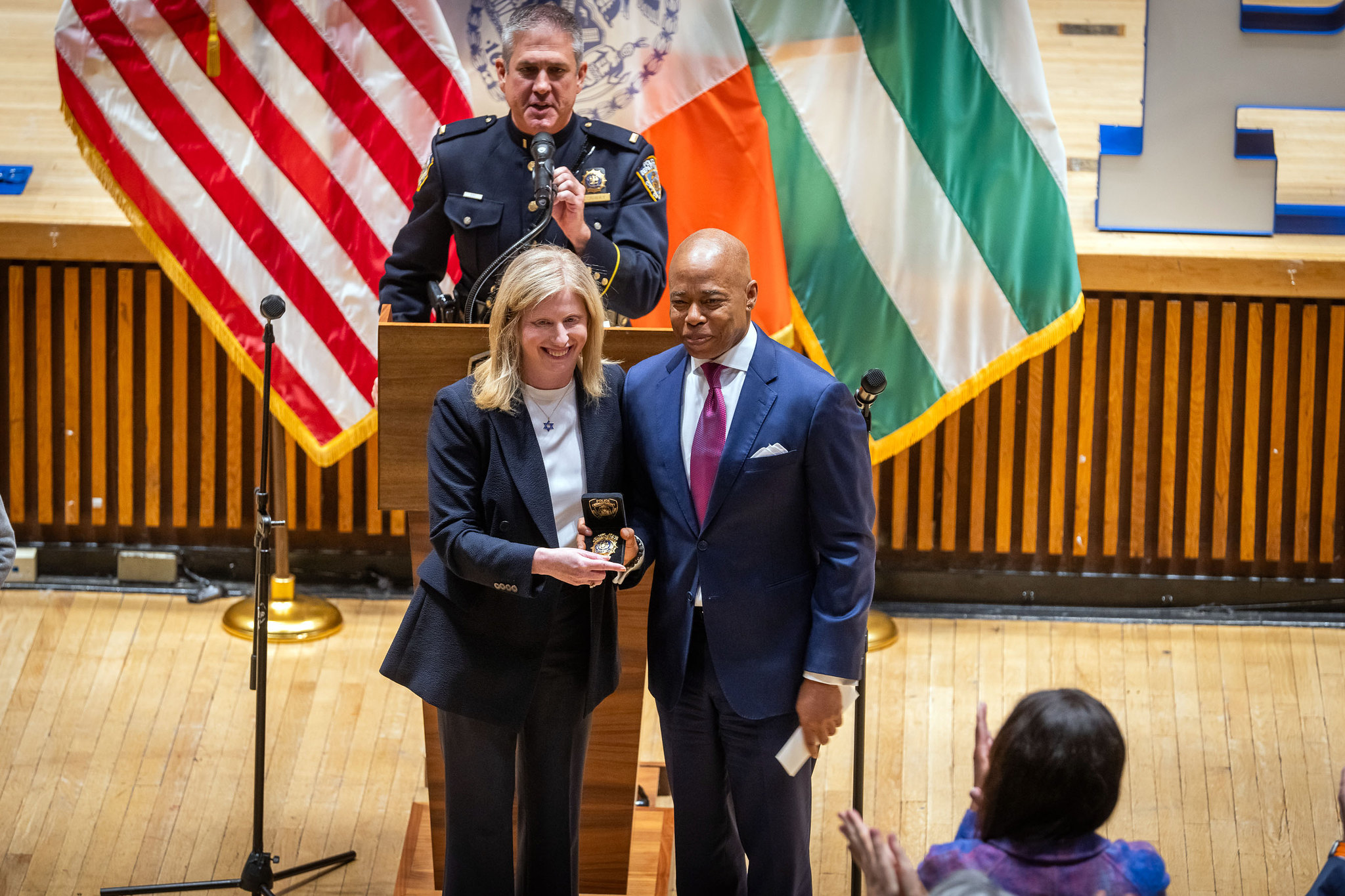
Swearing In Of New Police Commissioner Jessica Tisch. Image Credit – NYC Mayor

Swearing In Of New Police Commissioner Jessica Tisch. Image Credit – NYC Mayor
About Jessica Tisch
Jessica Tisch is a 17-year veteran of city government who has dedicated her professional life to serving the people of New York. Tisch was appointed DSNY commissioner in April 2022, managing the city’s waste collection, recycling, and disposal, as well as cleaning and snow removal for approximately 6,500 miles of city streets. Under her leadership, New York City has seen generational change in sanitation service, including the launch of the “Trash Revolution,” which, to date, has placed 70 percent of trash in New York City under container mandate, as well as the rollout of weekly universal curbside composting service to all 3.5 million residences in New York City.
Previously, Tisch served as commissioner of the New York City Department of Information Technology and Telecommunications (DoITT) and citywide chief information officer from December 2019 to January 2022. As commissioner, she ran the largest municipal IT organization in the country, with a wide portfolio ranging from public safety to human services to economic development as well as New York City 311. She also rolled out the city’s first text-to-911 capability. While at DoITT, Tisch additionally served as a core member of the team that managed the city’s COVID-19 pandemic response — building and managing critical programs that tangibly served New Yorkers, including the city’s vaccination system.
Prior to joining DoITT, Tisch spent the majority of her career at the New York City Police Department, where she served as deputy commissioner of information technology and oversaw the NYPD’s 911 operations. She spearheaded efforts to use technology to transform the NYPD’s fundamental business processes, including how officers are dispatched and respond to 911 calls, take crime reports, investigate, and search for wanted or missing persons.
She also managed the development and implementation of the flagship Domain Awareness System, which is at the heart of the NYPD’s crime fighting and counterterrorism operations. Under her leadership, every officer was equipped with a smartphone, giving them access to real-time information in the field, as well as improving their accessibility to the public. Tisch also managed the implementation of the NYPD’s body-worn camera program and drove additional efforts to improve transparency and public access to the NYPD, modernizing CompStat by prioritizing democratization of data to precincts. She began her public service career in 2008, when she joined the NYPD as a counterterrorism analyst.
Tisch is a graduate of Harvard College, Harvard Law School, and Harvard Business School and is a lifelong New Yorker.
TRANSCRIPT FROM THURSDAY, NOVEMBER 21, 2024: MAYOR ADAMS HOSTS COMMUNITY CONVERSATION
Commissioner Fred Kreizman, Mayor’s Community Affairs Unit: Good evening, ladies and gentlemen. My name is Fred Kreizman, commissioner of the Mayor’s Community Affairs Unit. It’s a pleasure to be here at the Mayor’s Community Conversation. This is our 33rd Community Conversation. It’s a pleasure to be here in Jamaica in the 12th Community Board at the 103rd Precinct.
I want to start off by thanking local police officers who are here today at every single table with members of the Mayor’s Office, but especially I want to thank the police officers who are here. On Tuesday, an officer for the 103rd Precinct as well as a bystander were shot here in Jamaica Avenue by an armed suspect. Both will be okay, but I just want to thank the extraordinary efforts of the police officer to neutralize the situation, and thank God, both the bystander and officer will be okay. I just want to give a round of applause for all officers who are here.
We also just want to thank our host school, P. S. 182, and Principal Andrew Topol.
We’re hosting these community conversations in all five boroughs. As I said, this is the 33rd that we’ve done because the mayor believes in equity, ensuring that every neighborhood, their voices get heard. I just want to go through quickly the runner show. We’re going to have Senator Leroy Comrie say a few words. I just saw him. We’ll have Jenifer Rajkumar, then the mayor will speak.
Deanna is here with us tonight. Will be joined by the chief of staff for the first deputy mayor, Nate Bliss. We have the chief of staff for deputy mayor Strategic Initiatives, we have Chief of Staff Jason Parker. deputy commissioner of NYPD, Mark Stewart. Will be joined by the Mayor’s Office of Immigrant Affairs Commissioner Manny Castro. We have ACS, Commissioner Jess Dannhauser. We have NYCHA, Dan Greene, executive vice president.
We have DYCD, Deputy Commissioner Darryl Rattray. We have DSS, HRA Administrator Scott French. H&H, the Population Healthcare, Dr. Ted Long. Department of Health & Mental Hygiene, Deputy Chief Medical Officer Toni Eyssallenne. Office of Community Mental Health, Executive Director Eva Wong. MOCJ, Director Deanna Logan. Department of Finance, Director of Outreach, Kieran Mahoney. We have New York City Emergency Management, Deputy Commissioner John Grimm. EDC, Senior Vice President Jennifer Cass.
To my left, actually, Senator Leroy Comrie. We have Assemblymember Jenifer Rajkumar. We have Department of City Planning will be joined by Edith Hsu-Chen, but right now, we have Lin Zeng, the borough director. Small Business Services, commissioner Dynishal Gross. Department of Consumer & Worker Protection, Commissioner Vilda Vera Mayuga. Parks commissioner, Sue Donoghue. Probation commissioner, Juanita Holmes.
DOB, First Deputy Commissioner Kazimir Vilenchik. DOT, Borough Commissioner Nicole Garcia. HPD, Assistant Commissioner Nicole Simmons. New York City Public Schools, Deputy Chancellor Simone Hawkins. Office of Rodent Mitigation, Director Kathleen Corradi. Mayor’s Office of Climate & Environmental Justice, Executive Director Elijah Hutchinson. Molly Schaeffer, the Office of Asylum Seeker Operations director. CCHR, Human Rights Commission, Chief of Staff, Jose Rios. DEP, Queens Borough Commissioner, Alfonso Lopez, a graduate of this school. Sanitation Commision– Alfonso. Yes. Sanitation Chief, Robert Cavanaugh.
[Crosstalk.]
FDNY, Deputy Chief Daniel Brown. We have NYPD as well, Borough Chief Kevin Williams. We have the 103 Precinct Commanding Officer, Deputy Inspector Ralph Clement. We’re joined by the 102 CO, Deputy Inspector Jeremy Kivlin, 107 CO, Captain Mo Tsang, 113 CO, Inspector Ray Jenkins, Transit District 20 CO, Captain Steven Hyland, Community Affairs Bureau, Assistant Commissioner Foster, and the Chief of Community Affairs Bureau, Chief Richie Taylor. Again, thank you very much for everyone being here. We’ll hand it over to Senator Leroy Comrie.
State Senator Leroy Comrie: Good evening, everyone. I’m going to be brief. I’m going to get out the way. I just want to say good evening. I want to thank the mayor for allowing me to sit next to him. I look forward to a spirited discussion from Southeast Queens and go from there. Thank you all for being here. Thank you.
State Assemblymember Jenifer Rajkumar: Good evening, Jamaica. I’m State Assemblywoman Jenifer Rajkumar. We made history when I became the first South Asian American woman ever elected to a New York State office.
Today, I want to say thank you to Mayor Adams for coming back to Queens again where he grew up. I think often of his motto, which is stay focused, no distractions, and grind, not just words, but a way of life. I’d like to report to you on a lot of the initiatives I’ve been taking to improve quality of life in our city. The first is a huge victory we had this year, the great Senator Leroy Comrie and I got through our SMOKEOUT Act, which allowed the city to now close down all the illegal smoke shops that have been plaguing our neighborhoods. I want to thank the mayor for already closing down, I believe, over 1,200 illegal smoke shops right now. We are on our way.
Along with quality of life, we all have almost been hit by an e-bike. I know I certainly have. We need accountability, which is why I have introduced a package of reforms to make sure that these e-bikes have license plates, registration, and insurance. That way we can keep our streets safer for all. Finally, there’s been the phenomenon of ghost cars. Ghost cars are ghosts because you can’t trace them because the license plates are covered up, concealed, or fake, and so I have introduced the Ghostbusters Act, which is going to crack down on these vehicles by giving our law enforcement the tools they need to get the job done.
I want to thank you for having me tonight. It’s always great to be among you. Finally, I want to invite you all to my Thanksgiving turkey giveaway, which I host annually. It’s this Saturday at 2:00 PM, not too far away, at my office on Woodhaven Boulevard. Thank you all so much, and happy Thanksgiving.
Mayor Eric Adams: Thank you. Thank you. I thank just all of you, and particularly the principal, for allowing us to use the school. It’s good to be back here in Southeast Queens. Southside, we outside, as we always like to believe. It’s good to see you, Erica. Things going well. We want a good lively discussion as we talk about the topics that’s impacting all of us in the city. At every town hall, I like to go back and tell us where were we, January 1st, 2022 when I became the mayor of the City of New York.
One of your own, grew up on 167th Street and the 111th Avenue. Went to P.S. 140, ISA, and then Bayside High School. My mother was betrayed by this city in so many ways. Having to work three jobs, raising six children. Even when she needed food from the city, they gave us that hard-assed cheese filled with salt and led to her high blood pressure. My sister lost her childhood because she had to be the mother for the six of us while mommy went back and forth. I was committed to dedicate my life to one day becoming the mayor so we can reverse some of those betrayals.
When I became the mayor, January 1st, 2022, we had a 40 percent increase in crime. We were not invested in foster care children, NYCHA residents didn’t have access to high-speed broadband, their children could not do tele learning and their mothers could not do telemedicine. Jobs were hemorrhaging. Unemployment was high. Black unemployment was four times the rate of white unemployment. Those who had learning disabilities were not getting the support that they deserved. 30 percent to 40 percent of the people in Rikers Island right now are dyslexic.
We saw the lack of investment in foster care, we saw the inability to build housing in this city, we saw COVID. Then in the midst of our economic recovery, what happened? We had 220,000 migrants and asylum seekers. People used to stop me all the time and say, “Eric, what are you doing to us?” They didn’t realize that I had no authorization to stop the buses from coming in. It was against federal law. Had no authorization to allow people to have a job and work. That was against federal law.

Mayor Adams hosts Community Conversation. Image Credit – Mayor Adams
I was required by city law to give three meals a day, educate 40,000 children, house individuals, and I couldn’t even take those who are committing serious crimes, violent crimes, I couldn’t even deport them. City law did not allow me to do that. In spite of that, out of those 220,000, 170-something thousand have gone on to the next leg of their journey because we get their intense training and we were committed to not one child or family sleeping on the street.
Two years and 10 months later, I know you hear a lot of noise, you pick up the paper and you think, “Oh my God, this city’s in disarray.” No, it is not. If you go back, that’s the same game they try to play when Dinkins was elected. Two years and 10 months later, we have more jobs in the City of New York in the city’s history. City’s history. More small businesses are operating right now in the city history. Deputy Mayor Maria Torres-Springer and her team, we financed and renovated in year one and year two more housing in those individual years in the city’s history. We move more people out of homelessness into permanent housing in the city’s history in year one and year two.
More people that needed subsidized housing with vouchers, we allowed the use of that in the history of the program. We’re now paying the college tuition of foster care children, giving them a stipend and a life coach until they’re 21 years old so they can be productive in society. We’re doing dyslexia screening for all of our young people so they don’t think they’re dumb, they just learn differently so that one day they can be like Eric Adams who’s dyslexic and can become the mayor of the City of New York because of opportunities.
The independent bond raters have raised our bonds. Close to 20,000 illegal guns, we removed off the street. Put money in the crisis management team so they can get on the ground and talk to our young people. 100,000 summer youth employment jobs. Never has been done before. 110,000 summarizing all year-long school learning for our children.
NYCHA residents, our babies now have free high-speed broadband in every NYCHA resident in this city. Dropped the cost of child care from $55 a week to less than $5 a week so parents can go back to work and have quality childcare in the process. You looked at what I ran on and then looked at what I’ve done, I kept my promise. Kept my promise. Every item that I ran on, we focused on and we were able to accomplish.
Do you know August? August is one of the most highly number– Erica, you know. Highly number of gun shootings in this city. Do you know, last August, we had the lowest number of gun shootings in our city in the history of the city? Do you know robberies on our subway system is the lowest in recorded history of this city? You don’t read that, do you? You don’t read any of that because they want to give you the impression the second mayor of color to run this city cannot run it in a sufficient way.
This is the greatest city on the globe, and we have created one of the greatest administrations and we turned this city around and no one thought we can do it. We did it in 2 years and 10 months. They told me we were going to take me five years to revise our economy. We did it in 2 years and 10 months. With all that’s going on every day, the attacks, their criticism, I wake up every day, put one feet in front of the other, and do my damn job, and I’m doing it every day. Every day.
We got a lot more to do. Got a lot more to do. Yes. There are some things we can do differently, yes. We got a lot we have to work on, but we stood 30-something town halls, 17 senior town halls, 7 youth town halls to hear directly from you. That’s what I want to do tonight. I want to take mayor privilege by starting with you, brother, because you had a video that I saw, and I didn’t understand it all. I know you were saying a lot, so I said, let me see if you’re going to come tonight. I’m going to give you the first mic so that you can– Don’t drop the mic. Just share the issues that’s facing you, okay? Introduce yourself.
Question: Good evening. I’m James Johnson. I am the Southern Queens Park Association chair of the advisory council. It’s a pleasure to be here, Mayor Adams. I don’t think you was aware of what was going on with Southern Queens Park Association, so I wanted to come here tonight to let you know that we need your help. You just got here. You just got here. The things that’s been happening in the park’s agency has been spewing for decades. It’s tough to say, “Come fix this,” but this park, this is the only community center in Southeast Queens. We’re talking about Roy Wilkins Park, the only one. It’s Black men since 1976.
Nothing else in the city is like Southern Queens Park Association, and we need your help. Parks is literally cutting our legs from underneath us, and we want full control permitting access through the park like we had since 1970 so it could be community-led. That’s what we’re asking. Complete community-led. We’re not asking for much, but we just need access to outside the park. We don’t need to be doing a seven-page document to Central, then Central comes and says, “We never got the permit a day before the event,” or they might say, “Seven page? We have to do again. Oh, we need a million dollars for insurance, for a car show. Oh, we have 30 cars, so that’s $30 million for insurance.”
These attacks have been happening under the new executive director. We’re on the right page. We got a young brother that’s doing his thing. He’s from Southeast Queens. We all grew up in that park. We are seeing time being shut and cut down from the nonprofits that’s been here for 20, 40 years in that park. We need your help. We’re with you. We never turn our back on you. You look like me, all right? This park needs to be Black-managed. No compromising, no negotiations. Let’s do this thing the right way since 1976.
Mayor Adams: Thank you. Listen, let me tell you something. I am not pleased, and I have never been pleased how whenever we want to do something, the game changes. I’m not the choir. I wrote the song. Even when you look at what we’ve been doing down in Bowling Green with flag raisings, we have been raising flags for communities, immigrant communities and other communities in the city. We just did the whole African diaspora. Their flag was never raised at Bowling Green. Only certain countries were allowed to raise their flags there. We opened Gracie Mansion to do cultural events from Diwali and others where they never had events at Gracie Mansion.
Being mayor is not only substantive of the things that we do successfully, but they’re also symbolic. I must show the symbol that this city is not just for some, it’s for everyone. That has never been in place. Tomorrow, there’s supposed to be a meeting around this issue. I have the parks commissioner here who I knew from Prospect Parks. She was in charge of the Prospect Park Alliance, and she brought so much innovation in parks. Sue, can you help me understand this issue? I only got a tidbit when I saw his video.
Commissioner Sue Donoghue, Department of Parks and Recreation: Yes, absolutely. Thank you, Mayor Adams, and thank you for raising the issue. I saw the video as well, and I said to Mr. Johnson, “I wish he had reached out first before the video.” We are about partnership and collaboration. It is the history of the Parks Department. We know our parks are stronger and better by having great community groups and partnership in our parks. We also know, and I deeply know how important SQPA has been to Roy Wilkins Park and the incredible partnership that there has been there over the years.
As Mayor Adams said, we do have a meeting there tomorrow to address these issues. We want to, and we’ve been working closely on moving forward in agreement. The existing agreement expired back in 2022, and so we absolutely want to work forward and create and sign a new agreement. You have had great support from your elected council member, Nantasha Williams. I’ve talked to here extensively on this. Senator Comrie has been involved.
We appreciate the importance of this issue, and we are completely committed to making sure that we can get to an agreement here, but it does need to be an agreement that reflects the city’s priorities, the mayor’s priorities. We are thinking about equity and access, and it has to be consistent across the board how we run all of our parks, how we engage with all of our community groups. There are regulations around permitting and events, and there does. The mayor and I have talked about this directly. We do need insurance for our events.
For the safety of your organization, if something happened when there was a big event, you need to be protected and the city needs to be protected. There is no doubt that there are very specific things that the city requires and that are legally required in things like events and it’s for the safety of all park users. We want to work through those issues. The mayor has great expertise on his team that we’re bringing to bear to that meeting tomorrow. Definitely, we want to sit down, roll up our sleeves, and get this figured out.
Mayor Adams: What we’re going to do, you’re going to meet tomorrow. You’re going to be in that meeting? Someone needs to be there to update you on what’s going on. You’re going to be there senator?
Commissioner Donoghue: Senator Comrie, yes.
Mayor Adams: I’m sorry? Okay.
Commissioner Donoghue: The head of SQPA, Jermaine, is going to be there, absolutely.
Mayor Adams: Let’s make sure the place at the table. Immediately after the meeting, team is going to update me. We have examples of communities running parks. We have the Prospect Park Conservancy, we have Prospect Park Alliance, we have the Bryant Park. They’re examples, and we’re going to use those as the models to give you what you need here. This community is very competent. This is some of the highest level of professionals. You have held down this community for many years. Whatever way we can duplicate what others are doing, we’re not going to give you anything less.
We got to follow the law because we’re restricted on some rules. That’s why it’s important to have– I think Adrienne Adams, the speaker, is going to be there also. The speaker is going to be there, the councilperson is going to be there, our team is going to be there. We’re going to walk out the room where we’re going to use everything within our legal authority to make sure you get the representation that you’re looking for. My understanding, this is the only park that Black folks are running. We want to maintain that, but we’re going to maintain a standard at the same time, because the last person that was running it, think he—
Question: [Inaudible.] We have a guy that went to [inaudible] he went to NYU [inaudible].
Mayor Adams: Okay brother. I’m not concerned with schools he went to, he could have gone to P.S. 140, long as he does the job.
Question: [Inaudible.]
Mayor Adams: Right, that’s all I want. Long as he’s doing the job. Some of the things that you ask for, it has to be within the law. If it’s within the law, we’re going to do it. It has to be within the law because we can’t violate the law to run something. The team is going to be there, your lector is going to be there, and we’re going to land the plane, okay? Alright.
Question: Good evening. My name is Rana Epps. I’m from the King of Kings Foundation. A hospital responder manager for CMS. We at table one have a question about the shared scooters, and how do we resolve the issue of them being around the community, just laying around in front of buildings, Rochdale, all the way down to the end of [inaudible]?
Mayor Adams: Who else from DOT? Okay. I’m with them on this one.
Nicole Garcia, Queens Borough Commissioner, Department of Transportation: Hi. Good evening, everyone. I’m Nicole Garcia, and I’m the Queens borough commissioner for New York City DOT. The first thing that I’d like to share with you and the audience, is that we have been in touch with a lot of the residents in Southeast Queens and heard from a lot of the elected officials, including Senator Comrie, Speaker Adams, the councilmember, and some of the civics. We heard about the issues of organization and also about enforcement.
We’ve been talking with the local elected, the community board, and we’re working very quickly to install corrals. These are going to be designated parking spaces. They will help organize the system, but at the same time, they’re going to help with enforcement because you have to take a picture after you complete a ride. All riders need to take a picture of where they deposit the bike. If they’re not doing it correctly, they’re going to get a warning, and then it escalates, and it could ultimately end up being a fine, or if they keep doing it, they could be banned from the system.
Another thing that we’re working on is rebalancing the system. Based on the direct feedback from the community, the companies have hired a team of 12 people that is covering their on-the-ground, responding to complaints. They’re visiting sites across the service area, including Southeast Queens, to respond to if a user dropped it off in front of someone’s gate, they’re on the ground to respond to those complaints.
Mayor Adams: Thanks a lot, Nicole. Listen, they got to step up their game, plain and simple. When I drive through South Jamaica, Queens, and I see those darn scooters all over the place, just in front of people houses, etc, we’re going to put them on probation. They have to step up their game. I don’t know if it’s a fit in a community like Southeast Queens, so we’re going to give them a few days to correct their action.
It’s a privilege to work in New York City, to sell your product in New York City. This is the place where your products are tested and determined if they can go national, if not international. I’m not happy with what those scooters are doing. If they can’t correct the problem, they have to bounce. They got to get out of our city.
I spoke with a Ydanis Rodriguez, the commissioner. I spoke with him the other day. He stated that when I drove through, I’m seeing these scooters all over the place, thrown in front of the streets. Listen, that’s disorder. I’m not about disorder. I’m about order. We’re going to give them an opportunity to correct their problem. If not, they need to find another city somewhere to do their duties. We’re going to give it a 30-day and take a look at the corralling and all the other stuff, but I’m not pleased with it. I’m going to be honest with you. I’m not pleased with it. Let’s see what happens in about 30 days.
How are you?
Question: Good. How are you doing?
Mayor Adams: Quite well.
Question: Welcome back to Southeast Queens.
Mayor Adams: Thank you.
Question: Thanks for bringing the team along. I’m a long-life resident of Southeast Queens. I’ve been here all my life. I love it. I’m a single-family homeowner. I’m here to represent–
Mayor Adams: What high school did you go to?
Question: August Martin. What, what?
Mayor Adams: We used to beat y’all down in ball, man.
Question: Oh, come, man. Which high school did you go to?
Mayor Adams: I went to Bayside, commodores. My brother went to August Martin. He didn’t have any game.
Question: You got a good point there. Alright. Let me get to my question. In regards to the City of Yes, how are you ensuring that the following quality of life issues are addressed: That housing is truly affordable and not just market rate, that you have the right funding to support the infrastructure that’s needed to support this type of growth, like parking, schools, sewage, as such? I know you’ve worked out some $5 billion things that you could maybe speak to.
Also, how are you going to ensure there’s proper code enforcement and that their agencies are going to be properly funded to deal with basement apartments and things of that nature, ADUs, when DOB today is vastly understaffed and can’t keep up with the stuff today? The other thing is, why isn’t Mitchell-Lama model or co-op model mandated in the City of Yes. Where you talk about generational wealth and everything like that, but these types of programs are just creating rentals and things that don’t inspire or support generational wealth. Thanks.
Mayor Adams: For those who are familiar with City of Yes, our zoning in the City of New York was racist. Going back to Robert Moses days, we created places in the city where you couldn’t build. We created places in the city where they wanted to maintain the communities. Folks, we’ve got a 1.4 percent vacancy rate. 1.4 percent. For low-income, it is functionally zero.
As I moved around the city, there’s not one elected official that’s here that won’t tell you the number one issue people talk about is public safety and housing. Our elders, when I go to my senior centers, some of these elders are in tears because they are afraid they’re going to be moved out of this city. They can’t afford to live in the city.
We have 59 community boards. Out of the 59 community boards, 10 build more and finance more housing than the 49 combined. Combined. Jordan came home from school from Washington, he can’t afford it and he doesn’t have a place to stay. The inventory is so low that those who have the inventory, when you have a lease or something, what do you do? You drive up the cost. We had to come up with a place, a way of how do we build a little more housing in every community, not in some communities, but every community. That’s what City of Yes is.
Did we have to talk about ADUs? Yes, we did. Did we have to talk about parking? Yes, we did. Did we have to talk about all these other issues and negotiating and come up with money to build the infrastructure? We allocated $4 billion to building the infrastructure that you’re talking about, and another billion dollars, we were able to talk to the governor who said, “This is so important, we’re going to put in another billion dollars,” because of the advocacy of our elected officials in getting it done.
We just signed the agreement. We’ve been up all night to talk about those issues that you’re talking about, brother. That people, the local electors say, “These are the issues that are important to our community because it’s not a one-size-fits-all,” but all of us had the same mission in mind. We got to build more housing for everyday New Yorkers so New Yorkers can have a place to sleep and stay. I have a home. I have a home. I have not bumped into one homeless person and said, “Don’t do more housing.” I don’t think anybody in this room is homeless.
Now, 1 of the 60,000 people that are living in homeless shelters say, “Don’t find another way to build more housing.” Not one. If a child is raised in a homeless shelter, he’s less likely to graduate from high school. If you don’t educate, you will incarcerate. The only common denominator we have on Rikers Island and in our state prisoners is education. They just put out a report of the number of children who are housing insecure.
I got you. We don’t want to disrupt Southeast Queens. We don’t want people building towers in their backyard. We sat down with the council people Selvena Brooks-Powers, Speaker Adrienne Adams, Nantasha Williams. They drove a hard bargain based on what they heard from their communities, and that is why this program is not a one-size-fits-all. They’re different carve-outs based on the neighborhoods and based on what was advocated. The speaker and her team said, “If you’re going to build more housing, you have to put the capital dollars into the infrastructure.”
We are putting $5 billion into that so we can get it right and we don’t disrupt the community, but we got to build more housing. If we don’t, you are going to see many of our seniors unable to stay in our community. Your children when they come home from school and college, they’re not going to be able to have a place to live in this city. Those who are expanding in families, they’re not going to have a place to live in this city. That is what we did, and we did it in a very humane way. Senator Comrie talks about it often. We do need to go to the Mitchell-Lama model. That was a good model.
My first property was a co-op, and I was able to move to buy a brownstone. We need to get back into home ownership. That is some of the stuff we’re looking at. How do we even be creative like Rubén Díaz Jr did where you go in and you rent with the eventual option to be able to purchase a home? We got to get home ownership. If people don’t have home ownership, you’re not going to build wealth. That is what we want to focus on. She’s not here to speak for herself, but we are zero focus on home ownership, housing. How do we build economic wealth for people?
Your question is dead on. It’s dead on. There were too many communities in this city that was doing nothing for the housing crisis, and they refused to, and we had to make sure that everyone plays a role in dealing with the housing crisis. Thank you for your question.
Question: [Inaudible] from you that you will build a unit in your residence as well?
Mayor Adams: My family house is here in South Jamaica, Queens. My brownstone is in Bed-Stuy. 14 years ago, probably even longer, when my tenants moved in, I gave them a piece of paper, the lease, and I said, “If you look at that last line on the lease, it is the commitment that as long as you live here for how long you live here, I could never raise your rent.” They never had their rent raised since they’ve been in my building. There’s a lot for human need, there’s not a lot for human greed. I’m committed to not only talking about it, but being about it. I’m committed to that every day in a real way.
Question: Good evening, everyone. I’m Reverend Thorbs, I’m the chairperson of CB12. Thank you, Mayor Adams, for having this event.
Mayor Adams: You’re quite welcome.
Question: As the chair, everything that’s being said from every table touches home for us because this is my district. The question I have here is in regards to quality of life, but I have to say, I would be remiss. We have built up downtown Jamaica. There was a 580-block rezoning, and that was to protect the homeowners. Now with the City of Yes, which is threatening us again, there’s more building that is intended to take place.
We don’t need that in our blocks. We have the buildings down here that aren’t all the way filled. We prefer to not have to build anymore. We’ve done our share. We’ve more than done our share. What’s being threatened, St. Albans and other areas that are by the Long Island Railroad, those are one and two-family homes. I had Department of Planning’s come into one of our meetings and tell us, because we’re one and two-family homeowners, it’s our fault. It’s our fault that we’re in the situation that we are in here in South Jamaica.
I don’t think that is fair. I know it’s not fair. This is our American dream. No one has the right to shuffle us around and remove us for somebody else to have their American dream on our backs.
Getting to the question, can you please tell us what are you going to do to ensure your agencies are responsive and adequately operating in our district in regards to quality of life, including the homeless situation in the district that is also impacting our school safety, and we need more police?
Mayor Adams: Thank you. Thank you for that. A couple of things. I want to peel back what you said because there’s a couple of things. First of all, I want to thank you for the work you have been doing. I come across your conversation a lot. I could never do my enough as long as there’s somebody that’s homeless. I’ll never say I did my share. My share is making sure everyone can have access to this city. There’s never time in my life that I want to be at a place that I can say, as long as someone is without, that I’ve done my share. My share is when it’s completed. That’s when I’ve done my share.
It’s important for us to realize that there are people in the city, folks, that are hurting, hurting. Hurt people not only hurt themselves, they hurt others. They hurt others. We have three New Yorkers who were stabbed. One is a mother of an eight-year-old. She’s gone because we had a person who was hurting. He was dealing with severe mental health issues. He was suicidal and homicidal. Many people beat this administration up when we stated in January 2022 that we need to do involuntary removals to take people off the street who are hurting themselves and hurting others and not wait until they commit a crime and put them on Rikers Island.
51 percent of the people on Rikers Island are dealing with mental health issues. We wait until someone do something, and we say, “You know what? That’s not my issue.” It is our issue because that person who’s hurting is going to hurt one of our family members.
Our quality of life pursuit of dealing with those quality of life from scooters to homelessness to garbage problems, the 70 percent of New Yorkers are now going to containerize their garbage because [these] garbage plastic bags [were] created, the rodent issues, the spiraling effect of ignoring these qualities of life issues, particularly in areas like Southeast Queens, it has impacted us for years. We’re on board with this, and particularly partnering with our community board leaders and those who are the chair of the community boards to address these very real issues.
The problems we’re facing that you mentioned, it is hard for us to believe, but they didn’t start January 1st, 2022. It’s been going on for a little while, but this administration is making impact. How are they going to be responsive? Look who’s here? You got my whole crew. I didn’t come here with one or two people. You got representatives from every aspect of government that’s sitting up here at this table here tonight because we’re not a 9:00 to 5:00 operation. This is showing you the respect that you deserve right up here.
Every piece of my administration is up here represented to hear your questions and respond to you. That’s responsive government. That is what you’re going to get from me as long as I’m your mayor. You have access to all of them. If they don’t do right, you have access to me. You have access to me.
Question: Hi.
Mayor Adams: How you doing? I saw you when I walked in. I knew you were going to be trouble.
Question: Hello. I don’t even think I need the mic. Do I need the mic?
Mayor Adams: Go ahead, you need the mic. They got to hear you over there.
Question: I do have a teacher voice, but I’ll try my best. Thank you so much for being here.
Mayor Adams: You’re quite welcome.
Question: So you did mention a couple of things about how you’re committed to helping and supporting, and I am a teacher in this building, and in the last few years, our migrant community has increased a lot. I’m just curious, what are some ways that our city has effectively worked with the state and the federal government? Because we do understand that your hands are tied in many situations, but how are we providing support for our migrant communities? If you’re having this kind of trouble working with the city and state, what are ways that we can collaborate so that way we can ensure success for all? Because the kids, they’re struggling, the teachers are struggling, and it’s becoming really hard, and it just seems a little unfair at this point.
Mayor Adams: 100 percent. Listen, we were getting 4,000 migrants and asylum seekers a week, 8,000 every two weeks, 16,000 a month that we had to house, we had to clothe, we had to educate. I think we had over 40,000 children were incorporated into our school system, and we had to come up with a real plan. You looked at with Dr. Long and what he did over our HERRCs, and we had to, one, advocate. I went to Washington 10 times to say the number one thing migrants and asylum seekers are saying. They say, “We don’t want anything free from you. We want to work. We want to work.”
That’s all they want. They want to work. You don’t travel thousands of miles on foot. When I went down to the South America, to the Darién Gap, watching people walk here. They came here to pursue the American dream, like all of us did, and they want to find their way, and that’s what we provided for them. We provided them the educational opportunities for their children. We provided them with an opportunity of 30 days for single adults to be able to stabilize inside our shelters, and then we gave them intense information on how to make your way inside the city like many immigrants have done.
This is a city of immigrants. It’s a country of immigrants, and many immigrants have come here and started out and made sure that they could get access to information so they can find their way, and that’s what we did, and we continue to do that every day. When you go down to the National Immigrant Leaders, national, came to the city, and they stated that we hear that you’re anti this, anti that, and then we gave them a whole day of watching what we’ve done, and know what they said at the end of the day when they had dinner with me at Gracie Mansion, they said no one in the country is doing what you’re doing. New York is the model for the country to put people on a pathway to pursue the American dream and not the nightmare of sitting around.
You go to Randall’s Island, you have 3,000 people, roughly, on Randalls Island that are sitting around all day doing nothing at all. That’s a recipe for disaster. Same in Creedmoor. Same in Floyd Bennett Field. We wanted to move folks in areas that won’t disrupt communities, but those areas had overflowed. Now, folks, we’re reticketing who said, I never wanted to come to New York in the first place. We’re allowing them to go to where they wanted to go.
This team of Deputy Mayor Williams-Isom, Dr. Long of the shelters, folks who are working in the shelters for the migrants and asylum seeker folks, you know who they are? They’re the same folks that had to deny their families because of COVID. Many of them couldn’t even go home. When you leave from one traumatic experience, and then you have to go directly into another traumatic experience, we owe those social service workers a debt of gratitude because they went through the trauma of COVID.
Many of them lost loved ones, lost family members. Many of them lost so many. They were sick themselves, but instead of throwing up their hands, they said we got these thousands of people coming into our city, we have an obligation to live up to them. I cannot thank them enough for seeing them all night long holding down this crisis. Think about this for a moment, 4,000 people a week, 8,000 people every 2 weeks, 16,000 a month.
I’m getting calls 2:00 AM in the morning, “Eric, we got another bus here that’s here, and we got to find a place for them to stay.” This is what we navigated, and we did, and gave people the dignity and respect that they deserve in the process, and we’re still doing that. We dropped that 220,000 to something like 64,000. We continue to have people cycle into being self-sustaining.
You’re right, but the real question is, federal government fix the immigration problem and don’t have New York, Chicago, Los Angeles, Houston, Denver. We should not be fixing a national problem, and it should not be $6.4 billion of our tax dollars to fix the national problem. They did nothing for us. They gave us $200 million out of a $6.4 billion price tag that we had to experience. Thank Senator Comrie and the state lawmakers that fought to give us the state, put billions of dollars into assist us as well. This has been a real struggle that we were able to overcome in the process.
Question: Good evening, everyone. My name is Kenya. I’m currently the program manager at 100 Suits, which is part of the New York City Crisis Management System. At table 5, our question was surrounding mental health support. If you look at mental health, it has… every problem that we suffer in New York City stems from some sort of mental health. Support in real life looks like what to you? All the young people I deal with, their family members, they come from some sort of mental health, and I don’t truly see mental health support for them. If we had more mental health in real life, right, I think that we would have a little less problems in our community.
Mayor Adams: Eva, can you– or either one of you, you chomping at the bit because you know we’ve done so much, so you want to respond to that.
Eva Wong, Executive Director, Mayor’s Office of Community Mental Health: Thank you for your question. I’m from the Mayor’s Office of Community Mental Health. I’m joined by my colleague from Department of Health and Mental Hygiene. Youth mental health is absolutely a priority for the mayor and for this administration. We put out a plan that really talks about valuing young children, young people, and families as one of the special population.
I hope that by now you are aware of Teenspace that is available for 13 to 17-year-olds. Through an app, they can get free access to mental health care. What we need to do is make sure that these type of resources that are completely available to young people is known to you. Another thing that I have to make sure that everybody here is aware of is the 988 number. Sometimes there are resources, but our community is not aware of it and they can get access.
The starting point I want to make sure everybody’s aware of is 988. That’s the number you call 24/7, a hotline. Anybody can call. It is a suicide hotline, but it’s also a referral line. You speak to a life crisis counselor when you call anytime of the day, and you get referral and you find out about what is available in your neighborhood, even including wait list and things like that. That’s only the starting point.
We hear you that– Dr. Tony and I were talking even right before this, that we need to make sure there are more resources, and we want people to get to help before they’re really suffering. This is something that we’re completely dedicated to. If there’s specific things that you want to speak about where you’re not seeing the integration of health services, that’s what DYCD and we work on that as well to make sure that whether it’s after-school program or even in school, we have teams are talking about how do we make these liaisons and people who are equipped with checking on people and even for young people to have the skills to cope. All these things are things that we talk about.
We converse. We meet all the time. I am available to talk to you more, but want to make sure you know Teenspace is through an app. You can just Google and look the Teenspace completely free and also 988. Is there anything else that you want to add? I’m available to give you my contact if you wanted to speak more.
Mayor Adams: I don’t know if you have it in front of you, but the numbers that we got from Teenspace, how many young people have— Teenspace is the new app because our young people are on their phone all the time. You get 24-hour service to speak with a mental health professional and the numbers that we just came out— If you don’t have it, don’t worry about it. Don’t give a shit.
Wong: Yes. I knew that it was those people who I think in the first six months, thousands of young people decided up to it and a higher part percentage that said that because they were able to tap into it, they did feel better but we want people, I think for a lot of time, for young people these days, stigma is not the issue for them.
They’re willing to talk about it, talk about it in social media what the issue is the help-seeking, “Do I have someone I trust? Do I have someone who really gets my life at the lived experience?” Really valuing peer support and also professional support, balancing it both. These are things that if there are more feedback where you’re not seeing it, we’re available to talk with you.
Mayor Adams: Partnering with folks like Life Camp and Erica Ford, your camp that you move around teaching young people, meditation teaching young people aromatherapy. We now require in our schools that our young people get breathing exercises to deal with the stress. These babies are coming to school by the time we trying to tell them to multiply and divide.
They say, “Listen, I’m broken. What are you doing about healing me before you start telling me to sit down in the classroom?” We know there needs to be a holistic approach to this mental health stuff. When I talk to my educators, they say, “Eric, these kids are high all the time.” All the time, cannabis shops. That’s why we’re closing down these darn cannabis shops.
They say they walk in smelling, wreaking with marijuana, opioids, social media are just hijacking our children. We had to dig into this in a real way. Dr. Vassan, when he came on board, we believed in the clubhouse model. Has to be community care and follow-up. You can’t just give people medication one day and when they come off of what they on, put them back out in the street. We are moving away from that model. You’re right. Mental health issue is leading to the randoms acts of violence, and it’s leading to some of the attacks that you’re seeing. We need to catch people before it gets out of control.
I’m saying we have a real mental health crisis in the country, in the country. People are hurting. When you hurt, you hurt yourself and you hurt others. We have to deal with that pain. That’s how I really take my hat off to what Life Camp has been doing with these young people, identifying the pain that they experience. Alleviating that pain doesn’t mean only medication, just giving somebody medication. It is doing some of the stuff that you’re doing, Erica, around breathing. Listen, when I left the Police Department, the madness that I saw, if my son didn’t come to me and tell me, “Dad, something’s not right with you.”
You may think you laughed it off and you did those 22 years and everything is all right. My son sat down at the table and said, “Dad, something’s not right. Something is not right.” I had to just say, “Listen, you got to go inside.” Think about all the madness we’re going through. Think about all this stuff we’re going through. Stuff is just not right. We have to be honest about acknowledging that I’m hurting. That stigma, particularly in communities of color, we’ve been afraid to say, “I’m hurting.” Then you stigmatize. Listen, folks, we’re in pain, man. We are in pain, and we are going to need each other in non-traditional ways to alleviate that pain. Meditation, breathing, aromatherapy, talking to each other.
Then that age, there are times you’re going to need medication, but that can’t be the starting point. Sister, you’re right, there’s a lot of mental health. There’s a lot. You know what? These folks here up here, think about it. Think about the vicarious trauma they go through. Think about in charge of ACS. Imagine how he feels when a four-year-old child died from starvation. Think about that. Think about what they’ve been in charge of— Commissioner Holmes in charge of probation. Think about what she feels when she see these young people, younger and younger in front of her all the time.
I tell them all the time, “Man, listen, y’all going through some vicarious trauma? Don’t kid yourself.” If you see pain every day, all day, you don’t think you internalized that. God forbid of thousands of houses he goes through, his team goes through, and save children every day. Let one slip through the cracks, and everyone want to beat him up. You don’t think Commissioner Castro, a dreamer right now is not going through some form of reflection and trauma? Let me tell you something, this job is hard, folks. We owe a debt of gratitude to these folks sitting up here doing this work. I’m telling you, this job is hard.
Oh, little man. My man. See, I came over to you. I just knew you were up to something. How you doing?
Question: I’m good. How are you?
Mayor Adams: Good, quite well.
Question: Hello, Mr. Mayor and everybody else in the audience. My name is Aiden. I am a student at Metropolitan Expeditionary Learning School. As a public school student, I’ve been told to my school administration that there is a shortage of teachers. What is being done to fix this problem?
Mayor Adams: Great question. We want to partner with our unions and all of our communities to recruit our teachers because we do have a shortage. That shortage can even grow because we have to change, because of the class size mandate, we’re going to need thousands of more teachers. We need to encourage people. It’s a noble profession. It’s a great profession. We need to encourage people to go inside the classrooms. Teachers inspire. I know you have a favorite teacher. I think about my teacher, Ms. Pasternak, I was dyslexic. People used to call me the dumb student, and I never wanted to read. She always encouraged me.
We want to encourage good people to go into the profession of being teachers. We’re recruiting to do that. That’s our goal. We need help from the UFT. We need help from communities. It’s unfortunate that in other countries, teachers are treated with the level of dignity they deserve. We don’t give them that support here. I did as the mayor. I gave them a good union contract. I actually allowed additional days off from school during the holidays, because a young person wrote me and said, “Why do I have to come back to school in the middle of the holiday?” We changed that.
We have been extremely, extremely receptive to creating an environment in our classrooms where our teachers want to be teachers and they get the support that they deserve. I’m sure they’re proud and happy to have you talk about how we going to do better for teachers? Thank you for that. You going to be a teacher one day? What you going to do?
Question: I would like to be a basketball player and a scientist.
Mayor Adams: A basketball player and a scientist? Love it.
How are you?
Question: Hi, good evening, Mr. Mayor and everyone here. As I looked at your New York City accomplishments, and my name is Elizabeth and I used to be homeless, like a year and a half ago. I stayed in the New York City shelter system. Prior to that, I used to work for ACS, 29 years and then 6 years in teaching. However things happened, went through a journey, had to go into the shelter system, that’s another subject. However, due to the loss of income, I lost housing. I had to result in going into the shelter. Something that I didn’t expect it, something I used to always tell my clients I wouldn’t go in the shelter, but never say never.
I experienced the one year in a shelter. First I want to thank you for changing the 90-day rule. When I came in the shelter and I was like, “90 days. I got to be in here for 90 days to get a voucher, to get assistant.” Like, “What is this?” Because I serve a good God, within three weeks of me going into the shelter, March 16th, 2022, I received my first voucher by the end of the month of March. Then I received another voucher, the Section 8, the emergency housing voucher within April. I stand on what the Word says. I confident prayed and he opened up the door.
Here I am now a community leader in a homeless union, a Vocal New York, based in Brooklyn for a year and a half because during my time in the shelter, I had to network with organizations because I couldn’t understand that system. I couldn’t understand what being in a shelter was like and what was I seeing and what the people was doing. I looked at your data. You said 63,800 plus affordable housing unit. Even though that I was in a shelter, even though I got that first voucher within a month and a half, two vouchers, it still took me a whole year that I actually found housing.
When you based on that look at the data and amount that for one individual with the shelter that I live close to $5,000 a month, no services, no housing specialists, none of that. Thank God, because I worked for ACS, so I had to navigate and did my outreach and everything. I was advocating for myself. I became a voice of the people. My question is, Mr. Mayor, as of today, we have over 131,000 people still residing in the New York shelter, and that’s not even— We’re not touching the migrant crisis. We talk about people that really now is in the shelter system. Then you have 45,000 children.
That’s a lot of children in the shelter system. Either they have vouchers or they’re still waiting on vouchers and then your administration is not telling these shelters that they don’t have to wait 90 days to get a voucher. Is this a revolving door, waiting and waiting, then waiting for the checks to get cut from HR? That takes another three months, but the money is there. I would like to know, why haven’t you not implement the last part of the CityFHEPS voucher passed in 2023 by the city council that would expand eligibility from, one, not getting people evicted from the apartment that they already living in, and also for those that are…
Because you have a lot of city workers in your shelter system. Understand what I’m saying? Then because they work and they have a certain amount of income, they can’t even get a voucher. What can you do to better that? Because shelters is temporarily. That’s what it’s supposed to be, and then you’re supposed to move into your permanent housing. I understand this housing prices units, but based on what you said here, right here, if you have affordable housing and we have over 131,000 people that’s in a shelter, how can that be possible that we still have so many people in a shelter?
Mayor Adams: Yes. First of all, your story is a powerful, powerful, powerful story. It’s a powerful story. It just goes to show you there by the grace of God, go high, ACS employee, city employee, all of a sudden, because of the changes in life, you found yourself in a shelter and you turned your pain into purpose. You didn’t say, “Woe is me. You say, why not me?” You came out and you became an advocate on behalf of others. Because no matter who we are, we’re going to find ourselves in dark places. It doesn’t have to be a burial. It could be a planting. You just have to believe.
We open up housing in certain area through the lottery system. You will have 800 units that’s available, and you will have 100,000 people applying for it. That’s what I talk about when I say we have an inventory problem. We have an inventory problem. When you talk about, why we don’t open up the voucher for anyone. If they’re behind in their rent, why don’t we just give them a voucher? We right now have thousands of people who have vouchers in their hands and can’t find housing because there’s not enough units for it.
To aggravate the problem more, for people who have housing but may have fallen two months back in their rent, now you give them a voucher where, “We going to pay X number of dollars for the rent,” when that should be going to building more housing. I’m sorry?
Question: Not shelters.
Mayor Adams: Not shelters.
Question: Housing.
Mayor Adams: Exactly. That’s what we’re doing. We need to increase the inventory. That goes back to my question and my statement about we got to bill more, and that’s what City of Yes was for so that we could have housing. I know Vocal New York so much because I put a ton of money in by our president into the building that they acquire, and I slept out with them in Albany to talk about homelessness in this city. We got to be vocal, and we got to stay focused. Thank you.
Question: [Inaudible.]
Mayor Adams: No one gets it done better than this administration. History has shown that. Thank you so much. Where am I?
Commissioner Kreizman: Oh, table number eight has a question.
Mayor Adams: I’m sorry, go ahead. What did you say?
Question: [Inaudible.]
Mayor Adams: Yes. You get a twofer. We’re not going to forget you, Erica. We’re coming right back to your table.
Commissioner Kreizman: We got a question, table eight.
Mayor Adams: I just saw Chief Macintosh here. This is one of my cops in the 88th precinct. Congratulations.
Question: [Inaudible.]
Mayor Adams: I did. I did give him a raise. Go ahead, this table here.
Question: Quick question. One of these other town halls might not have been under your leadership, and it might have been under your leadership. There was a question raised about the Baisley Projects Community Center. It opened up and then it never opened up. Then on top of that, they closed a senior citizen center. There’s no community center. There’s no senior center. They’ve stated at one of these meetings that they were going to open up.
De Blasio did a whole big thing that they were given money after the little boy got killed, but it’s still Mayor Griffith, correct?
Commissioner Kreizman: Dan Greene.
Question: There’s still no community center here, and we really need it.
Mayor Adams: Who? I have NYCHA?
Commissioner Kreizman: Dan Greene.
Dan Greene, Executive Vice President, Property Management Operations, NYCHA: Good evening. Thank you for asking that. We have had some challenges with our community centers recently due to some capital funding issues, but we are trying to get those started again. I’ll talk to you after the meeting to try to talk about what the deadlines are for those with and also bringing our capital team into the conversation about reopening those centers. I understand how critical are the centers are to our NYCHA communities.
I go to a NYCHA property every single day, and I see the amazing work that they do for our residents and also the broader community. We absolutely want to get them open, but sometimes due to the age of our building and some of our funding issues, the community centers sometimes suffer those long delays. I will meet with you after, and we’ll try to get you more details to talk about what we can do there.
Mayor Adams: Do we know the capital dollar amount? Do we know what it is?
Greene: I don’t know, Mr. Mayor.
Mayor Adams: Okay, can we look into that?
Greene: Yes, absolutely.
Mayor Adams: I was there, Erica, when Bill came and we did that park opening and we were talking about opening that center. We need to look at that. The senior center is close? All right. Can we–
Greene: Yes, sir.
Mayor Adams: Let’s just find out. Alright, Fred? Okay. All right.
Greene: Mr. Mayor, we have our vice president for Queen Staten Island and our neighborhood administrator here tonight. We’ll meet right after this meeting to talk.
Mayor Adams: Okay. All right. Good, good. Yes, we need to get it work— NYCHA has an $80 billion capital problem, and that’s why we’re doing the NYCHA land trust and we’re doing other things because everyone is talking about the cavalry is coming. That’s not the cavalry, man. That’s taps, those bugles. We need to really find a different funding stream for NYCHA. We need a different funding stream. How are you, ma’am? You taking off? Okay. We finally got rain. You did a rain dance for us? Yes, ma’am.
Question: Good evening–
Mayor Adams: Good evening.
Question: Thank you for the opportunity.
Mayor Adams: Thank you. Yes, talk into the mic, or you can hold it for her, either way.
[Crosstalk.]
Mayor Adams: You got it?
Question: Well, thank you again, Mr. Mayor.
Mayor Adams: Thank you.
Question: My name is Carol Hunt, and I am here to ask this question on behalf of concerned citizens for downtown Jamaica. We represent a relatively small area, and it concerns shelters. This question I’m asking concerns the philosophy behind shelters. Since I’ve been there a little while, I could show my heritage to prove it, it was easy to interact with the staff of shelters, to have collaboration to solve problems that would occur.
Presently, that doesn’t seem to be the case. You really confront two cultures come together when there’s a shelter population and a co-op population or a rental population trying to solve just living in the same space. The question is really how can shelter staff be encouraged to work with local community residents who are organized to work with them so that the cultures do not clash and other issues arise that do not have to?
Mayor Adams: That’s a great question, and I am disappointed to hear that we’re not doing that because that is one of our primary goals. Who could answer that for me?
Scott French, Administrator, New York City Human Resources Administration: Hi, Mr. Mayor. Scott French, I’m the administrator at HRA. I’m here on behalf of my colleagues at DHS. I definitely want to follow up with you afterwards because every shelter is supposed to work with the community, every shelter is supposed to have a community advisory board specifically to address issues around what might be happening in the community.
We’d like to get information on the specific shelters you’re talking about so that we can specifically talk to those providers and get everyone together and make sure that they understand what their responsibilities are because we certainly don’t want it to seem as if the communities and the shelter staff aren’t going to be engaging with you. That’s not our purpose at all.
Mayor Adams: Because that’s a huge win for us when we could collaborate with the community to create this environment of a family setting. Because people want to help and give back, so let’s do that. Identify that location that you’re talking about. Our goal is just that, go into communities and create this symbiotic relationship of how do we work together and help each other. Particularly now during the period of Thanksgiving. A lot of people think it’s called thanks receiving, but it’s called Thanksgiving.
Folks should be adopting a shelter, dropping off some socks. Every Wednesday just about I go and do this feeding late at night with a group called– The name escaped me. We do feeding, and I saw the line continue to grow. Everybody in that line, they’re not homeless. They’re just struggling New Yokers. If we can organize with communities, that’s a huge win for us, and so I want to make sure we do that, and thank you for raising that. PCNY. Thanks, TJ.
Commissioner Kreizman: Before we go to the last table, I just want to thank Kevin Morris, our Queensborough director, for helping organize this event.
Mayor Adams: Thank you, Kevin.
Commissioner Kreizman: Appreciate. The last table, table 10.
Mayor Adams: Yes, ma’am.
Question: Good evening, Mr. Mayor Adams.
Mayor Adams: How are you?
Question: Good evening to your entire team, and we thank you at table 10 for being here to engage with our community. My name is [Sonia Margaret Morales,] and from Table 10, our question to you is what unique initiatives or policies, accountability do you plan to implement that will set your administration apart from previous ones that address economic development and social equality in New York?
Mayor Adams: Thank you. A couple of things. SBS Commissioner Gross is here. She took over after Commissioner Kim left, and we knew the first order of business for economic development is to look at the low hanging fruit that we saw. We were over-penalizing small businesses. We were going in and finding ways to give them citations. Deputy Mayor Maria Torres-Springer, she took off the books a lot of these penalties that were hurting small businesses. Then we had an amazing person go over to the Department of Buildings for our small businesses.
People were opening their small businesses and waiting months just to get somebody to come in and give them the CFO. We saw just a real heavy-handed approach to small businesses, and we changed that dynamic. As I stated, we have small, small businesses operating in this city, in the city’s history right now. More small businesses in the city history, but we did something else. We never were able to get to 30 percent of M/WBE. Mayor Dinkins put the program in place over 30 years ago. We now under our Chief Diversity Officer Michael Garner, we announced about, I think last week, I don’t know if it was last week or this week.
Mayor’s every day is dog years, you know, but we announced for the first time over 30 percent going to M/WBE. Billions of dollars are going to M/WBEs, and he’s on the ground showing people how to get access to the resources and the goods and services of procurement in the city. Economic development is crucial and we knew by using governmental contracts, it was a platform that others could build on in the process. The combination of our amazing SBS commissioner– I thought I saw her. Oh, Commissioner Gross that’s here. Talk about what you just did last– Was it last week or the week after when you did the procurement fair that you did.
Commissioner Dynishal Gross, Department of Small Business Services: Yes, mayor, we did it on November 4th. The day before Election Day. We connected I believe 1300 M/WBEs in the room that day with city agencies and non mayoral agencies who want to do business with them. Mayor, the number that we announced last week for the OneNYC number, so that’s awards from mayoral and Department of Education, NYCHA, School Construction Authority, EDC, and Health and Hospitals was $6.4 billion.
Mayor Adams: $6.4 billion. Billion dollars, and making life easier for– Is anyone here from Deputy Mayor Maria Torres-Springer’s team.
Nate Bliss, Chief of Staff, First Deputy Mayor: Yes.
Mayor Adams: Nate, what was the dollar amount we saved on businesses because we took– If you don’t know it, don’t worry about it, but because we took all of those fines that were hurting small businesses. Do you know what the dollar amount that we saved?
Bliss: Couldn’t tell you exactly the dollar amount, but we took over 20 regulations and we took them off the books or we reduced the fines so they were not punitive. That was your first executive order, EO2.
Mayor Adams: Listen, we cannot change the price of bread, but we can put bread in your pocket, and $30 billion we have put back in the pockets of everyday New Yorkers. We are paying billions of dollars in medical debt. Number one cause of bankruptcy is medical debt. We’re getting ready to pay billions of dollars, take billions of dollars off of medical debt. We decrease the cost of childcare in the process. We raise earned income tax credit for the first time in almost 20 years. You look at all of these ways that we say, “Hey, New Yorkers, we can’t deal with inflation, but we can find ways of putting money back in your pocket.”
Reduce fare MetroCard, paying the college tuition for foster care children, paying for NYCHA high-speed broadband. We are creative. All of these agencies are coming together and saying, “What are creative ways we can put money back into the pockets of New Yorkers?” We’re getting ready to roll out some stuff for New Yorkers or low-income New Yorkers on taxes that is going to be completely unique on what has been done in this city.
Folks, we’re doing it. Let me not kid you, we are doing it. I’m proud of this administration during difficult times and tough times. Other people would have thrown up their hands. They would have surrendered through COVID. They would have surrendered with 220,000 migrants and asylum seekers. They would have surrendered going through these hard times, we’re showing the resiliency of the city and what makes us. And why?
My mother was a good-looking lady. She had six children. My mother was a good-looking lady. She has six children. She didn’t have to stay. Mommy could have said, “Listen, why am I giving up my life?” She didn’t. Mommy stayed, and because Mommy stayed and nurtured me and care for me, I’m the mayor of the City of New York. We’re never going to give up. We’re in New York. Thank you for coming out tonight.
Commissioner Kreizman: Mr. Mayor, senator– He has [a] question. Senator Comrie has one question.
State Senator Comrie: Yes. Mr. Mayor, I want to just echo everything you said and congratulate you and your staff. Just one quick thing. The DEP lead pipe program, there’s a new issue that’s coming out from DEP. It’s scaring a lot of my seniors because if they have to replace their pipe, it’s $7,000, $8,000.
I just want you to be aware of it. I don’t know if anybody from DEP is here. They started a pilot program in the Bronx, hope that they can expand it through Southeast Queens because we’re getting a lot of mail, a lot of people that are concerned about what that is, and a lot of folks are acting like they’re contractors and they’re not. I need some help with that.
Mayor Adams: Who’s—
Commissioner Kreizman: Alfonso Lopez from DEP is here.
Mayor Adams: Come and speak with the senator. Let’s do a program in it. Let’s do something in the area, okay?
State Senator Comrie: Alright. Thank you.
Mayor Adams: Come speak with the senator. Thank you. Thank you all for coming out tonight.
TRANSCRIPT: MAYOR ADAMS HOLDS IN-PERSON MEDIA AVAILABILITY
Mayor Eric Adams: Good afternoon. Something must be going on, it’s a little more crowded in here than normal. Great to be here. Before we do a few off-topic questions, I just want to go over a few items.
And again, yesterday, as you know, I issued a drought warning for our city. First drought warning we’ve had in 22 years. Who would have thought we would be praying for rain here in November? But the reality is that we need rain. Not only here in the city, but up near our reservoirs. It’s important. We have an eight-inch drop in the amount of rain that we normally have to be at full capacity. So it’s imperative that we take the necessary steps.
And not only is the lack of water something we should be concerned about for just drinking, everyday use. But we’re seeing a lack of rain. We’ve had over 300 brush fires in our city. And that’s up to the FDNY, the Department of Parks, and others who are responding to these brush fires to minimize the damage. And I want to thank Congressman Espaillat as he’s looking at the fire we had up in Inwood. How do we come together to sort of restore the land that was impacted?
FDNY, they have been extremely busy in fighting these fires across the month. And so, again, we’re reminding New Yorkers that if you’re dealing with breathing or respiratory issues, to be conscious of it. Stay indoors if possible. Use air conditioner and other ways of filtering the air. Grilling is banned in the parks at this time. And there really shouldn’t ever be any open flames in our parks area. So we can all do this together to prevent the fires, the brush fires. But also conservation. New York City, we’re asking you to shower. Don’t run the water while you’re shaving. And just the normal, common-sense tips to really— conservation of water.
Public safety, important. New York City continues to be the biggest, the safest big city in America. And for the last 10 months, we’ve reduced crime citywide. Last month, our subways— of crime was down by 26 percent. Remember January of 2022, where just about every day, we had a front-page story talking about subway crime. We should start writing about how safe it is in our subway system. And we continue to do a great job. And I want to thank the NYPD and the Transit Bureau and the passengers who are really responding. And, when you add that to the fact that we’ve taken over 19,000 guns, illegal guns off our street, and, using the technology such as drones, I am really excited about the initiative we’re doing with drones as first responders. This is going to lead the entire country on how we can patrol from the sky pennies on the dollars. The amount of money it takes to put a helicopter in the sky is thousands of dollars. And here we’re using pennies on the dollars to keep New Yorkers safe, to search for missing people, to respond to emergencies, and to be proactive, so police officers, when they respond, they would know what they are responding to.
Lastly, affordability, we have really focused on changing how we’re hiring New Yorkers. That’s why we were able to drop unemployment around Black and Brown New Yorkers by 20 percent. The numbers were high when we came in office. We’re doing the hiring halls. But we’re also reaching out and looking at the archaic ways that we hired people. And one way we saw that we were charging $47 per exam for the law enforcement exams. We’re now combining several law enforcement agencies where you would do one exam and it would cover each one of those agencies.
We have about 900 available positions for school safety agents, traffic enforcement agents, special officers, and sanitation enforcement agents. One exam, $147, and it allows you to take and be available for any one of those law enforcement agencies. So we’re continuing to change how we go about not only saving taxpayers’ dollars, that’s a 78 percent application fee decrease, but also how we become more efficient in carrying out our responsibility of staffing and hiring New Yorkers.
We also just really want to thank Chief Diversity Officer Mike Garner, who for the first time, David Dinkins’ vision of an M/WBE and making sure that we have those who have procurement contracts from the city look like the residents of the city. And that is not what I faced when I came into office. But we finally hit over 30 percent for the first time in this city’s history. Over 30 percent of the M/WBEs, 30 percent of our contracts are going to M/WBEs. We’re talking about in 2024, $6.4 billion. That is part of our overall employment plan. That is how we’re able to drive down unemployment, empower our local businesses, and make sure we have diversity in our city contracts.
And I’m really excited about what Chief Diversity Officer Garner was able to accomplish when I brought him on board. My mission was clear. That was our North Star. People who are doing business with the city should look like the residents of the city. And we’re getting closer and closer to accomplishing that. So why don’t we open to a few off-topics questions?
Question: Hi, mayor. Yesterday at a news conference, you mentioned that the stabbings were an example of the city’s health system, mental health system, failing New Yorkers. As the leader of the city, what are you doing to help with that problem in the city with mental health?
Mayor Adams: Let’s go back to January 1st, 2022. I came into office with a clear vision on how do we deal with, not only public safety, housing. My plan was clear. And what we have witnessed from the beginning is each time we implement these long-term, successful ways of addressing these issues, we had push back by a host of people who are the loudest.
Remember, I talked about involuntary removal. We walk past people every day that we know they do not have the ability to make the right decisions to take care of themselves. This is a problem that was created when we closed the psychiatric facilities many years ago. We closed them without giving people the support that they deserved. And because of that, you’re seeing it. All of you are seeing it. You’re seeing it on the subway. You’re seeing people walk the streets. You’re seeing it in your neighborhoods, where people are talking to themselves, yelling at themselves, walking around with no shoes on in 20 degrees weather. And what I said was, listen, we have to be honest about the ability that someone that’s gone through a severe mental health issue is not aware that they’re not on their medication, that they’re not receiving the support and family that they deserve.
And when we rolled that out, you know how we would treat it. Everybody said I was inhumane, that we just want to institutionalize people. Well, this is the result of that. This is the result of not taking actions and ignoring people who need help. Just this morning, I got a call this morning, we had a person with an ice pick trying to stab people in Manhattan. We have a real problem that we have to be honest about. And I’m willing to be honest about it.
So, what we have done, we have taken thousands of people off our subway system that are dealing with this issue, and many of them are still receiving the care that they deserve. We’ve been back and forth to Albany to say, let’s codify in law and give real clarity around the authority we have of dealing with people with severe mental health illness. We have partnered with [Mitchell] Katz from H&H to tell even the clinicians and others who have been really reluctant to hold people with severe mental health illness. They give you medicine for one day. They place them back into the street. They wait until they do something dangerous, and it’s recycling until the person commits an act, and then they go to Rikers Island. Fifty-one percent of the people on Rikers Island have mental health issues.
Question: How do you ease the fears of New Yorkers, though? They were all unprovoked attacks, and now people are walking around looking over their shoulder. You know, how do you ease the fears of New Yorkers now?
Mayor Adams: I’m asking New Yorkers to join me. We’re getting ready to go up to a new legislative session in Albany. Let’s finally deal with— we have to take those who can’t take care of themselves off our street and give them the humane care that they deserve. You know, that is what we need to do. We’re doing our part. Under the leadership of Deputy Mayor Williams-Isom and her team, we have removed thousands and tried to put them into care. Dr. Vasan, when he was here for the commission of Department of Health and Mental Hygiene, put a real plan together, from the clubhouse model to other models.
We’re doing our part. But we have to move away from which, I believe is wrong, to state people have a right to live on the streets when they are dealing with severe mental health illness. It’s a public safety issue, and we have been leaning from the front on this. And if you go back and look at the story, some of you wrote stories saying that I was inhumane for doing so. This is the result of denying that people who can’t take care of themselves as a society, we have to make the determination of giving them the care. And so my heart goes out to all those families, the family.
But just think about it for a moment. One person is just fishing on FDR Drive and he’s stabbed. Another person is on his way to work. A mother of a 8 year-old child, you know, that child came here, that family came here to pursue the American dream. And now that child—how do you explain to that child what happened? This is the failure of our unwillingness to face the problem, address the problem, and don’t be so idealistic that we’re not realistic. People need care. And I just refuse to act like it doesn’t exist.
And all those who are against me doing involuntary removal, you should be asking them. You say the mayor should not do involuntary removal. What is your question to these families? I have to go speak to these families. I’m the one that’s going to the hospital. I’ve got to reach out to that young child, 8 years old. I’ve got to speak to the families who are going through this. So everybody who wrote those articles and all the advocates who attacked me, ask them, what should we be doing with those who can’t take care of themselves?
Question: Okay, so as you give shelter to hundreds of thousands of immigrants, as you know, the elected president Trump, he declared that he’s going to deploy the army, he’s going to use the military for mass deportation. What is your policy? What is the policy of the city if we start the mass deportation? How the city will be?
And number two, if the mass deportation happens, then there’s a lot of family will be—separation, family separation will be happening. What is the plan if that thing happen? Then kids are—American born father and mother, they reported. How you are going to protect the city and what will be your role? What is the plan?
Mayor Adams: Listen, I don’t think— we spoke about this last week and probably a week after. We spoke about this over and over again. I can’t be any clearer. Our laws are clear. And I think misinformation and fear is really hurting people. You know, people stop me on the street every day and say, oh, I read this, I read that. You know, we need to stop all the misinformation.
We have this scenario, meetings and conversations. We are going to make sure that people who need city services, educating children, hospital care, public safety care, that is what we do in this city. And as the scenarios come in front of us, we’ll address them. You know, that’s what we do as a city, and that’s what we’re going to continue to do as a city. This is a country of immigrants.
But let’s not ignore the fact we have a broken immigration system. Broken. The American public, they have communicated they want it fixed. That’s what we need to be talking about. So, all of these little small items that we’re talking about is not getting to the heart of the problem. New York City should not have had to address 220,000 migrants and asylum seekers with no money from the federal government. $6.4 billion out of our budget that is going to impact this city in the long-term things that $6.4 billion should have given us.
Only $200 million, roughly, from the federal government, from a broken system that they ignored. And it’s time to fix the system, and it’s time to make sure, like what happened in that homicide and the double rape that we saw, those who are committing crimes should not be in our country. It’s a right to be in this country, and if you are a violent offender, you should not be in our country.
[Crosstalk.]
Question: Hi, mayor. Going back to Jen’s question with involuntary removals. Hearing everything that you had to say about the advocates who opposed your policies, we obtained some video from about two and a half years ago as you began the involuntary removal program. It appears to be the same gentleman who did the triple homicide yesterday. So you’ve moved forward with the involuntary removals, pushed back against the advocates, but we’re seeing this guy out there for so long and cycling through the system so many times. What does that say about the efficacy of what you’re doing to clean up the subways and streets?
Mayor Adams: I’m not understanding the question.
Question: So you’ve pushed back against the advocates that say no involuntary removals, and you’ve moved ahead with involuntary committals, and you’ve pulled people off the subway you say shouldn’t be there, but we still see instances like yesterday. So what do you say to critics that say your policies, we don’t just disagree with them, we’re not so sure they’re working?
Mayor Adams: First of all, people dealing with severe mental health illness didn’t start showing on our streets January 1st, 2022. The system has been failing for a long time. Administration after administration, I can recall stories and reading about people with severe mental health illness harming themselves and harming others. It didn’t start January 1st, 2022, pushing people on the subway track. It didn’t start January 1st, 2022, of assaulting people.
What I was willing to do and will continue to be willing to do is to confront it. Too many people were afraid to step up and say people who are dealing with severe mental health illness need to get the care they deserve, and even if it means involuntary removals. No one wanted to say that, because they were afraid to be yelled at, called names, and said that they were inhumane. And I was not willing to sit back and allow this to continue to happen. And the thousands we removed off the streets prevented incidents like this.
Is there more work to do? Yes. We need more psychiatric beds. After COVID, we closed down a lot of psychiatric beds. We need to get them back online. Everyone needs to be on the same page. And I can’t even tell you, even when I was back in law enforcement, you bring someone to the hospital and the hospital staffs did not want to keep them outside to give them the medication for the day.
We have to change our mindset. People need community. They need care. They need to be stabilized. Just because you get your meds and the next day you’re stabilized, no, there’s more. We need to get in the serious business of dealing with those, as you stated, the same people we’re seeing over and over and over again to make sure they get the care they deserve. Hundreds, I think we’re in the area of about 800, who we have put in permanent houses. Some of them are dealing with severe mental health issues and some of them long-term are homeless people. And so we have confronted this issue, but we need help on all levels of government.
Question: Mr. Mayor. How are you doing?
Mayor Adams: Good, and yourself?
Question: Good. So on outdoor dining, you know, we’ve seen a big drop off between the number of sheds that were around during the pandemic,, at the height of the program. And then, the new program that people are opting into. Do you feel some responsibility for the drop off there in approving the new program?
And then separately, we’re seeing these wildfires in the city, whatever we want to call them. You know, you’ve linked this to climate change. So has Rohit and others in your administration. President Trump is a climate change denier. Are you concerned about the president being a climate change denier, considering what we’re seeing right here in New York right now?
Mayor Adams: No, I’m not. The first part of your question was dealing with I was focused on the climate change. [Crosstalk] I’m not concerned about that. What was the first part of your first question? Because it’s not. I mean, what does that concern me?
We’re going to put out the brush fires. We’re going to continue to lead the way and doing what is to improve our climate, everything from electrifying our vehicles to all the other actions that we’re doing. We’re leading the way here. And so national leaders have their opinions. Agency heads have their opinions. We believe that climate change is a real issue and we’re leading the way in what we’re doing here. We’ve been rolling out our initiatives over and over again. You don’t hear about them because for whatever reason, they don’t get any coverage. But what we’ve been doing to be a leader in climate change from the wind farms, we’re getting ready to do, what we’re doing in new schools we’re building. So we’re not concerned about that. We have a job to do. Let’s do our job here. And that’s what we’re doing. So I’m not concerned about what other people’s opinions are on it.
Question: [Inaudible.]
Mayor Adams: I don’t understand why you said that we’re responsible for the drop off? I don’t understand.
Question: You feel responsible for it. Because you signed off on the new program, the opt-in program, where it’s seasonal.
Mayor Adams: Yeah. And you know that was a bill, right? Okay. Does the City Council pass the bill?
Question: And you signed it, right?
Mayor Adams: Right. So should we break the law? I’m not sure– It was the city council passed the bill. They did their research.
Question: I’m asking if you feel some responsibility for it. You signed the bill. There have been other bills that you’ve disagreed with and haven’t signed.
Mayor Adams: So why would I— City Council. Okay, we’re on the same page that the City Council passed the bill, right? Okay. So they passed the bill. So your question is, should the City Council and the Mayor’s Office feel responsibility? But whenever anything is not what people want it to be, should I just feel responsibility? Is it a partnership or not?
Question: I don’t really understand the question. We’ve asked the City Council.
Mayor Adams: I understand the question. Listen, the city council passed the bill after doing research. I think it was Councilwoman Velázquez, passed the bill after doing the research. We wanted to make sure that it was done correctly. Hats off to Mayor de Blasio for—we were dealing with an industry with 100,000 people. No one wanted to eat inside. And our restaurants are more than just places where people go to eat.
When I go inside there and I walk inside and I talk to the busboys, the waiters, the cooks, when I speak with them, these are everyday, working-class people. So, what Bill did—and really kudos to him and his team. He said, listen, we’ve got to get people off. People are afraid to go inside restaurants. And that was a major economic hit. So, he created the outdoor dining in an emergency. We came back, partnering with the city council. They said, okay, now we’ve got to do it so it’s safe, because some of these structures were not safe. And some of them have—they became places where rodents were located. People were sleeping in them. We started dismantling them.
But the City Council, very thoughtfully, came up with a way to do it. We agreed with what they produced. They introduced a bill. It passed in the City Council. We signed it into law. And now it’s being executed. Anytime you execute something new, there’s a slow start-up. Some people are still getting through the application process. Some people say, do I still want to do the outdoor dining? Is it still profitable, etc.? And then it moves forward. But to all of a sudden say, well, okay, it’s a drop-off, so now you have to take the blame. No, no, I don’t. Thanks to the former mayor. Thanks to City Council. And thank Eric for signing the law.
Question: Hi, Mr. Mayor.
Mayor Adams: Yes. How are you? What’s happening? How are you doing?
Question: I’m good, thank you. I just wanted to follow up on the serial stabber. You’ve only highlighted one issue that needs fixing. Are you saying if you had the power to involuntarily commit people that this wouldn’t have happened? And then I’ve got one more question.
Mayor Adams: Ask me them both.
Question: Okay. And then the second one, you and the governor have developed a more amicable relationship with the incoming President Trump. A stark difference with his first term, the Dems, with the goal of getting projects like Penn Station done. How do you think the city and state’s relationship with the President-elect will be affected given the governor is now trying to push through congestion pricing at the 11th hour? And do you think this will affect Penn Station funding similar to what happened with the Gateway Tunnel?
Mayor Adams: First, the stabbing, which was just horrific. I cannot express, when I first got that first call and the NYPD said, listen, we have a stabbing, and then they called me right back and said, no, we have another one. And right away, I said, something’s going on. Then I get a call, we got another one. And they did an apprehension plan and hats off to that officer. If that officer did not take action, we would have had more casualties. That officer did an unbelievable job, 19 years in the Police Department, did not lose his desire to still protect the people of the city, and just really hats off.
He ran towards danger and not away from it. And I believe he saved lives and that cab driver, I think, also saved lives at the same time by—he saw something, he said something, he did something. But there isn’t a one-size-magic-pill to solve the mental health issue that we’re facing. There are many rivers that feed that dam, and we have to dam each one of them.
Number one, we need more psychiatric beds. Long-term psychiatric beds. Two, we have to build community. And I go back to giving the support to the clubhouse model, which Dr. Vasan talked about. And voluntary removal is another one. Training our hospital staff, the reluctancy of those in our hospital facilities of keeping people in until they are stable and get the support that there is. There’s a culture we have to change. And I saw that culture back—even back when I was in law enforcement, where you immediately want to—the person come in with an episode, a psychiatric episode. The person comes in. You give them medication for a day. It could be bipolar. It could be schizophrenia or whatever. And then, the next day, since they calm down, we just put them back out in the streets.
No, there’s—we need a real system of follow-up care. We need to connect with family members and giving them the support. There are family members who are seeing their loved ones going down this spiral of negative behavior, and there’s no real support. And they’re afraid. And so, there’s a combination of B-HEARD, rolling that out, and having people responding to that more, training our law enforcement officers of what we’re doing with SCOUT and what we’re doing in our subway system to be proactive. So, there’s a large picture. There’s not one.
But we do need Albany to pass a supportive intervention act. It clearly clarifies the standards for holding a person for care in a hospital, because clarity allows people not to feel reluctant to make the decision. And that clarity is not there. And if you speak to mental health professionals, even police officers, when I’m walking the subway system and I’m at a station and I see someone laying on the platform and it’s cold and they don’t have any clothing on, I say, have the police officer come here. Why is this person—this is your pose? You know, they’re like, you know, ma’am, like, I don’t know what we are allowed to do and can’t do. There’s a lack of clarity, and there’s a lot of fear, because the people who yell the loudest have intimidated those who want to do the right thing. And we have to stop being intimidated by people who just because they yell the loudest.
Question: [Inaudible.]
Mayor Adams: Yes, yeah. You said the governor and I have— No, that’s not true. We don’t have a good relationship. We have a great relationship. We have a great relationship. I like the governor. I like the governor a lot. I think she’s a real leader. And, you know, when you’re a leader, you make tough decisions. She did an analysis of the $15 for congestion pricing, and she hurt the public. I mean, you know, people normally, in this game, you get dug into, you know, your position, and you don’t want to listen to the public. She hurt the public. And she said, listen, we’re going to drop down the cost.
Now, no matter what cost it is, are you going to get 100 percent of the people happy? No. I mean, it’s New York, 8.3 million people, 35 million opinions. You know? So even if you said it was 25 cents, people would say, 25 cents? You’re trying to take my George Washington away from me? You know, that’s just life. You know? But she made that decision. Now, do I believe, because she did congestion pricing, that all of a sudden the president is going to say, okay, we’re going to take away all the other stuff that we’re willing to do, Penn Station? No, I don’t. No, I don’t. You know? I’m sorry?
Question: I mean, the gateway tunnel. He has done that before.
Mayor Adams: Yeah. Listen, I think that it’s imperative. And you said something that’s very important, by the way. Communication. We weren’t communicating before. We were engaged in warring and not working together. And so, what happened when I was here two weeks ago? I think it was two weeks, you know, being mayor is dog years, so it could have been longer. What happened?
I said I reached out to the president. Right? What happened after that? The governor reached out to the president. Senator Gillibrand reached out to the president. Morning Joe reached out to the president. You know? So, what happened? When I said that, listen, let’s turn down the temperature and let’s work together for the City of New York, all of a sudden we got a different energy. You know? None of them, not the governor, not the senator, not Morning Joe, did you say, are you doing it because you want something? How about we’re doing it because we love New York? This is the president. And it’s time for us to stop yelling at each other and working with each other.
Question: Mr. Mayor, just pulling back a bit, according to the U.S. drought monitor that NOAA keeps, close to half of the country’s lower 48 states are in drought, which much of the eastern U.S. reporting worsening conditions for the second week in a row.
The Times Union is reporting that drought could delay a $2 billion project. The city has to fix a major leak in New York City’s upstate Delaware aqueduct that was shut down on October 1st for the final phase of the project. You have worked effectively with other mayors around the country on issues related to gun violence, to immigration. Are you still, like Mayor Bloomberg did, willing to work at least, because this is an economic issue here. New York City’s water is key to everything from bagels to everything else we rely on.
Mayor Adams: That’s what makes our pizza great. Our water. No, and you’re right. This drought issue is a real issue. And, you know, we’re hoping we don’t have to go to the next level of the emergency level. And the goal is to collaborate with the mayors across the region, through U.S. Conference of Mayors, African American Mayors Association and others, to really, you know, see and how we work together to address this issue.
But it does also come down to everyday New Yorkers. Conservation. You know, we have to get out of the habits that we used to. I know I would have the water running while I’m shaving or brushing my teeth. You know, so we really have to make sure that we do what is right. And so, we’ve come through the government crisis before, and we’re going to do it again. And so, when we put in place this citywide drought warning, we did it because it was important.
So, listen, these are simple steps that—because you got to—you want to keep it simple. You [don’t] want to [overcomplicate] things, because there’s—trust me, everyone is saying, listen, if I stay in the shower as long as I want, this is not going to impact us. But they don’t realize everybody in the block is saying that. Everybody in the neighborhood is saying that. And everybody in the borough is saying that.
So, it starts with doing these simple items. You know, repair the leaks, install water-saving appliances, fixtures, their fire hydrants. And we—it’s amazing. We have a large number of folks who are calling in with fire hydrants leaks now, because people are starting to respond. People understand how serious this is. But it’s going to take a collaboration. And I agree with you. We need to—we’re going to attempt to do that.
Question: Hi, Mr. Mayor.
Mayor Adams: How are you?
Question: Good to see you. Good. Back to the stabbings yesterday. We can all agree that the healthcare system failed this man. But the justice system failed all of us. It failed we, the people. And it’s wonderful. You have a great relationship with the governor. You’re talking about going up to Albany and advocating. But I’m wondering, you, as the mayor of the greatest city in the world, what tools do you need to fix the justice system? What can you do? And how can we, the people, help you?
Mayor Adams: I like that. And that’s a great question. The tools that are within my disposal, one of the tools, the New York City Police Department, that officer did his job. The tool of telling everyday New Yorkers, you see something, say something, do something, that cab driver followed the person. When he saw the individual assault the woman, he didn’t just turn around and say, let me go pick up my fare. He followed him until he came upon a police officer.
So our message to say to New Yorkers, see something, say something, do something, is part of the tools. But we need to really look at the, as I stated, the Supportive Intervention Act. Advocating to get that passed is imperative. Advocating to get more psychiatric beds online is imperative. Making sure that we communicate with the advocates and tell them we need to take a real look at this. The street corner is not a psychiatric ward. It’s not a psychiatric bed to sleep in the parks. We have to change our mindset.
And I said from the time that we started this, you know, idealism collides with realism when you have three innocent New Yorkers that are stabbed and murdered. That is, that’s a wake up call for our criminal justice system and our psychiatric system. And I’m hoping that we get to respond. We have three New Yorkers who were murdered in our city by a person who was betrayed by the health care system. And that should trouble us all.
Question: Question about your drones. Were you able to put them up yesterday during this crime spree? And would that have worked, having the NYPD put up a drone yesterday while this guy made his way around the city? Was it used?
Mayor Adams: Great, great, great question. No, we did not use the drones. But what we did, Deputy Commissioner of Operationa Kaz Daughtry, he instituted this emergency notification system. Once we had a photo of the person, it is now deployed to every cell phone that police officers are carrying. So we mobilize the entire law enforcement apparatus, which was an amazing idea that he created some, I think, sometime last year.
Because all the officers carry devices now, smartphones. So immediately when we got the—I think it was the second incident. It could have even been the first. It was immediately deployed to every phone. So now every officer on patrol is able to look at it. It was a brilliant idea on his part. And it helps us in apprehending, you know, when we have these type of incidents.
I remember we had a person who was doing random shootings in Queens, and we were able to do a faster apprehension. So we didn’t use the drones, but he used another form of technology. Let me tell you, Deputy Commissioner Kaz Daughtry, you know, you don’t realize how much this young man has really changed the game of policing in this city and how he’s constantly finding different ways of making it better for our city. But, no, we didn’t use drones, but we did use that.
Question: We hear all of your suggestions about reforming mental health. We’ve been covering them for years. The question I have, though, is what have you learned internally about the specific breakdown in this particular case?
So, for instance, have you asked your team what interactions your outreach teams, the city outreach teams, had with this man? How many times did anybody ever ask from the city that he be hospitalized involuntarily or that he receive mental health treatment? So where was the breakdown based on what you understand? And also, if we could just ask you to tell us a little bit about your ringside chat with President-elect Trump over the weekend.
Mayor Adams: We’re doing a complete analysis, because I’m a big believer in case studies. And when you do these case studies, like we’ve done on a couple of them, you’re able to see where the gaps, you know, because being fair to these mental health professionals, listen, they’re inundated. And they say thousands. I think we moved six or seven thousand off our subway system. And all it takes one.
And then when one happens, everyone goes back. And we almost beat up these mental health professionals who are living through vicarious trauma themselves of having to deal with people with severe mental health illness. So we’re going to do a case study and analyze it, not in the desire of now we want to point fingers and say, well, why did you miss? Why did you miss that? Why did you miss that? But say, how could we be better at this? You know, those mental health professionals, if they were in contact with them, they are feeling bad about losing three New Yorkers also.
And I think far too often we beat up the mental health professionals who do this work every day. Many of them do it because they feel it’s a calling. And like you look at a Norman Siegel, those volunteers that Norman Siegel put together to go into the streets and talk to those who are dealing with mental health, they took a substantial number of people off the street because they felt it was their calling. And so we need to support those who are doing this work. This is hard work. It’s restrictive legally for them. You know, there’s times, I think I went out with NBC one day and we tried to talk with a person who was clearly unable to take care of himself. He didn’t have any shoes on. His clothing was unkempt. He was— human waste all over him for the most part. And he was like, I don’t want any help. Leave me alone.
You have to constantly go back over and over and over and over. And so this is challenging work. We’re going to look, we’re going to do a case study and see where our interactions, what could we have done differently? How do we show up or what we have to do? But this is hard work.
You know, if any of you have have interacted with a person who’s dealing with severe mental health illness, you know how hard it is. You know, I have family members who are who are dealing with it. And sometimes they disappear for, you know, extended family members. Sometimes they disappear for weeks. We don’t know where they are until one day we bump into them on the streets. And, you know, this is hard work. And so, you know, ABC went out with us on the day that we did it. But thus far, we removed 6,800 from the subways that were homeless and many of them were dealing with mental health illness.
Question: Just anything you can share with us about your chat with Trump over the weekend.
Mayor Adams: You know, we exchanged pleasantries and I didn’t hear— it was a lot of noise. So I didn’t hear exactly what he was saying. But it was something to the tune of that, you know, you are one of the greatest mayors the city has ever had.
You know, the city has turned around under your leadership. You know, so I didn’t get it all. The lip syncer missed that part. What was it? The lip reader. Right. I think they missed a part of, you know, how he talked about, you know, how I brought back the economy, brought back jobs. The bond rate is ninety eight thousand nine, nine thousand guns off our streets. Improve education, high speed broadband for NYCHA residents.
You know, so I didn’t get it all.
Question: [Inaudible.]
Mayor Adams: We said we would do it. The only thing we were concerned about is, you know, seeing a good fight. And, you know, I’m a fan of the sports. And, you know, so I think he as he moved to the city, he acknowledged, what a great job this administration has done. And, you know, I thank him for that.
Question: Congresswoman Nicole Malliotakis, she requested statistics on how many crimes were committed in or within five block radius of city run migrant shelters last year. She requested those statistics in January. NYPD a couple of times postponed the deadline to answer that question. The last deadline was provided to be yesterday, November 18th.
NYPD did not provide those statistics. And they just replied to me that data is not broken down to that level of specificity. But I wonder why first they said they will provide. Now they’re saying they don’t keep that statistics. What is your response to that? Would it be helpful to keep those statistics? If we talk about primary and–
Mayor Adams: This is around migrant shelters?
Question: Specifically around migrant shelters, it had to do with the sanctuary.
Mayor Adams: We should we should be able to tell you based on the address what type of crime is around that address. So let me let me let me speak with NYPD and see what we can give you, because if you’re given an address, we should be able to give you a profile of what is happening in that area. So let me find out. Alright. And we will call, we’ll call you later on today and see about getting that. I thought you were going to tell me something about lighting up City Hall, the Polish colors.
Question: Well, that wasn’t done.
Mayor Adams: But you did you put in a request?
Question: That was not me. I was just asking on behalf of, [inaudible].
Mayor Adams: Well, someone you—
Question: [Inaudible] have found out by me that was something between Robert’s Holden’s office and your office that–
Mayor Adams: That’s Robert. Did he put in a request?
Question: But the press office responded to me.
Mayor Adams: People have to put in formal requests. Same with the flag raisings. Same with a matter of fact, we’re doing an event at Gracie Mansion because of your requests. You remember that? Okay, so we’re doing we’re doing an event at Gracie Mansion to for Polish heritage. I think it’s the first time it has ever been done. You know, 110 mayors later. And finally, we acknowledge in a beautiful work of the Polish community. But Robert Holden needs to put in a request and we would love to light City Hall
Question: [Inaudible] was established. So, okay, I know I got my answer.
Question: In the wake of Monsignor Gigantiello doling out two million dollars in unauthorized loans to Frank Carone, the news broke yesterday. Are you reconsidering having Carone serve as the chair for your 2025 campaign? Are you still planning on having him serve in that capacity? And then my second question is, at a rally today for universal child care. Nearly all mayoral candidates were running against you, slammed you for how you’ve taken care of child care, saying that the city needs leadership. That’s going to make that a priority. Do you want to respond to that?
Mayor Adams: Yeah. The… Frank is not only a friend. Frank is a great New Yorker. He served us as the chief of staff here. He brought his skill set and abilities here. Whatever role he would like to play on my campaign, I welcome him to him to do so. So I don’t know about unauthorized loans and other things. I know how I’ve watched him throughout the years and just the level of humanitarian response to so many issues that he has done. So whatever that other part, I’m not aware of it.
And so when they were protesting, did they protest the fact that we dropped the cost of child care from fifty five dollars a week to less than five dollars a week? Did they mention that? Did they mention that we had sunsetting of childcare dollars from the previous administration because of COVID dollars? But we were able to find and put the money in. When you are running, you can say anything. Go look at my promises that I made on a campaign trail and see how I lived them out. That is what the numbers say.
We’ve done an amazing job recovering the city from covid to migrants to crime. And so I have a record to run on. What more can I say? I am so pleased with what this administration has done. It has reached beyond what I thought we were going to be able to do. We’re going to continue to do. We just got started. I’m just lacing up my shoes and stretching. We haven’t even start the real run.
Question: Councilmember Borelli told me yesterday that he had approached the administration with some carve outs for Staten Island that he says would have kept the plan mostly whole. He said that your administration rejected those trying to get a sense of why that was and how important it is to you that this plan does pass as completely as possible.
Mayor Adams: Yes. Well, first of all, I like Councilman Borelli a lot. I think he’s a common sense thinker and he’s willing to fight on behalf of broken class New Yorkers. And I enjoy, you know, just interacting with him on different levels of and hats off to Speaker Adams, because her and her team, we have had real conversations about this. And, you know, from all readings I’m getting in my daily updates, the conversations have been healthy. They’ve been engaging. Everyone knows we have to give a little to get a little. They put out their proposal, which I’m just happy to see that we both agree on some of the common things.
Listen, we have a housing crisis. There’s no getting around that. They understand it. We understand it. We’ve been able to do some great things. to how we have included NYCHA in our twenty six billion dollar housing plan. And over the years, the Bronx and Metro North of the Bruckner project, Innovation Queens, all of these items that we have been able to accomplish is because we were willing to sit down and come with— When we walked into the room, we came into the room with one desire.
We had a 1.4 percent vacancy rate. We have to put people in housing. And I believe that just as the speaker and I have been able to land a plane on so many items, I think we can land a plane on the City of Yes. And they’re going to look at all of these council. We have 51 council people, you know, and all of them are talking about issues around parking, issues around accessory dwellings, a whole host of things. But dear Maria Torres-Springer and the speaker’s team, the reports I’m getting is that they’re good, healthy conversations. And we want to we want to get this done for the people of the city.
Question: So, Mr. Mayor, I have two questions for you. My first question is regarding the specialized high school exam. Parents are very concerned because the contract is expiring. There’s supposed to be a vote about renewing the specialized high school exam. The votes, the votes being delayed indefinitely at this point. And, you know, the concern is, is the vote actually going to happen? And also, there are vacancies on the PEP with regards to your appointments. Do you plan on appointing any new members anytime soon? That’s question number one.
Question number two, Mr. Mayor. You know, you spoke briefly about the work that this administration has done in regards to M/WBEs bringing in bringing opportunities for Black and brown businesses. And in addition to doing that, when you look around the room, Mr. Mayor, we see a number of ethnic and community media outlets that are here today.
My question, Mr. Mayor, is Justin Brannan introduced a bill a few weeks ago to undo the Room 9 policy that allows many of us who are in this room access to Room 9. And the bill is a retroactive bill. So, in effect, that bill will evict us from Room 9. There are 19 desks in Room 9, and three of those desks are now ethnic and community media outlets because of you letting us into that room and diversifying the room. What is your position on this bill? Those are my two questions.
Mayor Adams: And I spoke with Councilman Brannan. You know, we had a conversation around that because I was a little surprised of turning back the hands of progress and hands of time. You know, it’s almost like someone coming in and, you know, the progress we’ve made, you know, we’re turning them back. And he shared that was not his desire. And he also stated that he was going to reach out and communicate with you. And I believe he should really look at what the goal was. I thought he was giving a false impression because there was a reporter that stated we’re trying to restrict access to reporters. And that’s not not true.
Look, Room 9 can’t look like the U.S. Senate. Has to be integrated. And we need to let in ethnic media. We need to let in diverse media, diverse opinion, diverse thoughts. And I’ve been clear on that. You know, it’s not like I say one thing and do another. We need to diversify every area of this city. When I became mayor, Mona, there were there were countries that we would not raise their flags at Bowling Green. When I raise their flags now, you hear all the time. First time ever. There were countries that were not allowed to celebrate their culture inside Gracie Mansion.
We have been a one dimensional city and we’ve ignored groups because they did not have a voice. They got a voice now. Mayor Adams, you know, and Mayor Adams makes sure I speak on behalf of all of them, because those are the people who came together and said this non-traditional, non-mainstream. I don’t even know what the heck that is, is coming to our communities for the first time. And he sees us. And so when I looked into Room 9, I walked in and did a peep in Room 9. And I was like, what is this?
That is why we made this initiative. And hats off to Fabien, you know, our first Sephardic, you know, deputy mayor in the history of this city that knows what it is to be denied and said we need to do this and we need to do this. We need to do this everywhere. And so I’m hoping Justin, you know, my conversation with him, I’m not going to go into the depth of it, but Justin is a decent person. I’m hoping he looks at what was the spirit of that, of that bill, of the bill that an initiative that we took.
We need to diversify. If we diversify Room 9, we’re going to diversify opinions. We’re going to diversify thoughts. We’re going to diversify how stories are written. And people are going to get different opinions on what is happening in the city. And that’s why we have to diversify Room 9.
Question: [Inaudible] specialized high school exam?
Mayor Adams: The vote is where?
Question: It’s been delayed.
Mayor Adams: From where?
Question: Last month. Then it was supposed to be tomorrow. Now it’s been delayed indefinitely.
Mayor Adams: Who’s doing the vote?
Question: It’s supposed to be the panel for educational policy.
Mayor Adams: Okay, I’m not. Listen, I believe in I’m a supporter of the specialized high schools. I think instead of taking opportunities away from accelerated learners, we need to expand them. That’s why Chancellor Banks opened new schools. So we need to have pathways for accelerated learners.
And so, I don’t know why it was delayed. Let me look into it and see why it was delayed. But we should always have opportunities for accelerated learners. And we need to expand those opportunities. What was frustrating that there are a lot of accelerated learners because we didn’t have enough seats. They were not… because they may have missed the scores by a fraction of a point and they were not able to get access.
And then we need to diversify our specialized high schools. And when I was growing up in the 70s, there were these programs that clearly placed these children on pathways to be prepared to take these exams and give them the support. And that’s some of the stuff we did in Borough Hall to give that support. So we we don’t need to take away opportunities. We need to expand those opportunities.
Question: I wanted to ask you who paid for your UFC ticket to go on Saturday night. I also wanted to get your opinion. Trump nominated somebody new for the Southern District of New York. Do you see any changes to your federal case right now?
I also wanted to ask you about the stabbing.
[Crosstalk.]
But they were very long. The second part of my question is the third stabbing spree victim was a woman that we believe her address came up to a migrant shelter. Can you tell us if that was a migrant in your care? And then the 68 year old man was fishing on the East River. Was that man a New Yorker?
Mayor Adams: I paid for my ticket. You know, my legal team here told me what ways that I was able to attend. I could have I could have gone for free. You know, the offer was there. But I said, no, you know, I paid for my ticket.
The question around the the migrants, you know, we have to look into that. We’re still clearing out exactly what’s going on with that and exactly what happened. It doesn’t matter if there was migrants shelter. It’s not. It was a tragedy that should not have happened. You know, we lost a mother and an eight year old child does not have their mom. I don’t even know how you explain that to an eight year old child. And I just have to find a way to speak with him and with the child and just explain what happened, to the best of my ability.
Question: [Inaudible.]
Mayor Adams: The… I do not know who the choice [is] that the president made. I do not know that I’ve stated over and over again. I did nothing wrong. I should I should not have been charged with this. And the attorneys are handling every role possible to bring justice to me.
Question: Can you go back to the drought guidance real quick?
Mayor Adams: Yes. Do we have the droughts?
Question Third from the bottom, flush your toilet less often. Yes. People are only flushing their toilets… and like pretty specific…
[Crosstalk.]
I was wondering, is this guidance, you know, to like reprise the phrase that was used in the 80s to if it’s yellow, let it mellow. Is that what you’re telling New Yorkers to do? And are you are you flushing your toilet less often?
[Crosstalk.]
Mayor Adams: Well, first of all, I like those if it’s yellow, let it mellow, you know. But also you’d be surprised why we flush our toilet that does not have to do with personally relieving ourselves. Some people put, you know, food in the toilet. Some people drop after they floss. They would drop the string in the toilet. So we’re just saying be conscious of what you’re doing. That’s what we’re saying. Everyone be conscious. Think a second. Take a second to think what I am doing. That’s what it’s all about.
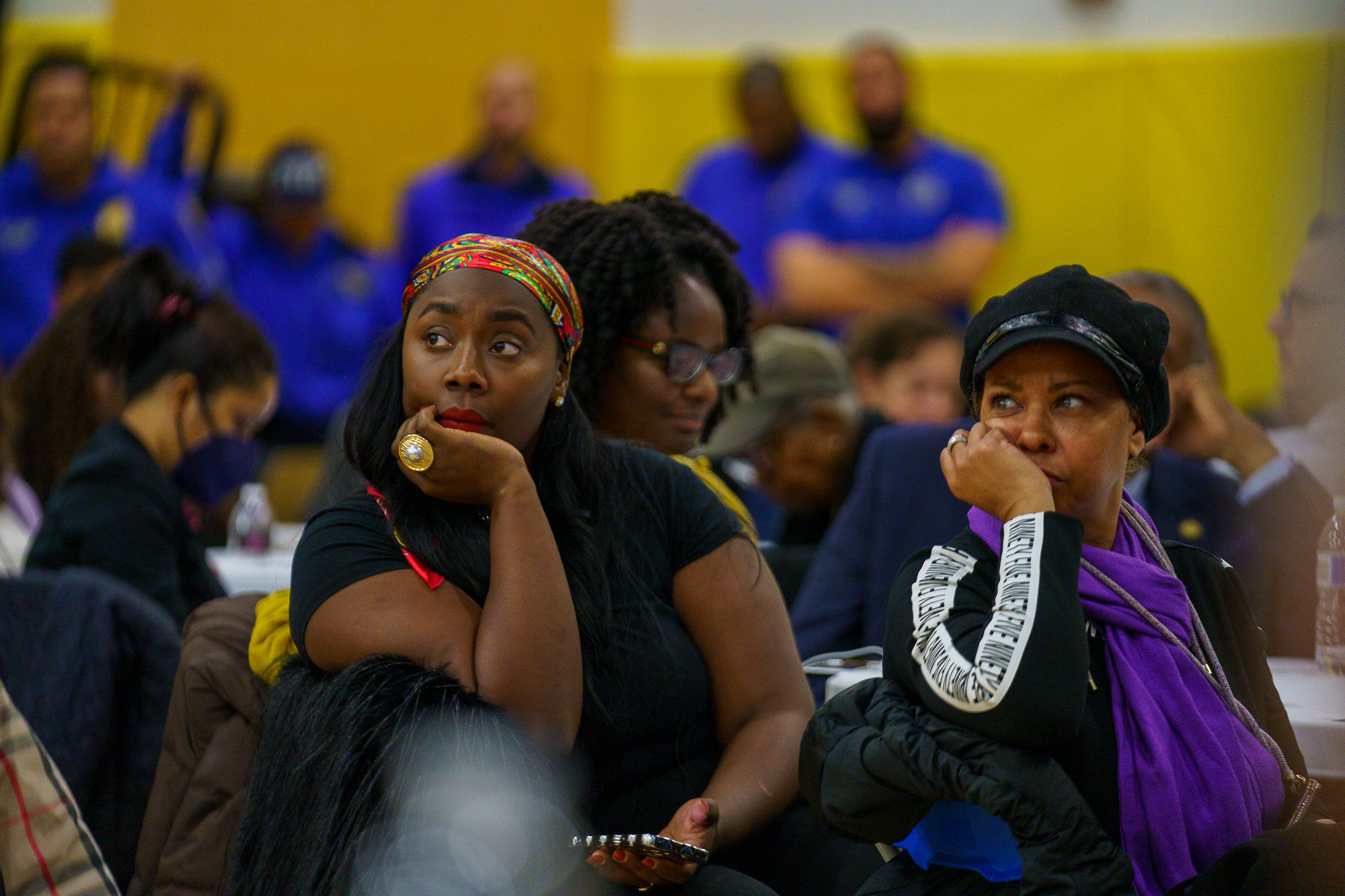
Mayor Adams hosts Community Conversation. Image Credit – Mayor Adams

Mayor Adams hosts Community Conversation. Image Credit – Mayor Adams
MAYOR ADAMS RELEASES NOVEMBER 2024 FINANCIAL PLAN UPDATE WITH NEW INVESTMENTS IN PUBLIC SAFETY, AFFORDABILITY, AND QUALITY OF LIFE MADE POSSIBLE THROUGH ADMINISTRATION’S ONGOING STRONG FISCAL MANAGEMENT
Technical Plan Updates Revenue and Savings Since Budget Adoption, Makes Strategic Investments to Address Budget Cliffs Funded with Temporary Stimulus, Meet Underfunded Needs, and Support Priority Programs and Services
New Investments Include Addition of 1,600 Police Officers, Funding for Cash Assistance Program, Support for New York City Public Schools, and Purchase of Thousands of New Sanitation Bins to Continue “Trash Revolution,” Among Other Initiatives
Administration’s Proactive Fiscal Management Has Driven Savings of $785 Million in Fiscal Year 2025 and $85 million in Fiscal Year 2026, With Asylum Seeker Cost Savings Reaching Nearly $500 Million Over Two Fiscal Years
NEW YORK – New York City Mayor Eric Adams today announced the release of the November 2024 Financial Plan Update with investments that continue to make New York City safer, more affordable, and more livable for working-class New Yorkers. The update marks the beginning of a new budget cycle in which New York City continues to practice the strong fiscal management that helped successfully navigate the city through the fiscal impact of funding a humanitarian crisis and having to close budget holes left by expiring short-term stimulus dollars that were used to support long-term critical programs under the previous administration. The plan update reflects the Adams administration’s ongoing commitment to strong fiscal management by achieving citywide savings and making targeted investments that will support working-class New Yorkers, meet underfunded needs, and invest in critical programs.
“From day one, our administration has put working-class New Yorkers first and have been working to make this city safer, more affordable, and more livable,” said Mayor Adams. “We have remained focused on strong fiscal management and achieving savings to make the best use of taxpayer dollars and balance the budget. Because of our smart and tough decisions early on, we are able to continue investing in working-class New Yorkers and their families, and today’s November plan update does just that. This plan reflects savings of almost $900 million over two fiscal years and over $200 million in additional tax revenue, signaling a strong New York City economy. We are proud to add an additional 1,600 police officers, which will increase our uniform force to nearly 34,000 officers to keep our communities safe. We are also helping working-class New Yorkers pay for necessities like housing, groceries, and bills by putting over $467 million in the cash assistance program and $115 million into our CityFHEPS rental assistance program to help families stay in their homes. We are funding school contract nurses, supporting core technology projects in public schools, and fully containerizing all Department of Parks and Recreation curbside trash locations with 9,000 lockable steel bins to continue our ‘Trash Revolution’ across the five boroughs, amongst other investments. Together, we will continue to build a city for working-class people that is safer, more prosperous, and more livable.”
“Today’s November plan update balances our steadfast commitment to strong fiscal management with our recognition of where targeted investments in public safety, affordability, and quality of life are particularly necessary and timely,” said First Deputy Mayor Maria Torres-Springer. “The citywide savings we are recognizing, as well as the incremental tax revenue we expect to see, allow us to make meaningful investments that further our administration’s agenda to support working people.”
Ongoing Strong Fiscal Management
The FY25 budget is now $115 billion, with gaps of $5.46 billion in FY 2026, $5.57 billion in FY 2027, and $6.34 billion in FY 2028, which are all slightly lower than at FY25 budget adoption due to reduced pension costs. Growth since budget adoption is primarily due to recognition of grant funds.
The plan update reflects $201 million in additional tax revenue in FY25, largely reflecting increased collections since the budget was adopted in July, signaling a strong New York City economy.
The administration has remained focused on achieving savings to make the best use of taxpayer dollars and balance the budget. This plan reflects citywide savings of $785 million in FY25 and $85 million in FY26, driven by asylum seeker cost savings of $436 million in FY25 and $59 million in FY26, primarily due to lower-than-expected number of asylum seekers entering the city’s care since July 2024. This is in addition to savings the city has achieved over previous plans due to the administration’s efforts to help migrants take the next steps toward self-sufficiency and reducing household per-diem cost. The savings achieved in this Plan Update substantially offset agency expense changes over FY25 and FY26 that prioritize public safety, meet unfilled needs, and fund budget cliffs for critical programs.
FY25 Investment Highlights
Keeping Communities Safe
- Funding January and April 2025 NYPD Academy classes that will put 1,600 new officers on the streets by October 2025 and increase uniform force strength to nearly 34,000 officers ($140 million).
- Funding for staffing, equipment, and other needs to support operations at the Bellevue Outposted Therapeutic Housing Unit, a secure, clinical unit within a hospital that serves patients in custody who have serious health conditions and follows the jail-based therapeutic housing model, that is scheduled to open in early 2025 ($6.7 million).
- Expanding the New York City Sheriff’s “electronic ankle monitoring program” with funding for 51 new positions to help increase safety, while at the same time allowing carefully selected, screened, and monitored pre-trial detainees to return to their communities and jobs ($5.3 million).
- Reducing recidivism by justice-involved individuals, helping reintegration into the community, and improving jail safety by deepening support for New York City Department of Correction programming, including transition planning for people in custody, substance misuse education and support, supplemental education sessions, and therapeutic services ($4.7 million).
- Increasing staffing for the “Operation Padlock to Protect” cannabis enforcement program with funds directed to the Office of Administrative Trials and Hearings and the New York City Sheriff’s Office to help with administrative support due to increased task force inspections and closure of illegal cannabis shops ($1 million).
Making New York City More Affordable
- Adding funding to the cash assistance program to close a fiscal cliff and meet growing caseload needs in order to provide stability to a program that helps nearly 570,000 eligible children and adults meet their basic daily needs, such as paying for housing, utilities, and food ($467.6 million).
- Filling a budget hole in the City Fighting Homelessness and Eviction Prevention (CityFHEPS) rental assistance program that had been supported with short-term stimulus dollars in order to help prevent homelessness and keep vulnerable New Yorkers in their homes ($114.9 million).
- Closing the funding gap for the “Groceries to Go” program that helps eligible food insecure New Yorkers purchase groceries for delivery or pickup ($7.3 million).
Filling Gaps in the New York City Public School Budget Left by Expiring Stimulus Funds in an Effort to Protect Critical Programs
- Supporting critical New York City Public Schools technology resources to fund core needs that had previously been funded with temporary stimulus dollars ($80 million).
- Funding for school contract nurses that had been supported with temporary stimulus dollars ($65 million).
Improving Quality of Life by Keeping New York City Clean and Green
- Funding to continue Mayor Adams’ “Trash Revolution” with the purchase of approximately 5,000 tilt trucks for about 1,400 school buildings that allow for easy loading, transportation, and unloading of waste to help comply with containerization regulations ($4 million).
- Purchasing over 9,000 lockable steel bins to fully containerize all New York City Department of Parks and Recreation curbside trash locations ($1.85 million).
The plan update reflects updates to the FY25 Adopted Budget, which the administration balanced in the face of a record level $7.1 billion budget gap through strong fiscal management and remaining focused on savings and reducing asylum seeker spending needs. By managing its way to a stable fiscal position, the Adams administration was able to make record investments in early childhood education, public safety, and programs that maintain the health and quality-of-life of New Yorkers. These investments included holding school budgets harmless from mid-year funding adjustments, safeguarding more than $600 million in educational programs previously funded with short-term stimulus, funding police academy classes that put more officers on city streets to keep New Yorkers safe, and protecting libraries and cultural institutions.
Banner Image: New York City Mayor Eric Adams hosts a reception to celebrate Native American heritage at Gracie Mansion on Wednesday, November 20, 2024. Image Credit – Michael Appleton/Mayoral Photography Office

There are no comments yet
Why not be the first