
New Yorkers: Learn About Daylighting, Vision Zero Initiatives – Fewer Travel Lanes on 34th Street
Editor’s note: Readers learned about daylighting from DOT, where they provided descriptions of the intervention, along with details of how they’re situated and where they are located, including on Staten Island.
DEPUTY COMMISSIONER ERIC BEATON DISCUSSES DAYLIGHTING, DELIVERIES, AND FUTURE OF VISION ZERO ON LATEST EPISODE OF NYC DOT’S CURB ENTHUSIASM PODCAST
Beaton Oversees the Design of City Streets, Vision Zero Safety Projects, the Development of the Bicycle, Pedestrian, and Public Safety Program, As Well as the Implementation of Select Bus Service and Transit Priority Projects Alongside the MTA/NYC Transit
This Installment Features Beaton Discussing the Agency’s Daylighting Report, the Shift From Commercial Freight Delivery to Residential Delivery, the Safety Impacts of Protected Cycling Infrastructure, and the Next Phases of Vision Zero With a Focus on Dangerous Drivers and Vehicle Design
NEW YORK – New York City Department of Transportation (NYC DOT) Commissioner Ydanis Rodriguez today announced the release of the ninth episode of the agency’s Curb Enthusiasm podcast. The episode features the second installment of a conversation with Eric Beaton, NYC DOT’s Deputy Commissioner for Transportation Planning and Management (TPM), with over 18 years of service at the agency. In this episode, Beaton discusses daylighting, the continuing shift from greater commercial freight delivery demand to greater residential delivery, initiatives such as Commercial Loading Zones and the new Microhub Zones NYC DOT uses to address deliveries, and the future of Vision Zero.
“Each day the work of NYC DOT touches the lives of every New Yorker as soon as they walk out the door,” said NYC DOT Commissioner Ydanis Rodriguez. “Deputy Commissioner Eric Beaton oversees a division at NYC DOT that is at the forefront of the many great initiatives where NYC DOT is a national and world leader, including street redesigns and Vision Zero. I encourage everyone to listen to this episode to gain better insight to how NYC DOT makes decisions that affect everyone’s streets and lives on a daily basis.”

In the discussion about daylighting, Beaton covers the surprising findings of the agency’s recent study on daylighting. He notes how universal daylighting could, counterintuitively, lead to an increase in traffic injuries, while discussing the benefits of hardened daylighting that uses bike racks, concrete blocks, and pedestrians neckdowns extending the sidewalks. Daylighting had never really been studied before because the general consensus was that its benefits were obvious, regardless of the type of daylighting. As it turned out, hardened daylighting proved to have benefits, but injury data showed that unhardened locations largely yielded either neutral or even harmful results. Other street design treatments, including measures that cause drivers to turn more slowly were more beneficial.
During the rest of the discussion, the focus turns to the transition since the pandemic from greater commercial freight delivery demand to greater residential delivery needs and the resulting increase in truck traffic. Beaton cites Commercial Loading Zones and the new Microhub Zones as two NYC DOT measures to address this changing how deliveries are made. Beaton also discusses the next phase of Vision Zero and the safety value protected bike lanes have for all road users, by making the roadway more predictable.
The Curb Enthusiasm podcast focuses on issues at the local, national, and international level and features guests who discuss the most consequential transportation work happening all over the globe.
The episode is hosted by Emily Weidenhof, assistant commissioner of public realm at NYC DOT.
Curb Enthusiasm is available on Apple Podcasts, Spotify, Amazon Music, YouTube, and other major streaming platforms.
More information is available at nyc.gov/CurbEnthusiasm.
About Eric Beaton
Eric Beaton serves as NYC DOT’s Deputy Commissioner for Transportation Planning and Management (TPM), and oversees the design of city streets, the City’s Vision Zero street safety program, development of bicycle, pedestrian, and public space programs, and the implementation of bus and other transit priority projects in partnership with the MTA. Beaton’s TPM division also includes the units responsible for the installation and maintenance of the city’s 225 million linear feet of roadway markings, as well as production, installation, and maintenance of over one million street signs citywide. Eric has worked at DOT since 2006 in a variety of roles, most recently as Senior Director for Transit Development. In this role, he worked in partnership with the MTA to build a program making the city’s buses faster, more reliable, and easier to use through the use of improved fare collection, dedicated bus lanes, transit signal priority, real time passenger information, and other mobility and safety treatments.
Eric earned a Bachelor’s Degree from Cornell University, and well as a Master’s Degree in Urban Planning from Harvard University’s Graduate School of Design.
About Emily Weidenhof, Episode Co-Host
Emily Weidenhof is assistant commissioner of public realm at NYC DOT. Emily works closely with community organizations throughout the five boroughs to transform their streets as public space. For over a decade, she has focused on strengthening communities through the creation of plazas and shared streets and retooling the curb lane for innovative programming. She’s also played an integral role in NYC DOT’s Broadway Vision Plan, which employs a range of tools to reimagine the famed Manhattan corridor from Union Square to Columbus Circle, which now prioritizes pedestrians and cyclists. Emily has worked as an architect and urban designer in Pennsylvania, New Jersey, and New York, including at the NYC Department of City Planning.
Emily received her bachelor’s degree in architecture from Pennsylvania State University and her master’s degree in architecture and urban design from Columbia University.
NYC DOT PROPOSES BUSWAY FOR 34TH STREET IN MANHATTAN
Busway Would Make Commutes Faster and More Reliable for 28,000 Daily Commuters and Improve Safety on Corridor
Agency Also Proposes Extending Bus Lanes South on Madison Avenue To Speed Up Service
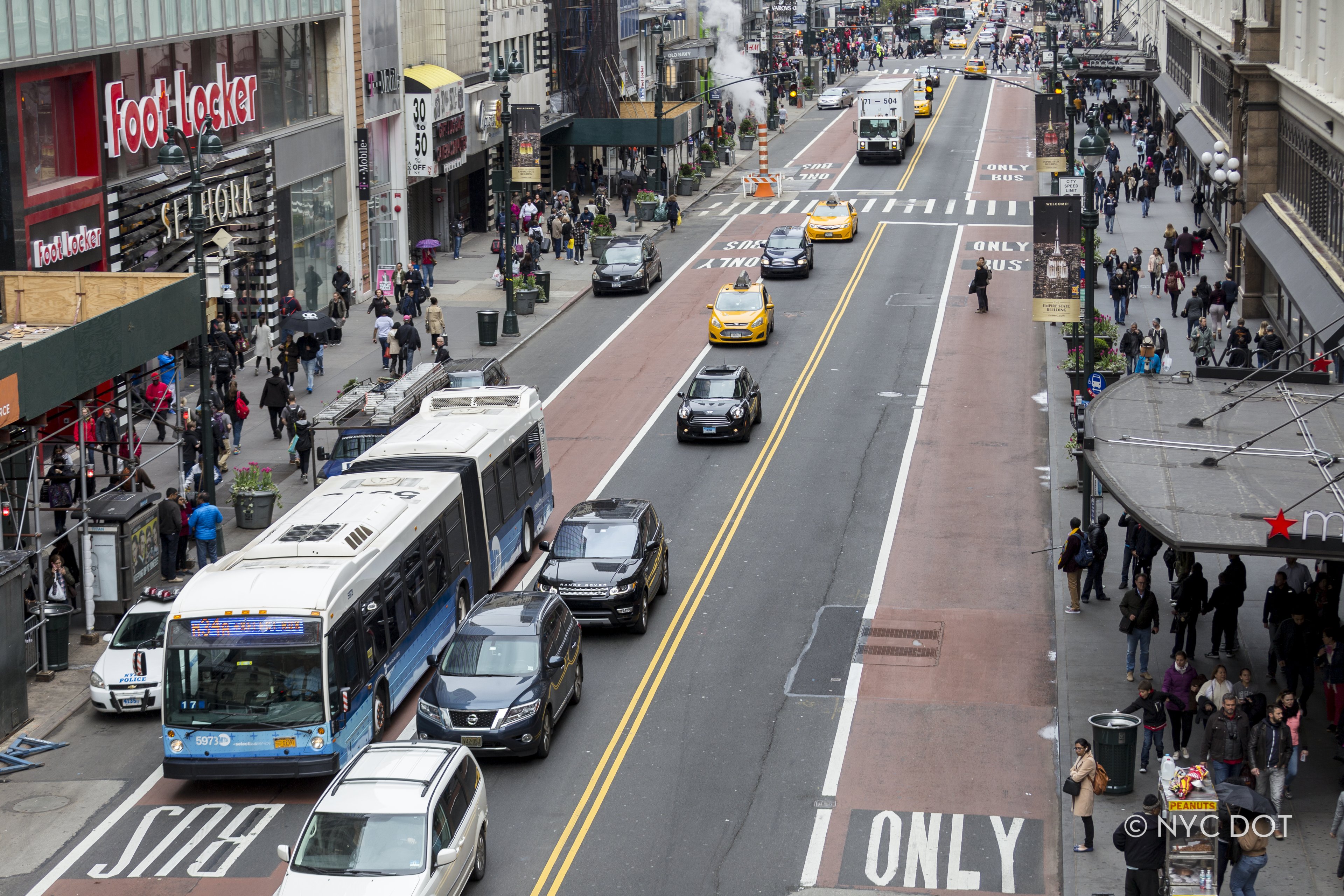
The current configuration of 34th Street in Manhattan. Image Credit: NYC DOT
NEW YORK – New York City Department of Transportation (NYC DOT) Commissioner Ydanis Rodriguez today announced the agency has proposed a busway for the 34th Street corridor across Manhattan following the remarkably successful installation of a similar design on 14th Street. The midtown busway would speed up bus service, with shorter, more reliable waits for 28,000 daily bus riders on 34th Street on the M34/A Select Bus Service and 22 express bus routes as well as New York Waterway, tour, and other buses. After the busway was implemented on 14th Street, bus speeds increased up to 24 percent and crashes on the corridor dropped by 42 percent. The proposal follows support from all three local community boards for a busway on 34th Street.
“The vast majority of commuters in Midtown are traveling by transit, and they deserve world-class, fast, and reliable buses,” said NYC DOT Commissioner Ydanis Rodriguez. “After seeing tremendous success on 14th Street—where buses have sped up, traffic has virtually disappeared, and far fewer New Yorkers are getting hurt in crashes—we are excited to propose a similar design on 34th Street. We look forward to refining the design with the community.”
“Busways and bus lanes are proven to move buses faster and provide riders with more reliable commutes,” said MTA NYC Transit President Demetrius Crichlow. “Converting 34th Street to a busway would improve speeds for 28,000 daily riders’ by up to 15 percent.”
NYC DOT on Monday evening presented the proposal for a 34th Street busway, as well as a proposal to extend the northbound double bus lane on Madison Avenue, from 42nd Street down to 23rd Street—two separate projects to speed up Manhattan buses–at Community Board 5. More community board presentations are to come.
34th Street Busway Proposal
Improved bus priority on 34th Street was a key proposal in the administration’s Connecting to the Core plan to make it easier to travel around Manhattan’s Central Business District without a vehicle. The 34th Street busway would utilize a similar design as 14th Street, where NYC DOT freed up space for buses and improved traffic safety without seeing any significant spillover traffic to neighboring streets.
The proposal would deliver a busway from Ninth Avenue to Third Avenue, and would prioritize buses and trucks while maintaining local access for pick-ups, drop-offs, and loading needs. Like 14th Street, local-access vehicles would be required to turn off the busway at specific intersections to avoid a traffic violation.
Installing a busway will free up curb space for deliveries and bring new pedestrian safety improvements, including painted curb extensions, and improved visibility at intersections across the corridor. Outside of the busway, NYC DOT would maintain the existing bus lanes along 34th Street, from 11th Avenue to the FDR Drive.
34th Street would be New York City’s eighth busway and the seventh installed since 14th Street in 2019.
Madison Avenue Bus Priority Proposal
Madison Avenue is a critical corridor for transit, serving 92,000 daily bus riders on 34 bus routes—including the M1, M2, M3, M4, Q32 local buses, as well as 29 express bus routes from other boroughs. During morning and evening rush hours, the majority of people on the roadway are on a bus—yet they occupy just a quarter of the space thanks to the efficiency of bus service.
NYC DOT is proposing extending the existing double bus lanes of Madison Avenue, which currently run from 60th Street to 42nd Street, further south to 23rd Street near Madison Square Park. The corridor is also undergoing expansion of Automated Camera Enforcement mounted on M2 and M4 buses to ensure speedy and efficient bus service for the corridor.
Extending the bus lanes will quicken the commutes for New Yorkers traveling from across the city. When NYC DOT implemented similar lanes on Fifth Avenue, speeds on local routes increased between 6 percent to 12 percent, and on express routes by 11 percent to 20 percent.
NYC DOT plans to review feedback from the community on each project before moving forward with implementation.
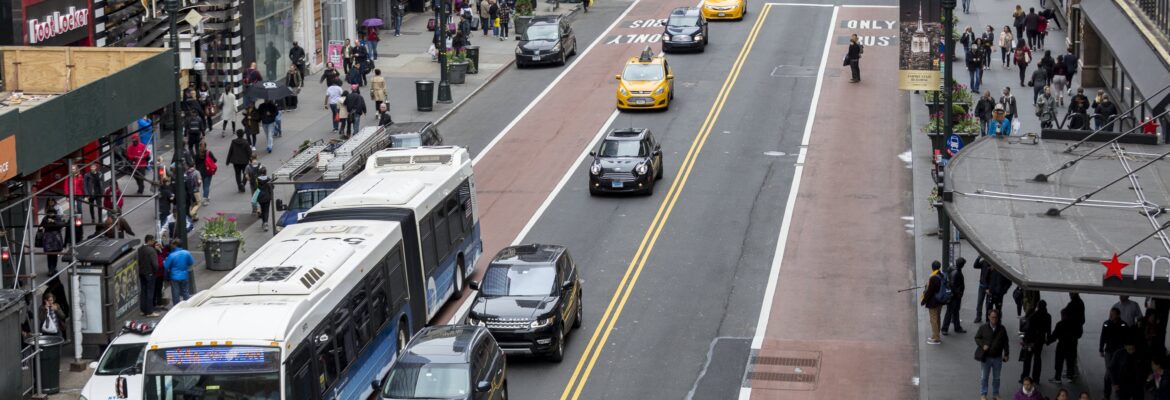
Banner Image: The current configuration of 34th Street in Manhattan. Image Credit – NYC DOT


NYC DOT
The New York City Department of Transportation’s (NYC DOT) mission is to provide for the safe, efficient, and environmentally responsible movement of people and goods in the City of New York and to maintain and enhance the transportation infrastructure crucial to the economic vitality and quality of life of our primary customers, City residents.
There are no comments yet
Why not be the first