

Staten Islanders, New Yorkers Can Participate In E-Bike Health Study On Effects Of Cycling, Exercise On Heart: UPDATED
Editor’s note; We reached out to the researchers for this study (at NYU) and were informed that the last date to submit a survey form for the first phase is the last day of August, the 31st. Staten Islanders and other New York City residents that want to participate should follow the links below and take the five minute survey about bicycling and health improvements. The other two study segments will be chosen from the first cohort based on survey answers. While using an e-bike provides more exercise than walking or being sedentary, those who ride a manual bike (the old fashioned type with pedals that work 100% of the time) will definitely get more exercise than e-bike riders. But no one has ever studied heart benefits from electric or assisted bicycles. These results may be used to influence policy changes in favor of more or fewer bike lanes and available e-bikes from Citibike and other vendors, depending on what the data shows. This is similar in concept to the speed and red light camera studies that were used to justify increases to those respective programs. See below for our questions about the program, which were answered by NYU (questions in bold, answers in italics):
NYU and the New York City Department of Transportation are examining how e-bike riding and conventional bicycling are associated with physical activity and cardiovascular health compared to each other and sedentary travel modes. More specifically, the study will compare the intensity and duration of physical activity among e-bike riders, conventional bicycle riders and sedentary travel modes.The study is intended to evaluate these differences objectively rather than to prove a predetermined conclusion.
2- Will the second cohort (chosen from the first for the wearables portion) also include standard bicycle riders or is that expected to be only e-bike riders?
4- What has been shown anecdotally that you are seeking to prove (regarding e-bike usage and cardiovascular health)?
One common assumption is that because pedal-assist e-bikes provide motor assistance, riders exert less physical effort and may receive fewer cardiovascular benefits than riders of conventional bicycles. At the same time, e-bikes may allow people to ride more frequently, travel longer distances, or cycle when they otherwise would not. The study is examining these questions using objective data. We cannot draw conclusions until the analysis is complete. Study findings will be published on ebikestudy.nyc when they are available.5-Will your network’s healthcare providers be using these results to make recommendations to patients based on this data? Such as a certain number of hours of e-bike riding to get the equivalent exercise to a standard bike or to walking?
No. This study is not designed to establish clinical exercise guidelines or determine precise equivalencies between e-biking, conventional bicycling, and walking.
BIKE MONTH: NYC DOT COLLABORATES WITH NYU ON NEW E-BIKE HEALTH STUDY THROUGH AUGUST
In celebration of Bike Month, DOT teams up with NYU to explore heart health and cycling infrastructure
New survey open to all adult New Yorkers who can ride a bike at ebikestudy.nyc
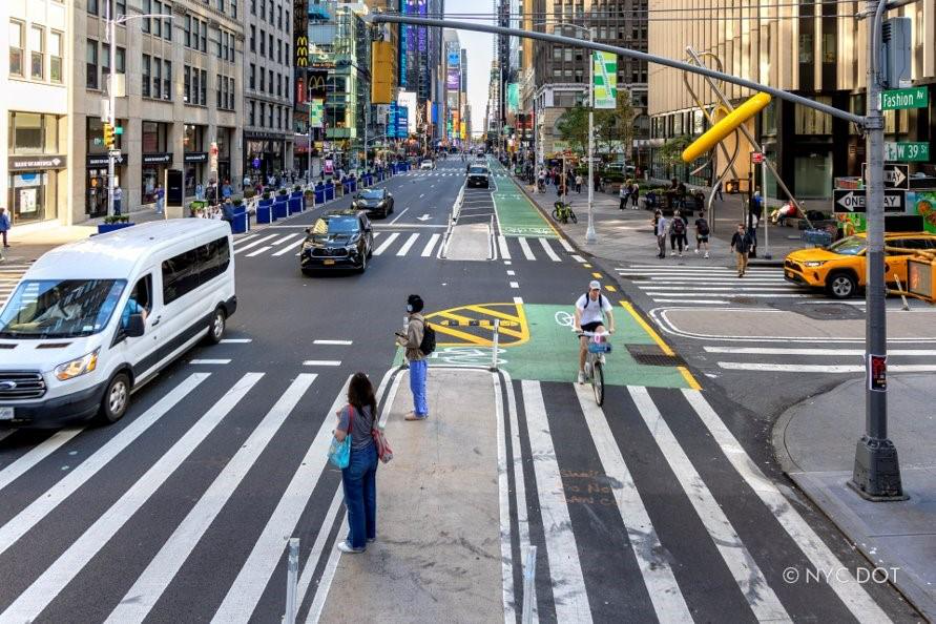
An electric Citi Bike rider travels down Seventh Avenue in Manhattan. Credit: NYC DOT
NEW YORK – New York City Department of Transportation (NYC DOT) Commissioner Mike Flynn and New York University (NYU) today launched the NYC E-Bike Health Study, a first-of-its-kind research collaboration examining how electric bike (e-bike) use and cycling infrastructure shape the cardiovascular health of New Yorkers.
Research shows that e-biking produces moderate physical activity that is greater than walking or sedentary travel, yet large-scale, population-level evidence on what that means for New Yorkers’ health, and whether those benefits are available to all residents, is still limited. The NYC E-Bike Health Study, led by NYU professor Dr. Rumi Chunara, is designed to fill that gap.
“More and more New Yorkers are cycling than ever before because it’s a safe, affordable, and convenient way to get around the city. That’s why the Mamdani administration will be doubling down on delivering safe cycling infrastructure,” said NYC DOT Commissioner Mike Flynn. “E-bikes are increasingly popular among delivery workers, families, and other riders that benefit from an added boost while riding. We know we must do more to adapt our policies and street designs to keep riders safe, but also to understand the health benefits of these changes for all New Yorkers. We are grateful to work with NYU and Professor Chunara on this research.”

“We want to understand how e-bikes compare to conventional cycling and other modes of transportation when it comes to physical activity and cardiovascular health. For cyclists, this includes where you ride, what feels safe, and what keeps you from biking more often,” said Dr. Rumi Chunara, Director of the NYU Center for Health Data Science and an associate professor at NYU School of Global Public Health and NYU Tandon School of Engineering. “Understanding how our streets can influence our choices can help create better health outcomes for all New Yorkers.”
Each day, more than 600,000 cycling trips are taken in New York City, up 64% from the 380,000 daily trips taken in 2013. E-bikes have transformed how New Yorkers get around, with ridership expanding rapidly across five boroughs as NYC DOT has invested in protected lanes, greenways, and micromobility programs. An EPA study has found that if Americans walked, biked or e-biked for half of all trips of less than one mile, they would collectively: decrease 2 million metric tons of CO2 emissions, save $575 million on fuel, and [reduce] $900 million in car maintenance costs.
The research, funded by the NYC DOT, is intended to quantify how much e-bikes are increasing the number and length of New Yorkers’ biking trips. These trip patterns along with a wearable device study that will come later in 2026 will reveal the effects of increased e-biking on New Yorkers’ cardiovascular health. The study’s findings could further bolster New York City’s plans to expand its protected bike network. New York continues to be at the forefront of the global movement to use active transportation as preventative medicine. These safe routes not only keep New Yorkers safe on sustainable and cost-saving e-bikes but are vital pieces of public health infrastructure for New Yorkers.
NYC DOT and NYU plan to have draft results of the study prepared next year.

E-Bike Study. Image Creduit – NYU
About the Study
The NYC E-Bike Health Study is a mixed-methods research study of adults 18 and older who live in New York City and can ride a bike.
The study has three components:
- Survey: A brief, online survey open now through August 2026, examining riding habits, barriers to cycling, and health. The survey is open to all NYC adults 18 or older who can ride a bike, including e-bike riders, standard bike riders, and e-bike delivery workers, and is available at ebikestudy.nyc.
- Focus Groups: A subset of survey participants will be invited this fall to join a 90-minute, in-person focus group. Focus group participants will be asked to share about their cycling experiences and choices.
- Wearable Device Study: A subset of survey participants will be invited this fall to wear a fitness tracker for a period of time, generating objective activity data that will be compared against self-reported survey responses. Selection is based on survey responses to represent a range of riders.
About NYU’s Center for Health Data Science
The Center for Health Data Science at NYU School of Global Public Health leverages data in combination with knowledge across disciplines and places, with the ultimate goal of addressing quality of life and other public health priorities. For more information, visit healthdatasci.org.
Banner Image: E-Bike Study. Image Creduit – NYU



NYC DOT
The New York City Department of Transportation’s (NYC DOT) mission is to provide for the safe, efficient, and environmentally responsible movement of people and goods in the City of New York and to maintain and enhance the transportation infrastructure crucial to the economic vitality and quality of life of our primary customers, City residents.
There are no comments yet
Why not be the first