
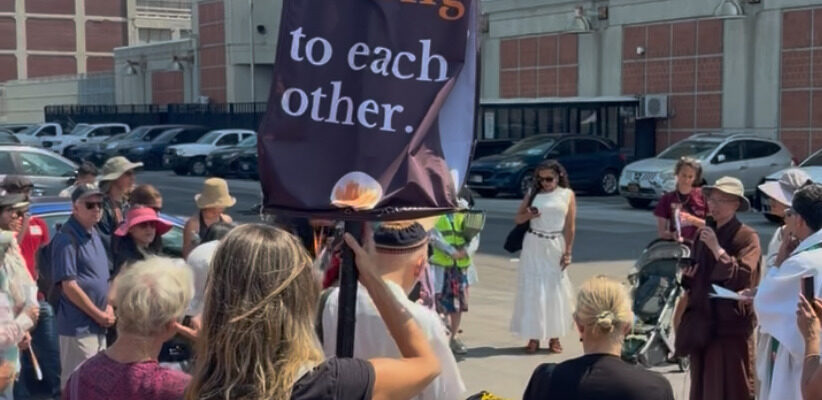
From Staten Island To the Bronx, With Stops At African Burial Ground, Manhattan Detention Center With Prayer, Mindfulness
Note: We covered the announcement of this walk prior to its occurrence, which can be found here. See the video below with all footage provided by the organizers, Mahansangha NYC. Videos are provided by Mona Chopra, Glenmore Marshall, and other individuals and organizations that shared their videos with Mahasangha NYC.
As we have discussed previously, particularly in our review of Wisdom of Happiness, the Dalai lama’s film, Buddhism is not a theistic religion in the traditional sense. While some sects, such as Tibetan Buddhism, do have rituals and ceremonies similar to other religious sects, much of Buddhism is about meditation, contemplation on the Infinite, and compassion toward oneself and all other living beings. Many Buddhists are also vegetarianism, and many practitioners are adherents of other faiths that see it as an additive philosophy that is not in disagreement with any of the other religions. Hence, the organizations that participated are from many different sects and religions, including Christianity and Hinduism. Thich Nhat Hanh, a Buddhist monk from Vietnam, is also an inspiration for many of the participants.
A complete list of collaborators/partners is below:
– Owl Steven Dennison Smith (Ramapo Munsee Lenape)
– The Thích Nhất Hạnh Program for Engaged Buddhism, Union Theological Seminary (visit their Substack: https://uniondharma.substack.com)
– Rev. Doyeon Park, Won Buddhism of Manhattan
– Mindful Rebels (Extinction Rebellion)
– Wanda Salaman, Lisa Ortega, Mothers On the Move / Madres en Movimiento (MOM)
– Bhante Sanathavihari, Sarathchandra Buddhist Center
– Sheryl Durant, Kelly Street Community Garden
– Buddhist Council of New York
– Buddhist Action Coalition
– Brooklyn Zen Center
– DSA Buddhist Circle
– Fire Lotus Temple
– Kaira Jewel Lingo
– Adam Bucko
– Tenzin Mingyur Paldron
– Mid City Zen
– Rev. James A. Lynch
– New York Insight
– Sylvain Leroux
– Dharma Gates
– Rev. Juan Carlos Ruiz
– Nara Garber (Resistance Revival Chorus, Singing Resistance)
– Gary Baker (New York Sings Along)
– Leah Penniman, Soul Fire Farm
– Sister True Vow, Blue Cliff Monastery
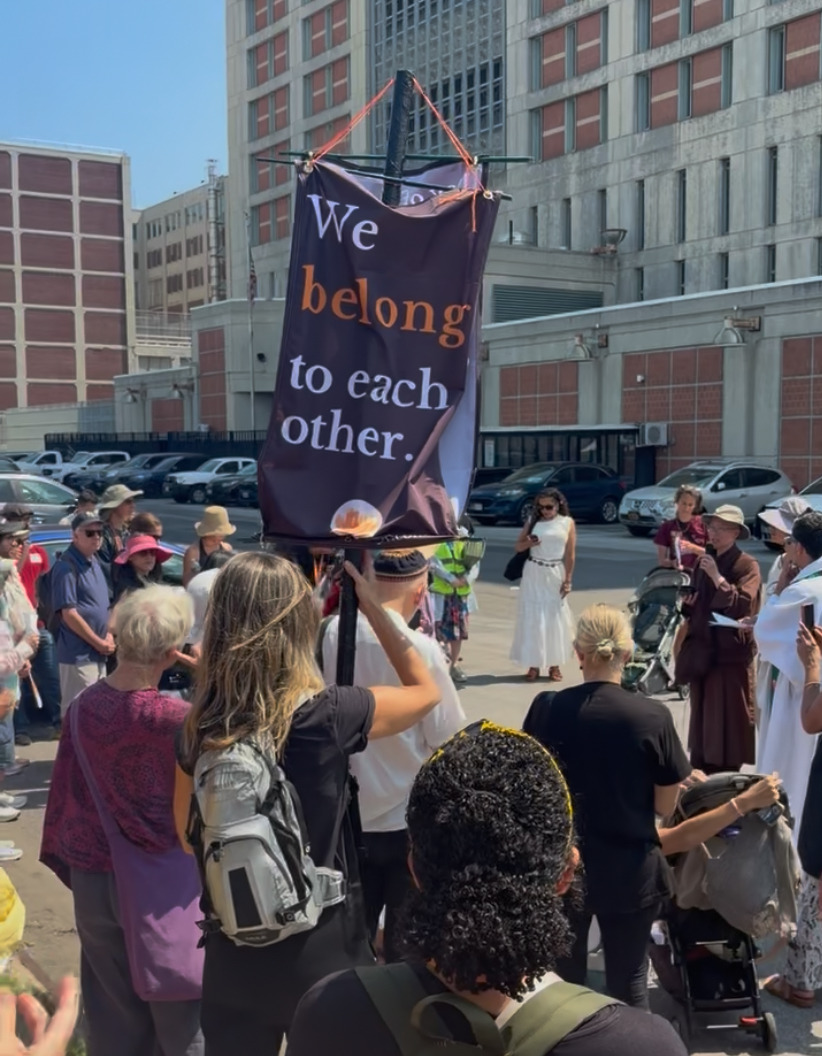
Walking Meditation in front of MDC. Image Credit – Kaira Jewel
Another Kind of Song: Remembering Our Interdependence
Kaira Jewel’s July 2026 Newsletter
Dear friends,
I recently turned 52. When I woke up that morning and remembered it was my birthday, my first thought was deep gratitude that I have lived this long. I felt how precious it is to still be alive—especially when I consider all those who don’t get to live as long. Some don’t even make it to being born. Others die as children—from war, illness, poverty. Still others are killed as teenagers, young adults, or in their middle age.
I thought especially of Lorenzo Salgado Araujo, shot and killed by ICE agents at a traffic stop on his way to work in Houston on July 7. I sensed we might be similar in age, and later I confirmed it — we were both born in 1974, he in Mexico and me in the US. And I also grew up spending summers with my grandparents in Houston. I know those streets. He was on his way to work, just living his ordinary life, and it was taken from him. His death was preventable. It was a tragedy, as are the deaths of so many people arrested or held in detention by ICE and CBP.
That birthday morning, as I breathed in and out, I felt acutely that this life is a gift—every single day is a gift. I don’t want to forget its preciousness. I felt a surge of determination to live my life in service of others, so that fewer people like Lorenzo are killed needlessly. To put my energy into helping us all remember that every person, no matter where they come from, is worthy of dignity and respect. That their lives are sacred.
On Sunday, July 12, I joined the Day of Remembering Our Interdependence — a Buddhist-led, interfaith day-long practice and pilgrimage in NYC, inspired by the Buddhist monks’ 2,300-mile Walk for Peace. The pilgrimage began that morning from two starting points, one in the Bronx and the other in Staten Island. We joined at the second stop, where the two groups converged at the African Burial Ground National Monument.
Before the ceremony, we visited the adjacent museum. I’ve been before, but I’m always moved by the reminder that enslaved Africans largely built the original city of Manhattan and colony of New York. As the museum’s documentary states, enslaved people were “colony builders.” So much of the nation’s wealth passed through New York’s ports and infrastructure, all powered by enslaved labor. In 1703, nearly 42% of New York households held enslaved people — a higher percentage than Philadelphia and Boston combined. New York was second only to Charleston, South Carolina, in the extent to which slavery was woven into everyday life. In school, most of us learn that slavery was only on plantations in the South. It is so important to learn the role the North played. We saw images of a skull of a stevedore/longshoreman, deformed by the neck and back muscles needed to lift 1,000-pound barrels they were forced to load and unload onto ships. Most enslaved people lived only into their 30s because life was so harsh. It was cheaper for colonists to work people to death and then purchase new enslaved people.
From the museum, we gathered outside for the ceremony. There we heard beautiful reflections from Grandmother Clara Soaring Hawk and Owl Steven Dennison Smith, both members of the Ramapo Munsee Lenape nations. Grandmother Clara offered a prayer in the Lenape language — the first time I have heard it spoken. What a blessing! I learned that Wanìshi (pronounced “wah-NEE-shee”) means thank you. They welcomed us to this land and spoke of their work preserving their culture and language so it can continue to thrive and nurture future generations — including all of us.
We then took the train to Brooklyn, where we had lunch in the wonderfully cool and welcoming Green-Wood Cemetery Visitor Center. Our group spanned all ages, races, orientations and backgrounds — elderly folks, mothers with children in strollers, local people and out-of-state visitors.
Then we practiced silent, slow walking meditation as a group of about 50 to 60 people from the cemetery to the Metropolitan Detention Center (MDC), where immigrants detained by ICE await deportation. We walked aware of each step, our breathing, and each other. As we approached, another 20 or so silent practitioners joined us, already gathered at the gates. We took in the large complex of several connected buildings, about seven stories high, with small opaque windows. We were told those inside couldn’t see us, but from time to time they would get word that people were holding vigil outside in solidarity — and they would bang on the windows to let us know they knew we were there.
Across from the MDC, a chain-link fence surrounded a power plant. On that fence were festive posters and banners: “Happy birthday, dad!” and “Best dad in the world.” It was bittersweet to see these heartfelt expressions of love for those held inside. Would they be able to see them and hug them in person? Would they be reunited with their families?

Sr. True Vow (of Blue Cliff Monastery) and I began the ceremony with a song of prayer for peace, a short reflection, and reciting a sutra invoking the power of Avalokita, the bodhisattva of Great Compassion. Some of the verses were:
Imprisoned or bound in iron chains,
with hands and feet placed in a yoke,
invoking the strength of Avalokita,
we are released into freedom.
All living beings caught in distress,
oppressed by immeasurable suffering,
are rescued in ten thousand ways
by the wonderful power of her understanding.
Look of truth, look of purity,
look of boundless understanding,
look of love, look of compassion—
the look to be always honored and practiced.
Heart of compassion like rolling thunder,
heart of love like gentle clouds,
water of Dharma nectar raining upon us,
extinguishing the fire of afflictions.
Then Adam Bucko, my partner and an Episcopal priest, offered a powerful Christian litany. These lines in particular have stayed with me — a prayer for courage, for mercy, and for the strength to choose love over fear:
Forgive us, O God, whenever we build cages where you have called us to build homes.
When laws demand what mercy forbids, grant us the perseverance to obey conscience before comfort and your love before every earthly power.
Woe to those who build walls where you have called us to build tables, who teach us to fear the stranger instead of welcoming our neighbor.
Break the spell of indifference.
Teach those entrusted with power that no nation is made stronger by forgetting the sacredness of the human person.
*And all of us responded: May love set us free. *
Padre Juan Carlos Ruiz, pastor of the Lutheran Church of the Good Shepherd and immigrant advocate, reminded us that we can — and must — stop this apparatus of death and destruction. He leads vigils in front of the MDC every Tuesday evening and Saturday morning and invited us to join him in supporting families who come to see their detained loved ones. He and a friend played flute and drum, and as they played, he invited us to turn toward the prison, offer prayers, and connect in whatever way felt authentic.
Many of us raised our outstretched hands to send our love and care to those inside. That’s when we really heard the windows rattling. It was deeply emotional — reaching out with our hands, aware of their hands on the other side of the walls. I felt the desire on both sides to be connected, not separate. The phrase “the sin of separation” arose in me. These policies of mass detention are breaking families, breaking communities, breaking hearts, and breaking lives. I could not stop the tears as I listened to the sweetness of the flute, felt all of us reaching out as one, and heard the clanging of the windows in reply.
The ceremony closed with a Tibetan practitioner, Tenzin Mingyur Paldron, a trans author, artist, and community educator, who told us about monks and nuns held in total isolation in Chinese gulags after the Chinese occupation of Tibet. One nun, who was imprisoned for 26 years, learned that the Dalai Lama had safely reached India — and to secretly share this with the other prisoners she sang a praise song in the courtyard while she was sweeping, so that all could hear from their cells. It told of how even though the snow is falling, the sun will come back and warm everything again. The song became a lifeline, proof that hope could survive even in total darkness. Tenzin then offered full-body Tibetan-style prostrations as we recited Shantideva’s prayer together, which begins:
May I become at all times, both now and forever,
A protector for those without protection,
A guide for those who have lost their way,
A ship for those with oceans to cross,
A sanctuary for those in danger,
A lamp for those in the dark,
And a servant to all those in need…
Watching him stretch himself onto the ground again and again, I felt the endurance and patience in that vow. If they could keep going in gulags, we can keep going here, in our daily lives, including outside a detention center, for each other. I thought of the windows rattling above us — another kind of song, another kind of reaching across walls.
We finished with slow, silent walking meditation along the length of the complex. At the corner, we stopped and dedicated the merit. We stood in a circle and using our arms we collectively gathered all the good energy we had generated through our practice. On the count of three, we threw that ball of fierce compassion, wisdom, patience, understanding — insisting on justice, resisting injustice — up into the air with a loud, festive, collective “whoooo!” so it could be shared with all beings everywhere in need.
The whole event was held with such lightness, selflessness and care. From the hats, fans and ice water passed out by the volunteer medics, to the calm and resourceful marshalls who made sure we got where we needed to go as a large group, to the 6 organizers who started this event simply by meeting weekly over the past two months. Adam reflected on how there was no ego during any part of the day, everyone was interested in simply supporting this vision of walking in peace, in remembrance of our interdependence. I’ve been carrying that feeling with me — the weight of what we witnessed and the lightness of offering it forward. It’s a feeling I want to live into, day by day, step by step, with all of you.
May we all remember and live into our interdependence,
Kaira Jewel
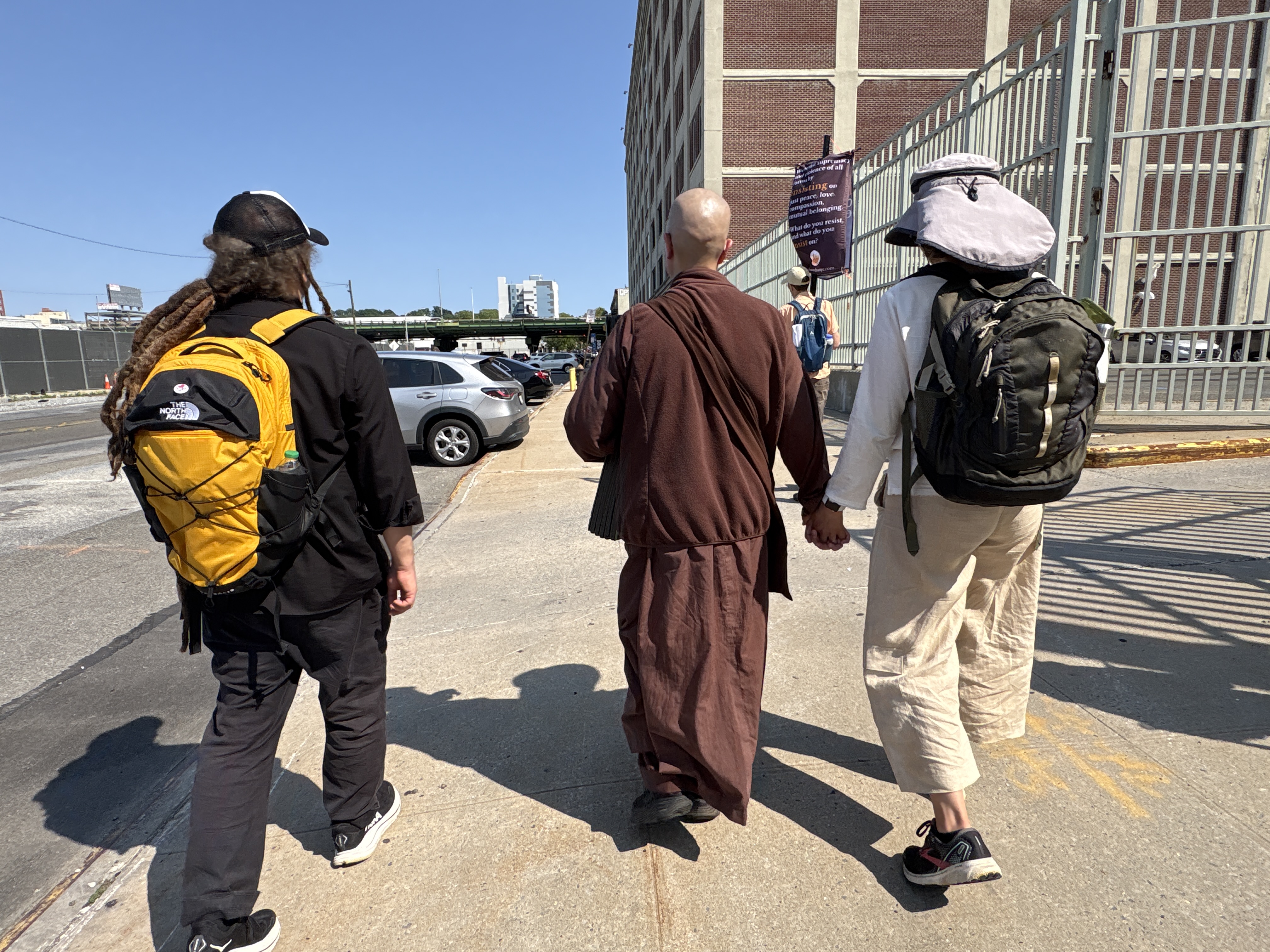
Walking Meditation in front of MDC. Image Credit – Kaira Jewel
The Walls Answered Back: Standing in prayer outside an ICE detention center, we heard the people inside answer
Yesterday we were grateful to join the Day of Remembering Our Interdependence, a Buddhist-led interfaith pilgrimage across New York City’s five boroughs. Inspired by the Buddhist monks’ Walk for Peace, we walked, prayed, chanted, and stood together at places that hold both pain and hope, remembering that our lives really do belong to one another.
One of our stops was the Metropolitan Detention Center in Brooklyn, where ICE is holding many immigrants in federal custody.
We were grateful for the chance to simply show up in solidarity and prayer.
Standing outside the detention center was heartbreaking. Families had attached signs to the fence: “Happy Birthday, Dad.” “You’re the best dad in the world.” “We love you.” Messages from children whose fathers had been taken from them and were now being held inside. It is one thing to know this is happening. It is another to stand there and read those words.
This is a facility where multiple people have died in custody in recent years. It has also faced years of criticism over prolonged lockdowns, inadequate medical care, chronic understaffing, and conditions that many have described as inhumane.
Alongside Buddhist recitations and the testimony of a priest who has been accompanying many of the families with loved ones inside, I offered a litany of prayer. These are a few lines from it, with everyone responding, “May love set us free.”
Forgive us, O God, whenever we build cages where you have called us to build homes.
Forgive us whenever we choose comfort over compassion.
Forgive us whenever we remain silent because speaking the truth is costly.
Deliver us from every obedience that betrays love.
When laws demand what mercy forbids, grant us the perseverance to obey conscience before comfort and your love before every earthly power.
Keep us faithful to the nonviolent way of Christ, who overcame hatred not with hatred but with love.
Woe to those who build walls where you have called us to build tables, who teach us to fear the stranger instead of welcoming our neighbor, and who ask us to believe that another person’s suffering can become the price of our own security.
Strip away every lie that justifies cruelty.
Break the spell of indifference.
Teach those entrusted with power that no nation is made stronger by forgetting the sacredness of the human person, and that no law is worthy of honor when it denies the dignity you have given.
As we prayed, as we mourned, as we stood there in silence, all of a sudden, from inside the building came the sound of people banging on the windows and the walls.
They were responding, and they wanted us to know that they could hear us.
And we wanted them to know that they had not been forgotten.
Sometimes this is where we begin: by showing up, praying, bearing witness, organizing, and putting pressure on the machinery that turns people into strangers, that keeps building walls where we are called to become neighbors, and that keeps building cages where we have been called to build homes.
Deep gratitude to MahaSangha NYC, to the many organizers and volunteers, and to everyone who walked, prayed, chanted, and bore witness together yesterday.
A Buddhist-led, inter-faith day-long practice and pilgrimage in NYC and with its peoples.
Inspired by the Buddhist Monks’ 2,300-mile Walk for Peace.
Embodying Thich Nhat Hanh’s edict:
The next Buddha May Take the Form of a Community.
We will do sitting and walking meditation, transferring merit and metta practice, chanting and ceremonies for everyone’s safety and protection.
The day will culminate in a joyful gathering, with songs, poetry, movement, food…
We resist supremacy and violence of all forms by insisting on love for one another and a deep sense of belonging for each and every being.
We resist by insisting on our inter-being, on non-separation.
May our choices and actions on this day and on all days come from this insistence.
May we respond to the crises of these times from this insistence.
All are welcome to join the entire five-borough pilgrimage or parts of it.
Updates will be posted here on our website as well as on our Instagram (@mahasanghanyc).

There are no comments yet
Why not be the first