

New Yorkers Generosity Is Measured By Its Benefit To Others: Are They Supporting Delivery Workers Or Big Tech Companies?
Editor’s note: We previously covered this story back in July, in the Mayor’s rundown here. New York City has recently announced the results of an impromptu social experiment, caused by the passage and then actual, aggressive enforcement of a new rule for the delivery app companies, large, small, and everywhere in-between: tips have to be on the home screen, easily findable, and easy to understand. A recent court case with the largest companies, as detailed below, put money into workers’ pockets. But the experiment? A smashing success – and a shock and surprise – but only to the app companies. As detailed by the mayor and others in the press conference below, app companies insisted that making tips obvious, easy-to-use, and encouraged, would cause sales to drop. It turns out that customers actually WANT to tip their drivers and servers. They WANT to provide tips to the workers themselves, and they aren’t that interested in supporting the big app companies at the expense of their workers, who are often (and still outside of New York) paid unfairly. While people were using these apps already, the data shows that it became perceived as less of a negative to use these delivery apps – if workers were in the loop. Everyone in most of the city knows at least one delivery driver personally or professionally. They know it can be hard for them to make ends meet, and that many of them did rely on tips even though they were hard to find and use for customers. But this social experiment showed that customers not only ordered 29% more delivery meals, they also gave the workers directly 700,000 more weekly orders right out of the gate. Instead of decreasing demand and usage, as the companies insisted it would, it instead created an extra 3.3 million orders per week, along with the doubling of the average chosen tip, putting $104 million right into the pockets of delivery workers in the first few months.
Below, see the press announcement celebrating these milestones, along with the study released by Department of Consumer and Worker Protections, as well as an article by DocumentedNY:
Delivery apps tried to take away workers’ tips.
New DCWP Laws forced apps to end design tricks and put $104 million back in delivery workers’ pockets since January.
On December 4, 2023, the Department of Consumer and Worker Protection (DCWP) began enforcing minimum pay protections for over 70,000 app-based restaurant delivery workers. That same week, Uber Eats and DoorDash implemented design changes to their platform to make it difficult for NYC consumers to tip their delivery worker. These changes included limiting tip choices to post-delivery screens that were hidden deep within app interfaces. In January, DCWP released a report analyzing how these changes drove $550 million in delivery worker pay losses.
In response, DCWP worked with the New York City Council to pass new laws to end these deceptive tipping practices, raise workers’ pay, and restore consumer choice. DCWP has enforced the new laws since January 26, 2026. Restaurant delivery apps like Uber Eats, DoorDash, and Grubhub are now required to give NYC consumers an option to tip their delivery worker before or during checkout, including a tip option of at least 10% that is selectable in the user interface, and an option to write in a custom tip amount. Tipping remains completely optional for customers, who may also choose to leave no tip.
The New Changes Are Already Raising Workers’ Tips
Delivery workers started seeing significant tip increases immediately after the laws went into effect. When comparing the four weeks before January 26, 2026 and the four weeks after, workers’ tips nearly doubled from $1.18 per delivery to $2.29 per delivery, an increase of $1.11 per delivery.
The changes to the interface required by the minimum pay rate had no discernible impact on demand for food delivery, as consumers continued to place record-high numbers of orders on apps, with 3.3 million orders placed per week. This is 700,000 more orders per week compared to December 2023, when DCWP began enforcing the minimum pay rate.

Though average tips per delivery increased from $1.18 to $2.29 as result of the new laws, this is still lower than the average per worker tip of $3.66 from November 2023, just prior to when Uber Eats and DoorDash redesigned their apps to discourage tipping. This is because the new laws do not require the apps to fully revert to their original designs, which they still deploy outside of New York City.
For example, at times Uber Eats and DoorDash have defaulted to tipping options below 10% in NYC but used higher defaults outside NYC.
Total Earnings Continue to Increase
Despite these design tricks, DCWP’s protections for delivery workers have had an enormous impact on workers’ earnings. Analysis of data through July 29, 2026 shows that the new tipping protections have lifted workers’ total earnings on restaurant delivery apps by $104 million, which is on pace to reach $184 million over the course of a year. That is an annual increase of $2,287 for the average worker. Since December 2023, when DCWP first began enforcing minimum pay protections for delivery workers, total hourly earnings (including pay and tips) have increased from $10.48 per hour to $27.32 per hour, a $16.84 per hour, or a 161%, increase. To date, the Minimum Pay Rate has resulted in over $2 billion in additional pay for delivery workers.
Tip Protections Are Just One of Several New Policies to Support NYC Delivery Workers
The tip protections that took effect on January 26, 2026 are part of a suite of policy changes to improve delivery work and promote street safety
Grocery delivery workers at apps like Instacart and Shipt are now covered by the same minimum pay protections as workers for restaurant delivery apps. This expansion brings dignified pay to an additional 26,000 workers.
All delivery services are now required to disclose routed trip distances on trip offers and provide workers with detailed and itemized pay statements each week. DCWP will set new minimum pay requirements in 2027 that will apply to all contracted delivery workers in NYC.
About the Data
Delivery services are required to maintain and provide data to DCWP every month in accordance with the Delivery Service Uniform Reporting Guide. DCWP analyzes the data to monitor compliance with minimum pay requirements and evaluate trends. All statistics cited in this report are based on DCWP’s analysis of data from monthly reports that delivery services are required to submit.
NYC Delivery Workers Earned $104M Extra in Tips Under New City Law
According to a new city report, enforcement of New York City’s tip transparency law has led to an average of about $2,287 in additional tips for each of the city’s 70,000 app-based delivery workers.
From DocumentedNY by Amir Khafagy
Delivery workers have endured it all this past year: extreme heat, flooded streets, and toxic air. But now, the city can finally deliver some good news to them.
Mayor Zohran Mamdani, alongside New York City Department of Consumer and Worker Protection (DCWP) Commissioner Samuel Levine, are set to release a new report Wednesday showing that the estimated 70,000 delivery workers earned a collective $104 million in additional tips.
The windfall of tips comes after a city law cracking down on deceptive tipping practices by app-based delivery companies took effect in January. Delivery workers are now on pace to earn an additional $184 million annually in tips. That’s approximately $2,287 more per worker.
Local laws 107 and 108, which took effect on Jan. 26, mandate that restaurant and grocery apps offer customers transparent tipping options at checkout. Since taking office, Mayor Mamdani has directed DCWP to vigorously enforce the laws.
Before the newest city regulations, Uber Eats and DoorDash attempted to bypass the city’s historic minimum wage law of $22.13 an hour for app-based delivery workers by making the tipping process harder for customers using their apps, resulting in delivery workers collectively losing $554 million in additional income since 2023.
According to DCWP data shared with Documented, during the last four weeks before the law took effect, delivery workers earned an average of $1.18 in tips per delivery. In the four weeks after the law’s implementation, tips increased an average of $2.29 per delivery.
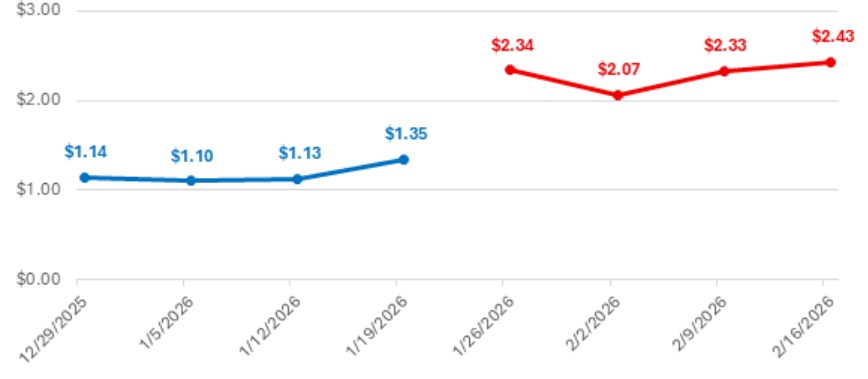
Tips per Delivery at Restaurant Delivery Apps Before and After DCWP Tipping Law. Credit DCWP
“Instead of respecting New York’s historic minimum pay law, app companies chose to manipulate their platforms to discourage tipping and protect their own profits, stripping millions of dollars from the pockets of delivery workers who earned that money,” said Ligia Guallpa, executive director of Workers’ Justice Project (WJP) and co-founder of Los Deliveristas Unidos, in a statement to Documented.
Companies like DoorDash opposed the city tipping law, arguing that the law would hurt consumers by making deliveries more expensive.
John Horton, DoorDash’s head of North America public policy, told Documented in January that its placement of the tipping screen after checkout was not intended to make it harder for customers to tip.
“What’s really happening is the DCWP wants to pressure consumers to tip even more,” he said in a statement to Documented. “As we’ve said, forcing people to tip may as well be a tax. It should be up to consumers, not politicians, whether they want to tip more in New York.”
A joint lawsuit by DoorDash, Uber and Instacart to block the law was struck down in federal court just days before the new laws took effect.
“For years, delivery apps buried the tip button to pad their own bottom line, and delivery workers paid the price,” said Mayor Mamdani in a statement to Documented. “We changed the law, enforced it, and it’s working: $104 million has gone back into the pockets of the workers who keep this city fed, rain or shine. New York will not allow billion-dollar tech companies to boost their profits by taking money from working people.”
In response to the delivery app companies making it harder for customers to tip, Ligia said that workers “refused to let those practices go unchallenged” and documented each instance of lost tips.
“Restoring this income means restoring economic dignity to thousands of delivery workers and their families,” said Guallpa. “But this victory is about more than restoring millions of dollars in tips. It demonstrates what is possible when worker organizing, thoughtful public policy, and strong enforcement work together.”
Despite claims that the new laws would impact customers, DCWP data show that the tipping law had no measurable impact on demand for food delivery. It has actually grown. Consumers placed a record-high of 3.3 million orders each week, 700,000 more orders each week than in December 2023.
“The data is clear: allowing consumers the clear ability to tip hardworking deliveristas benefits our workers and strengthens our economy,” said DCWP Commissioner Levine. “I said it when DCWP blew the whistle on delivery apps’ design tricks in January, and I’ll say it again: under Mayor Mamdani, the biggest corporations in the world will no longer be able to rake in record profits on the backs of New Yorkers.”
Delivery workers can learn more about their rights under Delivery Worker Laws at nyc.gov/deliveryapps. If you believe a restaurant or grocery delivery app has failed to pay the required minimum rate of $22.13 per hour, you are encouraged to file a complaint at nyc.gov/workers.


Staten Islander News Service Staff Writer
This byline indicates that this article was penned by a member/members of the Staten Islander News Organization office team. Our staff writers are the backbone of our newspaper, performing all sorts of important tasks like conducting interviews, investigating leads, besides writing the news stories you see.
There are no comments yet
Why not be the first